Author Archive
 Topband Trifecta
 February 5th, 2017 |
  Author:
It was a week of 'threes' when it comes to the 'gentleman's band'. The first was last weekend's CQ 160m CW Contest ... exciting as always, with propagation from VE7 land favoring the southeast. At times, signals from the Caribbean were exceptionally strong while it was a struggle on both nights to work eastern W1's. As usual, I entered in the low power division with a power limit of 150 watts, spending 8 hours in total and finishing with 249 contacts in 51 sections / 8 countries. Other than the odd State QSO Party, the 160m contests are about the only ones I enter these days.
The mail brought my next two Topband delights. The first being a copy of Jeff Brigg's (K1ZM / VY2ZM) spanking new "DXing on the Edge - The Thrill of 160 Meters". This is the second edition of Jeff's original classic which was published twenty years ago in 1997.
The new second edition carries all of the original content (except for the CD) along with four new added chapters. Although the original material is dated, it is still just as valuable and informative as it was when first published. Highlights of the book include chapters on:
- Propagation
- The Stew Perry Era (1930-1982)
- 160m DX Chronology 1930 - Present (8 Chapters)
- Notable Achievements
- Simple and Effective DX Transmitting Antennas
- Simple and Effective Receiving Antennas
- Tips From DXers
- Photographic Potpourri
- Off-The-Shelf Transmitting Antenna Solutions (new)
- Modern RX Solutions For Small Properties (new)
- Cycle 24 & A View Forward (new)
- 160m Achievement Levels As Of 2016 (new)
If you have any serious interest in DXing on 160m, you will find much inspiration in Jeff's book. The descriptions of many stations, from the simple to the extreme, highlight the fact that almost anyone can achieve DX success on the 'Topband' with a little perseverance and some thoughtful station design.
When it comes to Topband DXing, things have changed a lot since 1997 ... as Jeff indicates in the new section, his main reason for releasing a second updated version:
" ... was to publicly review the technical advances that are now available to the modern 160M DX'er. In this way, everyone - old timers and newcomers alike - would have the time to "get ready" for some great years that will be coming soon on Topband. So get going ... gear up ... start making plans now to be part of the action. It is probably going to be a wild ride ahead and a lot of DX'citement for those who are up to the challenge!"
If the coming solar low years are anything like the last previous low, we are indeed in for some fun times!
Jeff's book can be purchased through numerous outlets including Amazon and Chapters, often with free-delivery.
The third Topband event, again via the mail, was the arrival a new 160m QSL.

The sunrise 160m CW contact with H4ØGC, Temotu, was confirmed country #159 for me on Topband, with most of these being worked from here on Mayne Island using a half-sloper and an aging 500 watt amplifier with a pair of original 572Bs.
If you've not been on 160m and are keen on new operating challenges, Topband may be the place to begin ... along with a copy of Jeff's inspirational 'Topband handbook'.
2nd Midwinter 630m Activity Event
One week from tonight, on Saturday Feb 4th, the 2nd Midwinter 630m Activity Event will take place.
The highlight of this event will be the opportunity for amateurs, throughout North America, to attempt crossband CW contacts with Canadian amateurs operating on 630m.
Canadian stations will call CQ on announced frequencies within the 630m band and listen on individual HF (QSX) frequencies for callers.
Due to the RTTY and Sprint activities on the same night, some of the QSX frequencies have been shifted from those that might normally have been used in the past.
There appears to be a lot of growing interest in 630m among American operators. It is hoped that the USA will soon have access to 630m as a ham band.
There will also be a large turnout of U.S. experimental activity, either in beacon mode or in two-way QSO mode with other experimental service stations.
In past events, Transcontinental crossband contacts have been completed. It is hoped that operating events such as this can serve to demonstrate the interesting propagation possibilities of this unique part of the spectrum and generate more new interest in the 630m band.
To read more about this event, please see the ARRL news announcement here.
This time out, there will be six Canadian stations, from Newfoundland to the west coast, hoping to work as many of you as possible!
Station: CF7MM (Mark) CN89 Coquitlam, British Columbia
Time: February 5, 0200-0700 UTC
Transmit frequency: 475.0 kHz
Receive (QSX) frequency: 1,801 kHz, 3,501 kHz, 3,528, and 7,028 kHz
Station: VE7BDQ (John) CN89 Delta, British Columbia
Time: February 5, 0300-0700 UTC
Transmit frequency: 474.0 kHz
Receive (QSX) frequency: 1,833 kHz, 3,533 kHz
Station: CG7CNF (Toby) CN89 Burnaby, British Columbia
Time: February 5, 0200-0800 UTC
Transmit frequency: 476.5 kHz
Receive (QSX) frequency: 1,827 kHz, 3,527 kHz, 7,027 kHz
Station: VE7SL (Steve) CN88 Mayne Island, British Columbia
Time: February 5, 0200-0700 UTC
Transmit frequency: 473.0 kHz
Receive (QSX) frequency: 3,526 kHz, 7,115 kHz
Station: VO1NA (Joe) GN37 Torbay, Newfoundland
Time: February 4, 2130 UTC, until February 5, 0130 UTC
After 0130 UTC, 5WPM CW beacon until 1000 UTC
Transmit frequency: 477.7 kHz
Receive (QSX) frequency: 3,525.5 kHz
Station: VE3OT (Mitch) EN92 London, Ontario
Time: February 5, 0000-0500 UTC
Transmit frequency: 477.0 kHz
Receive (QSX) frequency: 3,610 kHz, 7,105 kHz
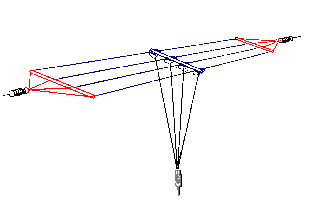
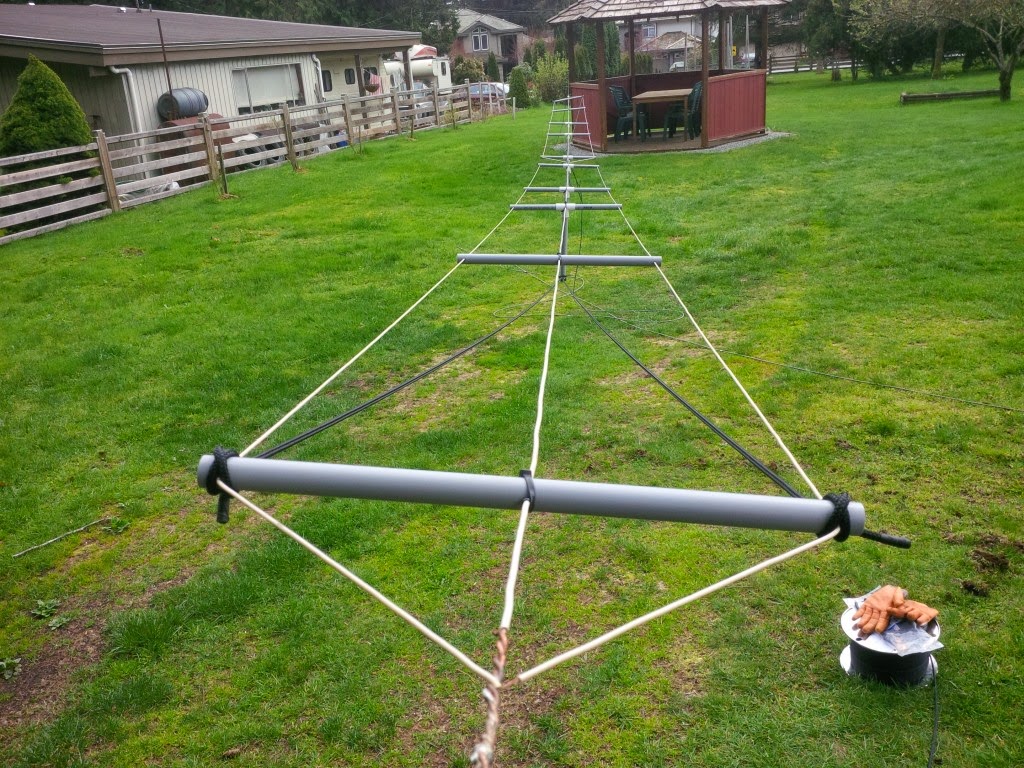 |
| VA7MM 630m Top Hat Under Construction |
ZF1 – VE7 On 630m
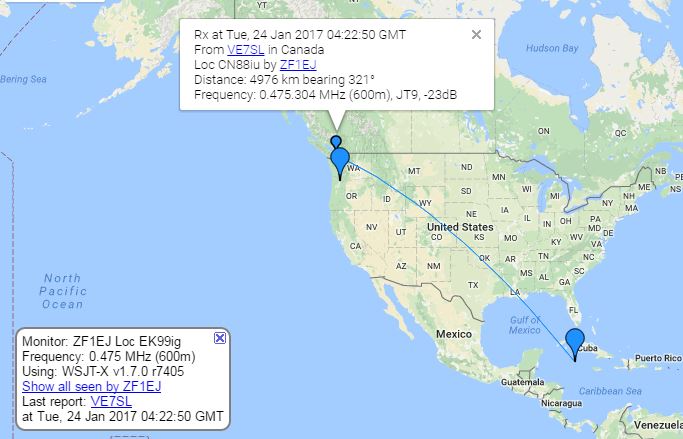
Early last night ZF1EJ (Eden) and I were able to easily complete a two way JT9 QSO on 630m ... 475.300 kHz to be more exact.
This was Eden's first 630m JT9 QSO as well as the first ever 630m QSO between Canada and the Cayman Islands. The contact was completed shortly between 8:15 and 8:30 PM local time. The contact attempt was initiated via the ON4KST 2200m / 630m chat page after I had decoded Eden's signal shortly before 7 PM local time ... the first time I have seen his signal so early in the evening.
Eden was using a VK4YB Monitor Sensors Transverter and a newly deployed transmitting antenna described below in the KB5NJD Daily 630m Report:
"This is how the antenna is setup:- It is a tophat vertical, the tophat is 65’ 6” long and about 80’ above ground, the vertical is 74’ 6”, There are 4 radials 10’ above ground, each 128’ 6” long. The antenna is made of #10, stranded insulated wire. The tophat is strung between two towers and is side on about 45 deg. The tuner was built by Ron and Ward a few month ago and shipped down to me. Just found the time to set it up recently. The SWR is 1.1-1 and I am using a Monitor Sensors Transverter built by Roger, VK4YB. Output to antenna 22 watts."
The only change to the above report was Eden's e-mail follow-up indicating that his power output during our QSO was 32 watts ... conditions must have been even better than I thought.
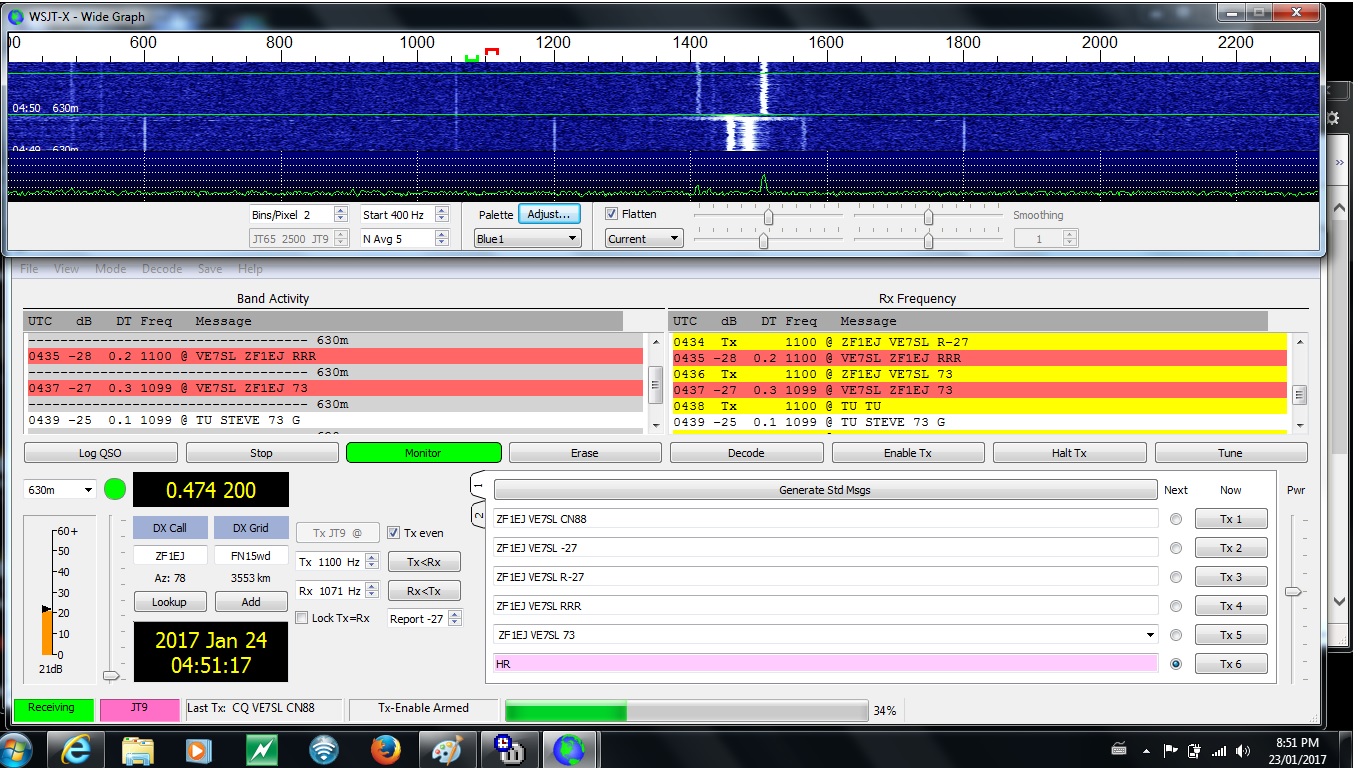 |
| JT-9 Screen At VE7SL |
With an even newer JT-9A mode now promising a 2db improvement, making contacts should be even easier. Once the USA gets access to 630m, it is clear that Eden will be a popular target for most North American stations!
ZF1 – VE7 On 630m
Early last night ZF1EJ (Eden) and I were able to easily complete a two way JT9 QSO on 630m ... 475.300 kHz to be more exact.
This was Eden's first 630m JT9 QSO as well as the first ever 630m QSO between Canada and the Cayman Islands. The contact was completed shortly between 8:15 and 8:30 PM local time. The contact attempt was initiated via the ON4KST 2200m / 630m chat page after I had decoded Eden's signal shortly before 7 PM local time ... the first time I have seen his signal so early in the evening.
Eden was using a VK4YB Monitor Sensors Transverter and a newly deployed transmitting antenna described below in the KB5NJD Daily 630m Report:
"This is how the antenna is setup:- It is a tophat vertical, the tophat is 65’ 6” long and about 80’ above ground, the vertical is 74’ 6”, There are 4 radials 10’ above ground, each 128’ 6” long. The antenna is made of #10, stranded insulated wire. The tophat is strung between two towers and is side on about 45 deg. The tuner was built by Ron and Ward a few month ago and shipped down to me. Just found the time to set it up recently. The SWR is 1.1-1 and I am using a Monitor Sensors Transverter built by Roger, VK4YB. Output to antenna 22 watts."
The only change to the above report was Eden's e-mail follow-up indicating that his power output during our QSO was 32 watts ... conditions must have been even better than I thought.
|
| JT-9 Screen At VE7SL |
With an even newer JT-9A mode now promising a 2db improvement, making contacts should be even easier. Once the USA gets access to 630m, it is clear that Eden will be a popular target for most North American stations!
The Green Glow
Recent emails from two friends brought new insight into a blog that I had been intending to do for some time.
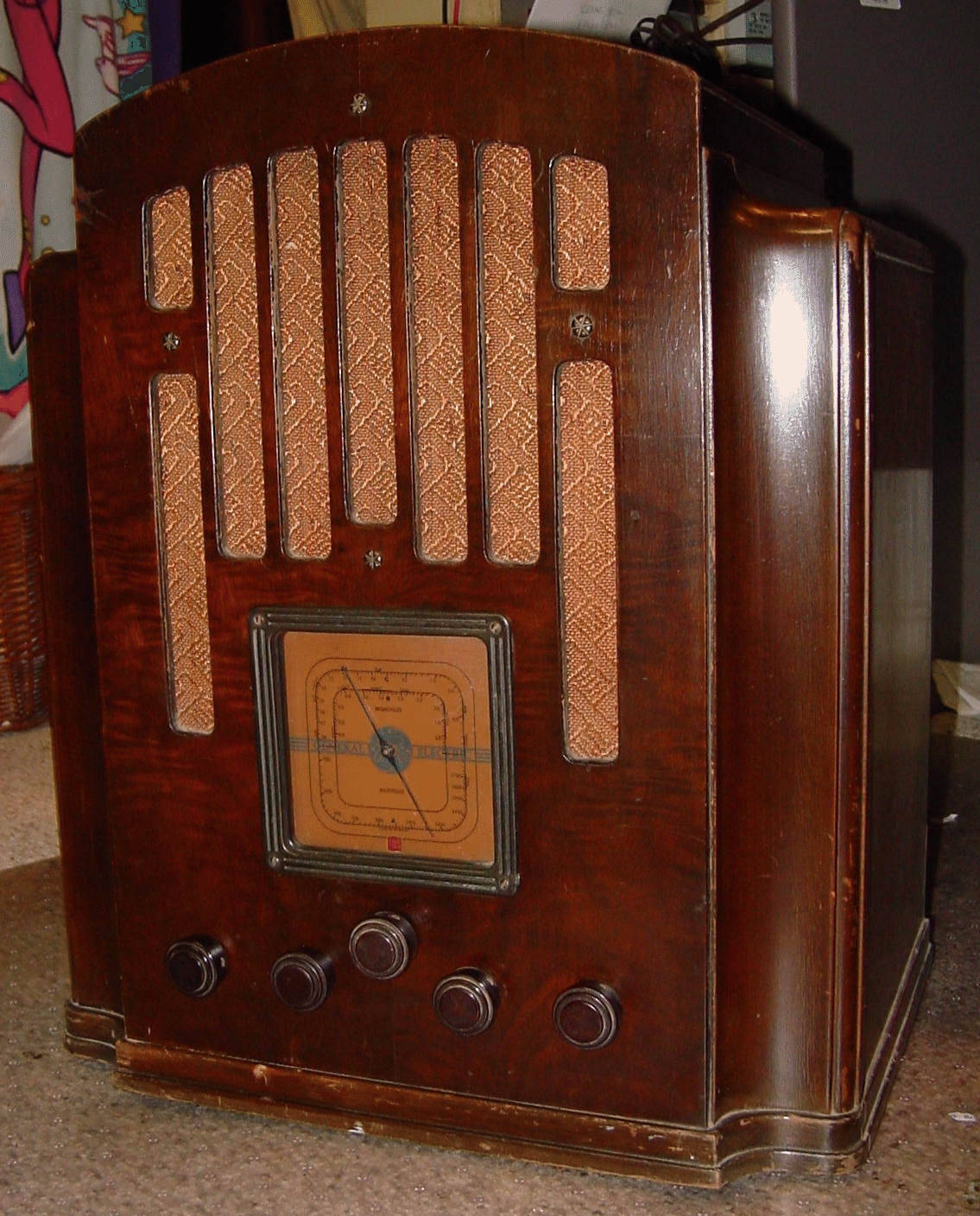
As has been mentioned on more than one occasion, I discovered radio at the age of 10, after reading an article about shortwave-listening in a drugstore magazine. My father was able to rescue an old GE cathedral from grandpa's downtown barbershop, where it sat gathering dust for several years in the back room storage space. Fortunately, it immediately came to life when plugged in and soon after dad spent an afternoon scurrying about on the roof of our 3-story house in central Vancouver, my radio-adventures began.
As I recall, the first couple of weeks were spent listening to radiotelephone traffic between various tugboats and their dispatchers, in the 2 megacycle marine band. Initially it took me awhile to figure out what I was listening to but found it fascinating to hear the tugboats up and down the coast getting their daily marching orders.
It wasn't too much later that I discovered the international shortwave bands and I was soon keeping detailed logs of my catches and mailing for a coveted QSL. Friday nights were always special as it meant I could DX well into the night and not worry about having to get out of bed for school early the next morning. My 3rd floor bedroom shack was the true definition of 'warm and cozy' and a memory I will always cherish.
Up to this point I had yet to discover ham radio. I must have tuned across a few conversations on phone but evidently hadn't been too awestruck at what I had heard ... perhaps I didn't know what I was hearing or was unable to comprehend some of the expressions they were using or what they were talking about when describing their gear. For whatever reason, the ham radio 'trigger-event' had not yet transpired ... but it soon would.
By this time, I had moved upward, from the Boy Cubs to the Boy Scouts. I must explain that these activities were forced upon me by my parents and not something I particularly enjoyed, especially the midwinter camping trips that were always pouring rain or freezing. Again, from grandfather, I had been provided with an old, virtually uninsulated, WW1 sleeping bag, that wouldn't have kept anyone alive at the western front for longer than a week. These all too regular winter excursions to the rain forest were pure misery and if I wasn't freezing to death then my sleeping bag was usually getting soaked from the river of rain running through the tent ... most of these weekend outings were sleepless and left me feeling like a zombie for the next few days. But ... not every scouting experience was bad and in fact, it was a scouting event that would soon provide my ham-radio 'trigger'!
The opportunity arrived for those that wished, to visit a local 'ham station' to partake in some sort of 'on-the-air experience'. This would have been in 1958 and having been already familiar with shortwave radio, I immediately signed-on.
A few weeks later, about six of us found ourselves in the basement shack of Ernie Savage, VE7FB. Although a stranger to me, Ernie was a well known 75m phone traffic man and an ardent 75m mobile operator. Although he was only about five-foot two, Ernie was a powerhouse of a personality and most of us cowered quietly as Ernie tweaked the dials and with a tight grip on his large microphone, barked louder than his small stature might suggest ... all of us quietly prayed that Ernie wouldn't pass the microphone to any of us.
And then I saw it! Although I didn't know it at the time, it was a pivotal moment in my development and would shape all aspects of my life from that point forward.
 |
| courtesy: Paul's Tube Radio Restorations |
 |
| Heathkit VF-1 VFO Dial |
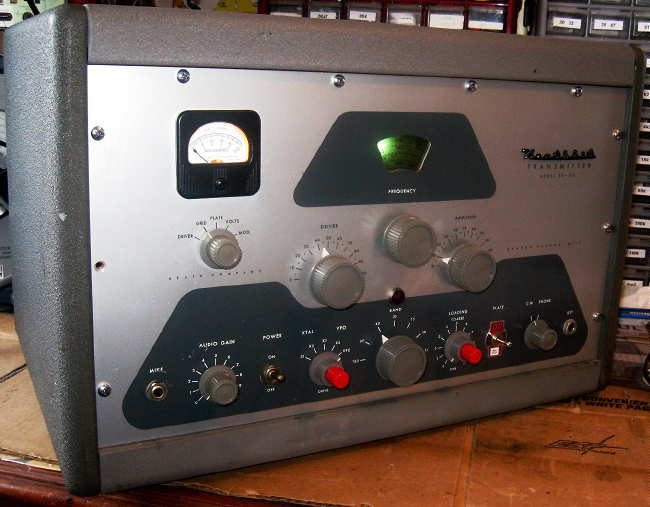
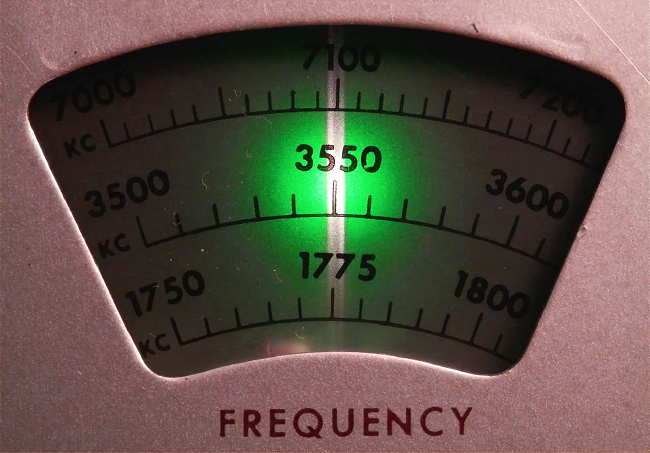
Perhaps the Heathkit engineers had learned of the 'power of green' from those earlier genius Hallicrafter's draftsmen ... can anyone deny the alluring appeal of a Hallicrafter's front panel or dial?
 |
| Hallicrafters SX-42 Dial |
As a young teen, I could never afford to buy a DX-100 but I was able to buy a VF-1 and added one to my Heathkit DX-20 magic transporter. With the lights turned off in the high attic bedroom shack, the orange dials of the Super Pro and its backlit S-meter combined with the seductive green glow of the VF-1. It just couldn't get any better!
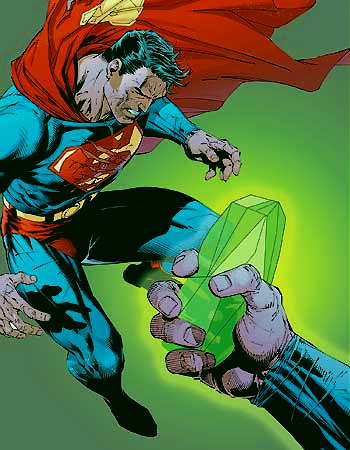
Until recently, I had no real idea of why I had found the green dials so enchanting but an email from Mark, VA7MM, finally made it all perfectly clear. Mark offered the most plausible explanation ... the diabolical Heathkit and Hallicrafters engineers had been putting Kryptonite in their dials ... the stuff that even Superman found overpowering and unable to resist!
 |
| Powerless |
The Green Glow
Recent emails from two friends brought new insight into a blog that I had been intending to do for some time.
As has been mentioned on more than one occasion, I discovered radio at the age of 10, after reading an article about shortwave-listening in a drugstore magazine. My father was able to rescue an old GE cathedral from grandpa's downtown barbershop, where it sat gathering dust for several years in the back room storage space. Fortunately, it immediately came to life when plugged in and soon after dad spent an afternoon scurrying about on the roof of our 3-story house in central Vancouver, my radio-adventures began.
As I recall, the first couple of weeks were spent listening to radiotelephone traffic between various tugboats and their dispatchers, in the 2 megacycle marine band. Initially it took me awhile to figure out what I was listening to but found it fascinating to hear the tugboats up and down the coast getting their daily marching orders.
It wasn't too much later that I discovered the international shortwave bands and I was soon keeping detailed logs of my catches and mailing for a coveted QSL. Friday nights were always special as it meant I could DX well into the night and not worry about having to get out of bed for school early the next morning. My 3rd floor bedroom shack was the true definition of 'warm and cozy' and a memory I will always cherish.
Up to this point I had yet to discover ham radio. I must have tuned across a few conversations on phone but evidently hadn't been too awestruck at what I had heard ... perhaps I didn't know what I was hearing or was unable to comprehend some of the expressions they were using or what they were talking about when describing their gear. For whatever reason, the ham radio 'trigger-event' had not yet transpired ... but it soon would.
By this time, I had moved upward, from the Boy Cubs to the Boy Scouts. I must explain that these activities were forced upon me by my parents and not something I particularly enjoyed, especially the midwinter camping trips that were always pouring rain or freezing. Again, from grandfather, I had been provided with an old, virtually uninsulated, WW1 sleeping bag, that wouldn't have kept anyone alive at the western front for longer than a week. These all too regular winter excursions to the rain forest were pure misery and if I wasn't freezing to death then my sleeping bag was usually getting soaked from the river of rain running through the tent ... most of these weekend outings were sleepless and left me feeling like a zombie for the next few days. But ... not every scouting experience was bad and in fact, it was a scouting event that would soon provide my ham-radio 'trigger'!
The opportunity arrived for those that wished, to visit a local 'ham station' to partake in some sort of 'on-the-air experience'. This would have been in 1958 and having been already familiar with shortwave radio, I immediately signed-on.
A few weeks later, about six of us found ourselves in the basement shack of Ernie Savage, VE7FB. Although a stranger to me, Ernie was a well known 75m phone traffic man and an ardent 75m mobile operator. Although he was only about five-foot two, Ernie was a powerhouse of a personality and most of us cowered quietly as Ernie tweaked the dials and with a tight grip on his large microphone, barked louder than his small stature might suggest ... all of us quietly prayed that Ernie wouldn't pass the microphone to any of us.
And then I saw it! Although I didn't know it at the time, it was a pivotal moment in my development and would shape all aspects of my life from that point forward.
|
| courtesy: Paul's Tube Radio Restorations |
|
| Heathkit VF-1 VFO Dial |
Perhaps the Heathkit engineers had learned of the 'power of green' from those earlier genius Hallicrafter's draftsmen ... can anyone deny the alluring appeal of a Hallicrafter's front panel or dial?
|
| Hallicrafters SX-42 Dial |
As a young teen, I could never afford to buy a DX-100 but I was able to buy a VF-1 and added one to my Heathkit DX-20 magic transporter. With the lights turned off in the high attic bedroom shack, the orange dials of the Super Pro and its backlit S-meter combined with the seductive green glow of the VF-1. It just couldn't get any better!
Until recently, I had no real idea of why I had found the green dials so enchanting but an email from Mark, VA7MM, finally made it all perfectly clear. Mark offered the most plausible explanation ... the diabolical Heathkit and Hallicrafters engineers had been putting Kryptonite in their dials ... the stuff that even Superman found overpowering and unable to resist!
|
| Powerless |
630m Thriving
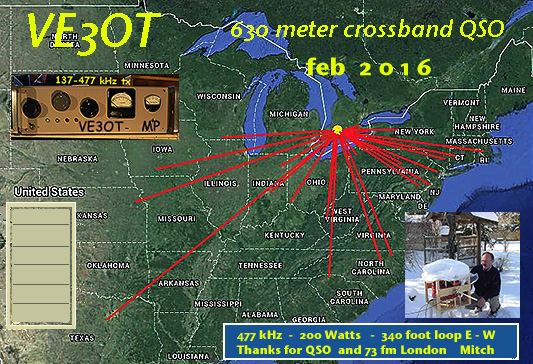
Fritz Raab, the ARRL's 600-Meter Experimental Group coordinator, recently released his quarterly report, with highlights being reported in the ARRL News.
In it, Raab tell us:
"Band activity has been very high, and there are often more WSPR stations — more than 110 stations — on 472 kHz than on 80 or 160 meters!"
"In a sense, 630 meters has become a mainstream ham band, in spite of not being authorized in the US".
"The paths to VK and JA have remained good. This was not the case last year, so perhaps it is an effect of the coming solar minimum. Many reports have been received for WSPR transmissions with relatively moderate power. There have been a number of polar and high-latitude openings to LA2XPA from North America. Many long-time operators say that they have never seen anything like that. There have also been a number of openings from the US west coast deep into Europe."
The ARRL's full report can be read here.
Also touched upon was the upcoming "Midwinter 630m Operating Activity", the second such February event ... this year to be held February 4-5th.
Stay tuned here for further details. Highlighting the event will be another opportunity for U.S. and Canadian amateurs to attempt CW crossband contacts with six Canadian stations operating on specified frequencies in the 630m band. Canadians will listen for callers on specified frequencies within the 160, 80 and 40m bands. Previous events have had much success, with Transcontinental and Transpacific CW crossband contacts being completed by many stations.
A detailed schedule of frequencies and times will be published as the event draws closer but in the meantime, see if you can keep February 4th (Saturday night) open for some 630m crossband excitement!













