Author Archive
 Novice Rig Round-Up Report
 March 1st, 2017 |
 Author:
Last week's Novice Rig Round-Up delivered far more enjoyment than I ever imagined!
Operating from the left coast and choosing to limit my output power to 5 watts, I really didn't expect to work more than a half dozen stations or so. The week-long event included two weekends, providing plenty of opportunity for participants to spark-up their novice-class rigs or their favorite pre-80's 'boatanchors' ... and they did!
I had 68 contacts with other 'NRR' stations, working numerous Heathkits, Drakes, Johnsons and homebrewed favorites ... even a Collins KWS-1! Staying true to the 'novice' class spirit, most were using hand keys and a surprising number were even using crystal control.
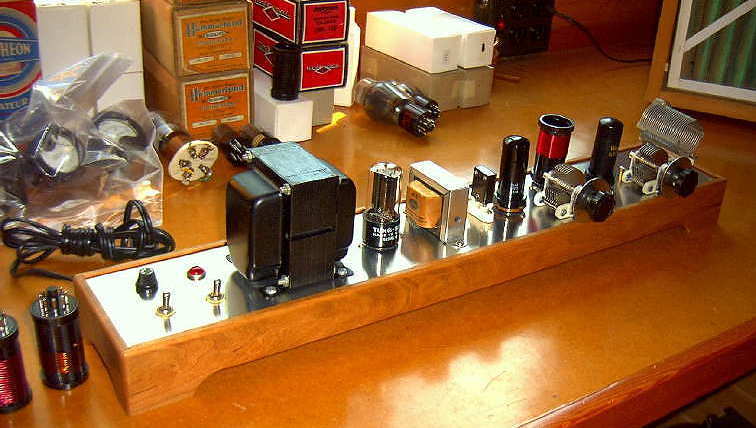
I decided to enter the fray with my homebrew "Longfeller", shown above, run at 5W to take advantage of the low power multiplier as well as using crystal control.
After struggling to work two stations, I soon decided that if I was going to work much at all, I would need to switch to 'search and pounce' mode and use the VFO. The once ubiquitous Heathkit VF-1, with all of its charming quirks, was pressed into service. Although I've always loved its green hypnotic dial, a week with the VF-1 reminded me of all the things I also hated about it as a teenaged ham back in the mid 60s'. But as it did back then, it served me well and allowed me to park the Longfeller wherever I wanted.
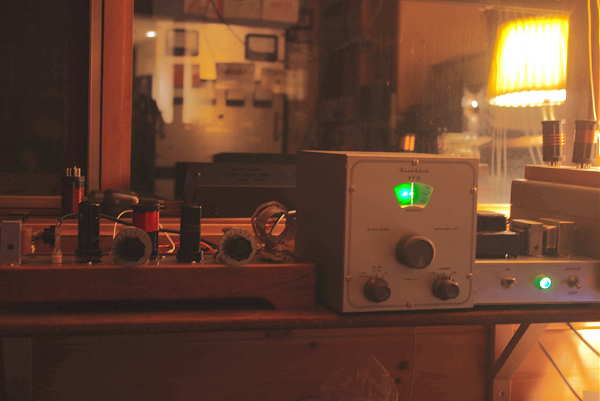 |
| My NRR Setup |
For the low bands (80/40m), the Longfeller was fed into full-sized vertical wire groundplanes made from homebrew ladder line and both fed with the same coaxial feedline.
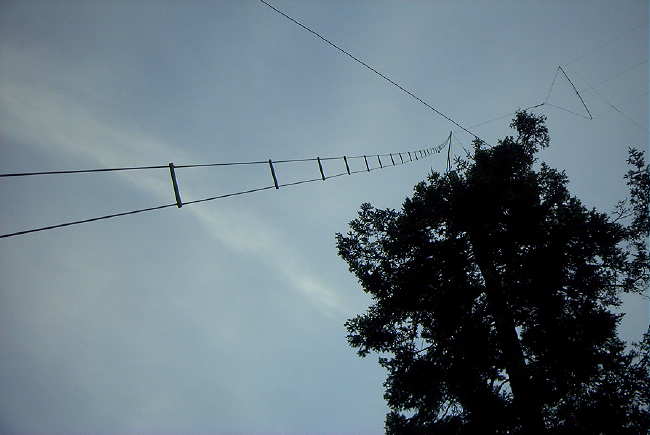
A counterpoise of eight wire radials were laid on the lawn temporarily with the feedpoint sitting about 20' from the ocean. Being right at the ocean allows me to take advantage of an approximate 6db of "sea gain", effectively turning my 5 watts into 20 watts of radiated power. At times, my signal needed all the help it could get.

It was also exciting to catch the sometimes fleeting transcontinental openings on 15m, as the MUF often struggled to reach 21 MHz each morning. This very much reminded me of past solar cycle peak winters and the morning excitement of watching the MUF slowly climb towards 50MHz, or in some cases, shoot up like a rocket. As Cycle 24 reaches the bottom, the effects of low solar flux values on our higher bands becomes increasingly more evident. I suspect that there will be no 15m transcontinental work in next winter's NRR and who knows how long that might be the case. High MUFs were fun while they lasted ... another thing often taken for granted.
Without question, one of the most interesting parts of the nine day event was following the propagation variances from night to night on 40 and 80m. With a couple of exceptions, low-band propagation was generally pretty good, with one mid-week night being just great. Signals from the east coast to the southern states were strong and with almost no QSB. The Longfeller pushed its 80m signal to Florida, Maryland, New York, Alabama, Louisiana, Ohio and Kentucky. I remember many nights like this when operating 80m back in the early to mid 60's, during the lull between monster Cycle 19 and wimpy Cycle 20. Hopefully we will see more of these really nice transcontinental nights on 80 over the next several years.
For me however, the highlight of the event occurred last Saturday afternoon, while on 40m, fully ninety minutes before our local sunset. I had called WW6D after his 589 CQ only to hear him respond to another NRR local, Mark, CF7MM. He gave Mark's 50 watt DX-60 a '589' and when he finished I called him again ... with not even a whisper of response or even a QRZ. After I called him a third time, he returned to his CQ, leaving no doubt that he wasn't hearing a trace of my signal. Now full-sized 1/4 wave groundplanes mounted beside the ocean are not noted for producing high-angled radiation, which this path would certainly have benefited from, but I would have expected something!
I immediately moved down the band a few kilohertz and sent a short hand-keyed CQ and received an immediate response from WS1K in Plymouth, MA! Jon's signal was a solid and unwavering 559 and he was running only 5 watts as well ... and, he was crystal-controlled! The groundplane had swiftly redeemed itself as this exciting contact went into the log on 40m ... and all in broad daylight! Pictured below is Jon's transcon ether-busting machine ... proof that form does indeed follow function!
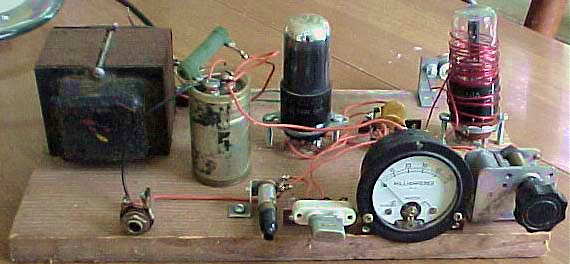 |
| WS1K's 40m Transcon 6V6 Ether-Buster |
I'm really looking forward to next year's NRR but will definitely be running more power. I was impressed with the several Drake 2NT's that I heard and luckily enough, have one such rig in my boatanchor basement. It will be a good project to recap and put back on the air, along with the VF-1, which will also be given the once over to encourage it to behave properly when driving the classy Drake.
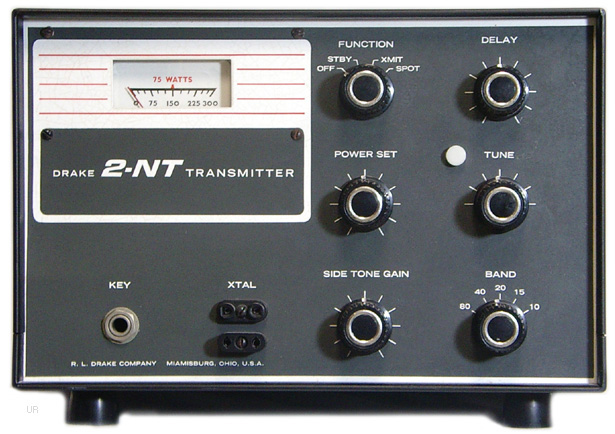
Please give the NRR some serious thought for next year ... it's not too early to start planning, refurbishing or to seek out and cherish that aging old beauty, presently hiding in someones attic gathering dust. See you in the NRR!
Hunting For NDBs In CLE 216
 |
| CLE 216 NA Targets! |
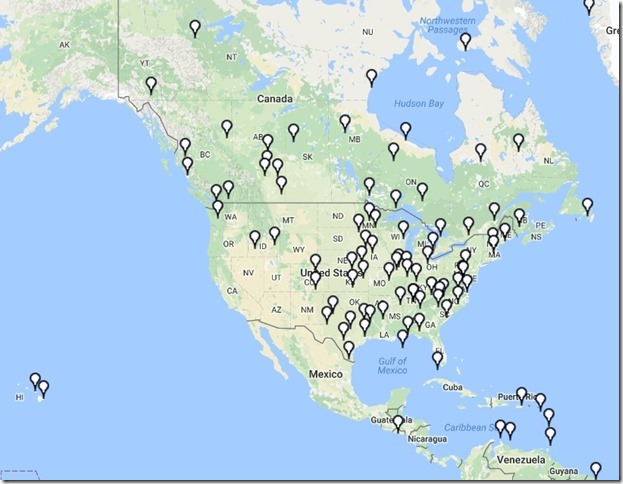
This coming weekend will see another CLE challenge. This time the hunting grounds will be: 320.0 - 334.9 kHz.
A 'CLE' is a 'Co-ordinated Listening Event', as NDB DXers around the world focus their listening time on one small slice of the NDB spectrum.
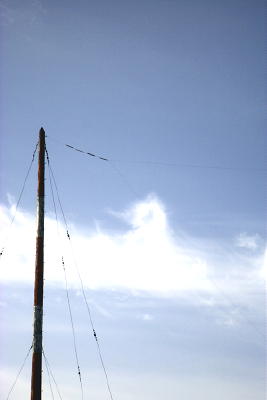
A nice challenge in this one is to hear the White Rock NDB, 'WC', on 332 kHz. The 'WC' NDB is located just a few hundred feet from the Canada - U.S. border, about 25 miles south east of the Vancouver International airport and about 20 miles west of the Abbotsford airport.
The beacon is located on a quiet residential street, nestled between well kept homes and towering fir trees.
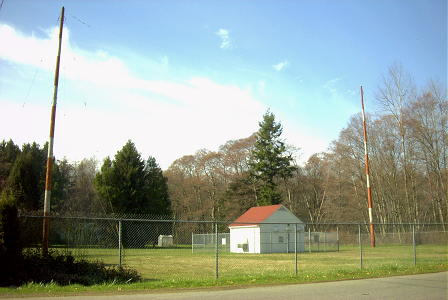 |
| 'WC - 332' White Rock, BC |
 |
| Antenna at 'WC - 332' |
Heard regularly in California, 25 watt 'WC' is not as widely reported as is 'XX -344', especially from points east. As the system is similar to what a typical amateur LF installation might be, I would be very interested in any reception reports of 'WC' by DXers to the east. 'WC's upper sideband modulation frequency is ~ 423Hz so look for it on 332.423 kHz with your receiver in the CW mode.
From CLE organizer Brian Keyte, G3SIA, comes the usual 'heads-up':
Hi all,
Here are all the details for this weekend's co-ordinated listening event.
First time CLE logs too? Yes, please!
Short logs are always as welcome as long ones.
Days: Friday 24 February - Monday 27 February
Times: Start and End at midday, your LOCAL time
Range: 320.0 - 334.9 kHz
Please log the NDBs you can positively identify that are listed in the
frequency range (no DGPS please), plus any UNIDs heard there too.
Send your CLE log to the List, if possible as a plain text email and
not in an attachment, with CLE216 at the start of its title.
Please show on EVERY LINE of your log:
# The date and UTC (the day changes at 00:00 UTC).
# kHz - the beacon's nominal published frequency, if you know it.
# The Call Ident.
Show those main items FIRST on each line, before any optional details
such as the NDB's Location, Distance, Offsets, Cycle time, etc.
As always, make your log meaningful to everyone by including your
own listening location and details of your receiver, aerial(s), etc.
(It would be OK to use a remote receiver, with the owner's permission if
necessary, provided that ALL your loggings for the CLE are made using it).
I will send the usual 'Any More Logs?' email at about 18:00 UTC on Tuesday
so that you can check that your log has been found OK. Do make sure that
your log has arrived on the List at the very latest by 09:00 UTC on Wed. 1st
March. The combined results should be completed later that day.
Remember that you can find all CLE-related information from the Group's
CLE page ( http://www.ndblist.info/cle.htm ), including a link to the seek
lists provided for this Event from the Rxx Database.
Good listening
Brian
----------------------------------------------------------
From: Brian Keyte G3SIA ndbcle'at'gmail.com
Location: Surrey, SE England (CLE co-ordinator)
----------------------------------------------------------
__._,_.___
(Reminder: You could use any one remote receiver for your loggings,
stating its location and owner - with their permission if required.
A remote listener may NOT also use another receiver, whether local or
remote, to obtain further loggings for the same CLE).
These listening events serve several purposes. They:
- determine, worldwide, which beacons are actually in service and on-the-air so the online database can be kept up-to-date
- determine, worldwide, which beacons are out-of-service or have gone silent since the last CLE covering this range
- will indicate the state of propagation conditions at the various participant locations
- will give you an indication of how well your LF/MF receiving system is working
- give participants a fun yet challenging activity to keep their listening skills honed
Final details can be found at the NDB List website, and worldwide results, for every participant, will be posted there a few days after the event. If you are a member of the ndblist Group, results will also be e-mailed and posted there.
The very active Yahoo ndblist Group is a great place to learn more about the 'Art of NDB DXing' or to meet other listeners in your region. There is a lot of good information available there and new members are always very welcome. As well, you can follow the results of other CLE participants from night to night as propagation is always an active topic of discussion.
If you are contemplating getting started on 630m, listening for NDBs is an excellent way to test out your receive capabilities as there are several NDBs located near this part of the spectrum.
You need not be an ndblist member to participate in the CLEs and all reports, no matter how small, are of much value to the organizers.
'First-time' logs are always VERY welcome!
Reports may be sent to the ndblist or e-mailed to either myself or CLE co-ordinator, Brian Keyte (G3SIA), whose address appears above.
Please ... give the CLE a try ... then let us know what NDB's can be heard from your location! Your report can then be added to the worldwide database to help keep it up-to-date.
Good hunting!
Hunting For NDBs In CLE 216
|
| CLE 216 NA Targets! |
This coming weekend will see another CLE challenge. This time the hunting grounds will be: 320.0 - 334.9 kHz.
A 'CLE' is a 'Co-ordinated Listening Event', as NDB DXers around the world focus their listening time on one small slice of the NDB spectrum.
A nice challenge in this one is to hear the White Rock NDB, 'WC', on 332 kHz. The 'WC' NDB is located just a few hundred feet from the Canada - U.S. border, about 25 miles south east of the Vancouver International airport and about 20 miles west of the Abbotsford airport.
The beacon is located on a quiet residential street, nestled between well kept homes and towering fir trees.
|
| 'WC - 332' White Rock, BC |
|
| Antenna at 'WC - 332' |
Heard regularly in California, 25 watt 'WC' is not as widely reported as is 'XX -344', especially from points east. As the system is similar to what a typical amateur LF installation might be, I would be very interested in any reception reports of 'WC' by DXers to the east. 'WC's upper sideband modulation frequency is ~ 423Hz so look for it on 332.423 kHz with your receiver in the CW mode.
From CLE organizer Brian Keyte, G3SIA, comes the usual 'heads-up':
Hi all,
Here are all the details for this weekend's co-ordinated listening event.
First time CLE logs too? Yes, please!
Short logs are always as welcome as long ones.
Days: Friday 24 February - Monday 27 February
Times: Start and End at midday, your LOCAL time
Range: 320.0 - 334.9 kHz
Please log the NDBs you can positively identify that are listed in the
frequency range (no DGPS please), plus any UNIDs heard there too.
Send your CLE log to the List, if possible as a plain text email and
not in an attachment, with CLE216 at the start of its title.
Please show on EVERY LINE of your log:
# The date and UTC (the day changes at 00:00 UTC).
# kHz - the beacon's nominal published frequency, if you know it.
# The Call Ident.
Show those main items FIRST on each line, before any optional details
such as the NDB's Location, Distance, Offsets, Cycle time, etc.
As always, make your log meaningful to everyone by including your
own listening location and details of your receiver, aerial(s), etc.
(It would be OK to use a remote receiver, with the owner's permission if
necessary, provided that ALL your loggings for the CLE are made using it).
I will send the usual 'Any More Logs?' email at about 18:00 UTC on Tuesday
so that you can check that your log has been found OK. Do make sure that
your log has arrived on the List at the very latest by 09:00 UTC on Wed. 1st
March. The combined results should be completed later that day.
Remember that you can find all CLE-related information from the Group's
CLE page ( http://www.ndblist.info/cle.htm ), including a link to the seek
lists provided for this Event from the Rxx Database.
Good listening
Brian
----------------------------------------------------------
From: Brian Keyte G3SIA ndbcle'at'gmail.com
Location: Surrey, SE England (CLE co-ordinator)
----------------------------------------------------------
Here are all the details for this weekend's co-ordinated listening event.
First time CLE logs too? Yes, please!
Short logs are always as welcome as long ones.
Days: Friday 24 February - Monday 27 February
Times: Start and End at midday, your LOCAL time
Range: 320.0 - 334.9 kHz
Please log the NDBs you can positively identify that are listed in the
frequency range (no DGPS please), plus any UNIDs heard there too.
Send your CLE log to the List, if possible as a plain text email and
not in an attachment, with CLE216 at the start of its title.
Please show on EVERY LINE of your log:
# The date and UTC (the day changes at 00:00 UTC).
# kHz - the beacon's nominal published frequency, if you know it.
# The Call Ident.
Show those main items FIRST on each line, before any optional details
such as the NDB's Location, Distance, Offsets, Cycle time, etc.
As always, make your log meaningful to everyone by including your
own listening location and details of your receiver, aerial(s), etc.
(It would be OK to use a remote receiver, with the owner's permission if
necessary, provided that ALL your loggings for the CLE are made using it).
I will send the usual 'Any More Logs?' email at about 18:00 UTC on Tuesday
so that you can check that your log has been found OK. Do make sure that
your log has arrived on the List at the very latest by 09:00 UTC on Wed. 1st
March. The combined results should be completed later that day.
Remember that you can find all CLE-related information from the Group's
CLE page ( http://www.ndblist.info/cle.htm ), including a link to the seek
lists provided for this Event from the Rxx Database.
Good listening
Brian
----------------------------------------------------------
From: Brian Keyte G3SIA ndbcle'at'gmail.com
Location: Surrey, SE England (CLE co-ordinator)
----------------------------------------------------------
__._,_.___
(Reminder: You could use any one remote receiver for your loggings,
stating its location and owner - with their permission if required.
A remote listener may NOT also use another receiver, whether local or
remote, to obtain further loggings for the same CLE).
These listening events serve several purposes. They:
- determine, worldwide, which beacons are actually in service and on-the-air so the online database can be kept up-to-date
- determine, worldwide, which beacons are out-of-service or have gone silent since the last CLE covering this range
- will indicate the state of propagation conditions at the various participant locations
- will give you an indication of how well your LF/MF receiving system is working
- give participants a fun yet challenging activity to keep their listening skills honed
Final details can be found at the NDB List website, and worldwide results, for every participant, will be posted there a few days after the event. If you are a member of the ndblist Group, results will also be e-mailed and posted there.
The very active Yahoo ndblist Group is a great place to learn more about the 'Art of NDB DXing' or to meet other listeners in your region. There is a lot of good information available there and new members are always very welcome. As well, you can follow the results of other CLE participants from night to night as propagation is always an active topic of discussion.
If you are contemplating getting started on 630m, listening for NDBs is an excellent way to test out your receive capabilities as there are several NDBs located near this part of the spectrum.
You need not be an ndblist member to participate in the CLEs and all reports, no matter how small, are of much value to the organizers.
'First-time' logs are always VERY welcome!
Reports may be sent to the ndblist or e-mailed to either myself or CLE co-ordinator, Brian Keyte (G3SIA), whose address appears above.
Please ... give the CLE a try ... then let us know what NDB's can be heard from your location! Your report can then be added to the worldwide database to help keep it up-to-date.
Good hunting!
The 2017 Novice Rig Round-Up!
 |
| VE7AIJ's Original Setup |
There's a relatively 'new' contest in town that seems to be gathering a lot of growing interest. I'm talking about the 'NRR' or "Novice Rig Round-Up".
Harry, VE7AIJ, recently sent me a wonderful picture of his original station reproduction as used back in 1956. Hopefully Harry will be able to activate it along with countless others in the upcoming NRR.
The NRR is the brainchild of Bryan, AF4K, and Gary Johanson, WD4NKA, who developed the idea through chat on the Boatanchor and Glowbugs reflectors. They put the concept to the test in 2015 with the initial running of the NRR. Station pictures and soapbox comments from the last two runnings may be viewed here and here ... and they are truly inspirational.
With so many retired or soon to be retired 'baby boomers', there are a lot of guys out there that really enjoy recreating their original station setup, which for most U.S. hams, would have been their Novice station. There is also a huge group of 'not so old' hams that just enjoy refurbishing or homebrewing rigs from the 50's and putting them on the air ... the NRR will present another great opportunity to get on-the-air and light up those filaments once again.
As indicated on the NRR website, this is "more of an EVENT than just a typical contest ... once again taking our OLD ham radios off the shelf and putting them to use again! "
 |
| courtesy: http://novicerigroundup.com/ |
The full rules are available on the dedicated NRR webpage. You will also find information there for Yahoo's NRR Group as well as the Facebook link. An excellent FAQ page also makes for valuable reading.
Many of the contest stations will be crystal controlled, just as they were back in the Novice days and a list of individual rockbound frequencies can be downloaded for your reference here ... those using crystal control will also tune well above and below their own frequencies for callers, a long-lost technique once required, when all Novice stations were using crystal controlled rigs ... tuning high and low should give rockbound stations better chances of success.
The NRR takes place from 0000 UTC February 18 through 2359 UTC February 26 - 9 full days, covering two full weekends.
Suggested HF frequencies are: 3550 - 3650 kHz, 3579, 7055, 7060, 7080, 7100 -7125 kHz, 21.114, 21.120, 21.150 MHz, 28.114, 28.120 MHz.
An automatic logger page has been set up for log handling as well as a 'live skeds' page to announce your frequency or to chat. Clearly, a lot of effort by the organizers has gone into this event!
Hopefully you can participate and make the 3rd annual NRR an even more enjoyable event than the first two. I know of several VE7's, including myself, that will be operating.
Harry's homebrew 6AQ5 crystal oscillator (Feb '55 Popular Electronics) and Hallicrafters S-53, pictured above, allowed him to work the world back in the amazing radio days of Cycle 19. Let's relive some of that excitement in the closing days of Cycle 24 ... in the NRR!
The 2017 Novice Rig Round-Up!
|
| VE7AIJ's Original Setup |
There's a relatively 'new' contest in town that seems to be gathering a lot of growing interest. I'm talking about the 'NRR' or "Novice Rig Round-Up".
Harry, VE7AIJ, recently sent me a wonderful picture of his original station reproduction as used back in 1956. Hopefully Harry will be able to activate it along with countless others in the upcoming NRR.
The NRR is the brainchild of Bryan, AF4K, and Gary Johanson, WD4NKA, who developed the idea through chat on the Boatanchor and Glowbugs reflectors. They put the concept to the test in 2015 with the initial running of the NRR. Station pictures and soapbox comments from the last two runnings may be viewed here and here ... and they are truly inspirational.
With so many retired or soon to be retired 'baby boomers', there are a lot of guys out there that really enjoy recreating their original station setup, which for most U.S. hams, would have been their Novice station. There is also a huge group of 'not so old' hams that just enjoy refurbishing or homebrewing rigs from the 50's and putting them on the air ... the NRR will present another great opportunity to get on-the-air and light up those filaments once again.
As indicated on the NRR website, this is "more of an EVENT than just a typical contest ... once again taking our OLD ham radios off the shelf and putting them to use again! "
|
| courtesy: http://novicerigroundup.com/ |
The full rules are available on the dedicated NRR webpage. You will also find information there for Yahoo's NRR Group as well as the Facebook link. An excellent FAQ page also makes for valuable reading.
Many of the contest stations will be crystal controlled, just as they were back in the Novice days and a list of individual rockbound frequencies can be downloaded for your reference here ... those using crystal control will also tune well above and below their own frequencies for callers, a long-lost technique once required, when all Novice stations were using crystal controlled rigs ... tuning high and low should give rockbound stations better chances of success.
The NRR takes place from 0000 UTC February 18 through 2359 UTC February 26 - 9 full days, covering two full weekends.
Suggested HF frequencies are: 3550 - 3650 kHz, 3579, 7055, 7060, 7080, 7100 -7125 kHz, 21.114, 21.120, 21.150 MHz, 28.114, 28.120 MHz.
An automatic logger page has been set up for log handling as well as a 'live skeds' page to announce your frequency or to chat. Clearly, a lot of effort by the organizers has gone into this event!
Hopefully you can participate and make the 3rd annual NRR an even more enjoyable event than the first two. I know of several VE7's, including myself, that will be operating.
Harry's homebrew 6AQ5 crystal oscillator (Feb '55 Popular Electronics) and Hallicrafters S-53, pictured above, allowed him to work the world back in the amazing radio days of Cycle 19. Let's relive some of that excitement in the closing days of Cycle 24 ... in the NRR!