An afternoon in the park.

The park setup
With the fall fast approaching which signals colder weather that is just around the corner and with that an end to outdoor op's for another year I decided to get outside today. It's a long weekend up this way with Monday being a holiday. I decided to use up some of my time off and took Thursday, Friday and Tuesday off as well. I went to our local park this afternoon and with it being a work day I did not find it too busy there I was able to get a nice spot under a shady willow tree. My first setup was an inverted "V" configuration. I was out last weekend and used the same configuration and was not spotted anywhere on 20m or 40m. I was reading this week that it's best to setup the inverted "V" with an angle greater than 90 degrees. I was not sure if that was my issue last weekend  but I decided to try again today but making sure my angle was greater than 90 degrees. I ended up having the same results with no spots. I then changed it up to a sloper configuration and I was able to contact K8DSS from Florida on 20m. Ed gave my 5 watt signal a 539 and I was happy with that but for the day that was all I had time for. It was soon time to pack things up and head home. While in a QSO with Ed his CW signal was in competition with practicing air show jets ( CF-18's and FA-18's) and the jets were
New power config
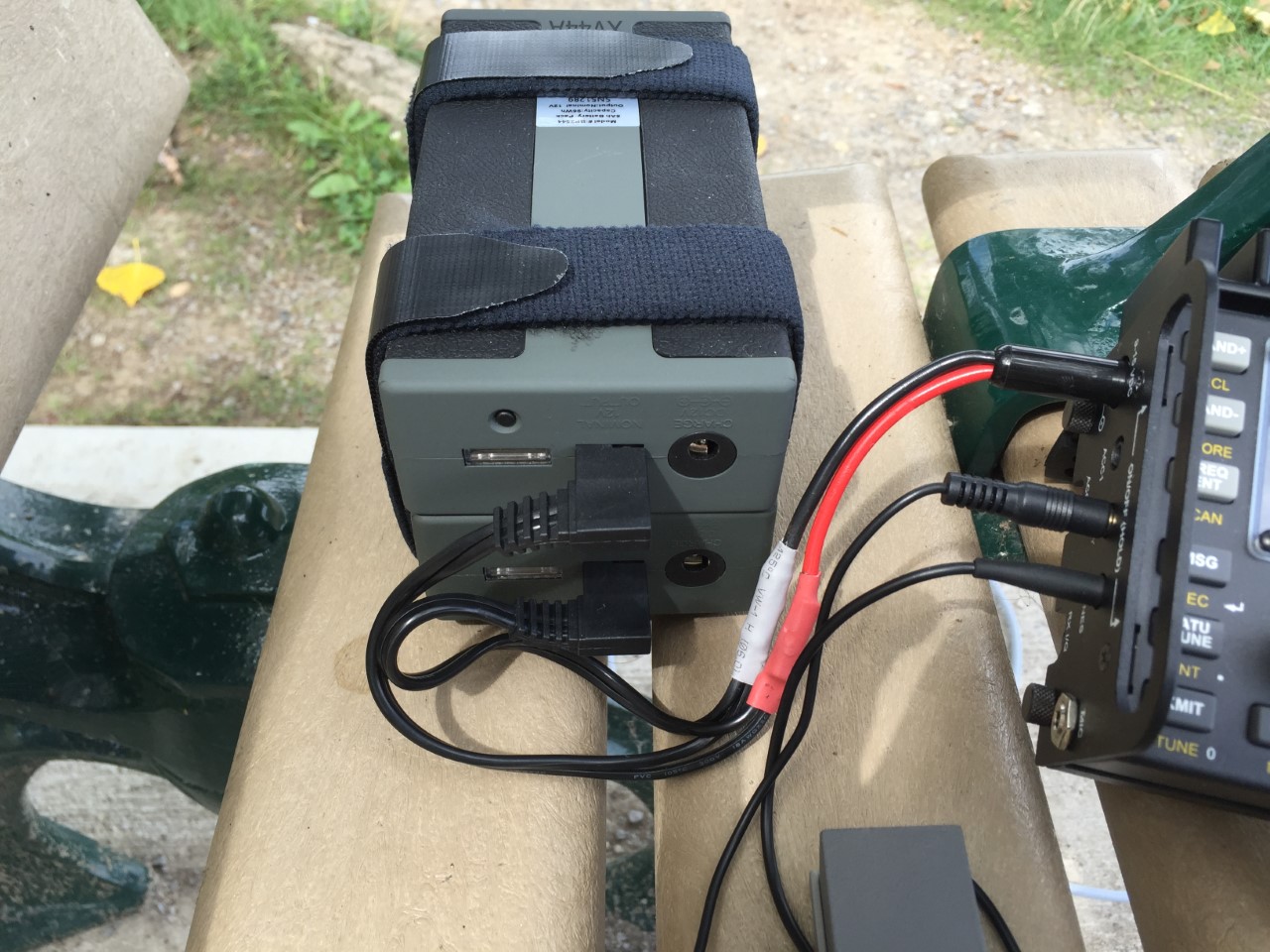
winning!  During the summer I have had on to many occasions battery issues. I have had AA cells in the KX3 not last more than a 1/2 even after a full charge. I have a Tracer lithium Polymer power pack that is an 8Ah pack. I decided to purchase the same item again and parallel the two 8Ah packs. This gives me a solid 16Ah's of power and a nice steady 12 volts. I have been using this arrangement for the summer and am very pleased with the performance.

An afternoon in the park.

The park setup
With the fall fast approaching which signals colder weather that is just around the corner and with that an end to outdoor op's for another year I decided to get outside today. It's a long weekend up this way with Monday being a holiday. I decided to use up some of my time off and took Thursday, Friday and Tuesday off as well. I went to our local park this afternoon and with it being a work day I did not find it too busy there I was able to get a nice spot under a shady willow tree. My first setup was an inverted "V" configuration. I was out last weekend and used the same configuration and was not spotted anywhere on 20m or 40m. I was reading this week that it's best to setup the inverted "V" with an angle greater than 90 degrees. I was not sure if that was my issue last weekend  but I decided to try again today but making sure my angle was greater than 90 degrees. I ended up having the same results with no spots. I then changed it up to a sloper configuration and I was able to contact K8DSS from Florida on 20m. Ed gave my 5 watt signal a 539 and I was happy with that but for the day that was all I had time for. It was soon time to pack things up and head home. While in a QSO with Ed his CW signal was in competition with practicing air show jets ( CF-18's and FA-18's) and the jets were
New power config
winning!  During the summer I have had on to many occasions battery issues. I have had AA cells in the KX3 not last more than a 1/2 even after a full charge. I have a Tracer lithium Polymer power pack that is an 8Ah pack. I decided to purchase the same item again and parallel the two 8Ah packs. This gives me a solid 16Ah's of power and a nice steady 12 volts. I have been using this arrangement for the summer and am very pleased with the performance.

When 100mW’s QRPp can be QRO power!!

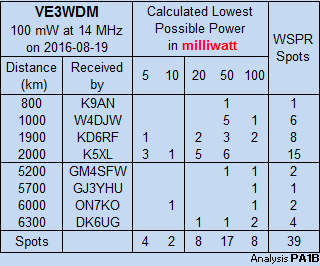
Above is a table that was made for me by Bert PA1B his blog can be found here .Shortly after reading my QRPp WSPR blog post Bert sat down collected my data and made the above table. It shows the calculated lowest possible power in milliwatts. Bert explained to me that the "calculated" lowest power, is the power that could be used (by my dinky antenna setup) to be received with an SNR of -29dB. From the above table it would seem that the 100mW's of power I was using for some contacts could had been considered QRO power!

When 100mW’s QRPp can be QRO power!!

Above is a table that was made for me by Bert PA1B his blog can be found here .Shortly after reading my QRPp WSPR blog post Bert sat down collected my data and made the above table. It shows the calculated lowest possible power in milliwatts. Bert explained to me that the "calculated" lowest power, is the power that could be used (by my dinky antenna setup) to be received with an SNR of -29dB. From the above table it would seem that the 100mW's of power I was using for some contacts could had been considered QRO power! Bert thanks very much for your time and effort and bringing to light the power of QRPp.

When 100mW’s QRPp can be QRO power!!

Above is a table that was made for me by Bert PA1B his blog can be found here .Shortly after reading my QRPp WSPR blog post Bert sat down collected my data and made the above table. It shows the calculated lowest possible power in milliwatts. Bert explained to me that the "calculated" lowest power, is the power that could be used (by my dinky antenna setup) to be received with an SNR of -29dB. From the above table it would seem that the 100mW's of power I was using for some contacts could had been considered QRO power! Bert thanks very much for your time and effort and bringing to light the power of QRPp.

100mW

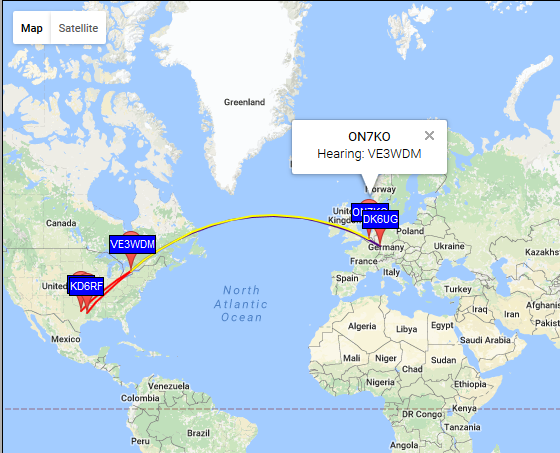
The other evening I was having a cup of tea and checking out my new QST that just arrived and found myself very interested in a piece written by Steve Ford in his column Eclectic Technology. The title caught my eye "When a signal is barely a WSPR" Steve looked at how the Raspberry Pi could be used for WSPR transmissions. Seeing I have the Raspberry Pi3 this sparked my interest. It was pointed out that all you need to turn your Pi into a WSPR transmitter is a board from TAPR called QRPi.  The board is offered at a very reasonable price of 29.00 U.S and it's set for 20m at 100mW. Before I got to excited about this little project  I wanted to see if using 100mW's would net me any results. I have seen other hams in the past net great results with far less than 100mW's and WSPR is known for it's great decode at very low power........BUT.......I do have a challenging setup here. On Friday late afternoon I gave WSPR a go on 20m at 100mW and was I impressed with the results. I was received by DK6UG for a distance of 39383 miles per watt and also ON7KO for a distance of 37285 miles per watt. I was amazed that my setup was able to produce those results! Now another question I wanted to consider is at 100mW how much of that actual power makes it to my antenna? To do this I referred to a coax calculator I punched in the type of coax (RG8X) the SWR (1.4:1) the length (30 feet)  the frequency (14) and finally the power (100mW) The calculated amount I was informed was 92mW of raw power! So this bumped my miles per watt to 4281 for DK6UG and 4053 for ON7KO! It's not timo look more into the TAPR project!!

100mW’s of raw power!!

The other evening I was having a cup of tea and checking out my new QST that just arrived and found myself very interested in a piece written by Steve Ford in his column Eclectic Technology. The title caught my eye "When a signal is barely a WSPR" Steve looked at how the Raspberry Pi could be used for WSPR transmissions. Seeing I have the Raspberry Pi3 this sparked my interest. It was pointed out that all you need to turn your Pi into a WSPR transmitter is a board from TAPR called QRPi.  The board is offered at a very reasonable price of 29.00 U.S and it's set for 20m at 100mW. Before I got to excited about this little project  I wanted to see if using 100mW's would net me any results. I have seen other hams in the past net great results with far less than 100mW's and WSPR is known for it's great decode at very low power........BUT.......I do have a challenging setup here. On Friday late afternoon I gave WSPR a go on 20m at 100mW and was I impressed with the results. I was received by DK6UG for a distance of 39383 miles per watt and also ON7KO for a distance of 37285 miles per watt. I was amazed that my setup was able to produce those results! Now another question I wanted to consider is at 100mW how much of that actual power makes it to my antenna? To do this I referred to a coax calculator I punched in the type of coax (RG8X) the SWR (1.4:1) the length (30 feet)  the frequency (14) and finally the power (100mW) The calculated amount I was informed was 92mW of raw power! So this bumped my miles per watt to 42810 for DK6UG and 4053 for ON7KO! It's not timo look more into the TAPR project!!

Subscribe FREE to AmateurRadio.com's
Amateur Radio Newsletter

 
We never share your e-mail address.


Do you like to write?
Interesting project to share?
Helpful tips and ideas for other hams?

Submit an article and we will review it for publication on AmateurRadio.com!

Have a ham radio product or service?
Consider advertising on our site.

Are you a reporter covering ham radio?
Find ham radio experts for your story.

How to Set Up a Ham Radio Blog
Get started in less than 15 minutes!


  • Matt W1MST, Managing Editor