Author Archive
 New satellites second pass: QB50P1 and P2 heard – perhaps Nanosat-BR too?
 June 19th, 2014 |
  Author:
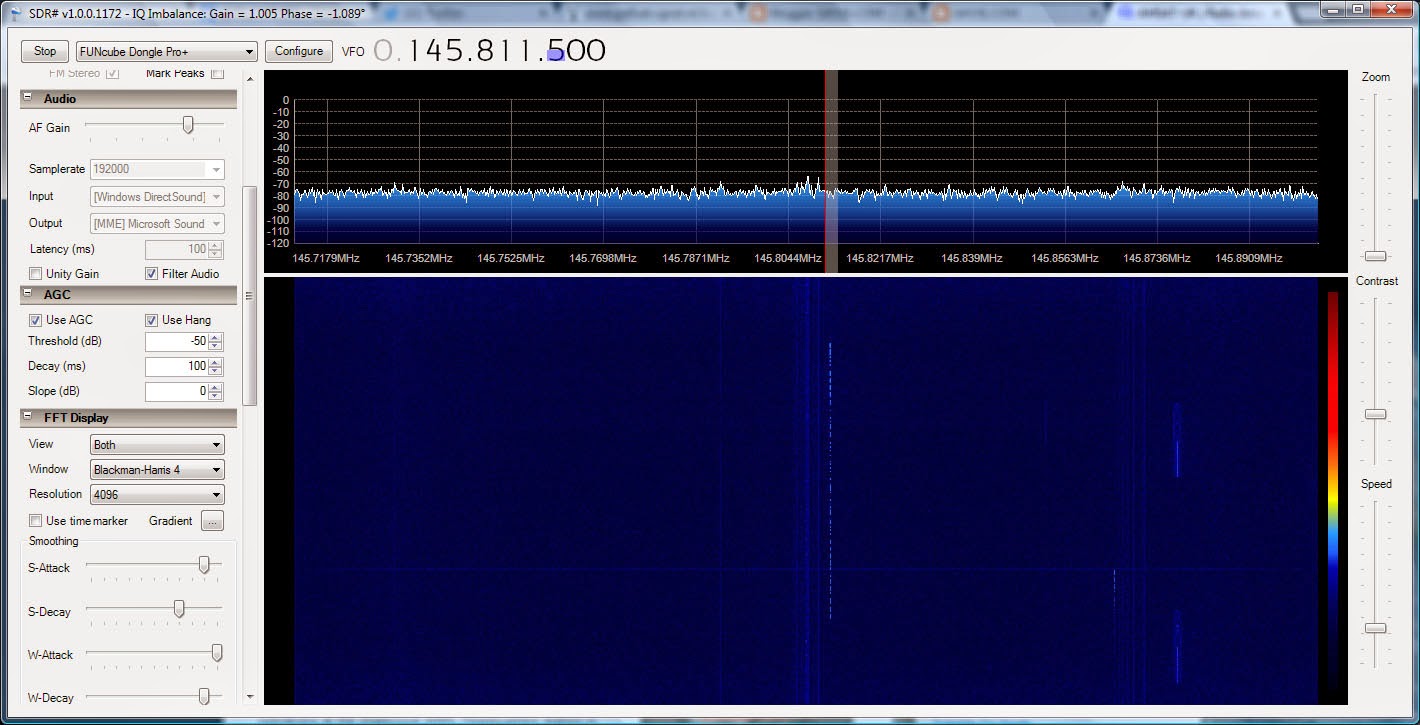
 I decided to listen on the second pass of the new satellite deployments, this time using the Funcube Dongle Pro, recording in baseband, so I would have the chance to replay it again if there was anything interesting.
QB50P1 was heard sending CW, QB50P2 was sending QPSK. Down on the 145.865 there was some CW (a sample was B1UARJZB4K – hopefully not too many errors there!) which I think may have been Nanosat-BR
Fascinating!
First copy of new satellite QB50P2 over the UK
With the launch of a number of Cubesats this evening, I was keen to take a listen on the first pass over the UK. I listened for QB50P1 on 145.815 and QB50P2 on 145.880. The pass was very low here – only a couple of degrees, but I was delighted to hear QB50P2 on CW – weak but easy copy.
You can read more about the satellites here
Latest TLEs for tracking here
On Twitter, Dave G4DPZ reported he’d heard P1, so they are both alive and well!
Finished work on the TYT TH-9800 quadbander review for Practical Wireless
I’ve had a review model of the TYT TH-9800 quadbander (28/50/144/433MHz) around for a little while, to do a review for Practical Wireless and over the last few days, I’ve wrapped the review up.
Clearly, I can’t give too much away here – the review will be in the next issue of PW – but it’s fair to say that the rig worked out well. As regular readers will know, I’ve had a Yaesu FT-8900 for a few years now. The TH-9800 follows that pattern very closely and works well (though is not identical). Well worth a look if you’re in the market for an FM quadbander. I’ll be sorry to send it back!
Tuning 50 and 70MHz over a coffee – and an interesting blog (SV5DKL)
Tuning around this morning, 50MHz hasn’t been massively open, but there have been some interesting signals popping up. First thing as I was drinking my first coffee, I worked IK6HIR from JN63 who came up quite nicely for a while. I6WJB was heard calling CQ DX, so I didn’t call him, but he was a decent signal.
Although I don’t use clusters much these days – especially on HF, this Es season I have been looking at dxheat.com which is a very nice web based cluster and allows me to filter everything except 50 and 70MHz spots. I noticed a 70MHz spot fly by of Martin GM6VXB on 70MHz meteor scatter. I tuned to the frequency in question and did get a short burst from him, but not enough for a QSO. Hardly surprising, given my vertical antenna.
Returning to 50MHz just before getting some chores done, I tuned around the CW end and SV5DKL (KM46) was coming through. With the small antenna, I don’t work SV, SV5 or SV9 very often from here, so dropped in a few calls. Signals were quite weak and then, in typical Es fashion peaked up to S7 or so and I was able to sneak a QSO in, which was very nice. The distance is just under 2900km, which I think is ok for the setup here (SV5DKL was doing all the work, of course)
As I frequently do, when I work someone, I tapped his callsign into Google and found that Efstathios has a very nice blog, with information about his operating and QSOs, particularly on 50MHz.
Magic on the magic band… (JT65A on 50MHz)
Actually, I’ve never liked people referring to 50MHz as the ‘magic band’. Sure, signals can come out of nowhere, but that’s hardly peculiar to six metres! Either way, I’ve been having fun on 50MHz as is usual in the Es season.
Over the last few days, when there’s been not much happening on the band, I have been leaving the receiver running on 50.276 with WSJT-X running JT65A. I don’t think there is a huge amount of activity, but there have been some interesting loggings; Iceland, Greece amongst others. Typically the most interesting ones have been when I’ve been elsewhere, but I have called CQ a couple of times and was delighted to be called by 3 or 4 stations in succession. Signals were pretty small and there was no sign of any CW lower down the band.
For me, that’s magic – working stations that you can barely hear! Of course, when the band is well open, JT65A, taking at least 5 minutes to make a QSO, is not the way to go – but when you fancy a bit of magic, it can be fun!
An interesting afternoon’s 50MHz WSPR; propagation near and far
I mentioned yesterday that I had got WSPR-X running and tried it out on 50MHz.
Despite it not being the most active of 50MHz days, it actually proved to be very interesting. Later on in the afternoon there was some Es around and I was pleased to spot and be spotted by CN8LI at a distance of just over 2000km. Not bad for 5W or so.
But actually, the most interesting signals were from Roger, G3XBM over in Cambridgeshire at a distance of around 140km. Roger runs 1W to a vertical, like mine. Pretty much every transmit period he made, I could see his signals, although often insufficient strength to decode. Another challenge was that owing to the amount of aircraft in the skies between us, the signals were often heavily doppler shifted, which is a problem for WSPR.
To our delight, Roger was able to decode my 5W signals several times and I was able to decode his 1W signals on several occasions. Our suspicion was that tropo came up a little and that there might have been some assistance from aircraft, perhaps flying on such a path that there was limited doppler shift.
I did also note that on the couple of times that we exchanged signals, Es had bubbled up a little. Clearly there is no suggestion that the propagation was via Es. However, I did wonder whether there was some benefit from some sort of scatter associated with the Es. At such low powers, I’m doubtful, but will look to see if it happens again.
First play with WSPR-X on 50MHz (DirectX strikes again!)
Inspired by Roger, G3XBM’s 50MHz WSPR experiments, I decided that a wet bank holiday was just the time to see what I could do. Es has been quiet today, so I thought some WSPR would be fun to see if any weak signals would make it through.
A few days ago, I noticed a post mentioning a new version of WSPR, WSPR-X which can be downloaded at K1JT’s site Realistically, as the main improvement seems to be the addition of WSPR-15, mainly for VLF, I wasn’t sure whether there would be any major changes.
As it turns out, the user interface is a bit more modern, folllowing the WSJT-X design.
I downloaded it and installed it and could see noise being received. I set it up to transmit and was surprised when G8JNJ and G8JNJ/A, 80km away or so did not copy my transmission. I tried again, still no. Then I remembered that when I first played with WSJT-X, I couldn’t get anyone to copy me, until I switched the output audio device driver to Direct X. I did that and immediately, I was spotted! Not really sure why – but pleased that it works ok.
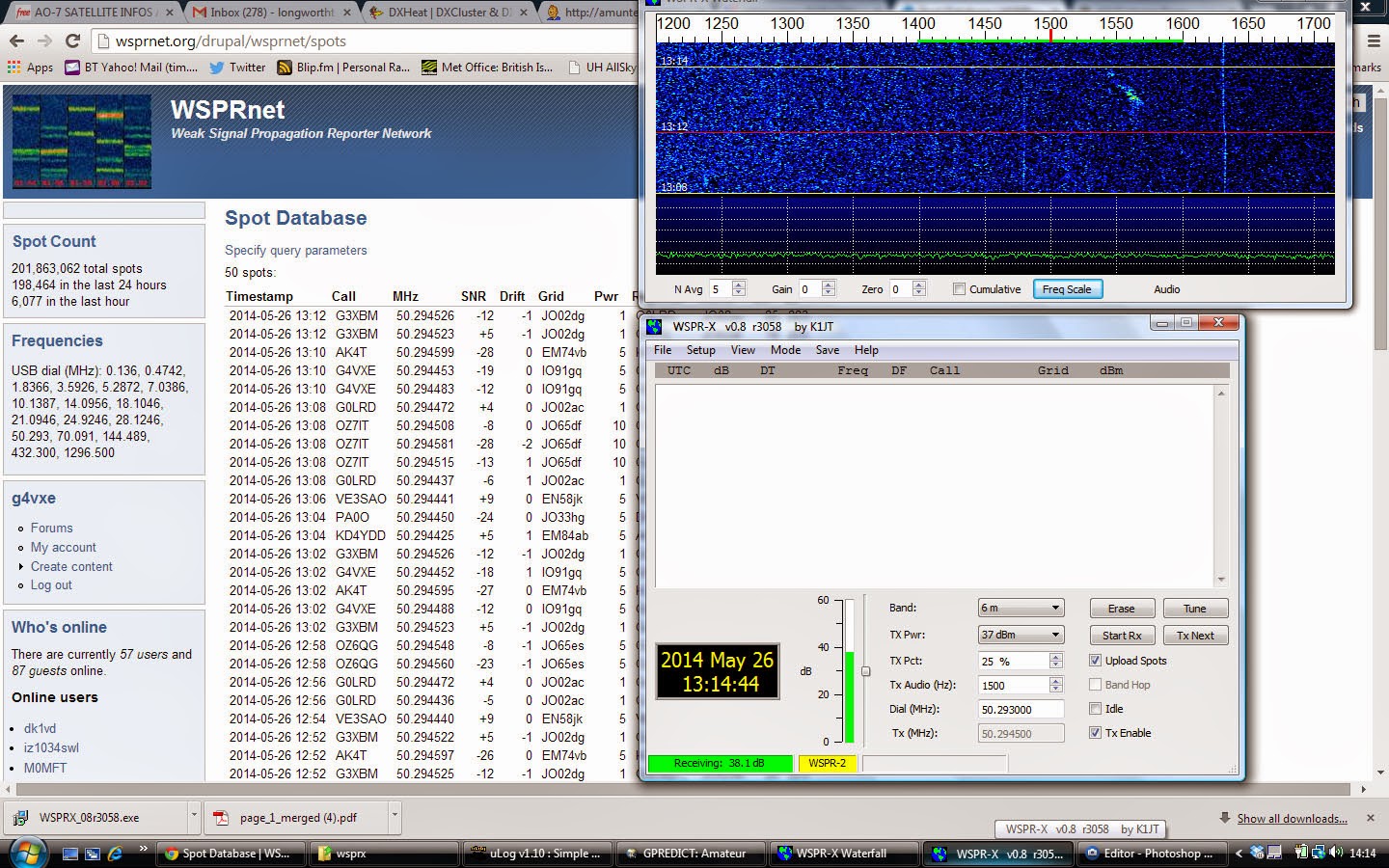
So far, nothing decoded – although actually, I am seeing G3XBM and G0LRD’s transmissions. The screenshot shows one of Roger’s transmissions, with a huge amount of Doppler from a passing aircraft.
.













