Author Archive
 Nostalgia time again: My first shortwave receiver (almost..) the Sony ICF2001
 December 29th, 2012 |
  Author:
 Since I seem to have engaged in nostalgia a bit, with the IC-740 post here’s another one! As I was driving back to Cheltenham with Mum this afternoon, talking about her father, Harold Iles, my Grandpa (who incidentally features in Laurie Lee’s novel, ‘Cider With Rosie’) . Harold was a great experimenter and really should have been a radio amateur. He was building radio sets when this was very cool stuff. Mum was telling me that he’d helped her build her own valve receiver. Certainly in the 1970s, he helped me build my own crystal set, which I still have! When he died in 1979, he was kind enough to leave me a little money.
By 1979, I was already very interested in amateur radio and had been shortwave listening for sometime, using a Nordmende Globetrotter broadcast bands radio which I had acquired when a dear, if distant, uncle had passed on. The Globetrotter was excellent, although the tuning was not so precise and it was hard to know exactly where you were listening – which could be tricky when sending off SWL reports!
I think I really wanted to buy myself a Trio (not Kenwood in those days) R1000, but could not really afford it and I was not working at the time, so the affordable option, which would bring me SSB reception for the amateur bands was the Sony ICF-2001D.
.JPG)
I’ve a feeling that the ICF-2001 was £199, but I’m not sure. I remember buying it from a shop on the High Street in Cheltenham, ‘Ray Electrical’ (Robber Ray, as my Dad, perhaps unkindly, referred to him!), using Grandpa’s gift.
Having digital readout and SSB was amazing! Being 1979/1980, solar conditions were good and I was able to hear lots of DX, particularly on 28MHz. With the receiver in my bedroom using the whip antenna, I listened to the USA working into the Indian Ocean (VQ9) and much more DX! I was captivated and knew that this was the hobby for me.
The ICF-2001 served as a great introduction to amateur radio for me, and I entered the SWL ladder in ‘Short Wave Magazine’ for a couple of years. By early 1983, I had taken and passed the Radio Amateurs Examination (then a City and Guilds exam) and obtained my first callsign, G6TTU. The ICF2001 formed part of my first station, being used on the Mode A satellites (145MHz up and 29MHz down) enabling me to work such DX, to a VHF only call, at least, as OX3WS in Greenland and TU2IT in the Ivory Coast.
Of course, not long after, I aimed for my Class A licence, passing the 12 wpm morse test, and by then was working, and had purchased the IC-740 so the need for the ICF2001 was lessened.
However, my Dad was always interested in short wave and I made the rig available to him. When I was off on a DXpedition somewhere, such as D68C in the Comoros, or ZF1VX in the Caymans, he would listen out for me, which was a nice feeling.
Wind the clock forward to this afternoon. I wondered if the ICF2001, which was still in Dad’s old study, would still work (not having been used since Dad’s death almost 3 years ago), so I grabbed it and brought it home.
I popped a couple of AA batteries into the ‘computer’ battery box, connected a power supply and fired it up! IT WORKS!
Fun to listen around, just on the internal antenna – just for old times’ sake, but it’s nice to know it still works, and I’m sure I can still coax some DX out of it!
Thanks, Grandpa, for getting me started…
(PS This is the first blog post written on my Raspberry Pi computer)
Nostalgia time: QSOs with my first HF rig – the Icom IC-740
I was up in the loft this morning looking for a couple of bits (with an eye on another project) when I came across the microphone for my Icom IC-740 – my first HF rig from when I was licenced in 1983. Being a bit of a hoarder – well who would want to buy such a vintage rig (!) – I have never disposed of the rig. For years I kept it at my parents home in Cornwall, so that I could operate from there when I visited. Now they are no longer there, the rig has been living in our loft for probably the last 6 or 7 years lying unused.
.JPG)
I decided to bring the rig and the microphone down from the loft this morning and see if I could get it to work. I gave it a dust first of all and then connected the power. I was pleased that the rig came up ok and seemed to be responding. I put it on a dummy load initially. One of the long standing faults with the rig was an intermittent on the Comp button which needs to be jiggled around a little to get RF power out. I was a little concerned that might have become a permanent problem over the years, but happily it wasn’t.
Time to try it on an antenna! I plugged the HF vertical into the rig and the receiver was working well. Tuning around was quite pleasant. The VFO was a little more ‘plasticy’ that some of the other rigs I use now, but the receiver was ok. When I bought the rig, I used the 500hz CW filter pretty much all the time. Nowadays I am happy to tune around on a wider filter, but it sounded nice enough. Sadly the S9 noise on 14MHz experienced on the other rigs was still there on the 740 (I didn’t expect it to be otherwise!).
When I was living in Canada in the mid 90s, the local radio store in Toronto, Atlantic Ham Radio were closing out some of the modules for the IC740, so I had installed the keyer module and the FM board, which I didn’t buy in 1983 – I had only just started work and I’m pretty sure that the rig was several months wages as it was!
Anyway, I plugged in the paddle, turned the power down and had a play. It sounded ok! The keyer chip was obviously a little different to the keyers I normally used as I was dropping the odd dot here and there, but quite manageable. I had a listen on another rig in the shack and the signal sounded fine, so I decided to see if I could make some QSOs.
Forty metres seemed like the best bet, so I tuned the CW end looking for a nice strong CQ to answer. PA/ON6QO was CQing from IOTA EU-146, so we successfully exchanged reports. I then found Rob M0TIX calling CQ and we had a longer ragchew on the key and I explained I was using my very first HF rig from nearly 30 years ago. Finally, I decided to try 10MHz – when I first had the rig, the 10MHz band had only just been allocated to amateurs and I had to do a modification in the rig to enable the 10, 18 and 24MHz bands! Tuning up 10MHz I heard W1MK calling CQ (not bad for the middle of the day), so I replied to him and we had a short but pleasant QSO.
Perhaps sometime I will try it on SSB. I remember that the audio reports on SSB always were a bit poor – perhaps one of the reasons that in my early years on the air, I concentrated on CW operation! As I recall the Icom microphones of the day had a preamp in them.
A happy distraction with the old rig and I am delighted that it is still working. I will have to think of a use for it! Now, back to the original reason for the visit to the loft….
First steps on 472khz – with an IC706
As you’ll have gathered from my earlier post. I hadn’t premeditated any 472khz activity, although it will certainly interest me to try and hear something on the band. Googling around quickly, I found some interesting information from DL4YHF that he had used his IC706 as an exciter on the band.
This intrigued me as I have an IC706 Mark 1 which was the same model that Wolfgang mentioned. The IC706 had been tucked away in a cupboard for a little while, so I dragged it out and hooked it up to a dummy load and a power meter. To my surprise and delight, on the lowest power setting I discovered I could get around 2W output on 472khz.
However, what didn’t quite add up was that I couldn’t hear anything on the FT1000MP that was running in the shack- either the MP is a bit deaf – OR the 706 is not doing quite what I think it is! So I will have to look a bit more carefully!
Have a look at DL4YHF’s interesting post here
5MHz and 472khz NOVs received
Over the last day or so, I’d seen people commenting on Twitter that they’d applied for 5MHz NOVs. I’ve got a current one and I wasn’t sure whether I need to apply for a new one to use the new frequencies. I decided that it was probably just easier to apply for a new NOV and then there is no doubt!
Application for the NOV couldn’t be easier! Just head over to the RSGB’s NOV page – the only thing that slowed me up was that I didn’t know my licence number, so I had to log onto the OFCOM portal (having remembered my password!) to find it out.
On the same page there is the NOV application for the new 472khz band. I decided that, although I don’t have any gear for the band at the moment, I might as well apply for an NOV, which I have done and received. And it’s already given rise to a bit of experimentation which has been quite interesting. More on that in another post…
The NOVs don’t come into force until 1st January 2013, but I am looking forward to seeing what can be done on these bands.
Virtual Radar for a tenner – RTLSDR and ADSB: It works!
I had some time this morning to experiment with the RTLSDR USB dongle which I’ve previously mentioned. Designed as a DVB TV/DAB receiver, with different drivers, they can be used as a wide band scanning receiver. As I mentioned yesterday, I’d seen Pete 2E0SQL report success in decoding the ADSB transmissions from aircraft with his stick.
I used my latest USB dongle with the E820T tuner – having made sure that the drivers were up to date. The first ADSB decoder that I tried was the ADSBSharp program which you can download from here Having installed that – I started the program with the dongle plugged into a USB port and a small antenna which came with DVB stick plugged in. Immediately I could see that the dongle was decoding frames – and quite a few of them.
I wanted to try and plot them, so I started up ADSBScope which you can download here
From the menus, I selected Other/Network/Network setting and set the Raw Data CLIENT (not the server) to port 47806 which ADSBSharp was ‘broadcasting’ on. The URL should be set to 127.0.0.1
I then pressed the RAW Data Client icon – it’s the right hand of the group of three ‘network’ icons on the icon bar. Lots of messages started appearing in the right hand pane, but very few position decodes. I filtered around with the filter but didn’t see much improvement.
Honour was sort of satisfied as I knew the data was being decoded, but I wondered if if I could do better. I’d seen some discussion on Twitter about the RTL1090 software which would work with the RTLSDR dongle and should decode the data. I downloaded the program and installed it from the RTL1090 website
Running the program up, I could immediately it seeing aircraft and displaying ‘Active Flight’ data. However, even after reconfiguring ADSBScope’s Raw Data Client to point at RTL1090 which was running on port 31001 ADSBScope was not displaying flight information.
I then remembered seeing in the ADSBSharp instructions that you had to configure the client to use AVR format. I had no idea what that was, but wondered if I should get RTL1090 to send the data to ADSBScope in AVR format. This was what cracked it! Simply start RTL1090 from a command prompt with the /AVR flag and the data will then be sent to ADSBScope and mapped.
I am surprised how sensitive the receiver is. Not as good as the LZ2RR ADSB dongle, but as you can see from the map, the system is quite capable of receiving aircraft over distances of 20 to 50 miles away – even with a basic indoor antenna.
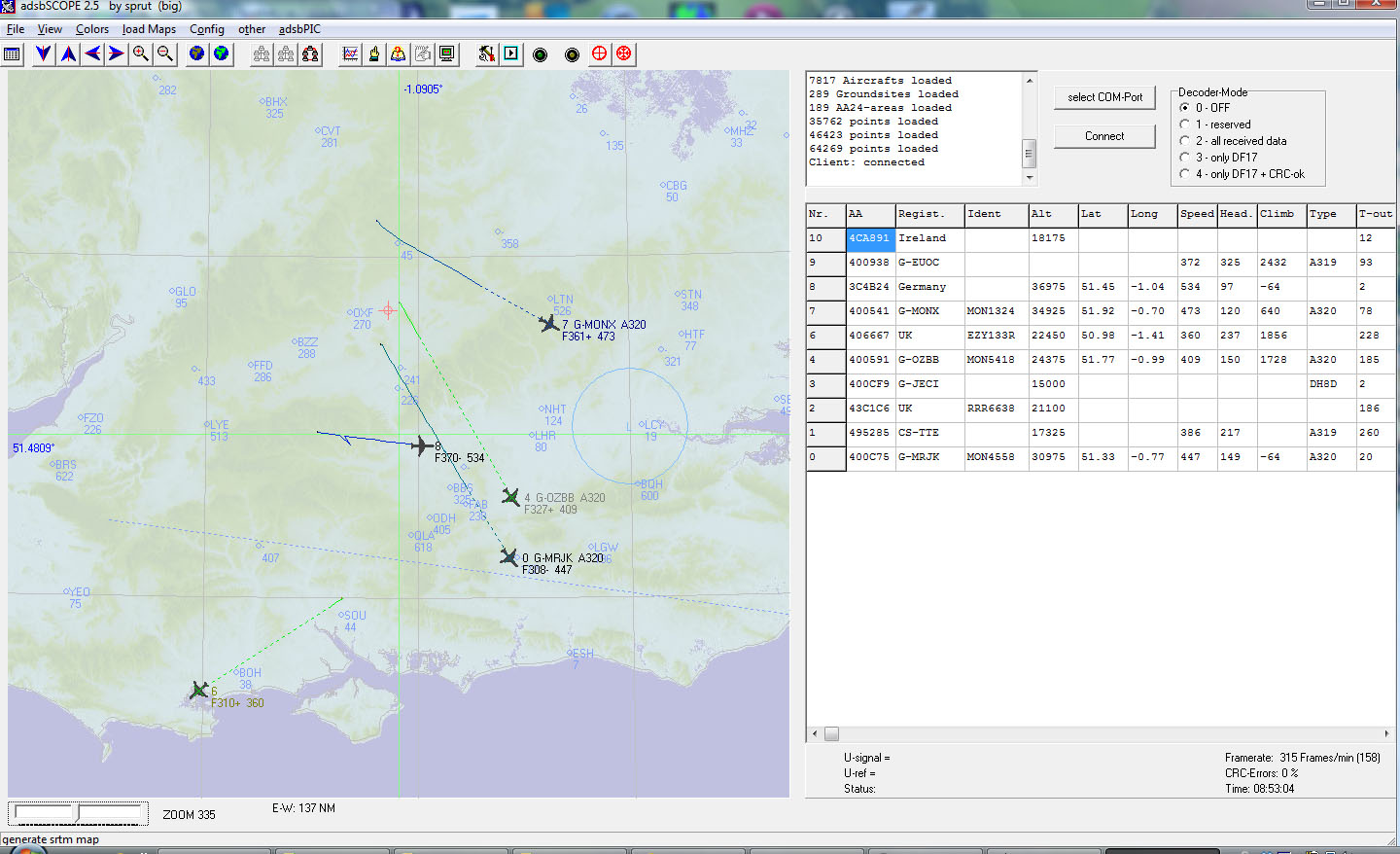
Definitely a great use for the DVB dongle, especially if you have been interested in Virtual Radar, but were put off by the prices!
Using your RTLSDR to decode ADSB transmissions
Chatting to Pete 2E0SQL on Twitter yesterday, I was excited to hear that he had been able to decode ADSB transmissions from aircraft using his RTLSDR dongle (you’ll recall that these are the devices which cost around a tenner). Although this is nothing new in the Linux world, it’s new to me in the Windows world.
Even better news is that it’s very simple to do.
If you already have the correct drivers from ZADIG installed, you should only need to grab the executable which is available on the SDRSHARP site
I haven’t tried this myself yet, but Pete reported that he was able to decode data and plot it, using Virtual Radar Server using just a bit of coax for an antenna!
I will give this a go over the next few days – as it sounds interesting!
PZTLog – much goodness
After my initial blog about Charlie M0PZT’s PZTLog, I have been using it more and more and finding it very enjoyable to use and very good.
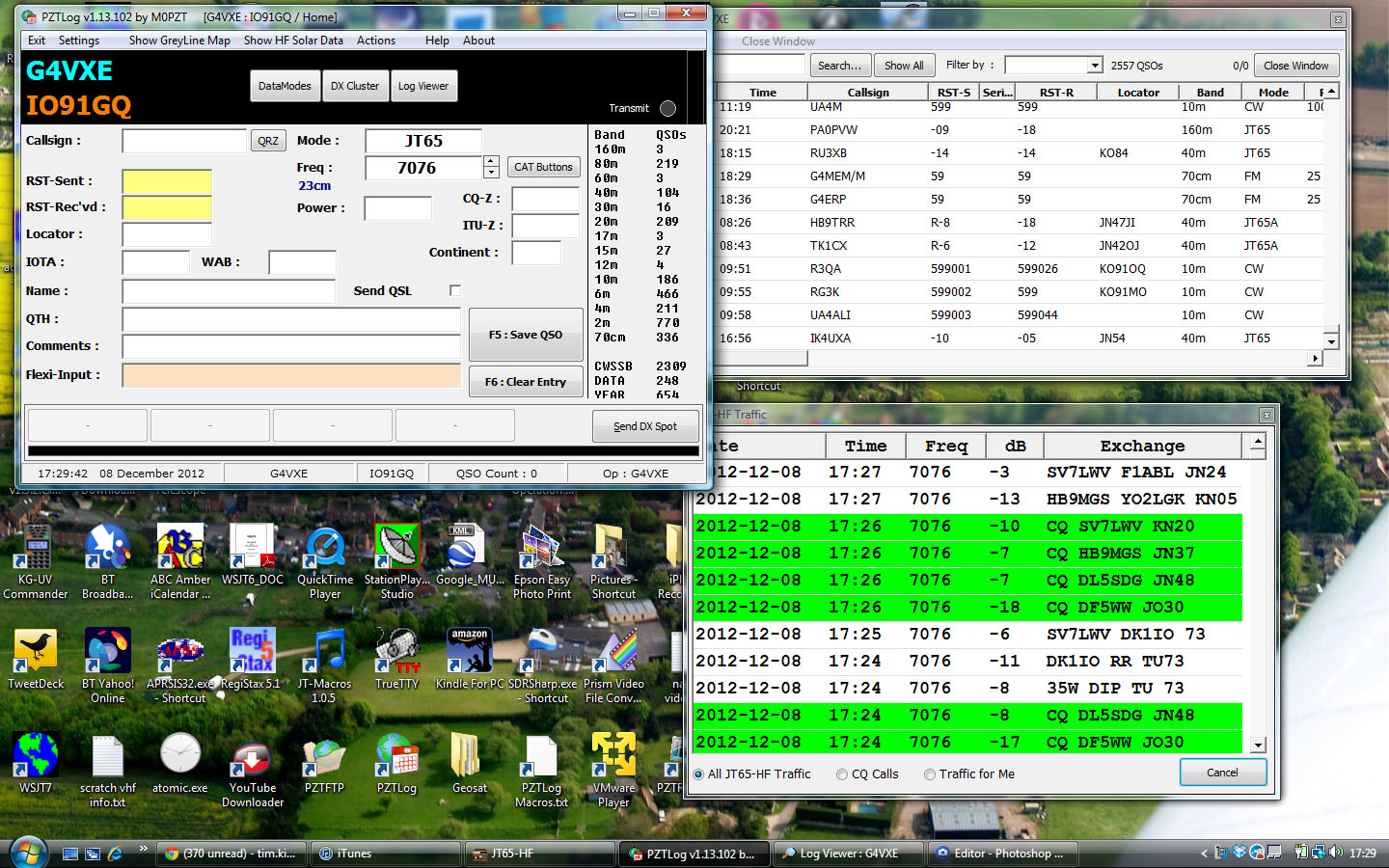
Of course I have been finding out more about the program, and Charlie has been busy adding new functionality to the software. The ADIF import now seems pretty robust and I’ve been able to import my log from Winlog32 into PZTLog.
There’s Locator Square listings, so you can see which locators you have worked on various bands – HF as well as the VHF bands – ideal if you enjoy chasing the grid squares on HF JT65A, for example. I like the integrated Grey Line Map display
Being a keen JT65-HF user, I particularly like the ability to display the JT65HF traffic within PZTLog. And best of all, double clicking on a line in the JT65 Traffic window will bring various details into PZTLog, so you don’t need to worry about doing a separate ADIF import to bring the QSOs in.
I can’t say enough nice things about Charlie’s responsiveness to questions and suggestions – updates appear very frequently- fixing issues – or adding new features.
PZTLog has become the default station logging software here at G4VXE – I’m delighted with it! Thanks for all your hard work, Charlie!













