Author Archive
 Raspberry Pi + DVAP Dongle = a nice little DSTAR hotspot
 February 2nd, 2013 |
  Author:
 A few weeks ago, I overhead a QSO talking about using a Raspberry Pi and a DVAP as a hotspot for DSTAR. Like a lot of things, it lodged in my brain, but I didn’t do anything about it immediately!
.JPG)
Googling around a little, I found lots of references, but the best suggestion seemed to be to join the pcrepeatercontroller group on Yahoo groups, where there was some good documentation on how to go about it in the Files/Documentation folder.
It turns around that thanks to the hard work of Mark, WD9JEN, Dave, K9RUF and Brian GW6WTK as well, of course, as the software author Jonathan G4KLX, the process is quite easy.
I got a new SD card (actually there was a slight false start as I discovered that not all SD cards work well in the Raspberry Pi). I downloaded the image for the Raspberry Pi of the operating system, Debian, with ircDDBGateway and DVAPNode already installed. You can download it from this link
Most of the instructions I read about copying the image to the SD card talk about using Win32diskimager, however, I could not get it to work with my internal SD card reader on the Dell laptop. I used a utility called Flashnul which worked fine. If you run into the same issues, you can grab Flashnul here
Once the image was written, I checked to see if I could boot the Pi with it and was delighted to find that I could. Following that, it was just a question of following WD9JEN’s instructions and substituting my call for his. I did a slight false start and found that though the DVAP node software was working alright, it wouldn’t link to anything. I discovered that I had inadvertantly entered a password in the ircDDB tab in ircDDBGateway. I removed that and it all started working.
My Raspberry Pi’s network connection is via WiFi but this seems fine and adequate for connectivity, though perhaps it would be even more reliable to take a cable directly to the router.
I have enjoyed some nice QSOs this afternoon, with Peter G0BZX, Dave M0NEY, Ian 2E0VTM (also experimenting with a Pi and a DVAP) and Bob MW0RBL.
Since I can leave the hotspot running without tying up the main computer, perhaps this will result in a few more DSTAR QSOs being made!
First signals received on 472khz
This morning, whilst I popped out for an hour, I set things up correctly and when an came back, I was delighted to see that I had copied M1GEO in JO01 square. It turns out that George has a very nice station on 472khz, detailed here on his Wiki
Later on in the day, I also copied G3ZJO from IO92 and then during the evening I received some nice signals from PA3ABK in JO21.
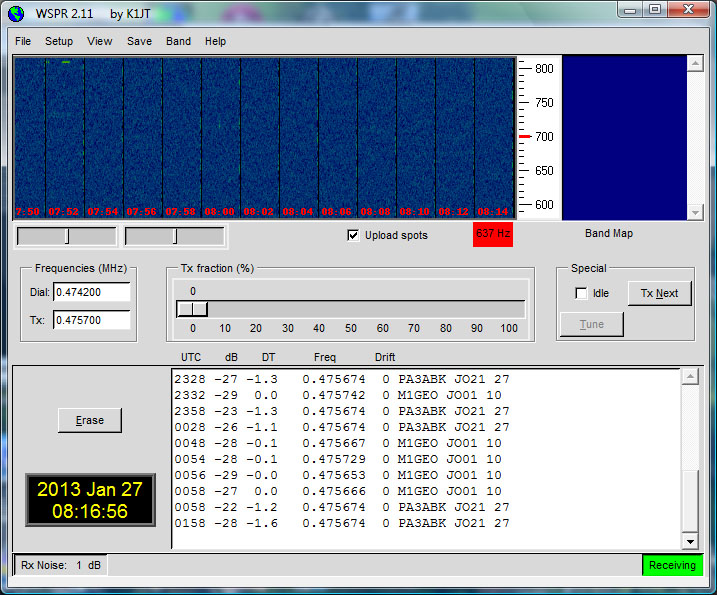
Clearly there is much that can be done to try and improve the receive performance, but it is encouraging to have received some signals without having to modify any equipment.
More on programming the Baofeng UV-5RA
After seeing my post about the fun and games with the UV-5RA yesterday, Steve G1KQH kindly dropped me a note to say that there are two versions of the UV-5 software. One of these can be used with the UV-5R and one which may be used with the newer models.
These may both be downloaded from the Sinotel site, along with many other utilities
Thanks, Steve!
Programming the Baofeng UV-5RA
A few days ago, I was chatting to Andy G6REG and he mentioned that he needed a lead to help program his UV-5. Rather than have him wait to order one from Hong Kong, I suggested that I send him my lead so that he could could get started straight away.
Life’s never quite that simple though. The lead arrived with Andy and he installed the drivers but on running up the Baofeng programming software, it wouldn’t talk to the radio.
At that stage we thought it was a driver issue on Andy’s laptop. Andy decided to order a lead and driver anyway and return the lead to me. On a whim, he suggested that he send me one of the radios to see if I could program it.
When I opened the packet, I immediately noticed that Andy’s UV-5 was different to mine – it’s a UV-5RA. I made sure that the programming lead was working on my laptop and then ran up the software and downloaded the memories from my UV-5. So far so good!
Then I tried to write the memories back to Andy’s UV-5. No! Communication fault. It was then that I realised that the Baofeng programming software that I had used to program my UV-5 would not work with the later model!
A quick Google around revealed that this was indeed the problem and that others had got around it by using the CHIRP programming software. It seems that the ‘stable build’ version of CHIRP (0.2.3) does not support the UV-5, however, the latest daily build does. This I was able to download here
I also found some interesting notes about programming the UV-5 with Chirp
CHIRP installed readily and I was quickly able to download an ‘image’ of my UV-5R and save it. I then tried to write it back to the UV-5RA. The first time I did it, an error occurred, however, I remembered I had seen this on a first communication before and persisted.
Yes! Second time through and CHIRP was able to write the memories back to Andy’s UV-5RA.
So there we have it. Most likely, Andy didn’t have a driver issue on his laptop. At that stage we didn’t know that the basic Baofeng UV-5 software didn’t work with the new style rig, so I suspect that had he installed CHIRP it would have probably worked fine.
Raspberry Pi progress (RTL_ADSB, WSPR, WSJT and Dump1090 all compiled)
This year, Santa was kind enough to bring me a Raspberry Pi computer for Christmas. I’d been aware of them throughout the year, but had become much more interested recently when I started to see some real solid amateur radio applications for the device.
The idea of having a £25 computer which could be tasked with running programs like WSJT or WSPR was very attractive, as well as being a handy machine for web browsing and general internet use (I’m writing this post on the Pi, for example).
Pete 2E0SQL had posted about getting RTL_SDR running on the Pi which was a very useful and interesting. The only issue that I had was with libusb1.0 – because I was compiling it seemed that I needed to install the libusb-1.0.0-dev package. Once I did that, everything worked well.
Initially, I tried the Remote_SDR which certainly worked, although was a little stuttery. What was more interesting to me was the rtl_adsb program, which I was able to use to decode ADSB messages from aircraft and send these across the network to the Windows laptop running ADSBScope. This was done simply by piping the output of rtl_adsb using netcat as follows:
rtl_adsb |netcat -lp portnumber (where the portnumber is where ADSBScope is pointing)
I was impressed and this worked pretty well and the receiver and decoder seemed sensitive – considering the antenna was downstairs and away from a window.
Dave G4FRE had posted about compiling WSPR on his Raspberry Pi which made a great basis for getting WSPR going.
I had to amend my configure statement as follows:
./configure -with-portaudio-include-dir=/usr/include -with-portaudio-lib-dir=/usr/lib/arm-linux-gnueabihf
Finally, when I ran the make install, I got an error which was quite terminal!
(no rule to make target mept162.f needed by WsprMod.w.so. Stop
However, Googling around a little, I found that a number of people had had the same issues compiling the latest release of WSPR, so I downloaded the 2840 version from the repository using the following command:
svn co http://svn.berlios.de/svnroot/repos/wsjt/branches/wspr -r2840
I still needed to use the amended configure statement but this seemed to work ok. The program compiles up and starts and I was able to select a USB sound card. I haven’t yet tried a decode (the Pi is in the lounge and not the shack!) but will aim to do that soon.
Next to compile was WSJT and I used Dave G4FRE’s post to guide me. There were no nasty surprises requiring too much thought and the process was simple and straightforward.
Finally, was a new ADSB decoder that could be used with an RTLSDR device. Called Dump1090 it was written by Salvatore Sanfilippo that I saw mention of on Twitter – this was very simple to get going:
git clone git://github.com/antirez/dump1090.git
cd dump1090
make
Once the program was built, I particularly liked running Dump1090 in interactive mode with the RTLSDR dongle in one of the USB Hub slots connected to the Pi
./dump1090 –interactive
This produces a simple, but interesting list of aircraft that the the decoder is seeing. Unlike any of the other decoders I’ve used recently, it gives an interesting indication of the sheer volume of messages that are being decoded.
It was good fun getting these different programs working and remembering some of my lost Unix skills!
Thanks particularly to Pete 2E0SQL and Dave G4FRE for their inspiration for these experiments.
G4VXE’s review of the year 2012
For the last couple of years, I’ve done at the post at the end of the year thinking about the highlights (and the occasional low light!) of the year from a very personal amateur radio perspective.

1. 70MHz
Four metres was a real star band for me in the summer and I found more openings than ever before. Having the new Spectrum transverter made things a lot easier and despite having only a simple aerial, I was very pleased with the results. A couple of gotaways, like SV8CS and an EA8. But there’s next year…
2. 50MHz
Lots of six metre openings too and I was particularly thrilled to make several transatlantic QSOs – no big deal you may say, but this was all on the vertical antenna.
3. Datamodes
I started to use JT65A heavily at the end of last year, but with the new G4ZLP interface that I bought at the start of the year, JT65 and the other WSJT modes have been in almost constant use here. I find the modes both extremely efficient and enjoyable to operate. CW and SSB activity has diminished quite substantially here this year.
WSPR too has been immense fun and I have devoted more time to it than before. 7 and 28MHz have been my favoured bands and it’s been fun to have reports from all the way around the world using no more than 1 Watt.
4. SDR
2012 was the year of RTLSDR and what a lot of fun I had! Although the cheap USB dongles are not the most sensitive, I have been surprised and delighted about what they can do. Probably the best use of them so far, for me, has been the Virtual Radar applications which up until now has been the preserve of the expensive, bespoke equipment.
SDR# even on a cheap USB dongle has given me a taste of what can be done and I shall look forward to trying out more advanced SDR technology in due course.
5. PZTLog
I’ve been excited to start to use Charlie M0PZT’s PZTLog program. It’s an excellent piece of software and I’ve particularly enjoyed the Datamodes and JT65 integration capability. Charlie is constantly updating the software – I even noticed a new release on Christmas Day. There’s dedication!
6. Cheap and cheerful equipment
Both the Baofeng UV-3 and UV-5 144/432MHz handhelds arrived this year and have proved a lot of fun, for a combined investment of under £50. Simply, you can’t go wrong.
7. AM
I was fascinated to listen to some 27MHz AM signals in the late summer which led me to wonder about what I would hear on 29MHz. Sure enough there were some fascinating stations to listen to and a handful of contacts. What a surprise to learn that as well as using old ‘boat anchor’ type gear, some people were using state of the art SDR rigs to generate their AM signals. Very nice they sounded too!
8. Having a message encrypted by an Enigma machine
Having the chance to have a message that I sent, encrypted by an Enigma machine in Cheltenham, sent over the air to Bletchley Park and then decrypted was quite special! Thanks to the Cheltenham ARA and Milton Keynes clubs for making this possible.
9. DSTAR: DCS reflectors
On D-STAR, the arrival of the DCS reflectors brought new resilience and quality, I felt. Some of the innovation was quickly applied across the D-STAR network resulting in less ‘black holes’ and better qualityQSOs.
10. Remote control
Although it’s as simple as using my iPad across the WiFi network at home to control the PC in the shack running the JT65-HF software – remote control has been brilliant and has resulted in a good number of QSOs in the evenings when I’ve been sat downstairs on the sofa! Highly recommended!
Output detected on 472khz from the IC706
I mentioned a few days ago that I had measured a couple of watts output from the IC706 on 479khz although I’d not yet detected it on a receiver.
This morning I did some better experiments and set the IC706 up on a dummy load and placed the ICF-2001 receiver close by to the dummy load. I was easily able to detect the keying on the receiver, so that was excellent news.
.JPG)
The next challenge will be to find some sort of antenna matching arrangement. I have ordered a ferrite rod from eBay (despite trawling through my junk boxes in the loft, I couldn’t find one). My first attempt at an ATU will, I think be similar to Roger G3XBM’s – although more of a bodge I expect!
However, I was speaking to Adrian G4GDR yesterday on 2m. Adrian has been one of the 500khz permit holders and mentioned that he had made a variometer out of a carpet roll and some rods. He very kindly invited me to inspect it, which I will certainly do.
I’m not sure how viable the IC706 will be for 472khz, but perhaps it will be possible to scrape a local contact or two.













