Author Archive
 Another K3 panadapter option?
 June 8th, 2010 |
  Author:
 Cross Country Wireless recently introduced a new product, a built, boxed and ready to use SDR receiver that is optimized to work with the bog standard sound card provided with every computer. It covers two 48kHz segments which may be on one or two bands using a switched local oscillator. At £49.95 it looks like something of a bargain.
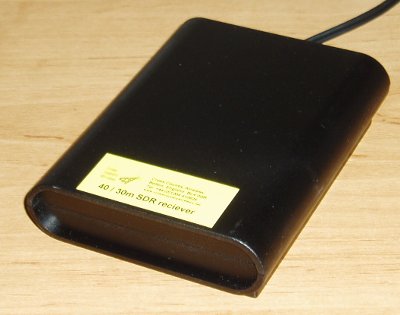 I was looking at the product’s web page this evening and the thought occurred to me that this might make a rather good inexpensive option for a panadapter for the Elecraft K3. It would need a different crystal to cover the K3 IF output frequency which is 8.215MHz, but that shouldn’t be a problem. CCW might even offer this as a stock option if there was a demand for it.
As the receiver covers 40m and 30m everything else should work OK unmodified. The key point would be whether there is adequate isolation to prevent the local oscillator leaking into the K3 IF and desensitizing the receiver – the reason why most people use a buffer amplifier when using SoftRock boards for this purpose.
I don’t have a great urge to have a panadapter display and I already have three sound cards (well, one and two USB sound modules) in use with my shack computer so this isn’t something I’m planning on trying. But I thought it might be worth mentioning the possibility for other K3 users. Even if the idea is a non-runner, the Cross Country Wireless receiver still looks like a very nice product.

Better late than never?
Yesterday I was surprised to receive a package, by air mail, from Greece. It was the micro transceiver module I ordered at the beginning of April from Elcom Research. I was informed that it had been sent by registered air mail, but when it didn’t turn up and further emails went unanswered I opened a dispute with PayPal which was judged in my favour and the money was returned to my account on May 21st.
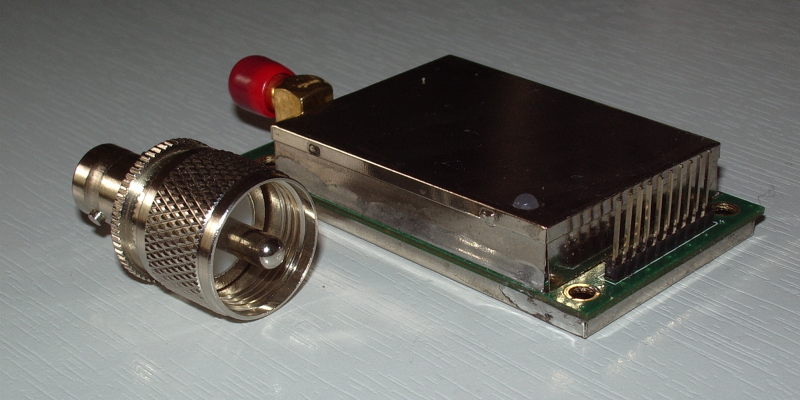 What I received was just what you see in the picture (less the PL259-BNC adapter which was included in the picture for scale). No documentation, no indication as to what the connections to the 10-pin connector are, nothing. It is completely unusable as sent. What’s more, the Elcom Research website I originally ordered it from now seems to be defunct. The only identification is the part number FC201SA on the circuit board. I typed that into Google and found that the module is an FC-201/SA Audio/Data RF Module manufactured by Friendcom in China. Google also turned up a PDF user manual on the Friendcom site, so I was able to download and print off that.
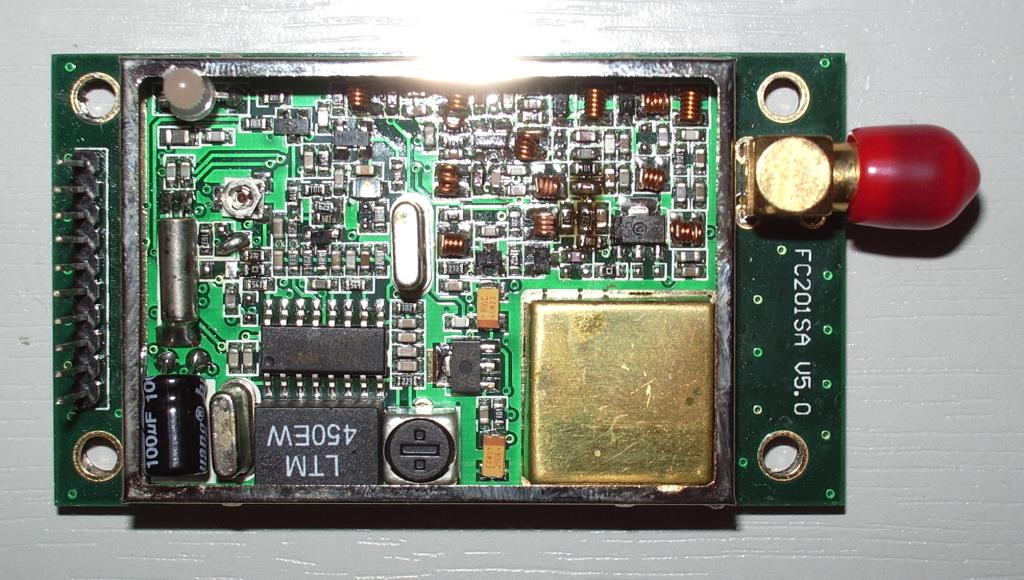 From the manual it appears that Friendcom would normally supply a cable for the 10-pin connector. I didn’t receive one. Without it I will have to solder directly to the pins, because although it looks like a standard 0.1in PCB header connector it isn’t. The pins have a spacing of about 1.8mm. I haven’t been able to find a mating connector, though I admit I haven’t looked at the professional parts suppliers as with minimum order quantities and so on it isn’t economic to order a single connector from them anyway.
My intention with this module had been to make a micro-power Echolink hotspot. As I no longer expected to receive it I had moved on from that idea, but now it’s here I guess I’ll have to pay for it. I don’t plan on doing anything with it until the autumn at least, as for me summer is not the time for constructional work.

QSLing made easy
As regular visitors to the site will know, I’m a big fan of eQSL. I don’t need QSLs for awards because I don’t chase them, and in a hobby that has embraced the internet in just about every other aspect electronic QSLing seems to me to be the most logical way of confirming a contact that saves time and money. And more important than that, for me, is that it relieves me of a tiresome chore.
 So when I read about GlobalQSL in John Harper AE4X’s blog my immediate thought was: Why haven’t I come across this before? As you’ll see if you follow the links, it’s a service that prints QSLs on demand and sends them to the bureau. You export your log to an ADIF file, upload it to the service, pay, and the job is done. As with regular printing services there is a minimum order of 100 QSLs and the price drops if you send 1,000 or more. You can also order blanks to be sent to yourself for direct QSL requests.
There is a free QSL designer program (for Windows) that you can download from the GlobalQSL site and use to design your card. As you can see from the sample above (and others on the site) the results are very professional and leave nothing to be desired. You can order 10 samples sent to you from your design for $8 to test the quality.
I created an account (it’s free), logged in and found that there were 14 QSLs already printed and sent to me. I think GlobalQSL is a brilliant idea that retains the convenience of electronic QSLing but allows you to satisfy those contacts who prefer to receive real QSL cards.

D-Star reaches Cumbria
Kudos to Lynn KJ4ERJ, developer of the brilliant APRS client APRSISCE. Yesterday he read my comment that the program doesn’t support transmit through the soundcard based AGWPE software yet, and today it does! So now my APRS beacons are braaping out over the Cumbrian airwaves.
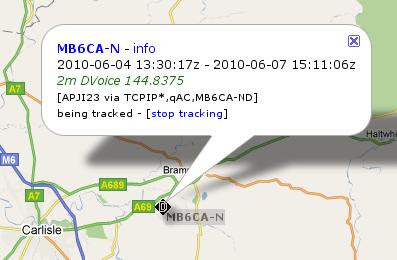
When I looked at the MB6CA coverage map I was reminded of a map I saw some years ago showing the spread of grey squirrels across the county. Overseas readers may not know that the grey squirrel is an illegal immigrant – from the US, no less – and it has been gradually wiping out our indigenous red squirrels, so that there are now only a few pockets of them left.
Will D-Star be the grey squirrel to analogue FM’s red, gradually increasing its territory as more and more people are persuaded to make the switch, until Icom ends up with a virtual monopoly over the VHF and UHF bands?

QRP on Echolink
My gardener XYL Olga has been waiting for rain as eagerly as I have been hoping for a Sporadic-E opening on 2m and today she got what she hoped for. As I was shack-bound I decided to hook the IC-910H up to the computer.
A few days ago I noticed to my amazement that the accessory connector on the IC-910H is exactly the same as the one on the FT-817. I could have simply used the interface I used with the ‘817, except that I had shortened the serial cable to make it the same length as the audio cables when used with a USB to serial adapter. My new PC has two real serial ports one of which was earmarked for exactly this purpose so I had to make up a new, longer cable before I could get started.
On the audio side I needed to use a USB audio “dongle” as the on-board sound card is used by the K3. I already use a Daffodil USB sound adapter for the computer audio. The dongle I used for the IC-910H is an even cheaper, more basic one than the Daffodil and I had purchased it to make an interface for my Echolink node. It appears to be satisfactory for that. Hopefully it will also be good enough for 1200baud APRS packet using the AGWPE sound card software as well. I doubt that it would be good enough for any kind of weak signal work like WSPR, as I observed a few weeks ago that the Daffodil adapter could not reproduce my recordings of weak CW bounced off the Moon from Arecibo. But I don’t plan on doing EME or even WSPR or PSK31 on VHF anyway.
I set up APRSIS32 with the AGWPE software so I will be able to run an APRS gateway again when not needing the VHF radio for any other purpose. This may be useful as there seems to be an increase in APRS activity in the area. As well as Colin 2E0XSD getting set up on RF I have tracked G1TGY driving around the area. I’m not sure if I have the audio levels correct as I haven’t heard any APRS to see if I can decode it and APRSIS32 doesn’t support transmit through AGWPE yet.
I also installed the Echolink software on the shack computer and set up my Echolink node / hotspot. This is a personal node operated under the remote control provisions of my license so it is a bit wasteful that I have to generate 5W or RF – the minimum the IC-910H will go down to – and then dissipate it all in a dummy load to stop it being heard outside my property boundary. However it is nice to have the node available again as my back is playing up a bit today and it enables me to do some ham radio from a reclining chair downstairs or even lying on the bed if I need to.
Whilst setting up Echolink I noticed a conference called *QRP* which I hadn’t seen before. I see that several QRP bloggers have been trying Echolink recently so perhaps we could use this conference for an occasional get-together? I’ll connect to *QRP* more often over the next few days to see what if anything goes on there.

888 miles using a hand-held
This afternoon 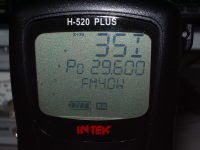 I made my first DX contact using a hand-held radio. It was a fine, warm day, so after lunch I left Olga doing things in the garden and went for a stroll with the H-520 10m FM radio. I took a footpath through fields to the north of the town that led up to the Carlisle road. It’s quite high up there, with great views down into the town and to the mountains beyond. However I was only carrying what would fit in my pockets, so the camera got left behind.
I used to take a 2m radio up there but I don’t think I ever made a contact so I lost interest. The other problem with that path is that you sometimes have to run the gauntlet of a herd of cattle. In the UK it’s illegal to put a bull into a field through which is a public right of way. However there is no such restriction on cows. They can be quite inquisitive, and there have been a few cases recently of people being knocked down and injured while walking through a field of cattle. It is quite frightening being followed across a field at less than the safe stopping distance by a couple of hundred tons of beefburgers in the making, as happened to Olga and I a couple of years ago. Shouting “horseradish sauce” at them has no effect at all!
Today, fortunately, the bovine creatures kept out of my way. I found a suitable operating spot, put the whip antenna on the Intek and started calling CQ. After a few minutes I had a call from Zdenek OK1AQW, coincidentally the same station that got away from me yesterday. Today he was strength 9 on the S meter, the same as Roger G0MWE had been from just a few miles away. We moved off the calling frequency and completed a solid 5 minute QSO, kept short only because Zdenek was receiving a lot of interference from other stations on the same frequency.
My report was initially 57, but was amended to 59 dropping to 51. At one point Zdenek informed me that I was coming over another British station that was calling on the frequency. He was running 100W to a quarter wave vertical and I think he was a bit surprised to hear I was running only 2.5W to a 140cm telescopic whip!
Incidentally it turns out OK1AQW doesn’t live near Prague at all as I wrote yesterday. His QRZ.com page is wrong. He is actually more than 100km east of Prague, about 10km from the Polish border, in locator JO80eb. I calculate that to be a distance of 888 miles or 1,430km. Not bad for a voice contact using a battery powered hand-held radio and whip antenna. Don’t you just love Sporadic E?
I didn’t manage any other contacts. I heard DO5DGH calling CQ repeatedly but he didn’t hear me. But this was a nice taste of what is possible. Some people might wonder why someone who owns nice radios like a K3 and even an FT-817 should put so much effort into trying to make contacts using a modified hand-held CB but I think to talk to someone direct using a battery powered self contained hand-held radio, without the aid of a satellite, a repeater or internet linking, is the ultimate challenge and far more exciting than anything I could achieve even if I had the full legal power, a tower and a beam!

Heard in Prague
I came a little closer to my objective of trying to make a DX contact using only a hand-held radio this afternoon. After dropping Olga off in town for a hair appointment I went up to my usual haunt Watch Hill accompanied my my 2m and 10m hand-helds. I had just stopped on the top when I heard Geoff G4WHA/P calling CQ WOTA from Kidsty Pike on the GP300 which was on my belt. He was a bit noisy as the radio only had the rubber duck on it so I foolishly decided to swap it for the 5/8 telescopic before calling him. Unfortunately in the minute or so it took to swap over the antennas I lost him and didn’t hear him call again.
 Colin 2E0XSD called me and we had a brief chat, then I made several other calls hoping to catch Geoff or anyone else who happened to be listening. After about five minutes Colin called again to say that he was hearing activity on 10m FM. I got out the Intek with the 4 foot whip and started listening around. I did hear some activity, including what sounded like a French station down in the noise on 29.600 who was not clearing the FM calling channel. I also heard what sounded like Russian on 29.620.
After numerous calls on 29.600 I heard a CQ from OK1AQW near Prague in the Czech Republic, loud and clear. I called him but he replied that I was too weak to copy. A couple of minutes later I started calling again and OK1AQW came back to me with my full callsign! I replied “OK1AQW this is G4ILO/P you are 55 in IO84 QSL?” but got no response from him. I repeated his report several times but heard nothing. I don’t know if a full 4W would have made a difference, but a couple of days ago I adjusted the full power level of the H-520 back to 2.5W to try to mitigate the problem of high current draw when the SWR is less than perfect. So that was a gotaway, unfortunately.
I didn’t hear any more DX on 10m, but I did have a QSO with Roger G0MWE from Dearham who was using a new FT-897D and pleased to hear some activity on 10m. Roger suggested I should use a better antenna which would certainly be possible to erect up there but that would defeat the object of using the hand-held. But I’m sure with perseverance I will eventually achieve my objective.














