Author Archive
 VX-8GR battery drain fault
 June 25th, 2010 |
  Author:
 This afternoon I was making some measurements to try to determine the current consumption of the VX-8G (and hence estimate the battery life) and I stumbled across a rather serious flaw. When the internal GPS is enabled it remains powered all the time, even when the radio is switched off. Enabling the GPS causes the current consumption to increase by about 30mA, and that same increase is noticeable in the current drawn when the radio is powered from the external DC socket, whether or not it is charging. This level of current drain would flatten the 1100mAH battery pack in less than two days!
I joined the Yahoo VX-8R group, which is the discussion group for the VX-8G as well, and noticed that some American purchasers of the radio had already discovered this problem. I hadn’t had the radio go flat on the shelf myself, mainly because in the three days since I got it I have been using it quite a lot. But my observation does help to explain why I found the battery life was poor. Like most people I suspect I have been charging it up after an outing and then taking it out of the charger in the expectation that it would still be fully charged the next time I used it. But with 30mA being taken from the battery all the time, even a 12 hour period off-charge would result in a significant loss of operating time.
The VX-8G isn’t yet available in the UK so there is not much point in contacting Yaesu UK for their comments on this issue. It’s possible that when the European VX-8GE version arrives Yaesu will have identified the problem and fixed it. If I was reading this and thinking about getting a VX-8G I’d certainly want to receive an assurance that the fault had been fixed before buying one. And if I’d bought this from a UK dealer I would probably be taking it back. So this is really an example of where buying from Hong Kong hasn’t paid off, even though the problem isn’t the fault of the dealer who sold the radio.
The workarounds would appear to be either to turn the GPS power off from the menu whenever you switch the radio off – a real hassle which will probably result in the GPS taking minutes to get a fix each time it is switched on – or else to leave it on charge all the time. The latter would seem to be the least painful.
It is a pretty annoying fault to be stuck with. I had been thinking about getting the high capacity battery pack but having found this problem I don’t think the VX-8GR will be a keeper. I shall look with renewed interest at the Kenwood TH-D72 APRS handheld when it becomes available, though I shall probably lose a lot on the exchange – giving publicity to this fault isn’t exactly going to help the VX-8GR’s resale value. 🙁

Deaf by design
 I’ve never been a fan of Apple products. I have always felt that Apple was a brand aimed at fashionistas concerned more with style and the coolness associated with owning a particular product than with practicality. So for example phones were made with non user-replaceable batteries in order to make them very slim.
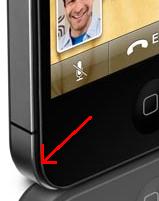
Now it appears Apple’s engineers have made another slip-up in the name of style. Users of the new iPhone 4 are reporting that they lose the signal whenever they hold the phone. Apparently a section of the stainless steel band that runs around the phone is used as the antenna, and the part that radiates is on the lower left hand side – nicely surrounded by the fleshy palm of your hand if you hold the phone in your left hand.
It seems to be that Apple could do with a radio ham on its design team. Even the newest Foundation licensee – in fact even a CBer – could have told them that antennas are supposed to point upwards.

Bouncing off the ISS
There was recently a change of crew at the International Space Station and one result of that has been the reappearance after a long absence of the packet radio digipeater on 145.825MHz. When the Space Station passes over you can receive some very strong signals from it. I have decoded APRS beacons on a VX-8 handheld standing on a window sill inside the shack. But it is even better to use the main station, then you can see the positions of the stations you received on a map.
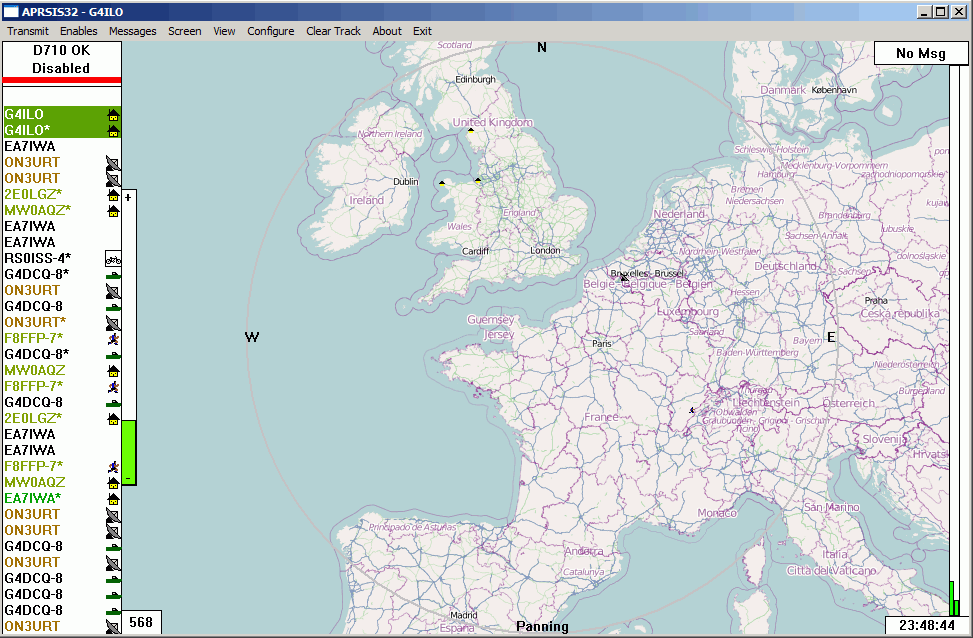 When using the ISS you need to use different settings to what you would use for terrestrial APRS. Digipeating, if enabled, must be turned off. You want to be connected to APRS-IS so you can gate received packets to the internet, but you don’t want to send anything received from the internet out to the ISS. You probably don’t want to display data from the internet on the map, to leave it clear to show those stations received by the radio. If you want to transmit through the ISS yourself you must also change the APRS path to “ARISS”.
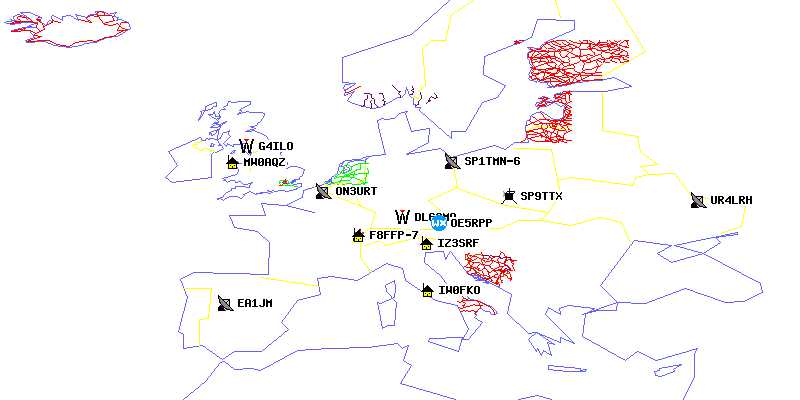
After thinking that we really need an ISS option in APRSISCE/32 for this it occurred to me that all I needed to do was make a copy of the program in a new folder, then I could change the settings however I wanted without affecting the copy I use for terrestrial APRS. It worked fine. It was fun to see the stations heard via the satellite show up on the map, although when the map is zoomed out to cover such a large area the icons are hard to see. It was also amusing to see that the icon for the ISS’s own beacon was a bicycle. Perhaps someone should tell NASA!
After several abortive attempts to get my own beacon digipeated by the Space Station I set the transceiver to Narrow FM and got through on the first attempt using just 10W to my 300ohm ribbon cable Slim Jim in the attic. The proof is in the map of stations heard through the ISS at ariss.net.
 Not a very useful activity perhaps, but fun to try.

Yaesu VX-8G
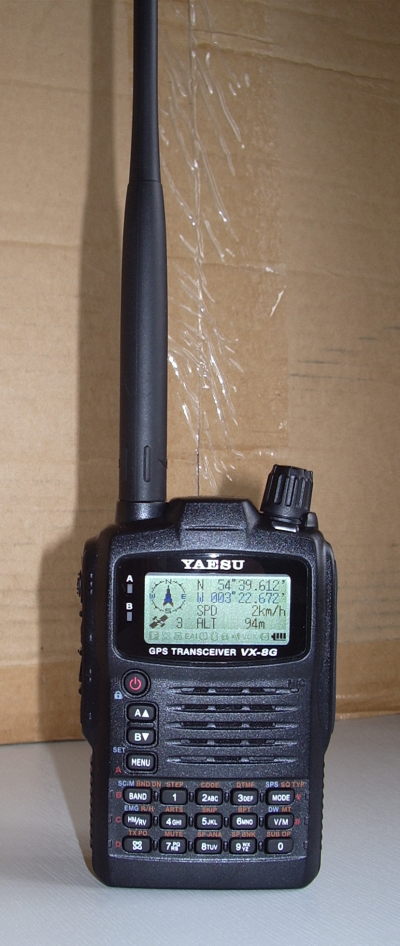 A recent addition to the G4ILO shack is a new Yaesu VX-8G hand held transceiver. In case you are thinking that I need professional help over my addiction to hand held radios you may be right – however a week or so ago I received an email from someone who has a collection of 150!
Long-time followers of my blog may recall that less than a year ago I bought a Yaesu VX-8E APRS transceiver with GPS. However I found that the usefulness of APRS was limited by the lack of digipeaters and internet gateways in this part of the world. I decided to use a smartphone based APRS client, APRSISCE instead and sold the VX-8E shortly afterwards.
Using the cellular network instead of amateur radio has its advantages but it eliminates the interest of seeing how far a little 2m RF can go. Interest in APRS has increased in this area over the last few months so I decided to give RF another go. In the meantime, Yaesu brought out an improved version of the original VX-8R called the VX-8DR and a lower cost version called the VX-8G. So I didn’t regret my decision to sell the VX-8R as it allowed me to acquire the updated version.
One of the things I really disliked about the VX-8R was the clunky way the GPS attached externally to the radio (and the absurdly expensive fixing bracket.) The VX-8R (and the updated DR) has a number of other features that I never used and didn’t need in an HT: 50MHz coverage (including AM), short wave receive (which was useless anyway without an external wire antenna), a barometer/altimeter and a temperature sensor. Nor did I care that it was submersible. I did lose a brand new HT in the Solway several years ago, but as I didn’t immediately notice it had fallen off my belt I never found it again.
The VX-8G lacks these unwanted features and can be set to vibrate when you receive an APRS text message – a new way to get a thrill out of amateur radio! More importantly it has the GPS built into the radio which makes for a much neater package. It costs about the same as a VX-8DR without the GPS option.
The VX-8G is not available yet in the UK so I purchased it from Solid Radio, an eBay trader based in Hong Kong. This was the most expensive thing I have ever bought from a Far Eastern trader and I felt like I was taking a bit of a gamble, but the radio arrived in just over a week and with no unpleasant surprise on delivery.
The VX-8G looks very similar to its older brother but is a little slimmer and lighter. I seem to remember that the body of the VX-8R was metal, or else it had a substantial chassis that added to the weight. With the standard battery installed the VX-8G is noticeably lighter than my Kenwood TH-F7E.
The Yaesu’s GPS takes much longer than the one in my hTC smartphone to acquire a signal. In fact after waiting several minutes on first turning on the radio I started to worry that the GPS wasn’t working so I stood it out in the garden on a table where it eventually established its position. On subsequent occasions it has still taken a few minutes to fix its position which is a bit annoying.
Operationally the radio appears to be the same as the VX-8R and the menus are very similar. One of the new features is SmartBeaconing which varies the frequency of position reports according to your speed and whether you have changed direction. There are different settings for this depending on whether you are walking, cycling or driving. The original model would only send position reports on a fixed time interval. Once I had enabled SmartBeaconing it sent a very accurate track of my walk.
It is too early to say with any precision what battery life is like but initial impressions are that with the GPS enabled it is pretty poor – a criticism that unfortunately is also true of the smartphone. I used to have a navigational GPS called an iFinder GO2 which ran for about 18 hours on two AA batteries so low current consumption GPS devices do exist – why doesn’t Yaesu use them? In the VX-8 radios when you use APRS the problem of short battery life is compounded by the need to disable the power saver (which causes the receiver to listen in short bursts rather than all the time) so you don’t miss the start of a beacon or message sent by another station. The VX-8G uses the same batteries as the VX-8R and DR models so a higher capacity pack available, but it is quite expensive.
I am pleased with the VX-8G so far and am looking forward to discovering where I can be tracked from. I think APRS holds some of the same fascination as WSPR on the HF bands in that it is interesting and sometimes surprising to see how far your low powered signals can travel.
I don’t know when the VX-8G will be introduced in the UK or what its UK retail price will be but I expect it will still be quite an expensive radio. A pity, as I think the cost puts a lot of people off discovering APRS for themselves.

Unsquelched
I did a quick lash-up of the UHF FM transmitter module I received a few days ago which I was planning to use in a low-power Echolink node, mainly just to see if it worked. It did, but I discovered a small snag. The audio output isn’t squelched.
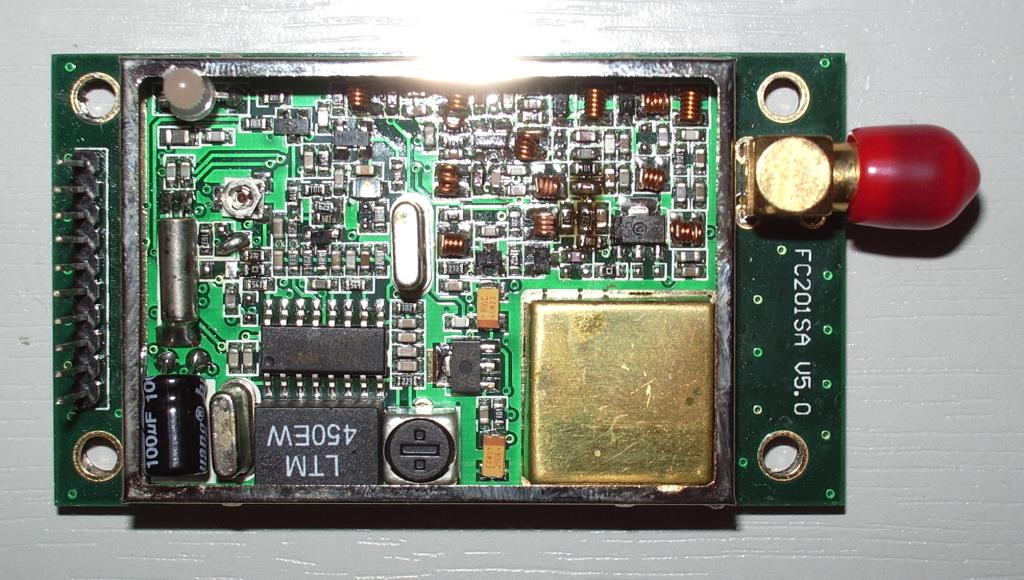 The Echolink software requires either normal squelched FM audio or a carrier operated squelch signal on one of the serial port control lines. As neither of those is provided I guess I am going to need to generate a squelch signal derived from noise. But as I am not knowledgeable enough about electronics to design my own circuit I am going to have to find one first. This appears easier said than done, though there seem to be a surprising number of patents on the subject.
It isn’t an urgent problem as I’m not in any hurry to build this project. I’ll probably have more enthusiasm for it once the gloomy autumn weather starts.

Making a mistake, rapidly
Someone commented in the eHam ratings for my blog that I spent too much time complaining about retailers. I’m sorry about that, I only tell it how it is, but it appears that no-one in this country is capable of doing their job properly. Perhaps the government’s policy of sending 50% of people to university means that most people are over-qualified for the job they do and are too bored by it to actually think about what they were doing.
Phase 2 of my shack renovation was completed earlier this week. It should have been finished a couple of weeks ago. Olga designed and ordered a system of wall units including shelves, cupboards and a bureau with a door that drops down to form a working surface. This bureau is to be my workbench – now I can start something and when I have done enough for one day I can just close the door on it so everything stays looking tidy.
The consignment arrived consisting of all 11 boxes as marked on the shipping labels. However as we started to assemble it we found that a few bits, including the entire bureau, were missing. On contacting the retailer they were sure that 12 boxes had been sent, but the bureau was never discovered and they had to order a new one from Sweden – hence the delay.
My workbench is now separate from my operating area so I can no longer use the Diamond power supply that powers my radios to power my projects. So I needed a variable power supply for the workbench. Yesterday I was pleased to win in an eBay auction a refurbished variable power supply from Rapid Electronics for about half what a new one would have cost. The courier delivered a large parcel this morning which was labelled with my address, but when I opened it I found four retractable mains cable extensions that had been ordered by Workington Sixth Form College, together with their invoice. So now I have to wait in while Rapid arranges for its courier to collect the mains extensions. Whether I will ever see the power supply, or whether it will just vanish like our original bureau, remains to be seen.
I’m sure some readers must be thinking “take a chill pill, mistakes happen.” But mistakes seem to happen rather too often, if you ask me. If you were in the mail order business, wouldn’t you put systems in place to ensure mistakes like this don’t happen, because they annoy your customers and cost money to rectify? Rapid Electronics “operates a Quality Management System to BS EN ISO 9001:2008.” What a load of spherical objects that is.
While on the subject of retailers, last week I sent an email to a company that advertises notebook PCs with Linux installed, asking for a quote for a system for my business. I have not received a reply. Why does that not surprise me?

One Foot in the Grave
This blog is meant to be about my hobby, amateur radio. Occasionally I have given in to the temptation to blog about some other event that has affected me, or let off steam about some topic that has annoyed me. But as I discovered a few months ago when a couple of the American ham radio blogs I read decided to vent about Obama, health care and other issues that Americans care deeply about, it can be very disconcerting to encounter far off-topic subject matter in a specialist blog, especially if the opinions expressed are ones with which you profoundly disagree. So in recent months I have tried to resist the temptation of controversial posts.
Sometimes I still get the urge to write about these topics, though. So to satisfy that urge I have started a new blog. Its title is One Foot in the Grave; the subtitle is Ramblings of a real-life Victor Meldrew. British readers who have seen the BBC comedy series of the same name will know what to expect from this. Readers from other parts of the world will have to see for themselves, though perhaps much of what I will be writing about won’t be of much interest to them anyway since it is going to be mostly about the trials and tribulations of life in the UK.
Nevertheless I hope that a few of you may find it worth following One Foot in the Grave and even telling other people about it.














