Author Archive
 Changes to 2m gear
 December 22nd, 2010 |
  Author:
 I have had a bit of a change round in the shack recently. Since getting the Kenwood TM-D710 which is used for 2m FM which is the vast majority of my VHF activity, the Icom IC-910H has really been under-utilized. 70cm is a dead band here and there isn’t too much 2m SSB activity. Besides, I never really liked the Icom. So I decided to swap it for an old Spectrum Communications transverter that I have and sell it in the new year.
The Kenwood has been moved into the “second rig” operating position. And the desk mic I used with the Icom is now attached to the Kenwood. I had some CAT5 UTP network cables which are terminated in the same type of plug Kenwood uses for a mic connector, so I cut one in half and made up a cable for the desk mic. Despite being unshielded (UTP stands for Unshielded Twisted Pair) there doesn’t seem to be any RFI even at 50W. And the reports I have had so far suggest that it sounds good.
The Spectrum transverter runs about 20W output. This is less than I would like for SSB. My plan was to set the transverter drive so the peak output was 5W and use it to drive a 50W linear amp that I have. But when I set the power to 5W, as soon as I put the cover on the case it dropped to 1.5W. So I thought that perhaps the whole thing needs realignment.
Unfortunately it did not go well. The transverter, which I bought umpteenth-hand in a private sale some time ago, had obviously suffered the depredations of the ham-fisted twiddler. Two of the ferrite tuning cores in the Toko coils were cracked and could neither be adjusted nor removed so they could be replaced. Despite this, the transverter receives pretty well.
However, while trying to realign the transmit side to solve the problem of changing power output when the case cover goes on, I noticed that there was often power out when the key was up. There was clearly some instability present. Although I could adjust the trimmers so there was no unwanted output, I could not eliminate the changing output as the case cover is put on. I do not have the test equipment (a spectrum analyzer) to be sure that the output is clean and I started to have doubts about the whole thing.
I did not want to risk wiping out the neighbour’s TV reception whenever I use 2m SSB. So I decided to scrap the transverter and order an XV144 internal transverter module for my K3. It is on its way, and hopefully will arrive in the UK before the increase in VAT takes effect.

Earthquake in Cumbria
I started up my APRS gateway this morning and noticed an unusual symbol on the screen. I clicked on it and discovered that WE7U had posted an object to mark the epicentre of a minor earthquake measuring 3.6 on the Richter scale that occurred about 20 miles to the south of here at around 2300z last night.
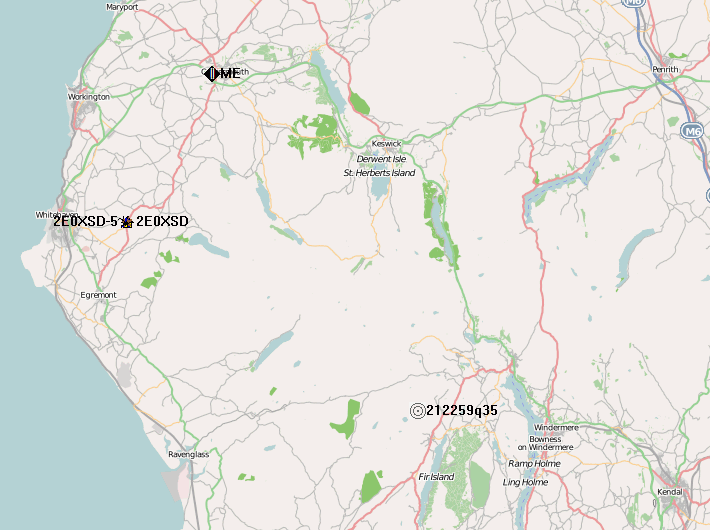
It was felt in nearby Workington and even across the water in Dumfries and Galloway with some people describing it as “scary”. We were completely unaware of it. But now I know what happened, I recall that just after we had gone to bed I heard a noise from the attic like someone was up there and stood heavily on the rafters. I said to Olga “did you hear that?” and she said she thought it was a heavy vehicle passing on the A66. So that was how the earth moved for us.

Frequency check
In all the years I have been a ham and home constructor one item of test equipment I have never possessed is a frequency counter. Whenever I have needed to test if something is oscillating I have just stuck a bit of wire in the antenna socket of a receiver and listened for it, and if I have needed to tune an oscillator on frequency I have just tuned it for zero beat using a receiver that has been adjusted as best I could using WWV or similar.
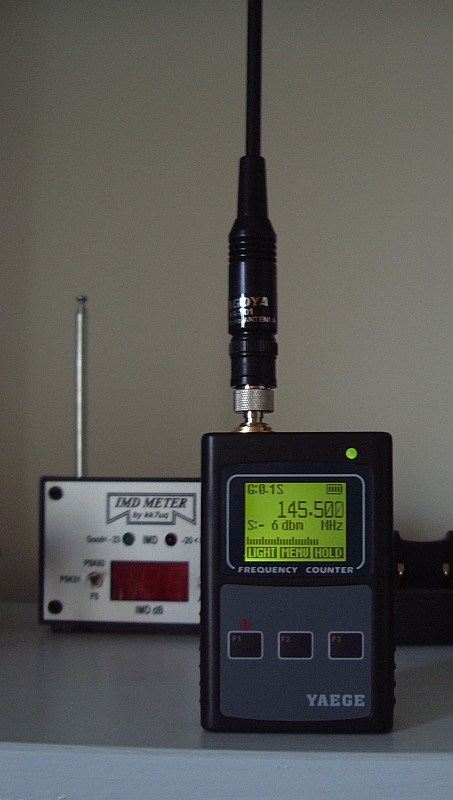
Recently I decided that it would be useful to actually have a frequency counter, preferably a really accurate one. I know that it is possible to buy secondhand lab grade frequency counters on eBay. The trouble is that when your shack / workshop is the size of a broom cupboard there is no room for boat anchors. I didn’t even have space for one of the inexpensive desktop frequency counters that are available. I decided that I would have to make do with a hand-held device. Farnell had one, but the price of £140 was rather too steep given the amount of use it was likely to get. I was about to give up when I came across the Yaege FC-1 being sold for about £30 on eBay.
My initial thought was that this was such a cheap device that it could not be very accurate and was probably not worth getting. The specification gives the time base accuracy as < 5ppm, which is worse than most ham radio transceivers. However, a bit of searching produced a PDF copy of the manual, which revealed that the TCXO module is user adjustable. I figured that I could get better than the quoted accuracy by regularly calibrating it using my rubidium frequency standard.

I ordered one from one of the Hong Kong traders and it came in just over a week. The antenna socket is a male SMA, similar to that used on the Chinese VHF/UHF hand-held radios and the opposite type to that commonly used by Japanese manufacturers. A short UHF rubber duck antenna is supplied with the counter. I ordered a BNC adapter so I could use my BNC whip antennas and also attach BNC terminated test cables.
I connected it up to my 10MHz rubidium frequency standard and found that it was already within a couple of Hz of the correct reading. The picture was taken before I set the gate time to 1 second which is necessary to get a reading down to 1Hz.
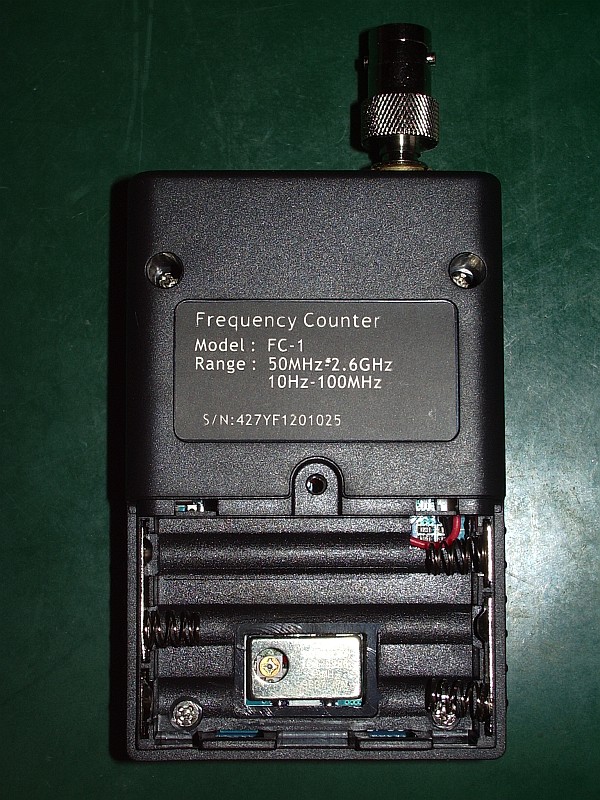 The time base oscillator adjustment is behind the battery compartment so you need to run the device from the charger while adjusting the frequency. You can see the adjuster in the picture on the right. Rather like adjusting the master oscillator in the Elecraft K2 the adjustment is incredibly touchy. The tiniest amount of movement can change the reading by a couple of Hz at 10MHz.
It turns out that it is not worth being so picky. The reading does slowly drift by a few Hz over a period of several minutes so you are never going to get absolute accuracy with a device like this. Nevertheless it is better than advertised and pretty good for the money, in my opinion.
One feature of the Yaege FC-1 that you don’t get with most frequency counters is a signal strength reading calibrated in dBm, as you can see in the top photo taken while I was transmitting a carrier on 145.500MHz. I wasn’t able to check how accurate the actual reading is but as a relative indicator the dB measurements seem quite accurate so this could be quite a useful tool for making antenna comparisons. It turns the frequency counter into a digital field strength meter.
Although it isn’t a lab grade high accuracy frequency counter I think the Yaege FC-1 is a useful addition to my electronic test equipment and is extremely good value for money.

Useful RFI
I apologize for being even more grumpy than normal but I haven’t had much sleep. Olga and I were woken up at around 1 in the morning by a lot of noise outside. It was a group of young people who had apparently been having a party in the house opposite. Despite the fact that the temperature was heading for -7C and the girls, according to Olga who was looking out of the window, were none too warmly clad, they were not simply saying goodbye but continuing an animated conversation. Someone decided the party must be carrying on outside so they switched on a car’s headlamps and turned on the stereo very loud. Because of the way the houses are crammed together here with virtually no front gardens this was taking place right below our bedroom window. After ten minutes we were both getting very angry. It isn’t often that Olga uses the f word about people.
I felt like calling the police, but the chances of them actually making an appearance before the miscreants had slept off their hangovers was pretty remote so we discarded that idea. Olga went downstairs and turned on the lights to try and make it obvious that we had been disturbed. I went into the shack, switched on the K2 and sent a 10W dit on 30m, which switched on the security lights of the nearby neighbours that have them. This did appear to have the effect of making the tiny minds think “gosh, other people live around here and oh my, it’s after 1 in the morning, perhaps they are trying to sleep and our noise has disturbed them!” because shortly afterwards the group dispersed and peace and quiet resumed. But neither of us are good sleepers and it took a while before we calmed down enough to sleep again. Hence the foul mood this morning.
It has sometimes been a bit annoying that I can’t go on any band except 80m after dark because of the problem with security lights. But on this occasion it turned out to be useful. If only I knew that the thoughtless young people had touch sensitive lamps by their bedside I might even have been tempted to try a bit of all-night WSPR!

An APRS Gateway
Yesterday I spent a couple of hours trying out aprsg – an APRS iGate that runs on both Linux and Windows which has been developed by Tapio, OH2GVE and Antti, OH3HMI and released under the GNU GPL.
The program has no user interface. Under Windows it displays a G icon in the system tray. All configuration is done by editing an INI file, in examples of which all the documentation is contained! Despite its relative simplicity there are a few unanswered questions about how things work, so some trial and error is necessary.
The unique feature of aprsg – as far as I know – is that it lets you specify filters to control what is gated from the internet to RF. You can gate packets addressed to specific callsigns or callsign blocks (using a mask) and this can be ANDed or ORed with area based filters (either a box or a circle centered on a point.) It was wonderful in this relative APRS desert to see local stations and objects appearing on RF and being displayed on my TH-D72 and VX-8GR. It was like being back in Prague again! This is not something you would want to do in an area where there is other APRS activity but for someone who lives out of range of any digipeater or gateway aprsg could make APRS usable and fun.
The program supports multiple RF ports and can do cross-band gating using the same rules. I didn’t try this, and did not understand how to set different call-ssids to the different RF ports. It appeared to me that the gateway and everything connected to it uses the same call-ssid, though this may be my misunderstanding.
A significant limitation is that aprsg only supports KISS TNCs (and AX.25 on Linux) but does not provide any way to send a script to TNCs that need a couple of commands to get them into KISS mode. It doesn’t support AGW Packet Engine, but those who don’t have TNCs might be able to connect it to a TrueTTY virtual TNC for sound card operation.
Aprsg provides no support for digipeating – a pity, the possibility of filter-based digipeating would be most interesting. It also doesn’t provide a local APRS-IS server for users to connect graphical APRS clients like APRSISCE/32. So you would need to connect your GUI client separately to APRS-IS using a different call-ssid to your gateway.
These limitations apart, aprsg is a potentially useful program for anyone wanting to set up an APRS internet gateway. It’s quite easy to get going and has a very low resource usage.

Work FM Satellites
I came across this website while reading a thread about the new Kenwood TH-D72. It claims to be the best website for current information about working FM satellites. It looks pretty good, but I really need to find the time to look through all the information. There’s a blog, too.
The trouble with this hobby is that there is so little time and so many interesting, challenging things you can do!

APRS Handies head to head
My long awaited package from Martin Lynch was finally delivered by UPS on Saturday afternoon and as one reader correctly guessed, it was a new Kenwood TH-D72! I was lucky. The UPS tracking page had been changed to say delivery was rescheduled for Monday, so we went out on Saturday morning. You can imagine how happy I would have been to get home and find a card through the door to say UPS had tried to deliver it! I was pleased to receive the radio and although I did consider wrapping it and putting it under the tree until Christmas Day, the chance of being the first blogger to write about it was too great to resist.
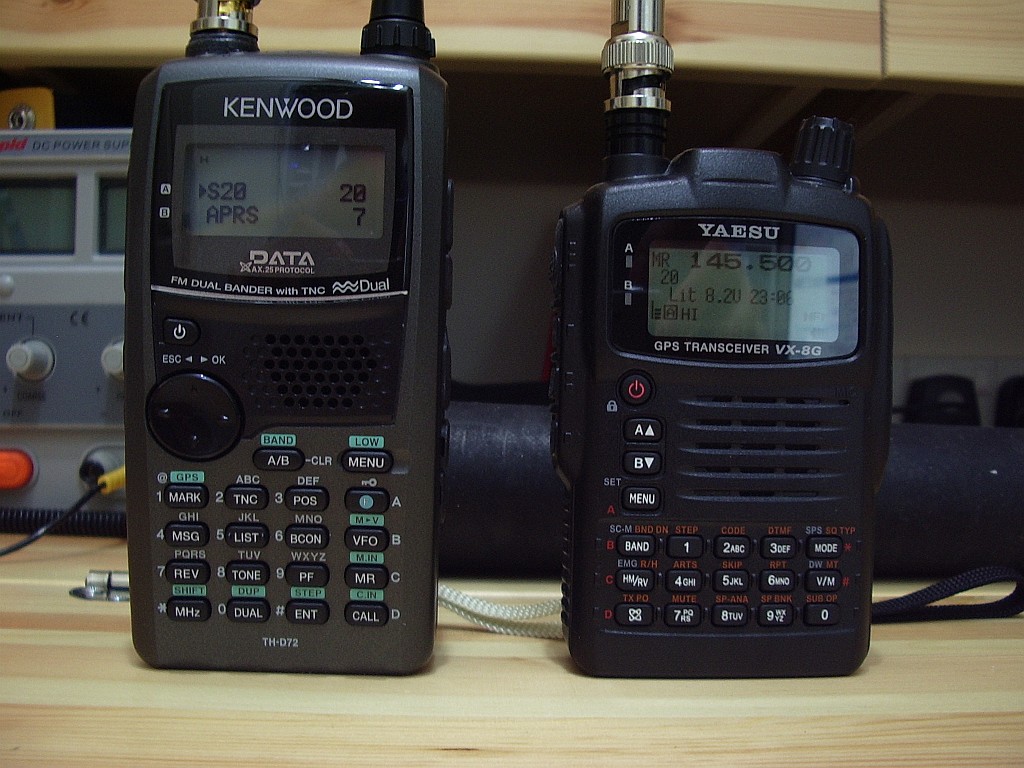
This is not meant to be a review of the Kenwood, more an account of my first impressions of the radio and how it compares with the Yaesu VX-8GR which I have been using for the past few months. The first thing you notice is that the Kenwood is quite a bit bigger than the Yaesu. It’s taller, thicker and heavier. Although I think the Kenwood is nicer looking, the Yaesu feels a bit more rugged and I think its plain black finish would take knocks and scuffs better than the Kenwood’s metallic grey finish. I’ll probably need to get a protective case for it.

The additional thickness and weight can partly be attributed to the Kenwood’s battery pack which has 1800mAh capacity, compared to the Yaesu’s 1100mAh. This should translate into longer endurance in the field. Yaesu does offer an 1800mAh battery pack for the VX-8 series but it is an optional extra for quite a lot more money. Still, there is no question the slimmer, smaller VX-8GR slips more easily into a pocket for about-town use.
The TH-D72 is a dual band 2m/70cm radio so it it is more directly comparable with the Yaesu VX-8GR than with the tri-band (quad band in the USA) VX-8DR. Both radios have an integral GPS rather than the expensive optional GPS of the VX-8DR which must be fitted to an even more absurdly expensive clunky looking bracket or to a specially made Yaesu speaker mic. (Having said that, the Yaesu GPS options are good value compared to the add-ons for Icom’s D-Star radios – talk about rip-offs.)
The TH-D72 comes with the usual pathetic SMA socket for the antenna and an equally pathetic dual band dummy load, er, I mean whip antenna. The first thing I did, and I mean literally the first thing, was to fit one of my SMA to BNC adapters so I can use any of my collection of BNC whip antennas with the rig. The SMA socket sits deep in a large recess on the top face of the Kenwood, so I was able to use one of the chunky gold plated adapters rather than the slimmer black one that I use on the VX-8GR.
I checked with a piece of paper to see if the adapter tightened all the way down to the body of the radio, which is essential to avoid the risk of snapping the SMA at the first accidental knock. It didn’t, so I added a steel washer to fill the gap. I covered the knurled base of the adapter with a layer of self amalgamating tape to hide the gold finish and once an antenna is fitted you wouldn’t know that the BNC socket was not standard equipment. Why couldn’t the manufacturers fit one in the first place? By the way, neither of these radios come with a wrist strap – the ones shown in the picture were salvaged from old mobile phones in the junk box.

One of the main reasons I decided to get the Kenwood TH-D72 even though I had the VX-8GR was that I was very unhappy with the performance of the Yaesu’s GPS which is slow to acquire a fix and usually can’t manage it at all from inside the house. I found this a real nuisance as often I just could not be bothered to hang around waiting for it, while the chance of acquiring a fix once you are on the move is even worse. As you can see from the picture above, the Kenwood has got my position while sitting on the bench being photographed while the Yaesu’s GPS screen was (and remained) blank.

The Kenwood has a display to show how many GPS satellites it is receiving and as you can see from the picture above, even on the bench it does quite well. This is a nice screen to have, but with this exception I prefer the Yaesu VX-8 display which shows more information at a glance. The Kenwood display often consists of a couple of short lines of text and you have to page through several screens to get all the information. However I do like that the Kenwood position screen shows the grid locator square – the Yaesu doesn’t.
The TH-D72 has the ability to plot your track and store it in memory – not something I can see myself using though. What I do consider very useful is the ability to enter and store the co-ordinates of several locations or waypoints. You can then select one and one of the Position pages will display your distance and bearing from it. This will be very useful during WOTA operating as I will be able to enter the exact co-ordinates of the summits I intend to visit, eliminating the difficulty sometimes experienced of identifying the summit on the ground!
The TH-D72 is virtually a hand held TM-D710. It has almost the same functionality of its bigger mobile brother, in fact more: it supports the Kenwood Sky Command remote control system which my European D710 doesn’t. A pity – it would have been fun to see if I could have used it to remote control my Elecraft K3, which uses a command set similar to the TS2000.
In common with the D710 the D72 has hierarchical menus. Personally I prefer the menu system of the VX-8 series, which has just two linear menus, one for radio settings and one for APRS. I know where the ones I most often use are and can quickly zip to them using the rotary control. The Kenwood menus require a lot of clicking with the four way directional button thingy.
If you want to connect your VX-8 to a PC for memory management you need to purchase third party memory management software and an interface cable. Kenwood provides the memory management software free and the TH-D72 has a USB port which can be connected to your computer using a provided, but in any case standard, USB cable – a significant saving. Through this cable you can not only manage the memories you can also edit all the radio’s settings and access the built-in packet TNC. This appears to be completely compatible with the one in the TM-D710. I just changed the COM port number and APRSIS32 as set up for the D710 was immediately able to use the D72 instead. A menu option allows the internal GPS data to be output over the same serial connection. I haven’t experimented with this, so I don’t know if this can be done at the same time as accessing the TNC or whether APRSIS32 would be able to take advantage of it.
Hopefully the TH-D72 will, like the D710 (and unlike the Yaesu radios) be software upgradeable. I discovered, to my disappointment, that my APRS repeater objects being transmitted by my G4ILO gateway were displayed by the VX-8GR but not by the Kenwood. The packets were received but were apparently considered to be invalid. A bit of research by Kai Gunter, LA3QMA led to the conclusion that this is a bug, not just in the TH-D72 firmware but in the TM-D710 as well, as the same objects were displayed by older model Kenwoods. The problem is apparently caused by the time-stamp in the objects created by APRSIS32 which is in local time (ending in ‘h’) instead of zulu time (ending in ‘z’.) The objects are correct according to the APRS spec, so the Kenwood should display them.
The TH-D72 is full duplex. That is, it can receive on 70cm while transmitting on 2m or vice versa. There are very few current model radios that can do this, one of which (the Alinco DJ-G7) doesn’t do it very well as 70cm is severely desensed by the 2m transmission. This would make it a good choice for FM satellite operation allowing you to hear your own signal. One of these days I will try this, I just need to get round to making a suitable dual band antenna.
Another neat feature of the TH-D72 is the nine EchoLink memories. This allows the radio to store the DTMF sequence needed to connect to up to nine different conferences or nodes so you can recall them by name and transmit them to your local EchoLink repeater. If you use EchoLink it is a real boon as I can never remember node numbers – heck, I still can’t remember my mobile phone number!
The Kenwood TH-D72 is quite an amazing radio packing an incredible number of features into its small form factor. However I would not go so far as to say it is a better radio than the VX-8GR. There are things I like and things I dislike about each of them.
- Yaesu VX-8GR – Like: smaller size, lighter weight, feels more durable, more informative displays. Dislike: deaf GPS.
- Kenwood TH-D72 – Like: sensitive GPS, editable waypoints, accessible TNC, EchoLink support, full duplex. Dislike: hierarchical menus, plain displays requiring scrolling through pages to view all information, more bulky.
In the UK, the VX-8GR is being sold for quite a bit less than the TH-D72, even at the discounted price I got from Martin Lynch. If you don’t want to connect the radio to APRS software on a PC, aren’t bothered about getting your GPS position indoors and never use EchoLink then you probably won’t think the Kenwood is worth the extra money. Though it does include a higher capacity battery as standard and if you want memory management software then both this and the connecting cable will cost you extra for the Yaesu.
I’m still making my mind up which of the two of them is going to be the keeper but I suspect it’s going to be the Kenwood.














