Author Archive
 No charge
 May 22nd, 2011 |
  Author:
 The object on the left of the picture is a 9600mAh external back-up battery for MP3 players, mobile phones and other 5V devices. I bought it on eBay (where else?) for $55.99 including shipping with the intention of using it to power my HTC Touch Pro smartphone so that it could run all day using GPS and internet connected apps like the APRS client APRSISCE. Previously I hadn’t been able to make much use of such applications when out and about on foot because if I was away from a power supply for more than a couple of hours the end result was a dead battery and a phone that could not be used to make phone calls.

The product arrived after a couple of weeks wait rather poorly packed in a jiffy bag containing the battery back-up unit, a 5V USB charger with the usual two-prong fold-out mains plug, and a USB cable with coiled lead and interchangeable power connectors. There was no box, nor any instructions so I had to figure things out for myself. Clearly the DC IN port was meant for the charger, the USB socket marked DC OUT was the output and the slide switch next to it turned the output on and off. The four LEDs showed the battery state for a few seconds after the POWER button to the left of it was pressed, and the charging state whilst charging.
There was no cable for charging, so I presumed I had to use the USB lead supplied for output and one of the interchangeable connectors. One of them did fit, though not very well, poorly enough in fact that it pulled out of the socket if there was the slightest tension on the coiled cable.
I started charging the power pack. Two lights lit up on the charger and the charge status showed two of the four LEDs lit. Next time I looked at it all the LEDs were off. Surely the batteries could not have charged so quickly? Eventually I measured the output from the charger and found it was about 0.25V. Clearly the charger had failed.
I sent an email to the eBay seller who was anxious enough about the possibility of receiving negative feedback to immediately promise to send a replacement. Meanwhile I found that the charger which came with my HTC phone had a USB output so I charged the battery pack with that. With hindsight that was rather foolhardy and I ought to have attempted to measure the current drawn first, but I got away with it. Though rated at 1.0 Amp output the HTC charger got fairly warm, but eventually the charge level reached full and the charger got cold again so I assume that it finished charging and the pack was fully charged.
The charger that came with the battery pack is labelled as an “MP3 Power Supply” and the output is rated at: DC 200mA +/- 30mA. Even the 1500mAh battery in the little Baofeng radio takes more than 400mA on charge. I managed to find a cable that would enable me to charge the battery pack from my workbench variable metered power supply and even when the battery pack is only half discharged it is drawing a current of almost 800mA. So I think the charger supplied simply blew up! I’m just hoping the eBay seller will provide a more adequate charger as a replacement. Sure, I can use my existing HTC phone charger. It may even be more convenient than having separate chargers for the two devices. But it would be nice to receive what one paid for.
By the way, if you ever wondered what is inside those Chinese wall-wart power supplies, how come they are so light, here are some pictures of the innards of the one that failed.
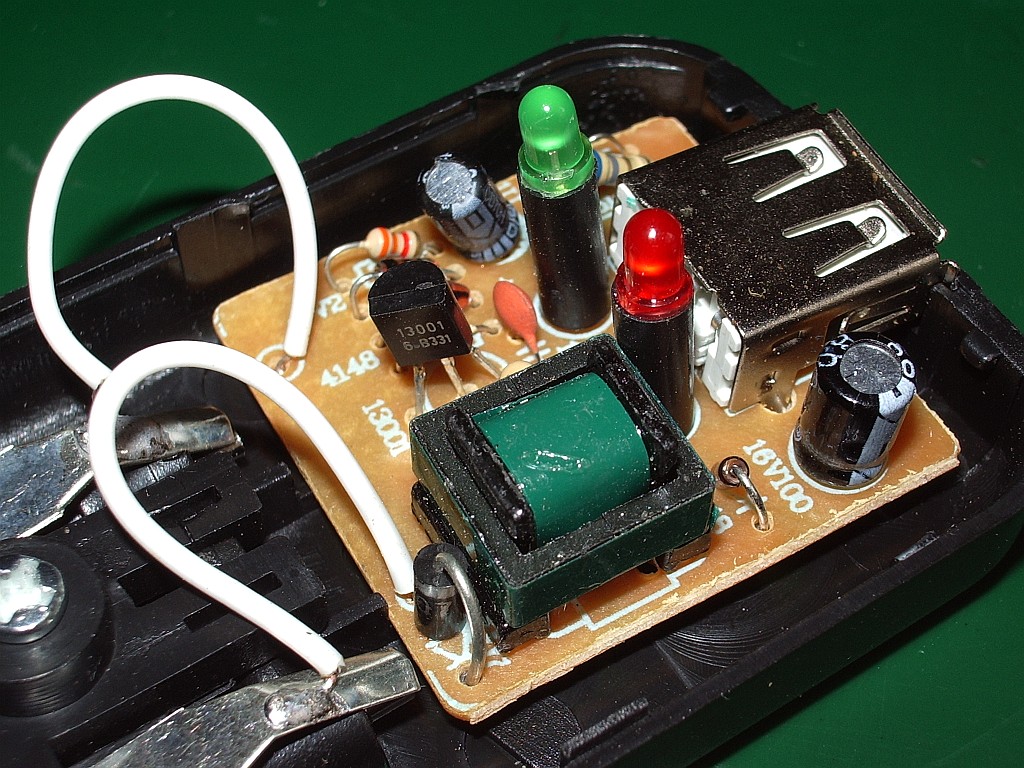
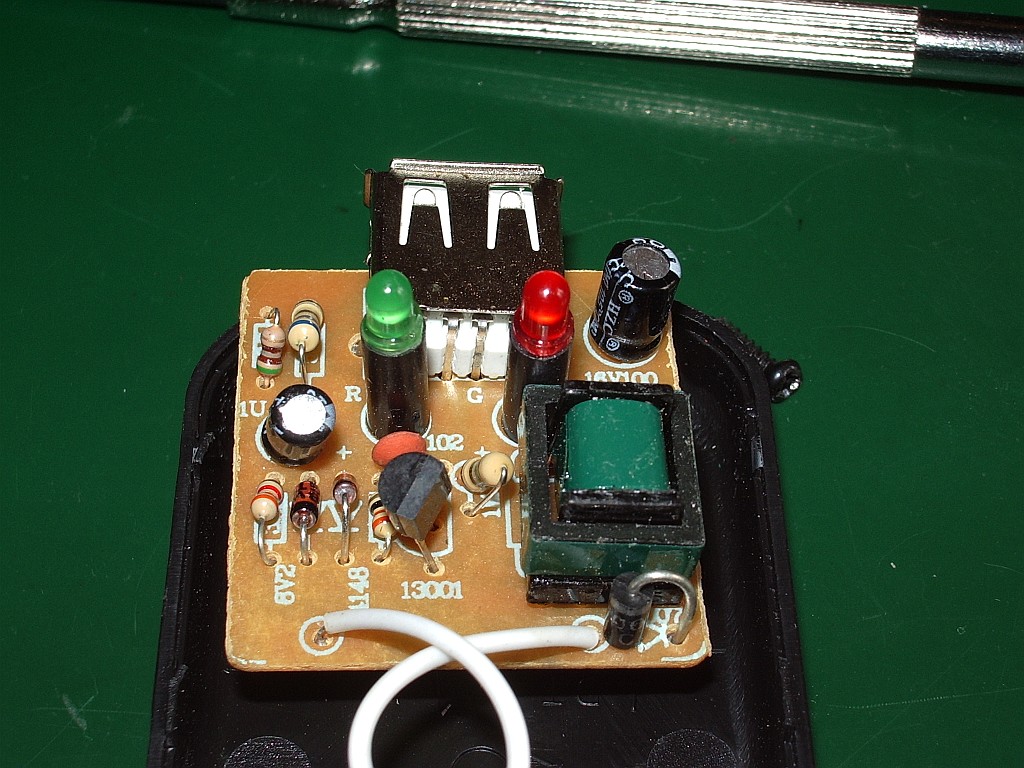

The answer, it seems, is not much. Call me old fashioned, but I’m just a bit apprehensive about having just a handful of components between my equipment and the 230V mains!
It’s a pity that this problem has occurred because I would have liked to have been able to recommend this battery pack to other users of APRSISCE on Windows Mobile. My initial test on the workbench suggest that this battery pack is more than capable of powering the phone with GPS and mobile data connection active during a day’s outing. The battery pack itself seems well made and I would guess that it is probably supplied by its Chinese manufacturer in a nice box with instructions and an adequately rated charger. The trouble in this case would seem to be caused by a cheapskate eBay seller.

6m magic
Today was the first really big Sporadic-E opening of the year. Six metres was wide open across the whole of Europe and Scandinavia. There was even a good 2 metre Sporadic-E opening in central Europe though no propagation appeared to reach the UK.
Yesterday I worked a string of Spanish stations on Six but that opening was not as good as today’s. This morning’s fun began with a contact with OK2IEN, then it was mostly Germans with a few other countries until round about lunch time.
I prefer the relaxing pace of Search and Pounce but when most of the stations you pounce on either have a pile-up and don’t hear you or are S&Ping themselves and move away it’s time to call CQ. It’s not something I often do and it’s almost more than my brain can cope with to talk to people while simultaneously typing into the computer their report, locator and call, but I quickly worked a string of stations and often had two or three at once replying to my CQ calls. This isn’t something that happens often when you run a stealth dipole so you have to enjoy it when you can!
In the afternoon, for a break, I tried JT65A. A lot of the interest in monitoring 50.076 seems to have evaporated when conditions were flat but a few stations were on and I made three contacts using the mode, though none were DX I could not have worked on SSB.
Later the propagation seemed to have shifted North to favour Denmark and Sweden and I worked a number of stations from there, many at massive signal strength. In all I made 45 contacts today – probably more than I have ever made during a single day except when playing in a contest.
I love six metres – it really is the magic band!

Elecraft KX3 demo video
A chance to see the new Elecraft KX3 demonstrated by N6KR at the QRP ARCI “Four Days In May” convention in Dayton 2011.

PLT debated in parliament
The issue of interference to short wave from power line networking devices was debated in Parliament yesterday. You can view the televised debate here. It’s quite long, but worth watching if you can spare the time.
If you don’t, here’s a summary: The only complaints are from a few hobby radio amateurs and the number of complaints has been too few to justify banning a technology that brings potential benefits to millions of homes.
Other points: “Hobby radio amateurs are not legally entitled to a completely clean radio spectrum”, and “no specific limits on interference levels have been set so that radio users can adapt as the use of PLT technology evolves.” It is also projected that the number of installed PLT devices will quadruple by the year 2020. So this spectrum-destroying interference will be coming soon to an antenna near you!
I’m afraid that the writing is on the wall for amateur radio. In today’s world, the only things that count are money and big business vested interests. There are too few radio hobbyists to count at the ballot box and they don’t contribute anything to the country that can be measured in financial terms. So we are just going to have to “adapt” to increasing interference levels by giving up hope of receiving weak signals, confining our activities to quiet portable locations, or using modes like D-Star which are interference-free once the signal level rises above the noise threshold.
I think we just saw a death sentence passed on our hobby!

PLT a threat to British intelligence gathering?
A report produced for the British intelligence gathering organization GCHQ claims that noise from power line networking devices is causing a detectable increase in interference at its monitoring stations and could adversely affect its operations. The report, which can be found on the website Ban PLT, was originally released by GCHQ’s Director of Engineering and Technology but has since been disowned by GCHQ which now claims it contained “inaccuracies.” The government organization also forced the online tech news journal The Register, which published an article containing details of the report, to remove the author’s identity from the article using measures designed, ironically, to suppress information that could be considered a threat to national security. So much for freedom of speech.
Ofcom meanwhile continues to deny that PLT devices cause a problem, stating that there have been “only” 272 complaints of interference (all from radio amateurs) and that of 233 cases referred to BT all but one have been resolved so there is nothing to worry about. Has pressure been brought from on high to force GCHQ to disown the report which is embarrassing to BT which has a couple of million of the Comtrend PLT devices installed nationwide? It is blatantly obvious that Ofcom couldn’t give a damn about the possible effects on a few hobbyists who don’t even pay a license for the spectrum they use. But a threat to the country’s ability to monitor the short waves to gather intelligence about potential security threats is something they would have had to take seriously.

Inside the UV-3R
Many people have been buying the cheap little dual band Baofeng UV-3R handheld radios from China. Some people have been pulling them apart, such as Fabrice, F4AVI, who has discovered that it is really quite a state of the art radio.

Fabrice found that the VHF/UHF transceiver functionality is provided by an RDA Microelectronics RDA1846 chip. This is a single chip fully DSP based transceiver capable of covering 134-174, 200-250 and 400-500MHz and supports CTCSS, CDCSS and DTMF with an 8dBm on-board PA. The Band 2 broadcast FM receiver uses an RDA5802E chip, also from RDA Microelectronics, which is a single chip broadcast FM stereo tuner. The UV-3R doesn’t cover the US 220MHz band, of course, nor is the FM broadcast audio in stereo. But future models might well do.
Some buyers of the Boafeng have experienced minor issues with their radios that suggest the quality control is not all it could be. Still, it is interesting to see innovative designs coming out of China. One can only wonder what next?

A birthday to forget
As you may have noticed, I have been experimenting with making software instruction videos. APRSISCE/32 has been the beneficiary of my attempts, but my real intention has been to make videos that would bring traffic back to the website that for the last few years has provided us with a living. For the core of the videos – and for APRSISCE/32 videos – the screen capture software I have been using (BB Flashback Express) is good enough. But I wanted to make the videos more professional by including shots of me talking to camera – which meant that I needed to buy a camcorder and get to grips with video editing software.
I ordered by post an AgfaPhoto camcorder which captured good quality video, though the sound level was low. I struggled with the supplied Arcsoft Total Media Extreme software. Eventually, and quite by accident, I found that my work laptop which is running 64-bit Windows 7 had on it a program called Windows Live Movie Maker. This is a brilliantly designed piece of software and easy enough even for me to use. Unfortunately I found that the audio level on the video made with the camcorder was much lower than that recorded by the screen capture software. I tried reducing the level in BB Flashback to match that of the clips filmed using the camcorder, but once the video was uploaded to YouTube the audio was much quieter than other videos and even with the PC speakers turned up to the max you could hardly hear it.
Olga made a test clip using the video feature of her digital camera and the audio on that was much louder. So yesterday we decided the camcorder must have a fault and emailed to the supplier saying we wanted to return it. Not wanting to waste time we then went to Argos and bought a different camcorder, this time one from Hitachi, which had received good reviews. You can imagine the sinking feeling when, after waiting for the battery to charge up, we tried it only to find that the recorded audio level was no louder than on the Agfa.
I felt out of my depth, clueless with no idea what to do. Other people managed to upload videos to YouTube with speech you could hear – why was I finding it so difficult? I asked in a couple of familiar ham radio forums if anyone had experience of this and could offer some advice. One person explained how to change the audio level in Windows Live Movie Maker, but as I had already found, the volume slider was at maximum in the video clips and the only direction I could adjust the audio level was down. Few people seemed to have experience of using camcorders, most using smartphones or other pocket devices to make their YouTube submissions, which would not give the HD quality I was hoping for.
Olga, trying to be helpful because I was getting stressed, found what she thought was a Hitachi support forum. Twelve Hitachi technicians were online waiting to answer my questions, the site claimed. I wrote my question and immediately received the response that this had been passed to someone who was an expert in this particular field and I should pay £12 for an answer by email or £18 for a consultation by phone. Ready to try anything at this point, I handed over my credit card details, only to find that this was not Hitachi support at all, but some generic advice service claiming to answer all kinds of questions. More than 12 hours later we have not received any answer for our £12.
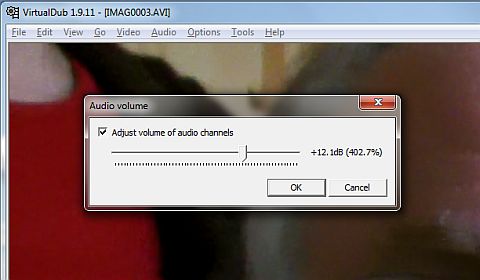
Eventually I stumbled upon a workaround. The Hitachi camcorder creates AVI files (unlike the Agfa whose video files are MOV.) Google found several answers to how to increase the audio in an AVI file, which suggests this is a common problem. Many of the answers were couched in gobbledygook I didn’t understand, using terms like “demux” that mean nothing to me. But eventually I found a “how to” procedure I could follow. It involved using a free utility called VirtualDub to rewrite the AVI file after processing and increasing the level of the audio track by 12dB. Even that didn’t work until I had visited a dodgy looking site and downloaded an iffy looking unofficial codec for the H.264 video encoding used by the Hitachi.
So I have a solution to the problem, though it’s a bit of a cumbersome one involving processing every video clip before I can start to assemble them in Movie Maker. To arrive at this point I have ended up buying two camcorders the first of which is probably not faulty as we first thought (it being unlikely they both are.) and been suckered into paying £12 to an internet scam site. This is not to mention the hours spent in front of the computer feeling frustrated and helpless on what was actually my birthday. Certainly not a birthday I particularly want to remember.
I think I’m getting too old for this tech stuff. I wish I could retire somewhere and keep chickens or something that did not require the use of computers at all. You would think that making home videos was something lots of people would want to do. Why is it so difficult?














