Author Archive
 Bicycle mobile
 August 10th, 2011 |
  Author:
 I’ve always been a bit of an armchair traveller, and also an armchair cyclist. I like to read accounts of people’s travels through foreign lands, particularly if they are travelling by bike. The slower pace and need to stop and talk to more people means that they are able to convey more of a feel for the place than you get from reading grossly overrated travel writers like Bill Bryson. So having just come across the blog of Raf, ON5RZ, who is currently cycling through the USA and Canada with an FT-817 and wire antennas, I have some reading to catch up on. Perhaps you’ll enjoy reading it, too.

Whispering with wonder
A few days ago I dug out of the cupboard the Wonder Loop portable magnetic loop that I made a while ago. I had lost the pieces of uPVC electrical conduit that made a Heath Robinson support for the coaxial cable loop element. But I had always felt the saggy coaxial loop was a bit of an eyesore anyway. So I decided to make a new loop using microbore copper tubing. It turns out that you can buy this stuff on eBay – any diameter and length that you want shipped to your door next day by first class post. Three metres of 1cm dia tube cost just over £12.

The new loop looks a lot better and certainly hasn’t harmed the performance of the antenna which continues to amaze me. I tested it using WSPR at a 1W power level on all bands (40m – 15m) that my Wonder Loop covers. The best result was obtained yesterday afternoon on 20m, between 16:30 and 19:38z, when I received 15 reports from VK2XN of from -9 to -25dB SNR, at a distance of 16579km. This, I repeat, was using just 1 watt from the FT-817 with the Wonder Loop sat on my shack “workbench” almost exactly as in the picture. (The FT-817 was moved to the radio/computer desk during transmission.)
I also spotted 9 reports of VK2XN during the same period, which surprised me due to the extremely high noise level I have here on 20m. The SNRs weren’t so good, though, and he was running 10 watts. Still, that almost qualifies as a two-way contact.
I haven’t tried other modes yet, mainly because the shack is so small and these days I’m a bit wary about sitting inches from an antenna even if it is radiating no more than a watt or two. But the original Wonder Loop was very successful using PSK31 and I hope to try this one with JT65A shortly.
The one disadvantage of the new copper loop is that it isn’t exactly portable, which had been one of my original objectives when building the antenna. If you could get hold of some metal strip it might be possible to make the loop from six pieces that you can join together using bolts and wingnuts to form a hexagon. Possibly you could even do this using tubing, flattening the ends of each 60 degree segment and then drilling them so the loop could be bolted together. But as I’m not planning on taking the antenna anywhere at the moment I’ll keep the one-piece loop which I can stick behind the shack door for storage.
This is a really great antenna that should enable anybody to operate HF from anywhere.

Tom Hammond, N0SS, SK
It was with great sadness that I learned from the Elecraft reflector today that Tom Hammond, N0SS, passed away early this morning after losing the fight with cancer.
Like so many of the friends we make in this hobby, I never net Tom in person. I never even met him on the air. But it felt like I knew him. Tom was one of the first beta testers of the Elecraft K2 and one of the most active members of the Elecraft reflector in helping other kit builders with any problems. As an early K2 builder myself, many has been the occasion when I have posted a question to the reflector and received a helpful reply from Tom.
Tom’s dedication to helping others get the best from their Elecraft radios was exemplary. Apart from assistance freely provided via the reflector and email, he maintained a website packed full of useful Elecraft-related material which I hope someone will take steps to preserve. Tom also produced several small kits and PCBs for modifications and add-ons to Elecraft radios which he provided at no profit to himself.
Tom Hammond, N0SS, was one of the finest examples of the ham radio spirit and our hobby today has suffered an irreplaceable loss. My thoughts are with his XYL and family.

Hitting a century
I have just noticed that this blog now has 100 followers. I’d just like to say thanks for reading my ramblings and I hope you continue to find them interesting.
Yesterday I heard about a new web service called about.me. It’s a site that lets you build a personal profile page with links to all your online content: websites, blogs, Facebook, Twitter and so on. Your profile has a URL like: about.me/your.name so in order to grab my name before someone else does I set up my own profile page at http://about.me/julian.moss. It only takes a few minutes to do so if you are interested in making it easier for people to find you on the web it’s worth the effort.
There aren’t a lot of links on my profile as I’m still not into social networks. I can’t see the point of Facebook, though I guess that’s just me as I know it is very popular. And I don’t know that people would be interested in my tweeting what I’m doing any more often than I do in my blogs already.

A day by the lake
The fine weather we have enjoyed for several weeks was forecast to change, so on Wednesday Olga and I decided to take the bus and go for a picnic lunch by Bassenthwaite Lake. For radio entertainment I took the UV-3R (in case of any SOTA or WOTA activations) and the FT-817ND.

HF conditions were pretty dire – WWV has been predicting blackouts – and I initially heard nothing above 20m. But even though I called the loudest stations that weren’t calling “CQ DX outside Europe” no-one even acknowledged my existence. (What’s wrong with working stations inside Europe, I’d like to know, especially when no-one is replying to your CQs anyway?)
The antenna I was using, the Wonder Wand L-Whip, could have been better. It does, however, have the advantage that it is small and light. At the moment I can’t carry much, needing one hand for my walking stick and the other for balance, so everything has to fit in a small shoulder bag. So I didn’t have anything else suitable.
The UV-3R produced a contact with Terry, G0VWP/P activating Walla Crag, the lowest Wainwright, prompting Olga to comment that the small radio was better than the big one!
After lunch I tuned around some more and heard some activity on 15m and 17m. And whilst tuning 17m I stumbled across this. Actually, that’s what I heard a couple of minutes later after I’d dug my smartphone out of my jacket pocket to make the recording using Voice Recorder. What I heard first was ZD8D (Ascension Island) calling CQ. Repeatedly. With no takers. He was not very strong – about S4 on the ‘817 S-meter – with some QSB, but perfectly clear. Clearer in fact than in the recording. I called, but needless to say he didn’t hear me.
As I’ve said before, I have little interest in working stations just to tick countries off a list. But I have a particular interest in the British colonies of Ascension Island and St. Helena as I visited both places during a “trip of a lifetime” in 1999 but have never worked either of them. Just my luck to come across a DX station calling CQ with no pileup when I’m surrounded by mountains and running just 5W to an extremely inefficient antenna!

K2 audio switchbox
My vision and steadiness of hand have improved to the point that I am able to build projects! Here is a picture of a switchbox I made for my Elecraft K2 a couple of days ago which allows me to switch the audio input source from the microphone to the computer sound card.
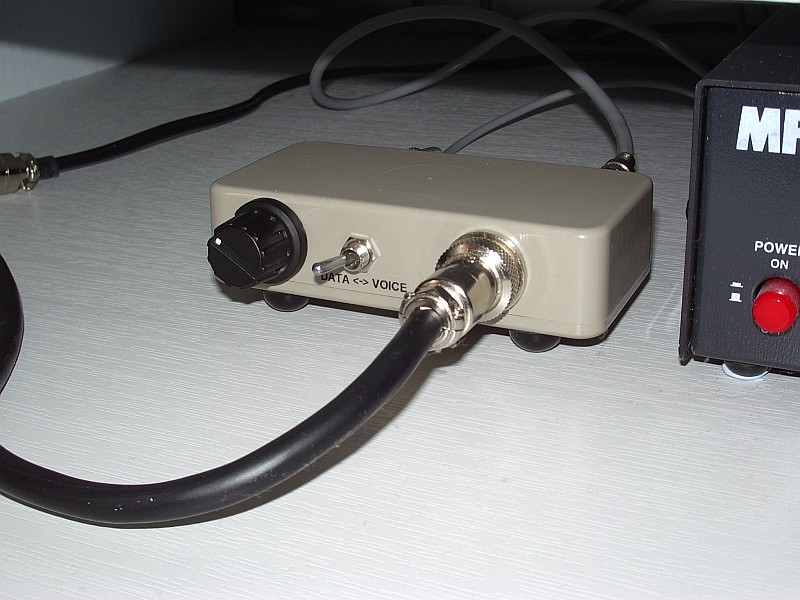
One of the niggling annoyances of the K2 is that it does not have separate inputs and outputs for voice and data modes. Most users carry out one of several published mods to obtain a fixed level audio output for the computer. Mine is tapped off the KAF2 filter module and runs to an RCA phono socket on the back panel. But for transmit most people just swap the mic lead and data lead over.
I used my K2 like that for years, though it wasn’t a great hassle mainly because I hardly ever used a microphone anyway. But I finally decided to come up with a better solution – hence the switchbox. It was easy to make and I thought it would be within my capabilities. Here is a picture of the internals.
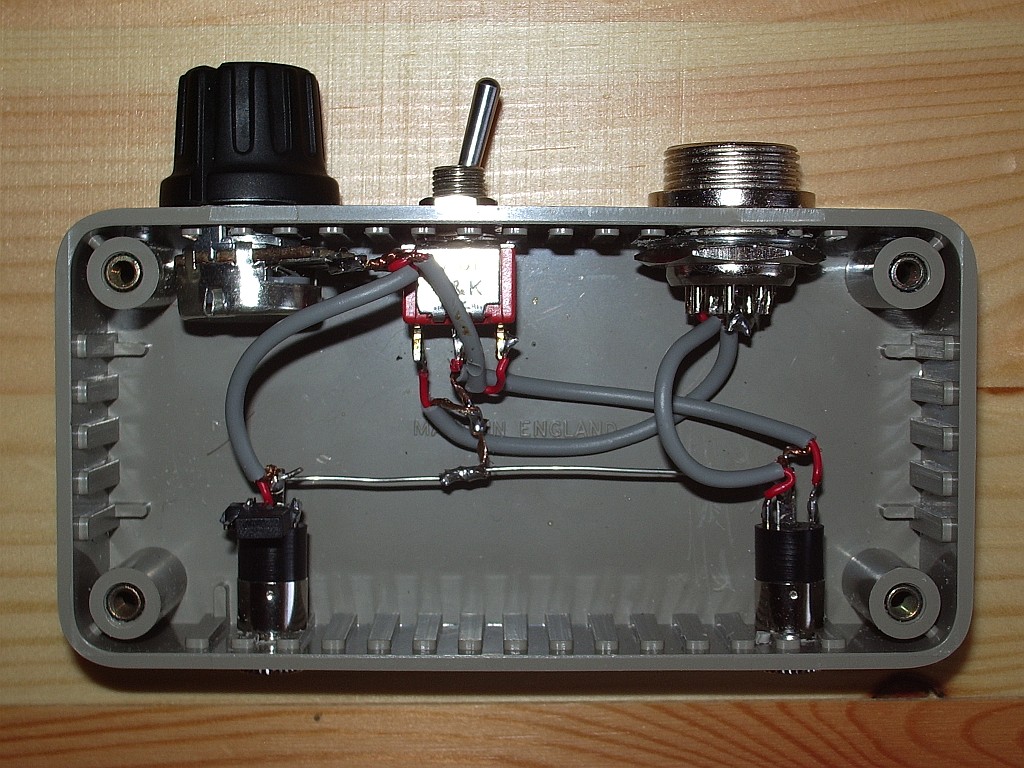
In one position of the front panel switch the microphone signal is switched straight through. In the other, the audio comes from the computer sound card headphone output via a potentiometer. Since taking that picture I added some resistance to the hot side of the pot so the control can be used over a greater range as the K2 mic input is very sensitive and needs some attenuation. As you can see, I don’t bother with isolating transformers. I’ve made dozens – well at least a handful – of computer/radio interfaces in my time and I have never, ever found the need for one. YMMV.
To celebrate the restoration of my constructional skills I have ordered a W5OLF WSPR beacon kit. John Harper, AE5X, recently reviewed it and wrote that it took him 50 minutes from starting to build to receiving his first spot. So I figured it shouldn’t be too difficult, though it will probably take me longer than 50 minutes. It would be nice to successfully complete a kit before I start undergoing the treatment that I expect will make me too tired to do all the stuff I am managing to do at the moment.

QRP and DXing
I rarely post on the Elecraft reflector these days but I do check Nabble from time to time to see what’s going on and today I saw one thread that got me annoyed. Someone who had just built a new base version K2 posted that until he had done so he hadn’t realized that it was possible to work DX using 15 watts. Someone then piped up that QRP DX claims are pretty meaningless unless the antennas used are also mentioned – a point with which I’d agree. But then someone had to add the hoary old argument “They also don’t report how the guy they worked had to struggle to pull them out or what his equipment was.”
This argument gets my goat every time. Whilst many people use QRP through choice, when it comes down to antennas many people don’t have a choice. If you live in an apartment, or like me in a tiny house on a postage stamp sized plot, or if you have HOA restrictions, or again like me have an awkward neighbour who likes to make your life difficult just because he can, then having a tower and a beam, or even a decent long wire antenna high and in the clear simply isn’t an option.
What these people seem to be saying is: “If you can’t run high power and a beam like me then don’t waste my time.” Now, excluding a lot of people from the hobby just because they aren’t fortunate enough to be able to put together a top class station doesn’t seem to me like a good thing for the future of the hobby.
It is surprising what you can work using low power, even with modest antennas. And what the naysayers who have probably never even tried using low power and simple antennas don’t realize is that it is also surprising how many contacts don’t have to struggle to pull the QRP station out of the noise. In fact they have probably worked many low power stations themselves without realizing it because the other guy never mentioned he was using QRP. The attitude that “life’s too short for QRP” is just bullshit.
But when making contacts with low power and limited antennas is a struggle there are always other things you can do. Personally, ticking countries off a list has always seemed to me to be an exercise in frustration, especially since the advent of the DX Cluster which means that you’ll almost never come across a DX station that isn’t on the end of a pileup. And whilst it’s nice to have a chat uisng the radio, these days it’s so much easier to have a discussion about the hobby online using forums, blogs and so on.
For many of the QRP persuasion, ham radio is a lot to do with seeing how far a little radio signal can go. And there are so many ways you can do that – with QRSS beacons, WSPR and weak signal digital QSO modes like JT65A. Today I saw a Google Groups post from Joe W6CQZ/4, the author of the JT65-HF program, who is using the mode to make contacts running 500mW to a 20m Hamstick mounted on the metal roof of his shed. This sort of thing is much more satisfying than working DX using a superstation. Let’s fact it, anyone could do that if they had deep enough pockets and enough real estate. Where’s the challenge in it?
So if you can’t run a superstation don’t be discouraged by the braggers with their QRO gear and big antennas. There’s a heck of a lot of fun to be had in this hobby using low power and simple gear. And I’ll bet a whole lot less frustration, expense and envy as well.