Author Archive
 Baofeng bother
 August 8th, 2012 |
  Author:
 I like my cute little Baofeng UV-3R+ though I find myself using its slightly bigger brother the UV-5R more often. Unfortunately the UV-3R+ has begun acting up with a fault that is difficult to fathom.
Quite often the UV-3R refuses to switch on. At first I thought that I had accidentally left the radio on and had depleted the battery, because I often do things like that. But the radio comes back to life if you remove and replace the battery or if you drop it into the charger for a few seconds. When I did this today the screen immediately showed a battery voltage of 4.0V which was expected given that it had been charged only a day earlier.
So the radio is failing to turn on even though there is plenty of juice in the battery. Like most HTs it has a “live” power switch and should turn on at the press of a button. The UV-5R on the other hand has a good old-fashioned rotary on/off volume control. Which, I now recall, was the thing that failed on my old Jingtong radio. Ho hum.

QRZCQ?
For more years than I care to remember I’ve always used qrz.com to look up calls I’ve worked or heard on the bands. Recently I’ve noticed that the site wants me to log in every time I try to access the details of a call. Perhaps my memory is faulty, but I’m sure that you didn’t used to have to log in to see the basic details, and the site remembered your login for at least a week. Now it seems you have to log in every day if you aren’t a subscriber. This isn’t very convenient, even though I understand the reason for it (presumably to encourage more people to subscribe.) I now hardly ever visit qrz.com.
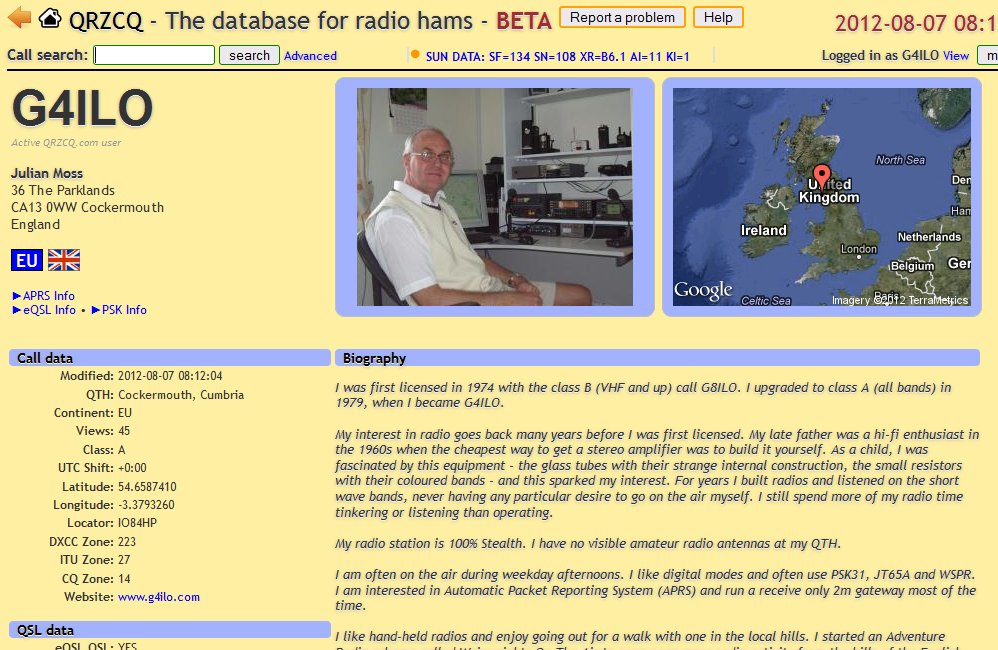 |
| The G4ILO page at QRZCQ.com |
Using Google to search for a call I found that one of the first results returned was from a site called qrzcq.com. I didn’t at first notice the different URL. QRZCQ has a callsign lookup similar to QRZ.com – it even uses the same URL format – but doesn’t require a login to access the details. The site’s database already holds quite a bit of information about me – all of it already in the public domain but I won’t ask where it came from! I have just registered with the site so as to edit and add to the information shown on the G4ILO page.
I don’t know who is behind the new site but they seem to have done a good job on it. The pages look a lot more attractive than qrz.com and they aren’t stuffed with ads – though it is early days yet and I suppose the desire to “monetize” the site will come eventually. But right now qrzcq.com looks like a venture that is well worth supporting, visiting and updating your own page.

Change of address
DX Sherlock, the website that has the very useful real-time propagation maps derived from DX Cluster and WSPR spots, has moved to a new site.

The addresses vhfdx.net, vhfdx.info and dxsherlock.com will now redirect to dxmaps.com. If you have bookmarked the site you will need to update your bookmarks.

Fake or genuine?
Buying radio gear on eBay is like gambling. It’s addictive, but often you lose. You win often enough to keep you coming back in the hope of finding that absolute bargain.
 |
| Is the antenna on the right a fake? |
I thought that I would buy a dual-band handheld antenna that was long enough to have a bit of gain but not too long to use in the shack. (I have several gain antennas but at over a metre in length they are not suitable for indoor use.) I have a Nagoya NA-701 which works very well for its length (22cm) so I thought I would get a NA-771 which is 40cm in length and ought to perform a couple of dBs better. I know only too well that there are a lot of fake antennas on eBay so I bought this one from 409shop, or rather from radiobanker which is one of the eBay IDs used by 409shop. The general consensus is that 409shop is a trustworthy trader and doesn’t sell fake stuff.
When the antenna arrived I was concerned to see that instead of the silver-on-black label showing the make and model number the details were printed on in blue. I have had other fake antennas with printed-on labels, even ones with the same shade of blue so it was not a good omen. When I tried the antenna on one of my handies I found that it performed no better than the much shorter NA-701.
 |
| SWR of the alleged NA-771 |
I put it on my AA-200 antenna analyzer and found that the SWR at 145.000MHz was about 4:1. There were two dips to the HF of the 2m band, the best of which was at 195.000MHz with 2.7:1. This is not the worst I have found but it explains why the antenna did not perform optimally.
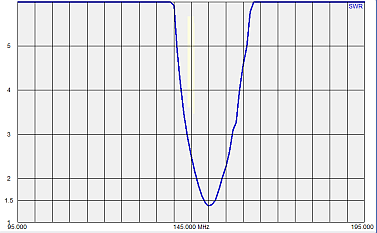 |
| SWR of Nagoya NA-701 |
For comparison I looked at the SWR of the NA-701 with the silver-on-black label. This was a really good match – better than 1.5:1 at 150.000MHz though closer to 2:1 at 145.000MHz. Given that the resonance at any given time will be affected by conditions surrounding the hand-held antenna that’s close enough.
So is the NA-771 from radiobanker a fake or not? The plastic sleeve the antenna came in bears a silver hologram label that says “Nagoya”, and the name “Reuex Industrial Co. Ltd.” That is the name of the company that manufactures Nagoya antennas and apparently they do use blue lettering.
So I conclude that this antenna is probably genuine and performs as well as it was meant to, which unfortunately happens to be not as well as I hoped. The Nagoya NA-771 is not worth its extra length.
FYI using an SWR/power meter I measured the SWR of the two antennas at 433.000MHz to be: NA-701 3.4:1, NA-771 4:1.

Do LCDs wear out?
Do LCD displays wear out or fade with age?
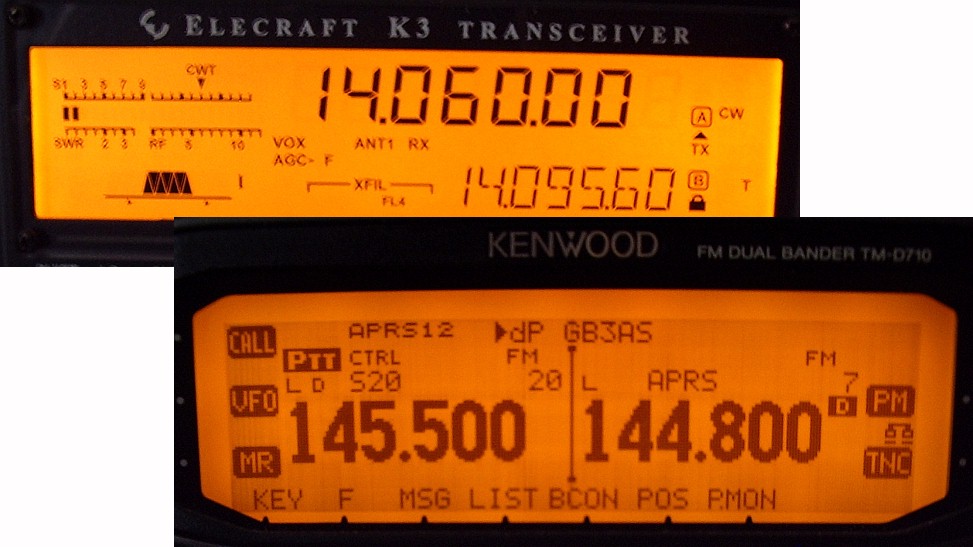
The picture above shows the displays of my Elecraft K3 transceiver and my Kenwood TM-D710 VHF rig. The Elecraft display is sharp with good contrast and characters look almost black against the orange background. The Kenwood display is much less contrasty. The backlight is not as bright as the K3’s but the characters look more murky brown than black no matter how I set the brightness and contrast. It’s quite noticeable when the two radios are side by side.
I don’t think the Kenwood’s display was ever as bright as the K3’s but I don’t recall it being as murky as it is now. Whenever I look at it I keep wanting to turn the contrast up. I’ve taken to turning the backlight off altogether so it doesn’t bug me but there is no option to have it turn on automatically when a button is pressed. (AUTO BRIGHTNESS: ON appears to do nothing.)
My D710 has been running 24/7 for more than a year (with a brief hiatus when I went into hospital until I felt like running the APRS gateway again.) Could the display have faded (for want of a better way to describe it) over time? Or is my recollection that the text used to look more black than brown faulty?

Baofeng brothers
Back in February I bought a Baofeng UV-3R+. It came after an unusually long wait for products from China, in March. In that time, eBay vendors had begun advertising the new Baofeng UV-5R which had double the output power and a key-pad that could be used for DTMF. To add insult to injury the price of the 5R was less than I paid for the 3R+.
As the months passed the knowledge that the UV-5R could still be bought for an absurdly low price niggled away at me, until eventually I gave in and ordered one. Unlike its little brother the 5R got here in little more than a week. So now I have two Baofeng HTs. A ham can never have too many radios, especially at this price!
 |
| Baofeng UV-3R+ and UV-5R |
After I sold my original UV-3R to make way for the Plus I had a few regrets. The original had the advantage of being lightweight and tiny. Although the Plus was only a few millimetres larger and a few grams heavier the difference felt more marked. It lacked the cuteness of the earlier model. But the drop-in desk charger was a nice standard accessory. The accessory port was the same as used by Kenwood and Wouxun, enabling some standardization. It is a nice little radio but functionally almost identical to the original 3R.
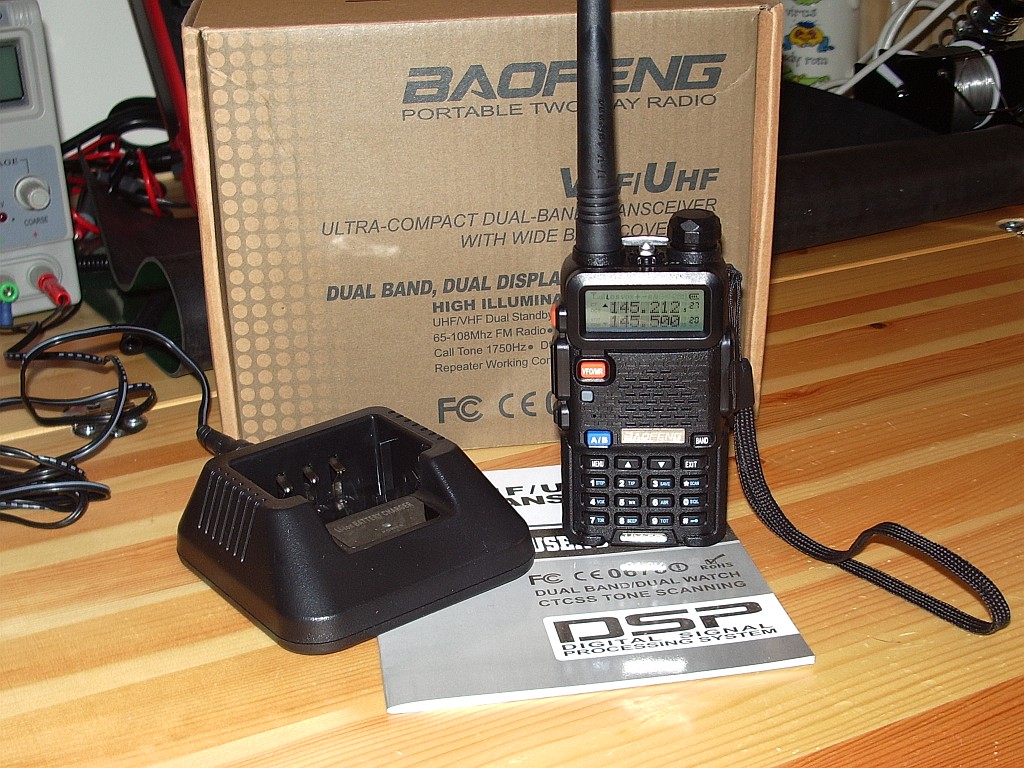 |
| Baofeng UV-5R unboxed |
The UV-5R is quite a big improvement over its little brother. It isn’t a lot bigger or heavier than the 3R+ but the extra size and weight gains you double the output power (4W compared with 2W) and a keypad which supports both frequency entry and DTMF. The latter makes the radio much more useful on Echolink.
The 5R feels solid and well built like the 3R+. In fact it feels like a radio that cost three times the price. I think Baofeng has hurt sales of the basic handhelds made by the Japanese “big 3.” Only rigs with ham radio specific extras like supporting D-Star or APRS will be able to justify a higher price. As neither of those things are useful for the typical Chinese business buyer of these radios I can’t see Baofeng starting to compete in that area. So Yaesu, Icom and Kenwood can breathe a sigh of relief.
Other things I like about the UV-5R are:
- 4W maximum power out
- Alphanumeric names for memory channels
- Backlit keypad – a classy touch
- DTMF – ideal for Echolink
- Analogue volume control with proper on-off switch .
I like the way the display (and keypad) lights up when a signal breaks the squelch and stays lit for a few seconds after the signal has finished. If you have more than one handie in use this feature lets you know which radio received the call. My Wouxun also does that.
There are a lot of other things to like, such as the voice announcement (my ham rigs don’t have that) and the fact that accessories and spare parts being really cheap. The same computer interface cable works with both Baofengs and the Wouxun. Headsets and speaker-mics work with two Kenwood radios as well.
Judging by the comments of some buyers in the user groups, “Baofeng quality” is still an oxymoron. You are taking a chance that the radio you receive will not have any faults. Sending the set back to Hong Kong But if you are prepared to take that risk (or pay a bit more and buy from a local dealer) then the Baofeng UV-5R is worth a lot more than you pay for it.

Ping!
WSPRing on 6m this afternoon and I captured this trace:
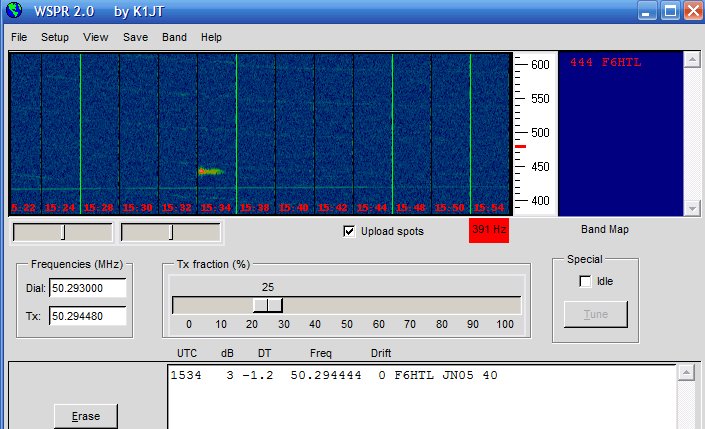
I’m not seeing anything else, though F6HTL spotted my transmission 2 minutes later. I wonder what type of propagation that was?
(Interesting that WSPR decoded the transmission even though the signal was only present for half a cycle.)














