Author Archive
 QRZCQ Update
 November 21st, 2012 |
  Author:
 I have just uploaded a couple of new images to QRZCQ.com, the new ham radio database site.

If you wondered where the nice QSL images in recent blog posts came from, I took them from those ham’s profile pages on QRZCQ.com. I thought it was a good idea to use a QSL image for the page, so I scanned one of my printed QSL cards and uploaded it to my own profile on the site. You are allowed two pictures, a main one and a secondary one, so I uploaded a photo of me in the shack for the secondary image. It’s good that the site developers allow decent sized high resolution images.
Somebody will probably take me to task for stealing images from a web site. But in my opinion (for what that’s worth) a QSL image should be okay. If I received it from the bureau what’s to stop me from scanning and uploading the image of cards I receive? I’m just anticipating receiving it. 🙂
I have also uploaded my contact log to QRZCQ.com. That was a simple matter of exporting the log to an ADIF file from KComm. The most up to date copy of my log will always be the one at G4ILO’s Shack, though, because that is taken directly from the off-site backup copy of my log, uploaded automatically whenever I close KComm.
20 November
Today my main rig has spent even more time on other things than WSPR. Besides trying to work some PSK31 DX I have also been testing a beta release of K3 firmware. This new version has an improved CW decoder that is a bit less finicky about settings. It works very well but is still beaten by the Windows program MRP40 which I regard as the gold standard for CW decoders. As Wayne N6KR says, the MRP40 algorithm is probably ten times more sophisticated and the K3 MCU doesn’t have enough code space for it.
I’ve been interested in Morse decoders since the first home computers and can remember keying in a program listing in BASIC from a QST article in the late 70s. Later I wrote a decoder in Hisoft Pascal which ran on my ZX Spectrum. It actually decoded strong, perfectly sent Morse but it was not reliable enough to be useful. More recently I tried implementing a Morse decoder in KComm but it was a total failure.
I didn’t have a lot of success with PSK31 DXing on 10m either. I only made two contacts but I heard what would have been two new South American countries: HC7AE in Ecuador and CE4BRO in Chile. I didn’t need to look up HC in a book as I remember from my teenage SWLing days hearing HCJB Quito, the Voice of the Andes!
I think band conditions were better today but they supported more propagation from Europe so there were higher QRM levels (and lower operating standards 😉 ) I moved up the band to try and get away from all the IMD products but hardly anyone was listening up there so it was a bit futile.
Someone who did hear my CQ calls was Vito IZ7DMT. He was a whopping signal but was signing IZ7DMT/QRP. He told me he was running 5 watts from an FT-817 and was rather indignant that I wouldn’t use the illegal /QRP suffix during handovers. Nice QSL though!
Here is the result of today’s WSPRing:
 |
| 10m WSPR spots @ G4ILO 20 November 2012 |

VOAProp Repackaged
If you are a user of my program VOAProp you probably know by now that it has a problem due to NOAA having made a slight change to the format of the WWV solar data report. I cannot fix the problem in the program as I no longer have the files needed to rebuild it. Thanks to Mirek, OK1DUB a solution was found that involves changing the web address of the solar data file to download a slightly edited version from Mirek’s web site. The Troubleshooting page in the VOAProp help was updated to include this information. Unfortunately hams never read the frigging manual and so I have had to use the holiday absence message of Gmail to send a rather annoying automatic reply directing those with a question about VOAProp to the aforementioned page in order to save myself the even greater annoyance of receiving several emails a week about it. (It would be really nice if GMail’s Filters could include the option of sending an automatic reply only if an email meets certain conditions.)

It occurred to me this morning that I could fix the problem for new installations by including a configuration file containing the address of the file on Mirek’s web site. So I rebuilt the setup file including this extra file and have now uploaded it to G4ILO’s Shack. It will not help existing users if they download the new file as the installer will not overwrite their existing configuration file so as to preserve the user’s settings during an update. As emails about the issue are still coming in I will have to continue sending the automated reply to everyone who writes to me.

10m 19 November 2012
Another day of good propagation allowed my love affair with 10m to continue.
| 2012/11/19 | 12:34 | 28.121 | BPSK31 | NP4EG | 599 | 599 | Edgar | N. Puerto Rico | ||
| 2012/11/19 | 12:50 | 28.122 | BPSK31 | UT5AJ | 599 | 599 | Vlad | Kramatorsk | ||
| 2012/11/19 | 13:50 | 28.123 | BPSK31 | UR4QX | 599 | 599 | Yuri | Berdyansk | ||
| 2012/11/19 | 14:11 | 28.121 | BPSK31 | RG5A | 599 | 599 | Alex | Moscow | ||
| 2012/11/19 | 14:25 | 28.122 | BPSK31 | YY4HAH | 599 | 599 | Heiroun | Valencia Vene… | ||
| 2012/11/19 | 14:35 | 28.122 | BPSK31 | N4PJL | 559 | 599 | Pete | Deep Creek La… | ||
| 2012/11/19 | 14:41 | 28.122 | BPSK31 | AB8O | 599 | 599 | John | Milford, OH n… | ||
| 2012/11/19 | 14:59 | 28.122 | BPSK31 | KJ4LEC | 599 | 599 | Marion | Cumberland Ga… | ||
| 2012/11/19 | 15:08 | 28.122 | BPSK31 | W5FER | 599 | 599 | Jim | San Antonio, TX | ||
| 2012/11/19 | 15:17 | 28.122 | BPSK31 | VE3NOO | 599 | 599 | Michael | Sandhurst, On… | ||
| 2012/11/19 | 15:23 | 28.122 | BPSK31 | AE5XI | 599 | 599 | Terry | Las Cruces, NM | ||
| 2012/11/19 | 15:44 | 28.122 | BPSK31 | K9ZJ | 579 | 579 | Rich | Waukesha, WI |
Besides these contacts I heard, but couldn’t catch, stations in Mexico and Paraguay. I’m hoping the good propagation will continue so that I can add these to the log.
Because of this, not too much time was spent on WSPR today, so the WSPR map looked like this:
 |
| 10m WSPR spots @ G4ILO 19 November 2012 |

10m 18 November 2012
I nearly got myself locked out of the WSPR map page today. I must have managed to save the settings to try to display spots for all bands for the last 24 jours, or something like that, because whenever I went to the page the web browser froze up while it tried to render the map and I couln’t get back to the settings boxes to change it. I had to find out how to delete all cached files in Chrome before I could access it again.
 |
| 10m WSPR spots @ G4ILO 18 November 2012 |
I lost quite a lot of time trying to sort that out. I also spent an hour or so seeing what I could work on 10m PSK31. I managed to QSO with several US stations including N7WET in Tucson, Arizona and KB5IAV in Baton Rouge, Louisiana.
I worked two all time new countries as well. Fabio CU3HN in the Azores has one of those QSLs that never fail to bring a smile to my face.
 |
| QSL of CU3HN |
Victor, HP1AVS in Panama I had heard before but not managed to work. So I was pleased to add his call to the log as well.
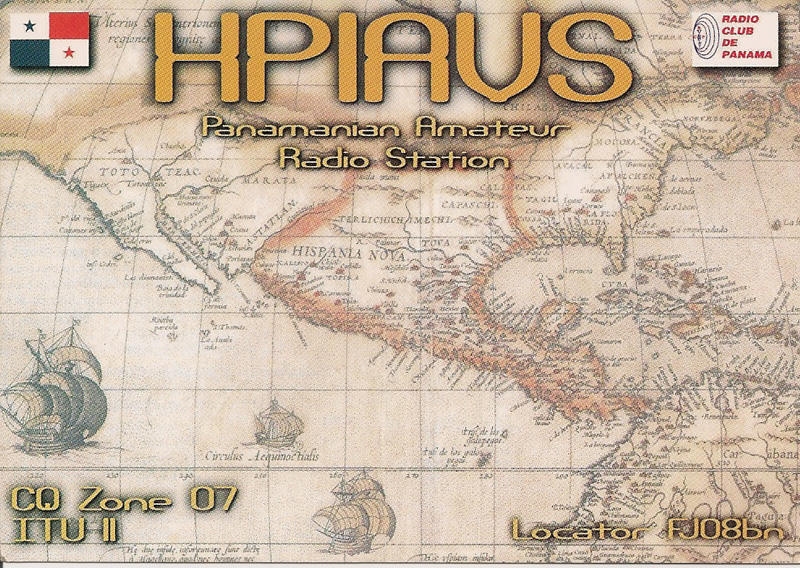 |
| QSL of HP1AVS |
I love 10 metres!

10m 17 November 2012
 |
| 10m WSPR spots @ G4ILO 17 November 2012 |
Another day of good propagation. I don’t know why OH1CO was using the suffix /QRP (aren’t most WSPRers using 5w or less?) but it really upset the WSPR encoding algorithm. His call was being decoded at my end as OH1/P00XEK!

It’s magic!

I’m starting to believe that my attic dipole does have magical powers on 10 metres. Right now I’m hearing or being heard by 8 different stations but they are only hearing or being heard by me!














