Author Archive
 A blinking nuisance
 February 11th, 2013 |
  Author:
 It’s beginning to look as if my shack PC monitor is on the blink. Recently I have noticed that when the system comes back to life after going into standby the picture flashes repeatedly – flash, blank screen, flash, blank screen and so on. Nothing I do seems to bring this cycle to a halt, I just have to wait until the picture eventually stabilizes on its own.
This morning for the first time this occurred upon powering up the system from cold. So it looks as if the problem is getting worse. One day soon I expect the picture may not stabilize at all.
It is a 19 inch (48cm) monitor and must be about 8 years old, bought at a time when 19 inch monitors were quite a pricey item. So I can’t complain that I haven’t had good use out of it. I must have had three different system units in all that time. I should take this as an opportunity to replace it with a newer, larger screen. Except for the fact that I don’t really have the room for a larger monitor as my shack is so small.
I do have a laptop that I could use. It is a nice wide-screen Dell running Windows 7, purchased for work about 3 years ago but now little used as I have given up most of the things I used to do. The trouble with that idea is that the laptop doesn’t have the 4 real serial ports and 6 USB ports that the shack PC has, all of which are used.
So I guess I’ll be shopping for a new PC monitor some time soon. The thing that always puts me off buying new computer hardware is the fear that it will be RF-noisy and add to the already high noise levels I experience here. This old monitor actually causes some hash on the 2m band, which went unnoticed when it was new as I didn’t use VHF at the time. I think I’ll ignore cheap Chinese products for once and stick with one of the well-known European brands that have actually passed emissions tests instead of just sporting a CE sticker like I suspect many imports do.
A brief spell of activity in the PACC contest
Sunday morning I was a bit late getting up. I felt like a change from listening to silence while waiting for someone to come up in DV mode so I decided to try some QRP CW using the KX3 to remove the temptation to turn the power up.
It was clear there was a contest on – the PACC contest – and I worked out that the PA stations were sending a city or county code and the rest were sending a serial number, so I decided to give away a few points.
I set the KX3 to 5 watts to keep in the spirit of QRP and started making some contacts. I thought 40m would be the best band to work Dutch stations from here. In 20 minutes I made 4 QSOs. All came back to my first call, and I was reminded that it really isn’t that difficult to make contacts on the 40m band with an attic antenna and low power.
I reached the bottom of the band and started tuning up the other way but the band seemed to have gone quiet. After a few minutes a light bulb flickered on dimly in my head and I looked at the clock: 1205. I dashed downstairs to get the February RadCom and looked in the contest news. Sure enough, the PACC contest ran from 1200 Saturday to 1200 Sunday. It had finished five minutes ago!
2013/02/10 | 11:39 | 7.021 | CW | PA5TT | 599 | 001 | 599 | ZL | ||
2013/02/10 | 11:42 | 7.019 | CW | PA6NB | 599 | 002 | 599 | NB | ||
2013/02/10 | 11:45 | 7.018 | CW | PA3BWK | 599 | 003 | 599 | UT | ||
2013/02/10 | 11:55 | 7.011 | CW | PA0AA | 599 | 004 | 599 | UT |
I really should get up earlier on Sundays!
Buying batteries on Ebay
Yesterday I wanted to experiment with using a ferrite rod antenna for WSPR. I was using my AA-200 antenna analyzer to try to tune the antenna when it suddenly restarted. I switched it off and on again and as soon as I chose any function the analyzer restarted again.
The last time I used the AA-200 I remember the batteries ran out so I charged it. It appears that after 6 years of use the rechargeable battery pack won’t hold a charge.
 |
| AA-200 antenna analyzer and open battery pack |
I’m useless at taking things apart but Olga managed to open the battery pack to reveal a shrink wrapped pack of 4 AA cells. I could have ordered a replacement from Strikalite but their price was £20. I found an Ebay seller in Hong Kong whose price was a quarter of that. So for the sake of a few days wait I could save myself £15.
I ordered the battery pack, but this morning there were two emails in my inbox saying “We are sorry to tell you that we are not allowed to dispatch batteries recently for the customs are very strict on exporting batteries.” Is this something new? It’s the first I have heard of it. I’ve certainly bought battery packs (including batteries for handheld transceivers)from China on Ebay before.
The seller has refunded my money (or at least he has said he will.) In the meantime I found a UK seller of Chinese batteries, Vapextech UK, which, while not as cheap as the Hong Kong seller, is still a third of the price of Strikalite. Having said that, Strikalite is still a good firm to go to if you want to refurbish a ham radio battery pack and like me you are useless at taking battery packs apart.
My second DV QSO
 |
| Elie, OD5KU |
Just as I was finishing writing my previous post I heard someone else calling on the 20m DV frequency. It was Elie, OD5KU. Yesterday I had heard him working a French and then a Dutch station but signals were weak and not good copy at all.
I replied to Elie but he couldn’t make out my call. I tried several times and was about to give up when he called again with solid copy. Perhaps he had turned his beam my way. I tried calling one more time. This time he heard my reply and we had a good QSO with several periods of solid copy punctuated by occasional break-ups. These occurred when QSB took the digital signal down to near-invisibility in the FreeDV waterfall. I doubt that good SSB copy would have been possible at those times either.
I managed to make a recording of the end of this QSO so you can get an idea of the audio quality. It was recorded off-air using my Olympus digital voice recorder, then played back using the mic input of the USB sound dongle to make an MP3 file. Given the way it was created I think the clip is quite a good example of the FreeDV audio quality. As you’d expect from a digital signal either it’s all there or you just get gobbledygook. It doesn’t degrade gracefully.
Is this the future of ham radio? Have a listen and let me know what you think.
My first DV QSO
I was in the shack, messing about with ferrite rods trying to replicate Roger G3XBM’s success using a ferrite rod as a transmit antenna. Meanwhile I was monitoring 14.236MHz, the 20m digital voice calling frequency.
Some audio came through the PC speakers. I didn’t catch what it was, but the callsign OZ1BXN appeared below the DV application waterfall. I waited, and shortly Chris called again. We completed a QSO with 100% solid copy each side. I gave Chris 5 by 8, which was the actual K3 S meter reading, and Chris gave me 5 and 9. Chris said he was running 200W peak power. I had the K3 in DATA mode with the power level set to 25W which is the recommended level to use with a 100W transceiver. Whether that results in an average or a peak power of 25W I have no idea.
Although Chris’s signal was solid copy with no dropouts the audio was rather boxy and I found it more difficult to read than a typical SSB signal. This is probably a consequence of the fact that Codec2 has been designed to use a 1.4kHz bandwidth rather than the 2.8kHz required by SSB. I can understand the thinking behind this decision but I agree with David G8JGO who commented on one of my earlier DV posts that it is a pity the codec wasn’t designed to give better than SSB fidelity within an SSB bandwidth. I think that would make the adoption of digital voice more compelling. I can see many people, particularly skeptics who can’t see the point of digital voice at all, being turned away by the audio quality. Has DV shot itself in the foot?
Having said that, Chris reported that I had very good audio. I had tweaked the equalisation built into FreeDV to give some treble emphasis and bass cut, so perhaps some adjustments are possible.
No QSOs
I spent all of Saturday monitoring the FreeDV suggested frequencies but so far I haven’t heard a thing. I am really surprised. Whenever a new data mode is announced the main problem is usually QRM as too many people pile eagerly on to the recommended frequencies. FreeDV is a development that is potentially as revolutionary for the hobby as the advent of SSB in the 1960s. I would have thought that more hams would want to be in at the start, especially as there is no cost apart from the time taken downloading the software.
Perhaps people just don’t know where to go. Since my last post I have discovered the FreeDV QSO Finder. This is a tool to enable potential users of FreeDV to find out where others are. Suggested frequencies are: 14.236, 7.190 and 5.4035, though I’ve seen people using other frequencies. This weekend’s contest will probably put the kibosh on attempts to set up contacts for now, but I hope for better luck next week when the bands are quieter.
Digital voice on HF
I was going to title this post “D-Star’s nemesis” but I thought that would be too provocative and premature! But the much talked-about Codec2 open source voice codec has just surfaced in usable form, in the shape of an easy to use bit of software called FreeDV.
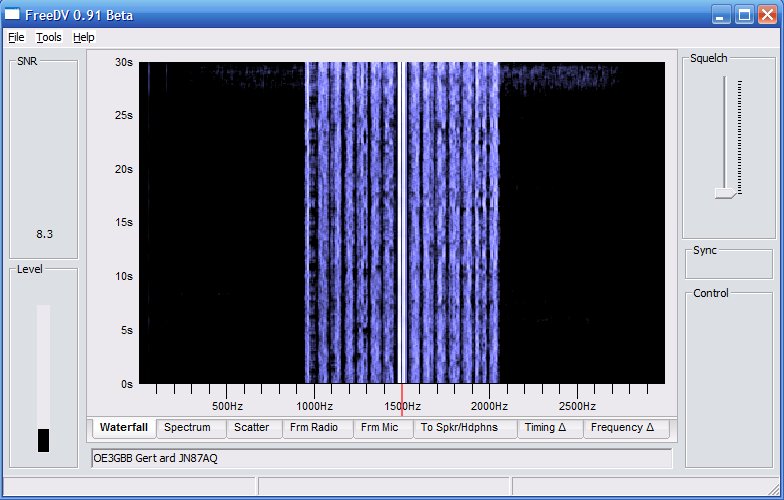 |
| FreeDV running on Windows |
FreeDV is available for Linux, Windows and Mac. I installed the Windows version, which is just a matter of extracting the files from a zip archive into a folder.
If you’re set up to run digital modes on HF then you’re half way there already. FreeDV uses the same sound card as your digimode software and the same audio levels. As with PSK31 you just need to make sure you aren’t driving the transmitter into ALC.
You’ll need a second sound card for the receive and transmit audio. Assuming that you aren’t using one sound card for both digimodes and computer sound, this will be the one you use for Windows noises. On my shack PC that’s one of those el cheapo eBay USB sound card dongles. You’ll also need a microphone or a computer headset.
There’s no VOX (perhaps that will come in a later version of FreeDV) so you have to click a button to toggle PTT. Before you can do that you need to set up PTT using a com port. In my case the same serial port used for CAT control and updating the firmware of my K3 was used. The rig went straight into transmit until I ticked the RTS +V check box.
The main challenge is finding other people who are using FreeDV. At the moment the frequency 14.236MHz on 20m seems to be the only calling frequency. It would be nice to have some centres of activity on other bands, but no doubt that will come in due course. There’s a Digital Voice Google Group which will probably become the meeting place for FreeDV users.
A FreeDV transmission is 1.1kHz wide, less than half of the bandwidth of an SSB signal. The audio is best described as telephone quality. It’s a bit boxy, but there is an equalizer called “Filter” in the software that can be used to brighten up both the transmit and receive audio. A nice feature of the software is a button that lets you instantly switch between analogue and digital so you can easily make comparisons. I wish I could include a clip of the audio recorded off air but I couldn’t figure out how to do it.
Right now I’m sitting on 14.236MHz waiting for someone else to come on the frequency. Hopefully as the word gets out more people will get on the air with FreeDV and contacts will be easier to come by.













