Posts Tagged ‘WSPR’
 13 Apr 2012 – 10m
 April 13th, 2012 |
  Author:
 A different picture of 10m propagation than a week ago. The band was dead for most of the morning. Then I started to receive and be spotted by German stations at around 1200km distance – weak Sporadic-E I think.
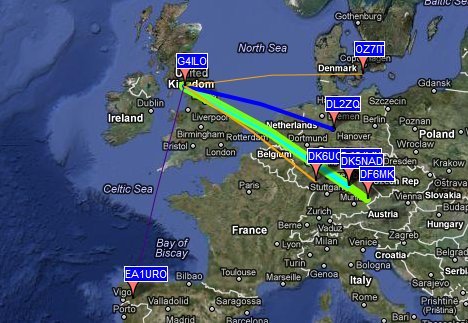 |
| 10m WSPR spots for G4ILO – 13 April 2012 |
Someone asked me whether these WSPR spots were obtained using the Propeller beacon I have been writing about. I’m afraid not. I haven’t managed to solve the frequency stability problems of my Gadget Gangster board so I’ve been using my K3 for transmit and receive.

New WSPR map
In case you didn’t know about it already, check out this new map of recent WSPR spots. (Editor’s note: please be advised that we have had a report of this link freezing a computer and requiring a reboot. I do not believe that it’s a malicious link, but it may be very resource intensive to load…)
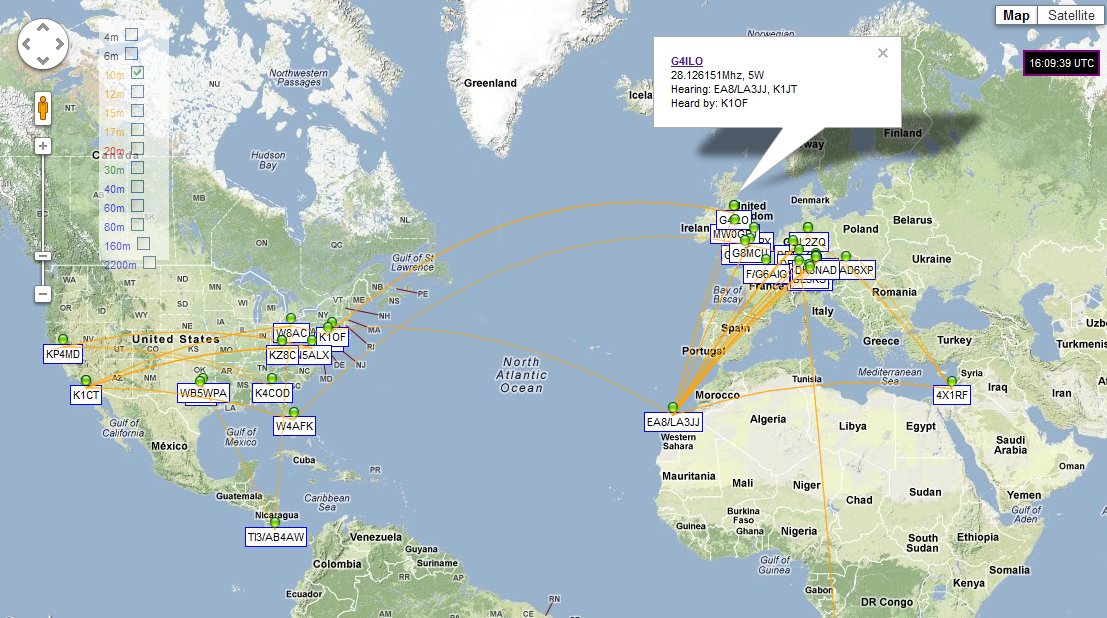
It’s much faster than the ‘official’ one, which could bring Firefox to its knees on a slow computer. And it remembers allyour preferences including zoom level. A must-bookmark, if you’re a WSPR fan.

Gremlins
This year I have decided to focus on the high frequency bands – 10m and 6m – this spring and summer. The predictions for the peak of this solar cycle are not very good, as you can read in several blogs, but it’s all we’re going to get for the next 10 years so I may as well make the best of it.
To this end I have started WSPRing on 10m when I switch on in the morning, with the intention of moving up to 6m if there appears to be a chance of propagation. On the previous few days I have been rewarded with a two-way path to VK on 10m at quite decent signal strengths. Not bad for 5 watts to an attic dipole. But today I received not a single spot, not a single trace.
Although not the reason for the lack of spots today, I think there is a gremlin in the machine. Twice I have come up to the shack to see what is happening and found the K3 in transmit mode but with no RF output. The K3 monitor mode shows no audio is being sent to the radio, so it isn’t a radio problem. The WSPR software settings haven’t changed, and are correct. Restarting the program makes no difference. The only solution is that hoary old first resort of the computer technician: Switch it off and then switch it on again. Works every time. But I wish I knew why it is doing it.

No contest
At the weekend I noticed that the CQ WW WPX phone contest was on. I’m not a fan of phone contests – hollering your call into a mic over and over again is not my idea of fun – but I thought it might be interesting to see what I could hear or work on 10m when so many stations were on.
In the end I only made a handful of contacts. It was just too manic for my current state of mind. I couldn’t remember the serial numbers I was given before typing them into the log, so I would have to wait for the station I worked to make another contact and see what the next serial number was. I much prefer CW contests using a code reader to print up the exchange so that I can just double-click the information to enter it error-free in the log.
I’ve just started my final cycle of chemotherapy and it has knocked me back a bit. So I think I’ll stick to pastimes like WSPR and JT65 that have a more relaxed pace until I’m feeling better.

Disastrous drift
I have decided to shelve the Propeller Beacon project. Actually the project made the decision for itself. Bored with receiving spots for my 250mW WSPR signal on 30m I decided to try 20m where there are almost as many monitors. But after a handful of spots there was nothing. After a while I decided something must be wrong.
I checked that the beacon was still transmitting at the right times and it was. So I switched on the K3, ran the WSPR software and the reason for the lack of spots became clear. My signal was drifting the best part of 10Hz in each two minute cycle!
When I first ran the beacon on the bare Propeller board I had found the signal to be pretty stable after only a few minutes warm-up. After adding the LCD board – which plugs on top of the Propeller board – I noticed that my 30m transmissions were being quite consistently reported with -3Hz drift. The RF amplifier board with its heatsink is separate from the Propeller board and nowhere near its crystal oscillator. I hypothesized that the LCD board is trapping some heat in, enough to make the master clock oscillator drift.
The drift is probably a multiplication factor of the clock frequency so the higher in frequency you go, the worse the drift. Whatever the explanation, the Propeller + LCD combination is not usable as a WSPR beacon as it is.
It seems to me that there are two possible solutions. One would be to make my own Propeller processor board with a temperature controlled crystal clock. The other would be to use the Prop to control a Si570 synthesizer or something like that. Unfortunately I don’t think either of those solutions are within my capabilities just at the moment. So I’m afraid the beacon project will be going on the shelf.

Now output
Everyone who commented to my last post about the lack of output from the Kits and Parts RF amp felt that the problem had to be the QRPer’s curse – the toroid inductor. Normally I don’t have a problem with toroids, but when they are so small that your thumb obscures the whole core while you are holding it, never mind winding it, they are not the easiest of components to work with.
So I gritted my teeth, tried to forget the hour I’d spent yesterday wrestling the thing into position, and yanked it out. One of the wires broke off in the hole leaving nothing to grab on to. I was unable to clear the small plated-through holes in any case. What I was able to do was melt the solder enough to push some bare wire through, creating “pins” that I could solder to. I twisted together the two wires that are connected so I had three ends to solder to the three pins I created. The toroid now stands up on the board a bit but it was easier soldering to the pins than trying to get four thin wires to go through four holes simultaneously. To my joy, on applying power and RF the power meter showed output.
I’m getting about 150mW if the amp is supplied with the recommended 8V, and just about 200mW from a 9V supply. That’s only about 10dB of gain, a bit less than expected but probably enough given that the Propeller does not generate the purest of signals. The WSPR beacon has already been spotted a few times in Germany. But the 2N5109 runs a bit hot to the touch so I’ll have to QRT until the heatsink I ordered arrives. In the meantime I still have the LCD UI board to assemble and play with.

Some assembly required
Yesterday a packet from the USA dropped on to the doormat. It was the LCD UI module from Gadget Gangster. The cheap international shipping option is pretty quick!
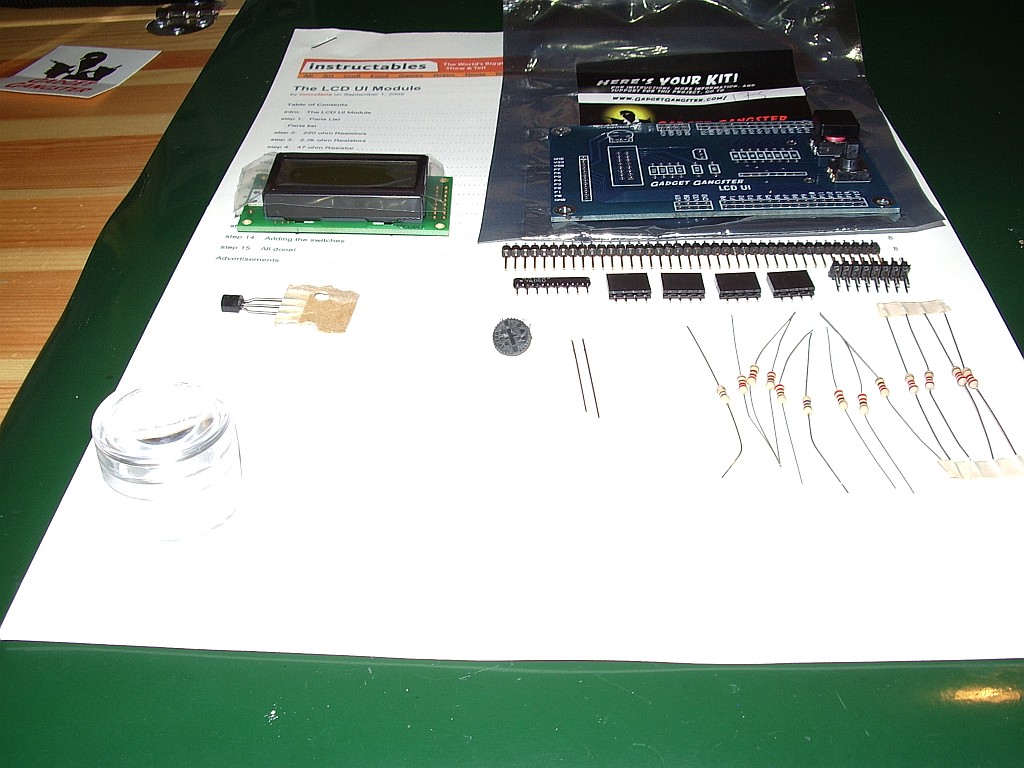 |
| LCD UI module ready for assembly |
On opening the envelope I was taken by surprise as I hadn’t realized the module was a kit. But there aren’t too many components and they are all through-hole so I should be able to manage it. I will take my time and double check everything to ensure I don’t do anything stupid like solder headers on the wrong side of the board. More than a few K2 builders have done that!
The instructions on the Gadget Gangster website are very comprehensive with several colour photos showing different stages of assembly. But on checking the parts against the parts list I found that I was missing one 2×8-pin header socket. Fortunately I found one (a pack of 2 actually) for a couple of quid from a UK based eBay component supplier so I should have it in a couple of days. eBay is my main source of electronic components these days as the usual sources like Farnell or Maplin all have hefty minimum order and postage charges that make ordering the single part you need to complete a project quite uneconomic.
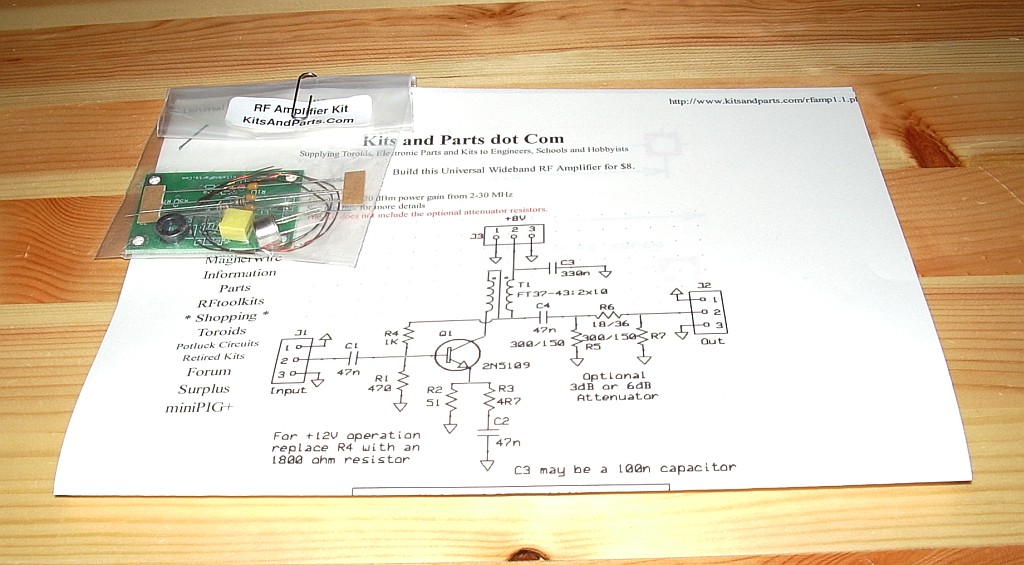 |
| Kits and Parts Universal RF Amplifier |
A few days earlier I received another kit from the USA: a QRP RF amplifier from Kits and Parts. I got this with the idea of using it with my Propeller beacon but it is probably too good for that. The beacon really needs only a simple class C amplifier to raise its output to a couple of hundred milliwatts. I had been tempted to go for a couple of watts but whilst WSPRing on 20m today and monitoring the signal on the K2 I noticed a weak in-band spurious around 14.05 MHz which no low-pass filter will eliminate. So it is probably best to stick to QRPp if using the Propeller as an RF source.
Another new arrival in the G4ILO shack was a GPS module from Hong Kong. This was used, ex-equipment, and cost about £12 including postage. I’m not sure what I am going to use it for but if I don’t put it in the beacon to provide a time reference (and locator) for WSPR it would be interesting to try to make an APRS tracker using the Propeller chip.
So many projects! But I am convinced that having this amateur radio hobby to give me so many different and interesting activities is the reason I remain cheerful and positive unlike so many people who have the same health condition and seem to fall into a slough of despond and hopelessness. I may never complete them but at least they give me something to stop me dwelling on darker thoughts.














