Posts Tagged ‘WSPR’
 October 7th, 2012 |
  Author:







 Double-hop Es?
Thursday brought more great 10m propagation. Take a look at the screen-grab below.
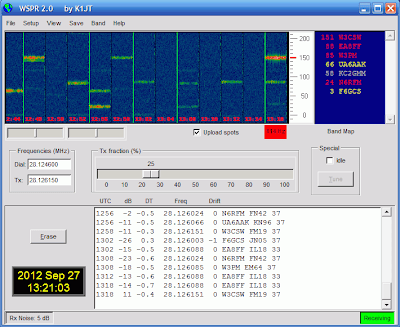 |
| 10m WSPR signals received on G4ILO’s attic dipole |
The bright trace at the top right is the 10 watt signal of W3CSW at 11dB over noise. That is one of the strongest WSPR traces I’ve ever seen, and definitely the strongest signal from a station outside Europe. I think it has to be double-hop Sporadic-E propagation. It is interesting that my previous spot of the same station was 11dB below the noise. My 2 watts produced a positive result from his side as well.
Tuning around the 10m band and there was not the wall of loud signals that such good propagation would suggest. A couple of good old boys from Mississippi and Tennessee were chewing the rag, oblivious to the fact that their signals were bending S meter needles thousands of miles away. But apart from those few stations there was an absence of signals. A station I worked called CQ with no takers for some time afterwards. I tried CQing myself, with no result. To me this also shows that the enhanced propagation was very selective, supporting the theory that it was Sporadic-E propagation.
 |
| 10m signals spotted by G4ILO, 27/9/2012 |
I did make a couple more SSB contacts but once again the digital sector provided the best returns for my efforts.
There is yet more interesting 10m propagation today. I have already spotted stations from VK2 and from Thailand. It’s a shame you can’t WSPR and operate on the same band at the same time. Or rather, it’s a shame that I can’t. So I’ll switch between modes, running WSPR when I’m not actually in the shack and able to use the keyboard or mic.

10m wide open!
Ten metres has been wide open today. Stations have been heard or worked in just about all directions. I ran 2 watts of WSPR during the periods that I wasn’t in the shack and the program screen resembled 30m!
 |
| WSPR spots on 10m at G4ILO, 26/9/2012 |
After a short period of WSPR I switched to voice mode and made a nice SSB contact with Ken, JA2FJP near Nagoya (nothing to do with cheap Chinese antennas!) After a rubber-stamp contact with R100BG I found phone a bit hard going with all the QRM and pileups so I retreated to the more restful pastime of working digimodes.
 |
| Digital stations hrd/wkd at G4ILO, 26/9/2012 |
I made one more Japanese contact – with JI4POR – and made my first-ever China contact – with BG8GAM – all on PSK31. I heard several more stations from those countries and also one from Korea (South, presumably) and one from Indonesia but didn’t manage to work them. Better luck next time!
A session of calling CQ produced an endless succession of Russian stations. Where do they all come from? There is no chance of working interesting DX unless you search and pounce on the DX stations. Even when calling a specific DX station I was being called by Russian stations! Why do they do it? I lost the chance of a couple of first contacts because of it.
As the afternoon wore on many stations from North America and Canada started to be in evidence. My final PSK31 contact for the day was with Bob KZ0G in Missouri which is probably a first for that state for me.
Not a bad haul for a few hours listening / operating using a maximum of 40 watts PSK31 to an attic dipole. I wish there were more days like that!

My first 24 hours on WSPR

My first beacon on 30 m, a free-running Ultimate QRSS kit (no GPS) has now been running for a full 24 hours using the Weak Signal Propagation Reporter (WSPR) mode. The figure comes from the WSPRnet page.
With an output power of about 150 mW to an 80 m horizontal loop it has not been possible to reach beyond Europe so far. Perhaps this will happen in the future with better conditions and/or with some more output power.
Added 26.9.2012: I made it for the first time across the Atlantic!
Timestamp Call MHz SNR Drift Grid Pwr Reporter RGrid km az
2012-09-26 00:50, LA3ZA, 10.140262, -26, -2, JO59fu, 0.2, WB2EEE, FN21xh, 5852, 290













