Posts Tagged ‘WSJT’
 Getting Started On The New LF and MF Bands
 September 26th, 2017 |
  Author:
  Finally the long wait is over! The LF 2200m band and the MF 630m band have finally arrived for amateurs in the USA! I'm sure most of you have read the fine print regarding deployment of the two bands, but if not, here is the ARRL's recent announcement.
It has been a very long wait for the FCC to implement these bands after they were approved for amateur use in 2007 and 2012 at the World Radiocommunication Conferences in Geneva. Canadian amateurs have had 630m since 2014 and 2200m since 2009 ... in the meantime, we have been anxiously awaiting the arrival of American amateurs to liven things up and to garner new interest in these bands.
Before operating on these bands, amateurs in the USA are required to register their intent via a simple web form found here on the Utilities Technology Council's website. Then follows a 30 day waiting period during which the UTC will check out your location to be sure that you are not located within 1km of any power lines that might be carrying LF or MF PLC (Power Line Carrier) control signals. If you hear nothing back from UTC within 30 days, you are good to go.
A positive outcome of registering via the UTC form is that there can be no PLC signals implemented on the lines near you at a later date! By registering your intended operating location(s), you are locking-in these spots for no further PLC development. If you have an EOC or Field Day site that you think you may want to operate from at some point, register these as well.
I think it is important that even if you do not intend to operate on either of these bands or perhaps a few years down the road, that you register as soon as possible ... the fewer PLC signals operating close to or within the amateur radio spectrum, the better, and this is one way of furthering that goal.
There has already been a vast amount of published information on both of these bands, describing transmitters, receiving systems and transmitting antennas so I won't go into much detail here regarding these topics ... and besides, it's always very interesting to search these things out yourself, learning as you go. Be assured that either of these bands will present interesting new challenges not encountered in typical HF operation, but all of the basic principles you are used to still apply ... it's just that things are much bigger down below the broadcast band!
Far and away, the best source of information for US amateurs can be found on John Langridge's (KB5NJD) NJDTechnolgies website. John has been operating on MF for several years already with an experimental licence (WG2XIQ) and is more than an expert on this topic.
His daily blog includes a detailed account of worldwide activity on 630m and makes for fascinating reading. His website provides all of the information and valuable links that you might need to plan your own LF or MF station. The information on his site, if printed out, would make a wonderful LF / MF Handbook!
My own blog and website also contain much helpful material, with a particular emphasis on Canadian activity on these bands. All of my blogspots dealing with 630m can be found here and contain enough bedtime reading to keep you busy for many nights.
If you are thinking of getting on either of these new bands, particularly 630m, here is a short Q & A that may help you through the initial planning stage of how to get started.
What modes are commonly used on these bands?
At present, due to the low level of two-way amateur radio activity, the WSPR mode has been dominant. This is a weak-signal 'beacon-only' mode so most two-way contacts take place either on CW or on the weak signal JT-9 mode. JT-9 has been specifically designed for HF and LF / MF weak signal two-way work and can dig as deep as -27db into the noise to provide a contact that could never be completed on other conventional modes such as CW.
With the influx of new activity on these bands, particularly on 630m, I expect that most two-way work will equal or surpass the amount of WSPR activity and that JT-9 and CW will do most of the heavy-lifting.
How far can I work on these bands?
Although the erp limits appear to be QRP-sized, this is somewhat misleading ... it is astonishing what can be done. Don't think that '5W eirp' means that you can only run a transmitter capable of generating 5W. Because antennas are so inefficient on these bands, it is often necessary to run several hundreds of watts in order to achieve the legal eirp limits. The bigger and more efficient your antenna, the lower the power needed becomes. On many nights, 5W eirp will get you clear across the country on MF.
However, if you build something for 630m that only produces 25W of power, you will still have the capability of working many stations in other states on most winter evenings or mornings, as propagation, the 'great equalizer', can be amazing at times.
Presently, most stations operating on WSPR will often be detected from one coast to the other and those with excellent locations near the coast will soon be working stations down under or in Europe, either on CW or on JT-9. If you can, design and build for the maximum eirp, 1W on 2200m and 5W on 630m.
What type of transmitter do I need?
If your interests are only in CW, then the sky is the limit when it comes to design. There are numerous simple solid state transmitter designs out there, using inexpensive FETs to generate power. I'm hoping, along with many others, that there will be a considerable amount of CW activity on 630m and even a simple 25-watter should provide you with lots of fun. There may also be some appetite for QRSS CW which can give the weak-signal digital modes a run for their money while still using a simple transmitter.
If you are interested in digital modes, such as WSPR or JT-9, the easiest way is through the use of a transverter to take care of converting your HF transceiver's capabilities to LF or HF. There are presently a few commercial transverter options available and can be found on the NJDTechnologies links page.
A good choice is the inexpensive 630m transverter produced by John Molnar, shown below and available both as a kit or prebuilt. It works well and is very popular.
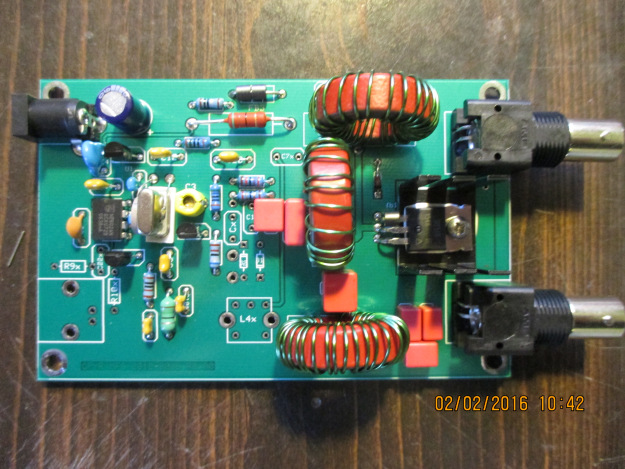 |
| 630m Transverter - John Molnar WA3ETD / WG2XKA |
 |
| G3XBM -630m Transverter |
If you want something in the 'Collins category', the tranverters (both 2200m and 630m models) produced by VK4YB's Monitor Sensors provide around 70W output and are incredibly well designed and built. I have been very happily employing a 630m model for well over a year now ... my review of the transverter can be found here.
 |
| VK4YB - 630m Transverter |
I would like to put on a beacon. What do you suggest?
The best and most informational type of beacon is a WSPR mode beacon. A WSPR beacon operator can always determine where his beacon is being heard, in real time, along with how well it is being heard, by watching the uploaded 'spots' of his beacon on the WSPRnet. You will have much better coverage with this weak-signal mode beacon compared to one on CW ... for every CW report received, you would likely get ten times or more that number on WSPR.
Although WSPR is a great mode for checking out propagation, it's very easy to get into the habit of nightly beaconing and not developing your station any further. If you do run a WSPR beacon, be sure to try some of the other two-way modes such as CW or JT9 and call CQ regularly ... ham radio is all about making two-way contacts!
I don't have enough property for the large antennas required, so I won't be able to use these bands.
Even if you are limited in space, you can still enjoy these bands. There are many examples of stations on small city or suburban-size lots that are consistently heard across North America on 630m. If you have the room for an 80m or 40m dipole or inverted-L, that will be enough space to work these bands. An inverted-L for example, can be base-loaded and tuned to resonance. Along with several ground radials, even a small antenna system like this will allow you to work skywave DX or be heard across the country when propagation is good. I'm constantly amazed at how well these bands propagate with very low amounts of erp. Don't let living on a small lot stop you from exploring these bands!
All I hear is noise on these bands ... how can I use them if I can't hear anything?
Growing noise floors are common to everyone and this is often the biggest challenge for LF and MF operators, especially those in densely populated regions. Armed with a little knowledge and investigation, oftentimes seemingly impossible QRN can be substantially reduced if not eliminated entirely ... even easier when the noise source is found to be in your own home! While some amateurs just give up at this stage, most will see it as an interesting challenge to be overcome and part of the many learning experiences offered by these new bands.
In addition to the informational links provided above, I have just added a new 'Getting Started On 630m' page to my website. This page has a two-part article that I recently wrote for The Canadian Amateur, our national amateur radio journal. The articles describe a simple way of getting on 630m CW as well as providing some basic antenna information and ideas.
This blog also has extensive writings involving 630m over the past few years, describing equipment used and suggestions for new operators, much of it involving homebrewing. There are several links on the right that will take you to specific blogs dealing with 630m.
For present LF and MF operators here in Canada, the arrival of our American friends to these bands is generating much excitement and anticipation. The opening of these bands in the USA will pump new life into this part of the spectrum for all North American participants and the opportunities for homebrewing and experimenting are boundless. It should be a very exciting winter!
If you have not taken the 60 seconds required to register your station on the UTC webpage, please don't neglect to do this via the link provided above. There have, reportedly, been thousands of amateurs doing this already, as it effectively locks-out their locations for any future PLC deployment that might keep them off these bands at a later date.
See you in mid-October on 630!
Canada Post / QSLs / Magicband Transformations

Several weeks ago I mused about my interest in earth-mode VLF experiments, following the inspirational exploits of G3XBM in his earth-mode work a few years ago.
His low powered system utilizing a 5W audio IC and simple circuitry produced surprisingly interesting results over several kilometers.
With possible future experimenting in mind, I found a nice low-powered IC audio amplifier kit from China on e-Bay, capable of producing about 18W at 12V ... more with higher voltage and proper heat-sinking.


Whenever buying from China, I look for a dealer with the highest feedback rating and always compare their complaints versus the number of orders shipped. There always seems to be a few that are 99.9 - 100%, which, for me, has always assured that they are probably not selling junk. Anything lower than 98% can often be a red flag.
The kit was just $1.50 and with free-shipping, what's to lose?
A few weeks after I had placed my order, the nightly TV news had a spot regarding the problem that these "free shipping" packets were creating for Canada Post and their customers. It seems that in the past few months, as more and more "free" shipments were arriving from the far east, Canada Post had not been able to keep up with the processing. The news spot showed row upon row of shipping containers parked at the back of Vancouver International's (YVR) postal processing plant, with all of them filled with thousands of small "free" packets waiting to be processed!
It seems that each packet needs to be scanned by the border security folks (CBSA) for illegal material before it can be processed by Canada Post and the back-up was building at a tremendous rate. There appears to be little if any profit for Canada Post with these smaller untracked packages and they are given the lowest priority-rating possible.
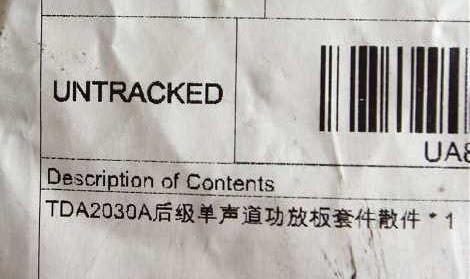
In order to speed up the process, both CBSA and Canada Post facilities would need to expand their operational capabilities at the airport and I suspect there is no serious will to do this until pressured politically by angry customers.
All parcels from China that are mailed to Canada stop at Vancouver's YVR before going further. The mammoth recent increase in online "free-shipping", in spite of the normally estimated 3-4 week delivery time, has proven too attractive for customers and our domestic system has failed to meet the new load demands.
With this new information in mind, my e-Bay purchase would prove to be an interesting test of the system and of the TV news spot's accuracy. Normally, I would have expected my tiny parcel to arrive in about 30 days, but mine would be one that eventually ended up in the airport parking lot.
The kit finally arrived this week, with a delivery time of 89 days! Many online sellers will offer an inexpensive option to pay for faster shipping, something that will still take a couple of weeks but much better than three months. If you are given this inexpensive shipping option I would highly recommend that you choose it, and if not, ask for an alternative to "free shipping". Unless something changes soon, delays will continue to increase.
I also wonder, and perhaps you can comment below, are U.S. customers seeing the same long delays as we here in Canada are experiencing when the "free shipping" option is chosen?

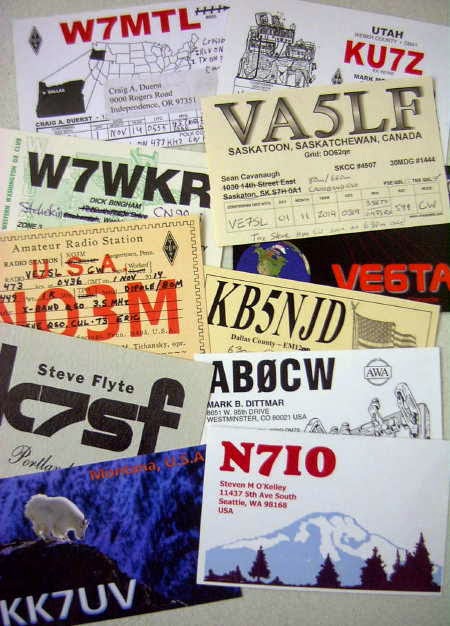
QSLs in my mailbox always excite me ... especially like yesterday's, arriving in a thin light-brown envelope decorated with colorful stamps.
I'm 100% certain this is because of receiving similar-appearing envelopes containing QSL cards during my formative years from age eleven onward and how much enjoyment the cards from shortwave stations all over the world brought me at this young age. For me, there is no replacement for a paper QSL, but sadly, this long-standing tradition is slowly slipping away due to the high cost of mailing even a normal-size envelope.
Earlier this summer I had a nice run of JA's on 6m Es but this time, instead of CW, they were on JT65A. Yesterday's card was for one of the digital contacts.

Signals were weak, at -23 db ... far too weak to be heard on CW but easily readable during the 60 second deep-listen period mandated by the JT65A mode. With so many stations now listening higher in the band for JT-mode signals, there has been very little activity on CW and now, with the introduction of yet another new digital mode, FT8, even the digital activity is split into sections, with neither mode being compatible.
I have held off installing the newer WSJT-X version containing the FT8 fifteen-second transmission mode until all of the bugs are ironed out ... the software will likely be tweaked a few more times yet before it reaches the polished final version we see for JT65 and others.
FT8 has been designed for weaker 6m Es openings that are often too short in duration for the longer time periods needed by JT65's sixty-second sequences. FT8 contacts can be completed quickly, before short-lived signals can drop out, but the shorter sequences come at the cost of reduced sensitivity ... probably a worthwhile tradeoff.
Conventional mode activity on 6m has suffered tremendously with the introduction of these new modes and it seems that if you want to work weak signal DX (and not all do), sadly it may be digital or nothing at all if the trends continue.
If all of the DX moves from CW to digital, for me, much of the magic will disappear as well. Letting the computer do all of the thinking is not nearly as satisfying or enjoyable as using my brain and CW skills to put a new rare one in the log. Six meters continues to evolve and I'm not overly excited by the direction it seems to be going.
Canada Post / QSLs / Magicband Transformations
Several weeks ago I mused about my interest in earth-mode VLF experiments, following the inspirational exploits of G3XBM in his earth-mode work a few years ago.
His low powered system utilizing a 5W audio IC and simple circuitry produced surprisingly interesting results over several kilometers.
With possible future experimenting in mind, I found a nice low-powered IC audio amplifier kit from China on e-Bay, capable of producing about 18W at 12V ... more with higher voltage and proper heat-sinking.
Whenever buying from China, I look for a dealer with the highest feedback rating and always compare their complaints versus the number of orders shipped. There always seems to be a few that are 99.9 - 100%, which, for me, has always assured that they are probably not selling junk. Anything lower than 98% can often be a red flag.
The kit was just $1.50 and with free-shipping, what's to lose?
A few weeks after I had placed my order, the nightly TV news had a spot regarding the problem that these "free shipping" packets were creating for Canada Post and their customers. It seems that in the past few months, as more and more "free" shipments were arriving from the far east, Canada Post had not been able to keep up with the processing. The news spot showed row upon row of shipping containers parked at the back of Vancouver International's (YVR) postal processing plant, with all of them filled with thousands of small "free" packets waiting to be processed!
It seems that each packet needs to be scanned by the border security folks (CBSA) for illegal material before it can be processed by Canada Post and the back-up was building at a tremendous rate. There appears to be little if any profit for Canada Post with these smaller untracked packages and they are given the lowest priority-rating possible.
In order to speed up the process, both CBSA and Canada Post facilities would need to expand their operational capabilities at the airport and I suspect there is no serious will to do this until pressured politically by angry customers.
All parcels from China that are mailed to Canada stop at Vancouver's YVR before going further. The mammoth recent increase in online "free-shipping", in spite of the normally estimated 3-4 week delivery time, has proven too attractive for customers and our domestic system has failed to meet the new load demands.
With this new information in mind, my e-Bay purchase would prove to be an interesting test of the system and of the TV news spot's accuracy. Normally, I would have expected my tiny parcel to arrive in about 30 days, but mine would be one that eventually ended up in the airport parking lot.
The kit finally arrived this week, with a delivery time of 89 days! Many online sellers will offer an inexpensive option to pay for faster shipping, something that will still take a couple of weeks but much better than three months. If you are given this inexpensive shipping option I would highly recommend that you choose it, and if not, ask for an alternative to "free shipping". Unless something changes soon, delays will continue to increase.
I also wonder, and perhaps you can comment below, are U.S. customers seeing the same long delays as we here in Canada are experiencing when the "free shipping" option is chosen?
QSLs in my mailbox always excite me ... especially like yesterday's, arriving in a thin light-brown envelope decorated with colorful stamps.
I'm 100% certain this is because of receiving similar-appearing envelopes containing QSL cards during my formative years from age eleven onward and how much enjoyment the cards from shortwave stations all over the world brought me at this young age. For me, there is no replacement for a paper QSL, but sadly, this long-standing tradition is slowly slipping away due to the high cost of mailing even a normal-size envelope.
Earlier this summer I had a nice run of JA's on 6m Es but this time, instead of CW, they were on JT65A. Yesterday's card was for one of the digital contacts.
Signals were weak, at -23 db ... far too weak to be heard on CW but easily readable during the 60 second deep-listen period mandated by the JT65A mode. With so many stations now listening higher in the band for JT-mode signals, there has been very little activity on CW and now, with the introduction of yet another new digital mode, FT8, even the digital activity is split into sections, with neither mode being compatible.
I have held off installing the newer WSJT-X version containing the FT8 fifteen-second transmission mode until all of the bugs are ironed out ... the software will likely be tweaked a few more times yet before it reaches the polished final version we see for JT65 and others.
FT8 has been designed for weaker 6m Es openings that are often too short in duration for the longer time periods needed by JT65's sixty-second sequences. FT8 contacts can be completed quickly, before short-lived signals can drop out, but the shorter sequences come at the cost of reduced sensitivity ... probably a worthwhile tradeoff.
Conventional mode activity on 6m has suffered tremendously with the introduction of these new modes and it seems that if you want to work weak signal DX (and not all do), sadly it may be digital or nothing at all if the trends continue.
If all of the DX moves from CW to digital, for me, much of the magic will disappear as well. Letting the computer do all of the thinking is not nearly as satisfying or enjoyable as using my brain and CW skills to put a new rare one in the log. Six meters continues to evolve and I'm not overly excited by the direction it seems to be going.
May Moonbounce / More 6m WSJT Observations
 Late May's EME activity seemed poorer and less active than the previous month of northern declination moonrises.
Unlike winter's northern moonrises, the summer ones occur close to 'new moon' time and for a few days on the much favored northern path, the moon is too close to the sun, resulting in lower activity and higher noise. As well, with the warmer summer weather, outdoor projects or other summer activities often take priority over ham radio operations at this time of the year.
Nevertheless, I did manage to work five stations with my small station, and added four 'new initials', bringing my total unique-station QSO total to 105 ... it seems there are still plenty of folks out there that I have yet to work!
- VE1KG
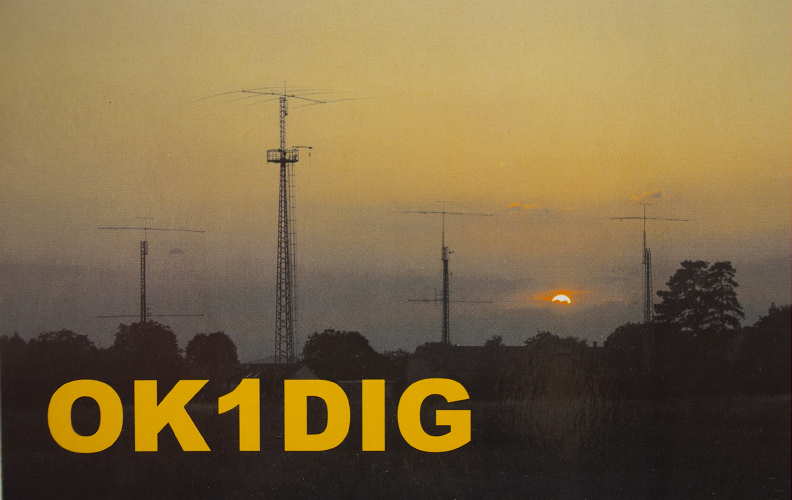
- OK1DIX #102
- S53K #103
- IK1UWL #104
- OZ1CT #105
 |
| IK1UWL's 4 x 9el cross-polarized array |
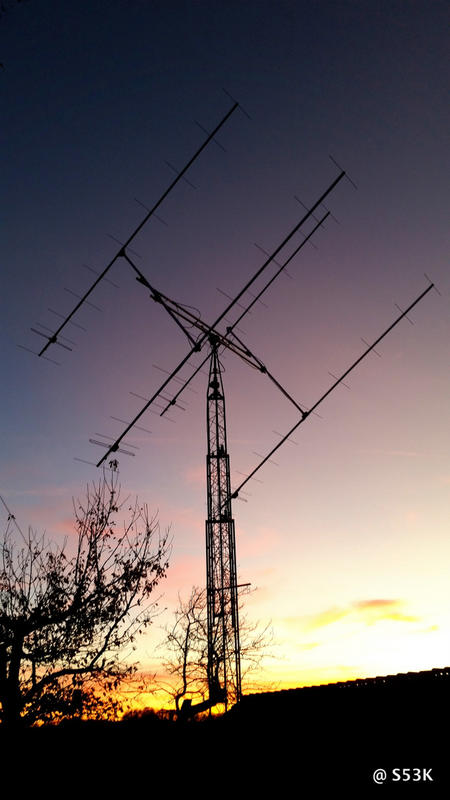 |
| S53K's 4 x 11el array |
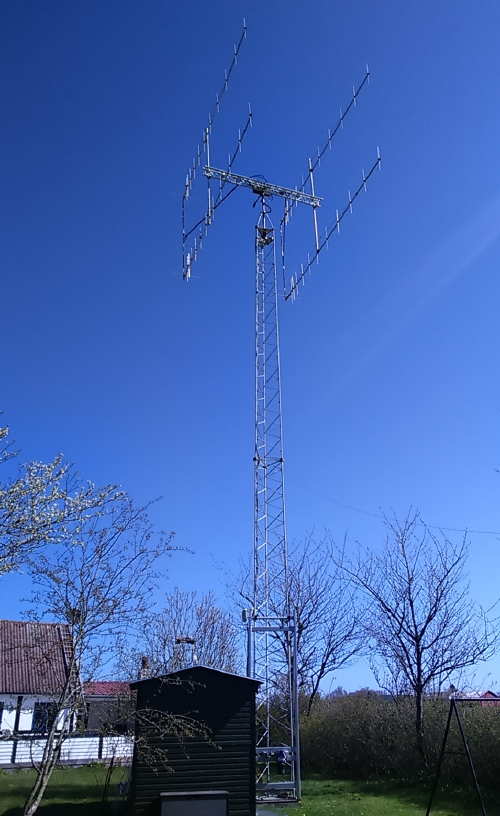 |
| OZ1CT's 4 x 10el cross-polarized array |
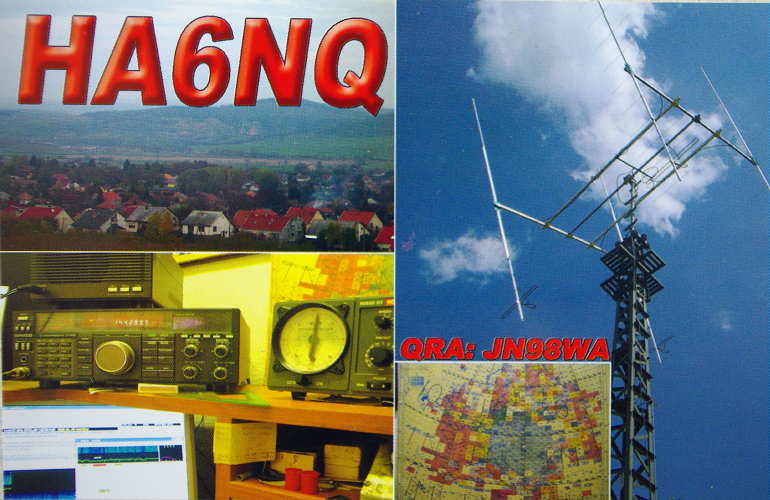
Latest Incoming EME QSLs:




With the summer Sporadic-E season now in full swing, I've had the opportunity to make some early observations regarding the growing use of the weak-signal digital modes. It seems my previous suspicions about the migration from traditional modes to the digital modes is occurring even more rapidly and in much larger numbers than I had expected. Almost all early activity has been concentrated on both JT65 and JT9 modes and most of the chatter on the ON4KST 6m chat page centers around these digital modes.
So far this season I have heard much more DX on JT65 than on CW or SSB, including two stations in Europe on Tuesday (EI4DQ and F5LNU). It seems that many QSO's are taking place with signals that are usually too weak to be heard by ear (~ -16db or weaker) and if listening for CW signals, the band would appear to be pretty much dead. With no full-blown openings to Europe yet, I just wonder if stations will stay put on JT65 or move to the much faster CW mode for making quick contacts when the propagation allows?
Making JT65 contacts is not a particularly fast process, with most QSOs taking a minimum of four minutes, if both operators are well acquainted with the procedures ... longer if not or if QRM or propagation throws a spanner into the works. Some of the newer JT9 sub modes allow for quicker exchanges as does the much less sensitive MSK144 mode but with so many options now available, it's often difficult to get everyone on the same mode or at least figure out what mode you are seeing!
I can see the advantages of using these modes when conditions will not support CW but will still allow digital decodes. If the normal 'weak signal window' can be sustained for a much longer time period than the usually short-lived audible CW-level window, perhaps more stations could actually be worked on these modes even though the QSO rate is much slower. But I still think that many easy CW QSO's will inevitably be missed when operators are watching their digital waterfalls and ignoring the CW end of the band ... of course, if everyone is doing that, then there will be nothing to be heard on CW, even though conditions may well support good signals.
It's a strange new situation and I'm probably not the only one that may be worried about the negative effects of the new weak-signal modes on 6m ... time will tell, but for me, if things keep going along this path, much of 6m's magic may be gone along with it.
Some other initial observations are:
- maybe it's possible to work more DX on weak signal mode, even though it is slower, because of the possibly longer propagation window at sub audible signal levels? ... ie. on a seemingly 'dead band' by ear.
- many are using the wrong sequence when calling for EU or JA. Folks need to pay attention to what sequence the DX is using!
- if your neighbours are running on even or odd sequence, then it might be neighbourly to also use the same sequence to avoid causing disruptive QRM. This seems to go south fast, once the band breaks wide open and it seems like 'every man for himself' ... not unlike 50.125!
- there are too many weak-signal modes and it would be advantageous to settle on a 'standard' mode for 6m DX. It seems as though many are wasting valuable time either switching modes or trying to figure out what mode they are seeing but not decoding! On long haul 6m Es, things change too quickly to waste time.
- there are still a lot of over-driven signals or signals with 60Hz components causing double decodes +/- 60Hz from their main signals.
May Moonbounce / More 6m WSJT Observations
Late May's EME activity seemed poorer and less active than the previous month of northern declination moonrises.Unlike winter's northern moonrises, the summer ones occur close to 'new moon' time and for a few days on the much favored northern path, the moon is too close to the sun, resulting in lower activity and higher noise. As well, with the warmer summer weather, outdoor projects or other summer activities often take priority over ham radio operations at this time of the year.
Nevertheless, I did manage to work five stations with my small station, and added four 'new initials', bringing my total unique-station QSO total to 105 ... it seems there are still plenty of folks out there that I have yet to work!
- VE1KG
- OK1DIX #102
- S53K #103
- IK1UWL #104
- OZ1CT #105
|
| IK1UWL's 4 x 9el cross-polarized array |
|
| S53K's 4 x 11el array |
|
| OZ1CT's 4 x 10el cross-polarized array |
Latest Incoming EME QSLs:
With the summer Sporadic-E season now in full swing, I've had the opportunity to make some early observations regarding the growing use of the weak-signal digital modes. It seems my previous suspicions about the migration from traditional modes to the digital modes is occurring even more rapidly and in much larger numbers than I had expected. Almost all early activity has been concentrated on both JT65 and JT9 modes and most of the chatter on the ON4KST 6m chat page centers around these digital modes.
So far this season I have heard much more DX on JT65 than on CW or SSB, including two stations in Europe on Tuesday (EI4DQ and F5LNU). It seems that many QSO's are taking place with signals that are usually too weak to be heard by ear (~ -16db or weaker) and if listening for CW signals, the band would appear to be pretty much dead. With no full-blown openings to Europe yet, I just wonder if stations will stay put on JT65 or move to the much faster CW mode for making quick contacts when the propagation allows?
Making JT65 contacts is not a particularly fast process, with most QSOs taking a minimum of four minutes, if both operators are well acquainted with the procedures ... longer if not or if QRM or propagation throws a spanner into the works. Some of the newer JT9 sub modes allow for quicker exchanges as does the much less sensitive MSK144 mode but with so many options now available, it's often difficult to get everyone on the same mode or at least figure out what mode you are seeing!
I can see the advantages of using these modes when conditions will not support CW but will still allow digital decodes. If the normal 'weak signal window' can be sustained for a much longer time period than the usually short-lived audible CW-level window, perhaps more stations could actually be worked on these modes even though the QSO rate is much slower. But I still think that many easy CW QSO's will inevitably be missed when operators are watching their digital waterfalls and ignoring the CW end of the band ... of course, if everyone is doing that, then there will be nothing to be heard on CW, even though conditions may well support good signals.
It's a strange new situation and I'm probably not the only one that may be worried about the negative effects of the new weak-signal modes on 6m ... time will tell, but for me, if things keep going along this path, much of 6m's magic may be gone along with it.
Some other initial observations are:
- maybe it's possible to work more DX on weak signal mode, even though it is slower, because of the possibly longer propagation window at sub audible signal levels? ... ie. on a seemingly 'dead band' by ear.
- many are using the wrong sequence when calling for EU or JA. Folks need to pay attention to what sequence the DX is using!
- if your neighbours are running on even or odd sequence, then it might be neighbourly to also use the same sequence to avoid causing disruptive QRM. This seems to go south fast, once the band breaks wide open and it seems like 'every man for himself' ... not unlike 50.125!
- there are too many weak-signal modes and it would be advantageous to settle on a 'standard' mode for 6m DX. It seems as though many are wasting valuable time either switching modes or trying to figure out what mode they are seeing but not decoding! On long haul 6m Es, things change too quickly to waste time.
- there are still a lot of over-driven signals or signals with 60Hz components causing double decodes +/- 60Hz from their main signals.
Growing 6m JT65 Activity
 |
| image courtesy: http://g8yph.blogspot.ca/ |
On several occasions this week, I have heard or worked dozens of others on JT mode while the bottom end of the band appears void of signals. Thursday morning was a good example, with several contacts down into the southeastern 'EM' grids on JT mode while seeing no reports of similar contacts being made on CW or SSB from my region.
This summer, there appears to be much more interest in 6m JT65 than ever before, as I see many familiar CW operators up the band on digital. There is no doubt that JT65's ability to dig deep into the atmospheric band noise and decode signals too weak to be heard on CW, provides an advantage when conditions are marginal. Perhaps this alone explains why I see such a difference between the two segments of the band. This is when JT65 really shines as it is primarily a weak-signal mode.
When the band really opens up however, things are different ... things can get messy pretty fast when the JT65 band fills-up with S9+ signals! Under these conditions, moving well away from the crowd is often better than trying to fight overlapping signals, often made worse by S9++ signals in your own grid, transmitting on the opposite sequence. In this respect, the JT65 segment is like a wider version of the 50.125MHz calling frequency ... the one spot in the conventional mode section of the band where anything goes ... the wild west of 6m.
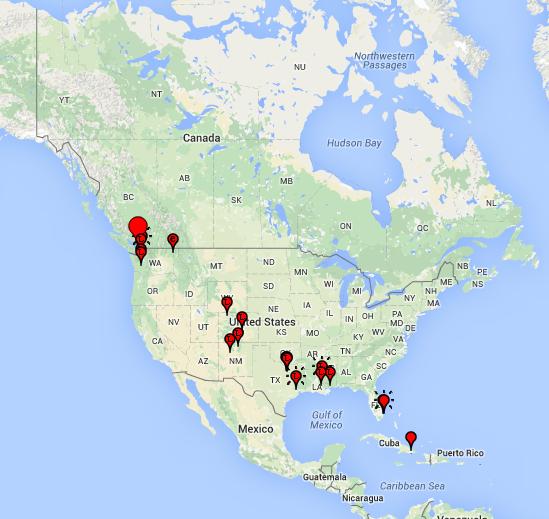 |
| Dead Band Spots - courtesy: https://www.pskreporter.info/pskmap.html |
During one particularly noteworthy period of no action in the lower part of the band, JT65 signals were either copied or exchanged with CO8, V31, TG9, KP4 and XE. Many of these signals were heard for several hours, making the difference even more striking.
Perhaps having all of the JT signals crammed into a 2kHz sliver just makes it seem busier but the mode is certainly gaining steam. Now actually working guys on JT65 is akin to watching paint dry, as its weak-signal sensitivity comes at the expense of time ... the same information that could be sent on CW in 10 seconds, requires a full minute. A complete QSO takes a minimum of four minutes and the 13-character message buffer does not exactly encourage much conversation, other than calls, signal reports, grid squares and 'RRs'. All the same, calling CQ and waiting for the telltale signs of a reply to appear on the scrolling waterfall is somewhat mesmerizing, not unlike an addictive video game of sorts ... just one more CQ!
Will I abandon the CW end of the band? Never ... but having another mode to play with on the magic band is proving to be much more interesting than listening to the usual din of white noise, waiting for the band to 'really' open.
You can read more about JT65 and download the free software, WSJT-X, here.
CW Forever …?
 |
| 24 Hour 'JT' 6m Activity |
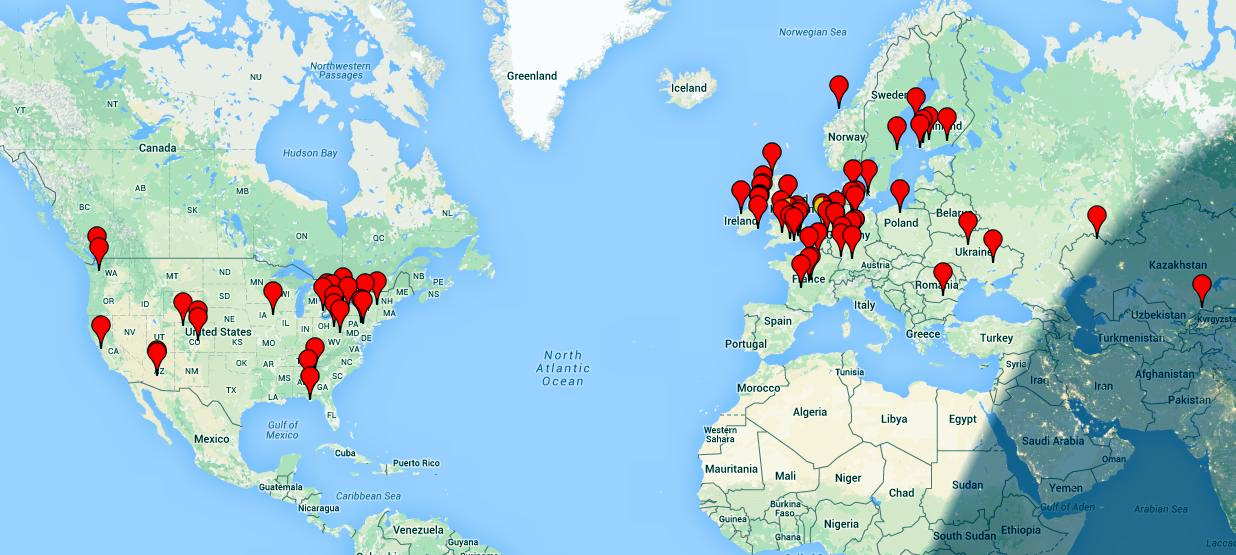
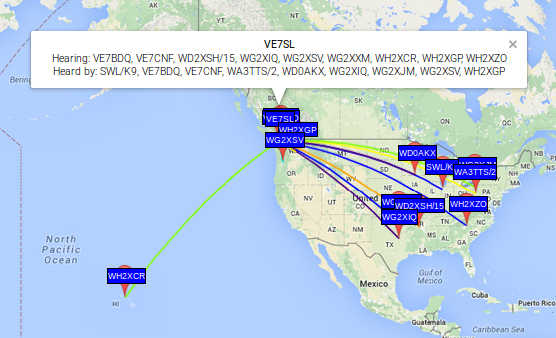
The transverter develops just over 70 watts output when run on 13V and so far, has been able to take all of the nightly punishment I've been able to throw at it with flying colors. Here is a WSPRnet screen shot taken from a typical night of my WSPR beaconing on 630m:
 |
| courtesy: KB5NJD's 630m Info |
I was also able to have my first JT-9 mode QSO this week, with Toby, VE7CNF. This mode is the weak-signal WSPR QSO mode, tailored for LF/MF work and allows for calls, signal reports and confirmations (R's) to be exchanged ... the minimum requirements needed to claim a contact. Although additional information can be exchanged, its 13-letter message buffer does not exactly promote ragchew style conversations and some creativity is required to exchange more than the basics.
With many of our newer 'digital-savy' amateurs not necessarily being proficient in CW, I suspect that JT-9 may well evolve to become the go-to weak signal communication mode on 630m, much as it has in Europe. In fact, popularity of this mode in Europe has already spawned a few JT-9 contest weekends on 630m, with high activity levels being reported. I'm really looking forward to a 630m JT-9 QSO party in North America, once the band becomes a reality in the U.S.A.
JT-9 is capable of decoding signals reliably down to -24db SNR and boasts a 50% reliability of decoding at -26db SNR. Audible CW drops out at around -16 to -18db SNR, so communicating with JT-9 is the equivalent of going from 100 watts to around 800 watts ... a significant improvement and very helpful on 630m! Like WSPR, JT-9 will work with non-linear transverters and amplifiers such as the commonly-used and simple to build switching MOSFET Class D/E styles.
There also appears to be a fast-growing use of JT-65A on the 6m band this summer, with numerous 'CW forever' operators finding the mode's ability to dig up to 10db deeper into the noise paying off with surprising results. Some western North American operators have noticed that European JT-65A signal levels indicate that they should be in the CW-copiable range yet no CW activity is heard, for which there seems to be no ready explanation. Perhaps more will be learned this summer as the use of this mode continues to expand.
As one of the 'CW forever' proponents willing to try something different, I also have been listening for and working stations on 6m over the past few days on JT-65A. With the IC-756ProIII throttled back to 25 watts, I've found it fairly easy to make contacts when the band is open but have yet to hear or work anything unusual.
I'd love to hear your own comments on the use of JT-9 or JT-65A, particularly on 630m or on 6m ... maybe you can pass along some tips for those of us that are new to the mode on this band.
I may have to reconsider this 'CW forever' thing!













