Posts Tagged ‘Training’
 Announcing the January 2015 WØTLM Technician License Class
 November 23rd, 2014 |
  Author:
  Ham Radio Two-Day License Class
Sat Jan 31 and Sat Feb 7 (8 AM to 5 PM) 2015
Location: Black Forest Fire Station 1, Black Forest, CO
The Technician license is your gateway to the world-wide excitement of Amateur Radio …
- Earn your ham radio Technician class radio privileges
- Pass your FCC amateur radio license exam right in class on the second day
- Multiple-choice exam, No Morse Code Required
- Live equipment demonstrations
- Learn to operate on the ham bands, 10 Meters and higher
- Learn to use the many VHF/UHF FM repeaters in Colorado
- Find out how to participate in emergency communications
There is a non-refundable $25 registration fee for the class.
In addition, students must have the required study guide and read it before attending the two-day class: HamRadioSchool.com Technician License Course $20.95
(make sure you get the most recent edition of this book, updated for the new FCC exam questions)
Advance registration is required (no later than one week before the first session, earlier is better! This class usually fills up weeks in advance.)
To register for the class, contact: Bob Witte KØNR
Email: [email protected] or Phone: 719 659-3727
Sponsored by the Tri-Lakes Monument Fire Radio Association
For more information on amateur (ham) radio visit www.arrl.org or www.wedothat-radio.org
The post Announcing the January 2015 WØTLM Technician License Class appeared first on The KØNR Radio Site.
Three Steps to Getting Your Ham Radio License
 These are the three basic steps to getting your USA amateur (ham) radio license: 1) Learn the Material 2) Take Practice Exams and 3) Pass the Real Exam.
This article is very short and to the point, for a more detailed explanation see Stu’s article over at HamRadioSchool.com.
1. Learn The Material
The entry level ham radio license is the Technician License, so you’ll need to get a book that covers the theory, regulations and operating procedures required by the Federal Communications Commission (FCC). My recommendation is the Technician License Course over at HamRadioSchool.com, which offers an integrated learning system (web, book and smartphone app).
While you can learn the material on your own, many people find classroom instruction to be very helpful. Check the ARRL web site for courses in your area or just do an internet search for “ham radio license class” and your location.
2. Take Practice Exams
The question pool for the Technician Level Exam is made public, so you have access to every possible question that will be on the exam. Better yet, various organizations have created online practice exams so you can test yourself in advance. After you study the material, take these practice exams to test your knowledge. Go back and study any topics you are having trouble with on the exam. A passing grade is 74%, so you’ll want to be consistently above that before trying the real exam.
These are a few of the available online practice exams: qrz.com, eham.net and aa9pw.
3. Pass the Real Exam
The FCC exams are administered by radio hams known as Volunteer Examiners (VEs), so the exam session is sometimes called a VE session. In most areas, there are exam sessions given on a regular basis. Check the ARRL web site to find a license exam session in your area.
Be sure to follow the instructions of the local VE team, since policies and procedures do vary. If you’ve studied the material and checked your knowledge by taking the practice exams, you should have no problem passing the Technician level exam.
4. One More Thing
Actually, there is one more step to this process. Getting the required FCC license is just the start, a learners permit for amateur radio. You’ll need to get on the air and gain some practical experience. It is extremely helpful to have some help during this process, so I highly recommend that you connect up with a local ham radio club. If you can’t find a club then perhaps make contact with a local ham or two.
There are many hams out there that are willing to help. However, it may be a challenge to find one. You can always drop me an email and I will try to assist.
73, Bob K0NR
2014 SET
Announcing the October 2014 WØTLM Technician License Class
Ham Radio Two-Day License Class
Sat October 18 and Sat October 25 (8 AM to 5 PM) 2014
Location: Tri-Lakes Monument Fire Station 1, Monument, CO
The Technician license is your gateway to the world-wide excitement of Amateur Radio …
- Earn your ham radio Technician class radio privileges
- Pass your FCC amateur radio license exam right in class on the second day
- Multiple-choice exam, No Morse Code Required
- Live equipment demonstrations
- Learn to operate on the ham bands, 10 Meters and higher
- Learn to use the many VHF/UHF FM repeaters in Colorado
- Find out how to participate in emergency communications
There is a $25 registration fee for the class.
In addition, students must have the required study guide and read it before attending the two-day class: HamRadioSchool.com Technician License Course $20.95
(make sure you get the most recent edition of this book, updated for the new FCC exam questions)
Advance registration is required (no later than one week before the first session, earlier is better! This class usually fills up early.)
To register for the class, contact: Bob Witte KØNR
Email: [email protected] or Phone: 719 659-3727
Sponsored by the Tri-Lakes Monument Fire Radio Association
For more information on amateur (ham) radio visit www.arrl.org or www.wedothat-radio.org
What? A Record Level of US Ham Licenses?
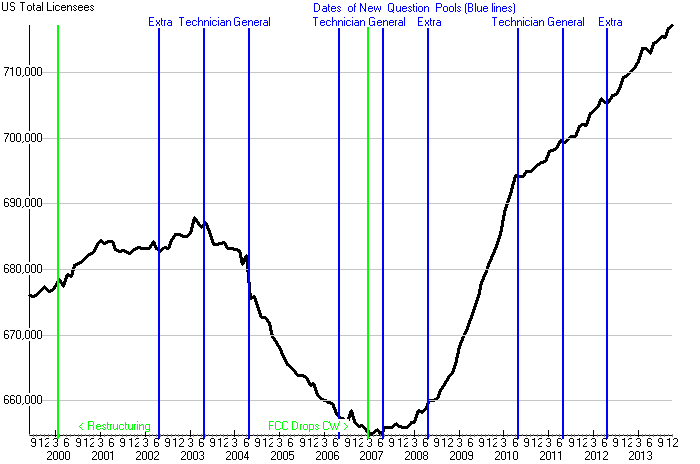
The ARRL just reported that the number of FCC amateur radio licenses hit an all time high of 717,201 at the end of 2013. Since we all know that the interwebz has made ham radio communication obsolete :-), this is a difficult statistic to comprehend. Joe Speroni AH0A keeps a useful collection of ham licensing statistics including the ability to generate plots of the data. I used Joe’s site to generate this plot of total US amateur licenses versus time. Note that the vertical axis does not start at zero, so the plot tends to exaggerate the amount of change.
Click to expand
From this plot, we see that the number of licenses was in decline from about 2003 to 2007. The no code Technician license was introduced in 1991 which is earlier than the data on this chart. The FCC completely dropped the Morse Code requirement from all license classes in 2007, as indicated on the chart. (See Wikipedia for the exact dates.) The decline in licenses was reversed at that time and has been growing ever since. There is an interesting inflection point in 2010 that coincides with the release of a new Technician License question pool. The line is noticeably less steep after this point, which seems to imply that something happened to slow down the rate of new licenses.
Over the last ten years, Technician licenses have grown slightly as a percent of the total, going from 47% to 49%. So about half of US licenses are Technician. The grandfathered Novice and Advanced class licenses are in a slow decline and currently represent 2% and 8% (respectively) of the total licenses. The percent of General licenses has grown slightly over the past ten years, from 21% to 23%. Extra class licenses showed the most growth over the decade, going from 15% to 19% of total licenses.
While it’s encouraging to see continued growth in the number of ham radio licenses, these statistics immediately raise a number of questions:
- How many of these licensees are Silent Keys and their FCC license is just clocking time until it hits the 10 year expiration date?
- Given the aging ham population, when will we hit a demographic brick wall and see the number of licenses decline?
- How many of these licensees are actively involved in ham radio? I have a number of friends that keep their FCC license current but are never on the air.
Clearly, the 10 year license term will tend to mask any decline for a while but it seems that sooner or later the numbers will flatten off and probably start to decline. I don’t know of anyone that has collected and analyzed the age distribution of hams, so I am basing this on what I see at radio club meetings and major ham radio events.
How many of these licensees are active? Really difficult to say. It seems that in the 21st century, people have many activities to choose from and their interest in any one of them may fade in and out. Not everyone is a Full Up 24/7 Ham Radio Enthusiast.
In the mean time, I am going to keep teaching Tech license classes and helping people get started in a hobby that I find to be a lot of fun. Remember the The Universal Purpose of Amateur Radio: To Have Fun Messing Around with Radios.
73, Bob K0NR
Announcing April 2014 Technician License Class
Ham Radio Two-Day License Class
Monument, Colorado
Sat April 12 and Sat April 19 (8 AM to 5 PM) 2014
Location: Tri-Lakes Monument Fire Station 1
The Technician license is your gateway to the world-wide excitement of Amateur Radio …
- Earn your ham radio Technician class radio privileges
- Pass your FCC amateur radio license exam right in class on the second day
- Multiple-choice exam, No Morse Code Required
- Live equipment demonstrations
- Learn to operate on the ham bands, 10 Meters and higher
- Learn to use the many VHF/UHF FM repeaters in Colorado
- Find out how to participate in emergency communications
There is a $25 registration fee for the class.
In addition, students must have the required study guide:
HamRadioSchool.com Technician License Course $19.95
Advance registration is required (no later than one week before the first session, earlier is better!)
To register for the class, contact: Bob Witte KØNR
Email: [email protected] or Phone: 719 659-3727
Sponsored by the Tri-Lakes Monument Fire Radio Association
For more information on amateur (ham) radio visit www.arrl.org or www.wedothat-radio.org
Tech Day 2013 – Saturday Sept 14
 Come join us on Saturday, September 14th, 2013 (9:00 AM to 2:00 PM) at the Prairie Winds Elementary School , 790 Kings Deer Point East, Monument, CO for Tech Day 2013. Tech Day is for beginner to intermediate hams who want to learn more and take that ‘next step’ in ham radio.
Everyone is welcome, no registration is required. Just show up with your bright smiley face, ready to learn something and have fun.
Presentations
9:30 am – Getting started in QRP operating from Steve WGØAT of Rooster & Peanut fame [http://www.youtube.com/user/goathiker]
10:30 am – Mobile radio installation tips with James KDØMFO
11:30 am – Practical antennas made out of copper pipe by Al WBØTGE
12:30 pm - Ham Shack 101 - the basics of setting up a home station by Stu WØSTU
1:30 pm – Some Practical Antenna Theory – Bob KØNR
* Each presentation is approximately 20 minutes with Q&A at the end.
Live Demonstations
All day long, we’ll have these displays set up so you can get a hands on look at radio operating:
QRP operating, Flex Software Defined Radio (SDR), HF antennas, mobile radio installation
The local Boy Scout troop will be selling hotdogs and drinks in hamfest style.
Tech Day 2013 is proudly sponsored by the WØTLM Amateur Radio Club













