Posts Tagged ‘SOTA’
 WOTA success
 September 5th, 2010 |
  Author:
  I think it’s fair to say the Wainwrights On The Air (WOTA) scheme has become a big success. At the start it was probably true that the main participants were existing Summits On The Air (SOTA) enthusiasts who appreciated the opportunity to make more of their Lake District excursions by activating the hills they would otherwise have walked past on their way to a SOTA summit. But recently several local amateurs have got started specifically in WOTA chasing and activating. There has even been a request for a list of the easiest Wainwrights to climb! There isn’t an award for that, but it does suggest that WOTA is encouraging people to get out on the hills who were not previously enthusiastic fellwalkers and I think that is one of the best possible outcomes for the scheme.
It’s a pity, though, that no-one offered to design a nice award certificate for the scheme, which the Workington Radio Club was then going to get professionally printed. The ones I made using a free online certificate maker and print on our cheapo HP multifunction printer (with expensivo ink cartridges) look a poor reward for all the time and sweat that has been expended earning them. I always have a fight getting them to print correctly anyway, so having some professionally printed certificates would have saved me a lot of hassle.

Highest activation?
Steve WG0AT, Rich, AC7MA and Guy, N7UN recently returned from their expedition to activate Huron Peak in the Sawatch Range in Colorado, USA, for Summits On The Air (SOTA). Together with their “sherpa” goats Rooster and Peanut, they took a GPS-equipped Yaesu VX-8R so people could track their progress.
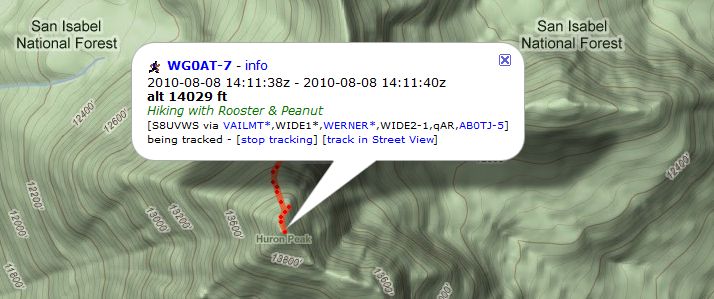
You can see a slide show of the expedition here.
I rather like the idea of using goats to carry the heavy equipment but I think you’d get some funny looks in the hills around here. This has made me wonder what has been the highest SOTA activation to date. Has anyone activated Mount Everest yet? I bet that would create a pile-up!

Pileup on the fells
The hills are alive with the sound of “CQ SOTA” and “CQ WOTA”. These two adventure radio programmes are becoming so popular that anyone trying to make contacts from a hilltop this last weekend on 2m FM had trouble finding a clear frequency. The sight of radio amateurs on mountain summits is becoming so commonplace that soon it will be the ones without radios getting the funny looks.
On Sunday morning Olga said to me “You should go for a walk”. Needing no further encouragement, I tossed the VX-8GR and a few bits and pieces into my rucksack and off I went. I parked at Thornthwaite near the old Swan Hotel and made my way up through the forestry roads to the minor summit of Barf. I didn’t go up by the direct path from opposite the Swan as it is very steep and slippery – I came down that way once a few years ago and it was enough for me.
On the way up I had a contact with top Wainwrights activator Phil, G4OBK/P on the summit of Brandreth. Phil is well on his way to completing the challenge of activating all 214 Wainwright summits in the English Lake District within two years and reached the half way mark this weekend. Visit Phil’s Wainwrights blog if you get a chance.
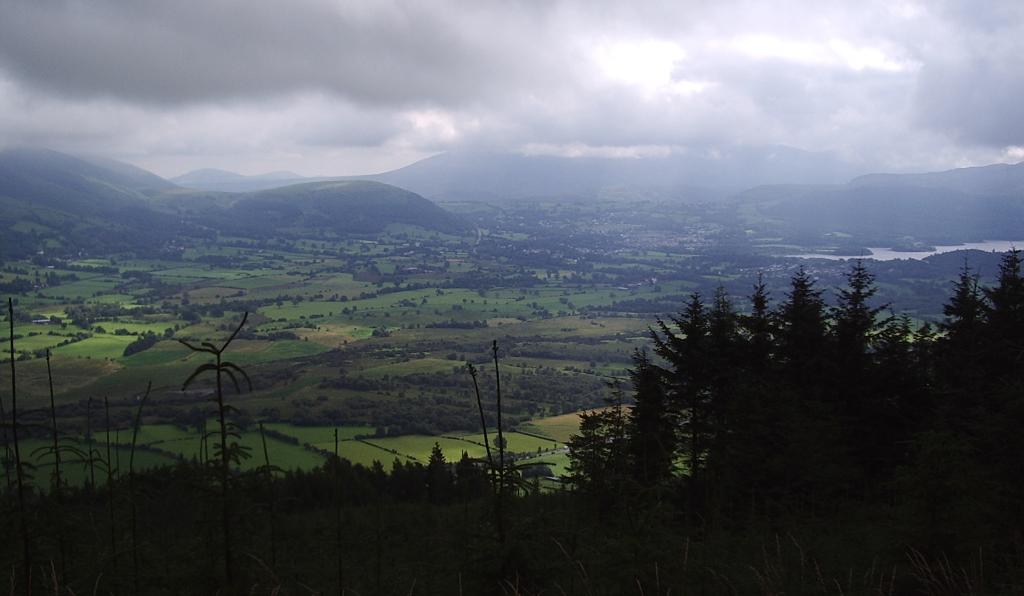
Shortly after contacting Phil I saw two ospreys circling over Bassenthwaite Lake and calling to each other with their high-pitched cry. I stopped and took the picture shown above of the view towards Keswick. About ten minutes later a small red deer came out of the forest about 100m ahead of me and trotted into the distance. Perfect!
It was cool but humid, but the misty weather creates a special atmosphere in the forest that is very pleasant. However once on the top of Barf a drying breeze was experienced. I made another contact with Phil, who was now en route for Great Gable, so he could tick Barf off on his “worked” list, and made another contact with Geoff GM4WHA. I also received an APRS message from Colin 2E0XSD, who unfortunately couldn’t hear me direct due to the amount of rock between us.
I then set off for the higher summit of Lords Seat, which I reached in about half an hour, where I stopped and had my lunch. By then Phil had reached Great Gable so we had a summit-to-summit contact. I made numerous other contacts, including Geoff and Colin and a couple people on SOTA summits outside the Lake District. I received a lot of comments about wind noise in the microphone, despite trying to shield the radio with both hands. The VX-8GR is the only one of my 2m hand-helds not to have a speaker mic, due to the fact that the only option is the expensive original Yaesu version. I should probably carry the VX-8GR just for the APRS and take the Motorola GP300 for voice contacts.
Simon, M3IWN/P called CQ from the top of Scafell Pike in the Lake District, which is England’s highest mountain. He was doing a SOTA activation and had a beam antenna with him. On a clear day I could probably see his summit from where I was, but he had so many callers that after 10 minutes of trying he still hadn’t heard me. I decided to move to another frequency and make some contacts of my own, checking back on Simon’s frequency now and again until eventually he got my call and we had a contact. At the time I worked him Simon had filled two and a half log pages with contacts including several summit to summits.
The QRM up there had to be heard to be believed. I was only using a 2m helical. The VX-8GR receiver tends to die in the presence of strong signals and I have heard strange things when using anything better than the stock antenna. Another reason for taking the Motorola, which has a better receiver. First, though, I will need to reprogram it to cover 145.300MHz, the frequency Phil likes to use on his activations.
Over the weekend I think something like 20 Wainwright summits were activated by around half a dozen different operators. Scafell Pike was actually activated twice on Sunday! Later in the afternoon after Simon had left I saw a spot had been posted for another station on the same summit.
I returned to the car via the forestry roads for a very pleasant walk with a lot of radio fun as well. If you want to join in, come to the English Lake District on a summer weekend – you won’t regret it!

Watch Hill
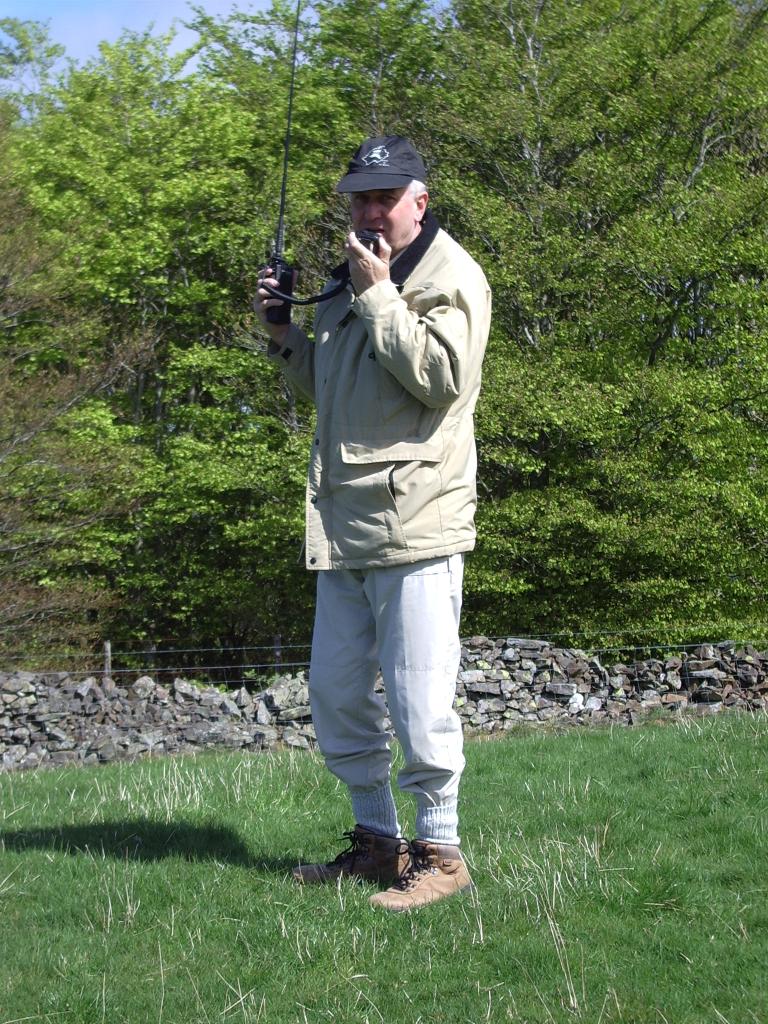 It was a fine sunny morning. I remembered – having worked a couple of activators yesterday – that it was the Summits On The Air (SOTA) Activity Weekend, so I thought we would go to Watch Hill, G/LD-054, and see what I could work from there.
Compared to all the people who have slogged up thousands of feet to get to their summits Watch Hill is a bit of a cheat. It’s a 15 minute stroll from the nearest car park, with only the last couple of hundred metres being a bit steep. But as it is a less than 10 minute drive from home it’s a popular walk for Olga and I and we often take a picnic lunch up there.
I took with me the Motorola GP300 and the Kenwood TH-205E with the 5/8 telescopic whip. Getting the 4 contacts required for a SOTA activation can be a challenge from there, as it is a fairly low hill and there isn’t a huge amount of 2m FM activity round here. Many have tried and gone away disappointed. However on Sunday morning the Workington Radio Club has a 2m FM net. I broke into that and soon had 5 contacts logged. Future would-be activators of Watch Hill please note.
I also made a summit to summit with 2M0NCM/P on Lamachan Hill SS-061 in Dumfries and Galloway, and then caught Geoff G4WHA/P who was just stopping for lunch on Wether Hill, WOTA summit LDW-103. I wouldn’t have heard him from home, so that was a nice WOTA chaser point for me.
The Motorola produced great, loud audio which is ideal for listening on a windy hill-top, and I got an unsolicited report of “BBC quality” audio on my transmissions, so it seems to be working well. However I noticed that some stations seemed to chop up a bit. I’m not sure if they were weak and the squelch is very sharp or whether their deviation is a bit wide for the Motorola IF filters. I will need to investigate this further.
The TH-205E came in handy after the Motorola gave a few beeps to warn, I think, that the battery was exhausted. There is no visual indication of battery state on the Motorola so I had no advance warning. The station I was working said that he could hear a carrier but no audio after the battery went. Still, it does seem to be a nice radio and rugged enough for this type of use.

Blackpool weekend
I hadn’t been to a hamfest (or radio rally as such events are known over here) for several years. On Friday I mentioned to Olga that the Northern Amateur Radio Societies Association Amateur Radio, Computer and Electronics Exhibition was being held at Blackpool on Sunday and it was supposed to be quite a good one and she said “why not go?” I then suggested that we book a hotel for the Saturday night so we could travel down the day before and see some of the sights of Blackpool, which neither of us had been to before. So we did.
The sights of Blackpool served only to help me understand why most Brits these days go to Spain for their holidays, but the NARSA Exhibition lived up to its reputation and was well worth the trip. I spent very little but came back with a large bundle of components most of which I will probably never use, plus an apparently unused Motorola Radius GP 300 handheld, sans battery, which I was unable to resist as the price was £1. It was also nice to meet in person several people I had previously only worked on the air, exchanged emails with or who were readers of my blog.
It’s impossible to give a full picture of an event this size so I’ll just mention a few of the stands that were of particular interest.
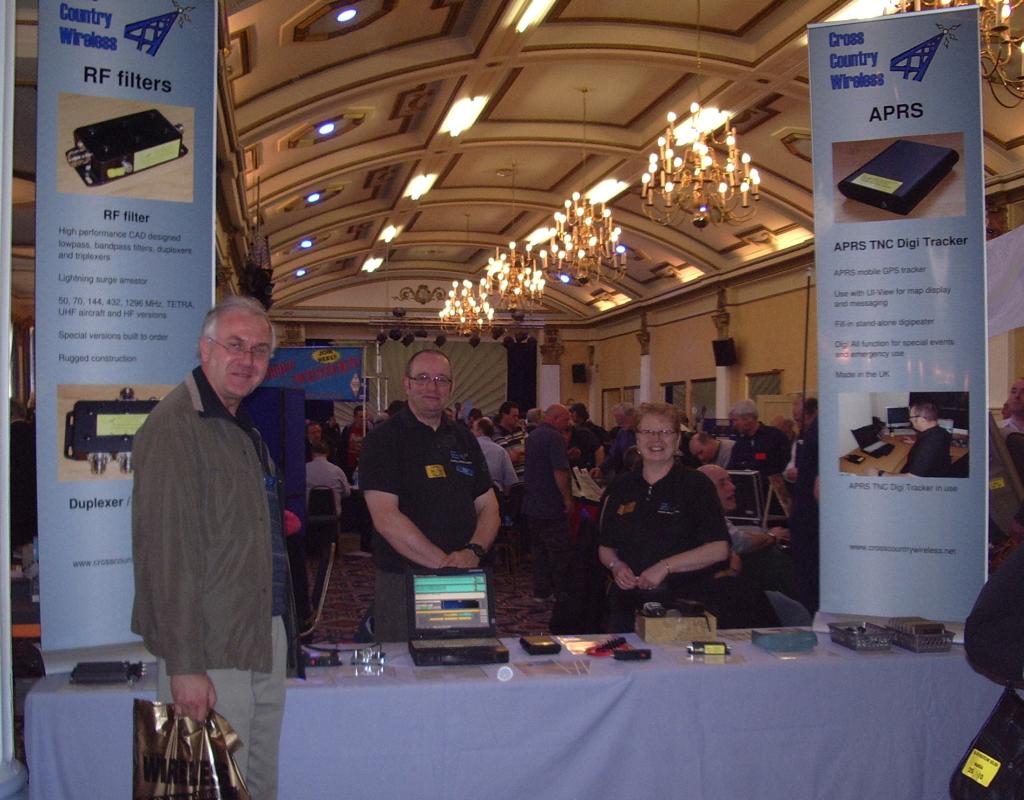 Occupying a prime position right by the entrance was the stand of Cross Country Wireless run by Chris G4HYG and his XYL. He was displaying the new end-fed antennas I mentioned a couple of days ago, as well as his well-established APRS products and the new program APRS Messenger. Chris commented that the number of visits to his site increased noticeably after I’d mentioned the antennas in my blog – hopefully he got some sales as well!
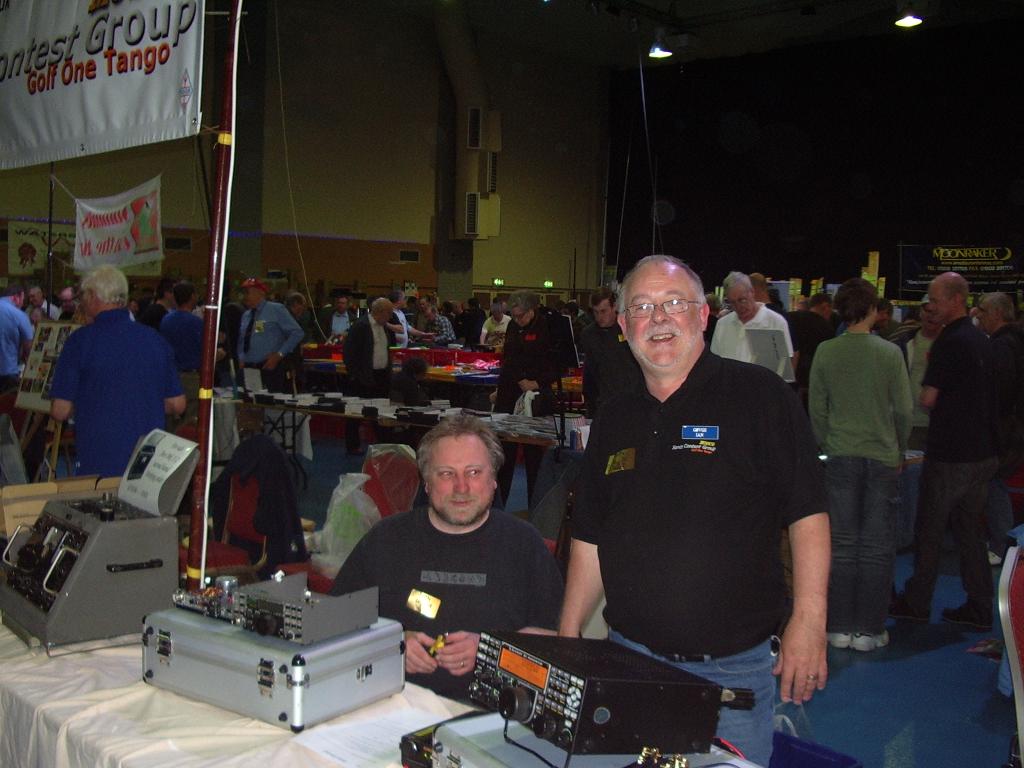 Ian G0VGS and Kev G6FKE were manning the Sands Contest Group stand and also giving visitors a chance to look at the K2 and K3 transceivers by Elecraft.
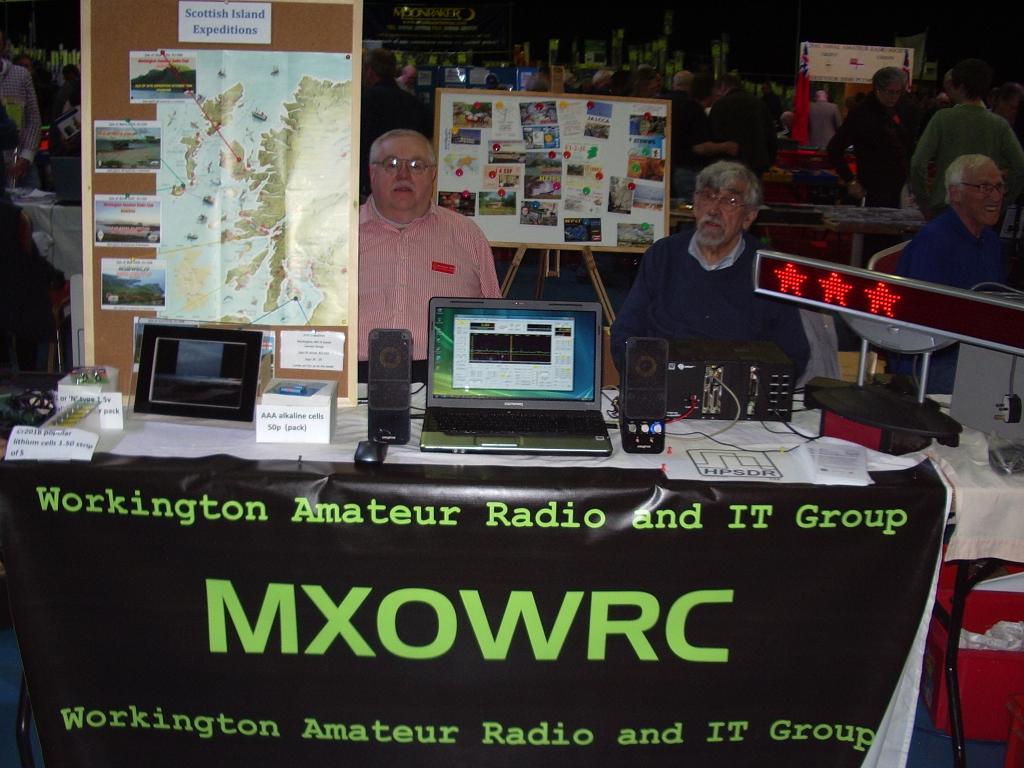 My local club, Workington Radio Club is a NARSA member and had an impressive stand, manned in this picture by Barry G0RZI and Tony G1OAE.
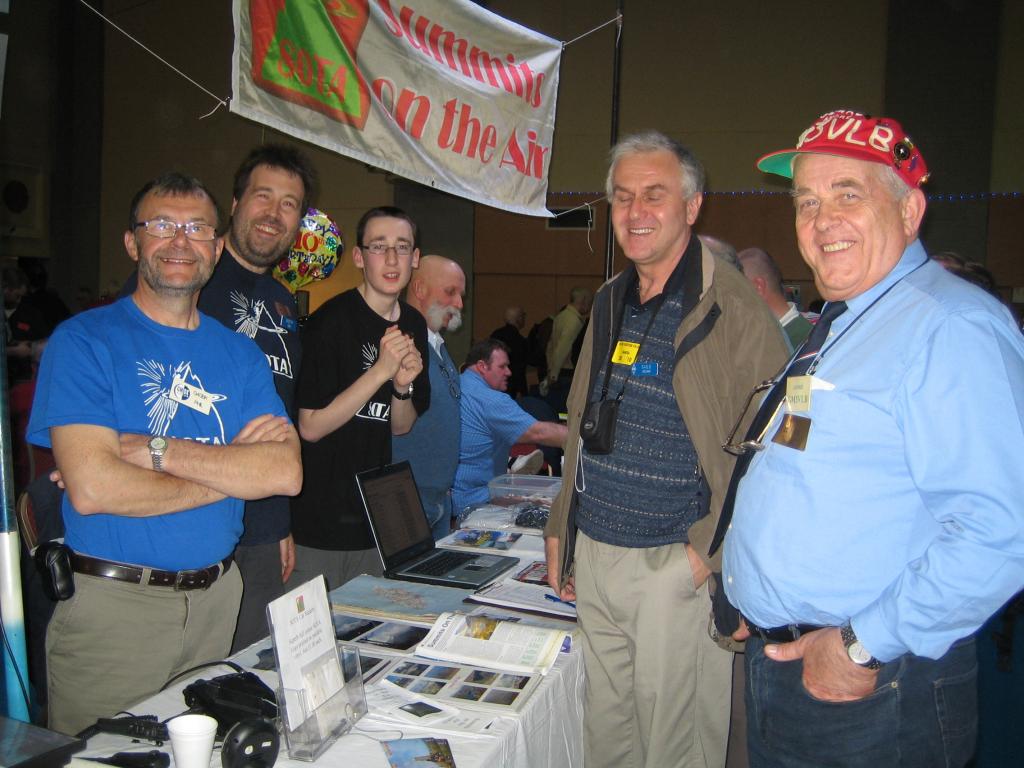 Summits On The Air also had a stand where I was able to chat about WOTA with Tom M1EYP and his son Jimmy M3EYP, and meet Phil G4OBK who is the top activator in the Wainwrights On The Air (WOTA) scheme (and the only one so far to have earned a certificate.) Olga took this picture but unfortunately she caught me just as I blinked!
It was a very enjoyable day, but now you’ll have to excuse me, I have a large bag of components to sort out!

Broken duck
I went for another stroll up Tallentire Hill this afternoon with the TH-F7E. The FT-817 is tied up running my EchoLink hotspot until I can find something cheap I can dedicate to the task – I have my eye on a pair of PMR446 radios that are modifiable to 70cm.
I took along my DIY 2m rubber duck antenna and a “Black Rod” 2m 5/8 telescopic whip that I recently bought on eBay. In case you are wondering, I use an “HT Saver” SMA to BNC adapter to take the strain of the longer whip. But I am seriously considering using the TH-205E for such outings in future, if I can sort out a battery pack for it, because it has a proper BNC antenna socket and is much better suited to use with a large telescopic whip.
The 2m FM channels were not exactly buzzing with activity but I heard the GB3CS repeater 100 miles away and a GW station (Wales) in QSO. I tried swapping the two antennas for a comparison, but could hear nothing on the rubber duck at all. This surprised me, as the last time I did a comparison there was hardly any difference between it and a quarter wave telescopic, and I didn’t expect the 5/8 to make such a huge difference.
The TH-F7E is multimode on receive, so I took a listen on 2m SSB as well. I heard the GB3NGI Northern Ireland beacon much stronger than I can receive it from here. But I couldn’t hear GB3VHF from South East England at all. I haven’t heard it from home at all recently either, although it is supposed to be back on the air after a move to a new location. I guess the new location isn’t as favourable as the one it has operated from for longer than I have held a ham radio license. GB3VHF was the first amateur 2m signal I ever heard, after building my first 2m receiver, so hearing its call in Morse always causes some nostalgia.
I put out several CQ calls on 145.500 and was eventually called by Bill G3WJH in Seaton, only a few miles away by line of sight. I swapped the antennas again, and he couldn’t hear me at all on the duck. Colin, 2E0XSD then joined us, and then we were called by Richard G0IBE/P on Lord’s Seat (a SOTA and WOTA summit) so we all exchanged reports with him for chaser points. Jim G3ZPD from just south of Cockermouth then called in and worked Richard as well. By that time I was getting a bit chilly as it was a lot colder up there than it was at home, so I came back.
On my return I checked the DIY Duck on my antenna analyzer and found an infinite SWR. I pulled off the whip and the copper wire had fractured just about level with the top of the BNC adapter, which is probably the point that experiences the most bending. I guess 22SWG enamelled copper wire isn’t flexible enough to use for a helical antenna. Back to the drawing board.














