Posts Tagged ‘Radiosport’
 Pile-Up Control System
 October 27th, 2025 |
  Author:
 PUCS: Take control of the pile-up!

Every special event station (SES) operator knows the thrill — and the chaos — of a true pile-up. The excitement of dozens of stations calling you simultaneously can quickly turn into frustration when QRM, doubles, and missed calls clutter the frequency. Wouldn’t it be great if there were a way to bring order to that chaos without losing the fun of real-time operating?
Enter PUCS, the Pile-Up Control System, a fully open-source, web-based platform designed by and for radio amateurs. Born from the ingenuity of the Radio Scouting Fellowship PA3EFR/J, PUCS elegantly blends traditional ham ingenuity with modern AI-assisted software development. The result is a modular, flexible system that any club or individual can tailor to their own operating style — from large-scale SES activities to small club field days.

PUCS can be seen operational at pucs.pa3efr.nl
From Normandy to the Netherlands
The idea for PUCS was sparked during an SES operation on the beaches of Normandy, where operators of TM80DDAY overheard multiple Australian colleagues discussing a private sign-up system for QSOs. Intrigued but unable to obtain the software, Erwin PA3EFR and his team decided to build their own version — and then share it freely with the world. With the help of AI tools and some Python wizard Barry, PC1K, PUCS was born. It was much later when Erwin decided to develop PUCS within his own environment.
Today, PUCS is freely available, fully documented, and open to anyone willing to experiment. It’s more than just software — it’s an invitation to collaborate, learn, and contribute to a smarter way of managing pile-ups.
What Makes PUCS Unique
At its heart, PUCS is a distributed system consisting of two parts:
- Frontend (commercial hosting): This is the public entry point where operators register their callsigns to join the queue. Think of it as a digital “waiting room” — transparent, fair, and visible to everyone.
- Backend (local PC): Here’s where the magic happens. The backend checks QRZ.com logbooks every minute, automatically removes callsigns that have already been worked, and provides an admin dashboard to manage the queue, export logs, and adjust settings on the fly.

Open Source, Open Spirit
PUCS is more than a tool — it’s a philosophy. The creators explicitly invite others to modify, enhance, and restyle the system to their own preferences. Whether you want to change the interface colors, add logging features, integrate digital modes, or redesign the operator dashboard, the code is yours to explore. There’s no hidden agenda, no locked components — just open code and open collaboration.
All scripts, examples, and documentation are available on GitHub:
https://github.com/PA3EFR/PUCS
Why You Should Try It
PUCS is a perfect project for your club’s next technical workshop. It offers practical lessons in networking, APIs, databases, and web hosting — all wrapped around a real amateur radio application.
Beyond that, it promotes fairness in pile-ups, gives weaker stations a chance to make contact, and even allows SWLs to log their participation.
So fire up your soldering iron if you must, but this time, your “kit” is made of code.
Download PUCS, make it your own, and bring calm to your next pile-up.
As Erwin, PA3EFR, says: “Ask AI as your friend for support — and enjoy your own moments of challenge!” On behalf of the Radio Scouting Fellowship PA3EFR/J we look forward to see you on our PUCS screens at a next special event occasion.
~ Sander PD9HIX
Special Event Station PA80OV
Radio Club Limburg

announces
Special Event Station
PA80OV
Next week, members of Radio Club Limburg (https://rclb.nl) in the North Limburg region of The Netherlands, will activate:

PA80OV is a special event station to commemorate Operation Veritable, celebrating 80 years of freedom. Operation Veritable, namesake of the station, and the successor of Operation Market Garden, was the northern part of an Allied pincer movement in the Second World War.
We are back in 2025 for the third consecutive time with this special event station; having added another 5 years to our callsign.
Members of Radio Club Limburg will activate the callsign PA80OV from February 13 to 28, 2025, to work as many amateur radio operators across the world as possible. If you're in the area, you can visit our station in the old town hall in the city of Gennep, The Netherlands between February14 and 16.
Whether you are an amateur radio operator, hoping to contact a new country, a new callsign, or you're a casual visitor, you're welcome to our website:
https://rclb.nl/pa80ov
We hope to hear and work you.
On behalf of the PA80OV team.
Jan, PA2P
https://rclb.nl/pa80ov
A video about ARDF (Radio Orienteering)
Whether you call it Amateur Radio Direction Finding (ARDF), Radio Orienteering, Fox or Bunny Hunting
The feature speaker at our May 2024 meeting was Robert Frey WA6EZV. Robert spoke on ARDF - Radio Orienteering - Fox (or Bunny) Hunting. Robert was first licensed in 1968, and his interests include DX and ARDF, as an on-foot foxhunter, for over 20 yrs. He was member of the US ARDF National Team in 2000, 02, 04, and 06 competing in China, Bulgaria, the Czech Republic and South Korea.
The presentation was recorded via Zoom so please excuse the video quality which is less than our usual presentations.
Robert Frey WA6EZVWe have documented some of our own SARC Foxhunts in years past, including this locally developed 80m fox receiver:
and
~ John VE7TI
Working POTA: A beginner’s guide and video
SARC in the park!
We had an interesting workshop on Saturday, September 16, 2023. 'SARC in the Park' was a presentation by Dmitry VA7DVO for our members interested in POTA activations. You will find more about getting started in POTA at their website, and in our free digital magazine 'The Communicator'.
With an easy to build and inexpensive segmented 5-band wire dipole antenna, we made several of the 17m SSB POTA contacts shown in this video, including Switzerland, Italy and with a mobile station in Northern England.
The antenna plan is at: https://bit.ly/SARC23Sep-Oct on page 45.


Alex VA7PVC, Dmitry VA7DVO , and Leandro VE7LSI at Serpentine Fen
Here is the presentation on video and a look at the activation
https://youtu.be/RTAKs40DHjQ
Do you want to know what else is happening at SARC?
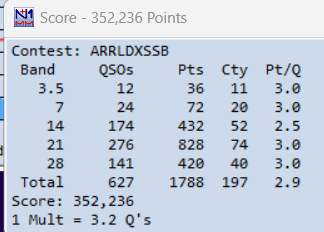
ARRL DX (SSB) Contest
Another successful event
I think we made a commendable showing this weekend, thanks to
all. Statistics below and log attached.
Thanks to all participants and especially the new guys, Doug and Larry,
who jumped in got their feet wet.
The bands were open although a recent solar storm could have had an impact. Most remarkable was 10m which was wide open worldwide on Sunday morning. The best contact of the event was Namibia, V55Y, by John VE7TI, on Sunday
afternoon 10m. Also Reunion Island FR8TZ off the SE coast of Africa. This is a good way to learn your geography!



80 Meter ARDF (Fox) Receivers
Better than ever!
Amateur Radio direction finding (ARDF), also known as Fox Hunting has become easier and more exciting using 80m. More and more kids are participating in our annual event and learning about radio. No transmitter, so no license required.

See the 'How-to' video at https://youtu.be/YK3gETNc2jU
This is a project by Surrey Amateur Radio Communications in support of the hobby
Remembering Jim Smith VE7FO – SK
We have lost another of the 20%
Looking back, it is ironic that Jim wrote the following about Brett Garrett VE7GM when Brett passed away in August 2018
"They often say that 20% of a given membership do 80% of the work... Brett was one of the 20%, no, more like 5%. An active member of both the Surrey Amateur Radio Club (SARC) and Surrey Emergency Program Amateur Radio (SEPAR), Brett freely shared his knowledge and led Surrey Amateurs to two very successful Field Days."
I can attest to the same about Jim Smith VE7FO and his involvement with VECTOR and SARC.
.JPG)
I first became aware of Jim when I laid the groundwork for the Vancouver Emergency Community Telecommunications ORganization (VECTOR) around 1999. Jim lived in the Dunbar area of Vancouver, and I became aware of his involvement with the Point Grey club, and that he was very knowledgeable about HF.
Jim was an avid contester who enjoyed working all modes -- especially CW and RTTY. A true mentor at heart, he often hosted "newbies" at his Vancouver home to introduce them to contesting. Many a new contester was given real experience operating "in the fray" and encouraged to keep honing their skills.
That knowledge translated into a very successful series of first Field Days for VECTOR. Jim also took on the project of planning the HF tower and antennas at e-Comm, the regional 9-1-1 and dispatch centre. That facility also houses the Vancouver EOC and its Amateur Radio component. Jim was a terrific resource in suggesting what might and might not work for that location, and he got that tower completed and functional. It was also Jim who persuaded me to look at offering our own Basic Amateur Radio classes. Well... 22 years later we are still offering them with the same basic content that we worked on back then, except now they are provided by Surrey Amateur Radio Communications (SARC), on-line, with successful students across Canada and even graduates abroad.

VECTOR Field Day (about 2003) Jim VE7FO as Station Manager in the new VECTOR bus.
Fred VE7CX in the foreground.
Around the time that I left VECTOR for the SARC group in 2004, Jim decided that he too would become a member of SARC. What followed was a mentorship program to introduce new members to contesting, one of Jim's passions. I spent many hours at his QTH working various contests under Jim's expert tutelage.
.JPG)
In one of many articles written for our SARC newsletter 'The Communicator', Jim wrote:
"My own involvement with SARC started when I was recruited by John VE7TI, as a Field Day operator. There are many enjoyable ways of conducting FD which range from everyone sitting around the BBQ, telling stories and making a few contacts to the hard-core contest style where everybody goes all out to WIN. I was told that it would be a hard core, win for Canada situation. Being a hard-core contester myself I took the bait.
Well, it turned out that the operators, while enthusiastic, didn't have the HF contest experience necessary to achieve the goal. Nonetheless, it was obvious that the potential was there so, once FD was over, I joined the Club and made a FD training proposal to the Exec with the goal of winning for Canada, which was accepted.
This training started in October and ran until next year's FD. It consisted of many formal training sessions including classroom style and participation in the major contests, during which the ops received coaching on the operating techniques for maximizing the number of contacts per hour.
This would be a very significant investment of time for the trainees. This "Get Your Feet Wet" program to provide a low commitment introduction to contesting so that they could see whether or not they liked it."
Jim was instrumental as well in the team organizing what was probably SARC's best scoring Field Day ever. It was in 2015 and, encouraged by Jim, Brett and Stan VA7NF, the Field Day Committee decided that operating QRP might put us in a better scoring position than our usual high power entry.
It took quite a lot of persuasion, but in the end, it was indeed to be QRP. Jim's specialty was consulting propagation predictions and other data to see what we might be able to do with just 5W. Hoo boy!! With some adjustment to our antenna lineup, he suggested that we could do very well indeed.
Did we? We sure did.
Shattered the Canadian record for all categories.
Out of 2,719 FD stations in the US and Canada in 2015, some with more than 10 transmitters and most running 100W, we ranked #91 with our 3 transmitters and 5W.
Altogether a VERY significant achievement which any club would be proud of.
Wouldn't have happened without Jim (or Brett)

It may not be common knowledge that Jim was responsible for a lot of improvements to the premier Amateur Radio Contesting software N1MM+. As an expert contester Jim was able to make suggestions to the programmers that made the software the contesting leader it is today.
Jim always had a liking for analytics, and he took the lead in creating 'Station Manager' training. This role is as important to getting the maximum number of points in a contest as it would be in a real emergency, ensuring that critical traffic got through. The role includes selecting the most useful bands according to shifting propagation, switching antennas, and to assigning operators, so he was constantly monitoring rates, band conditions/solar conditions, greyline, run rates, etc. Everything was graphed and plotted.
Jim was also an active member of ORCA DX and Contest Club, and of the BC DX Club.
As the BC coordinator for the Pacific Northwest Challenge, for many years he looked after the collection of scores for the inter-club contest trophy -- the Pacific Northwest Cup -- and was a frequent attendee at club meetings.
We will miss you, Jim.
Thank you for all that you taught me and others.
We were very fortunate to have had you as a member.
Now Jim is gone
Damn!
Rest in peace.
~ John VE7TI













