Posts Tagged ‘QRP’
 PSK31 up and running…….
 January 14th, 2012 |
  Author:
  |
| Giving PSK a go |
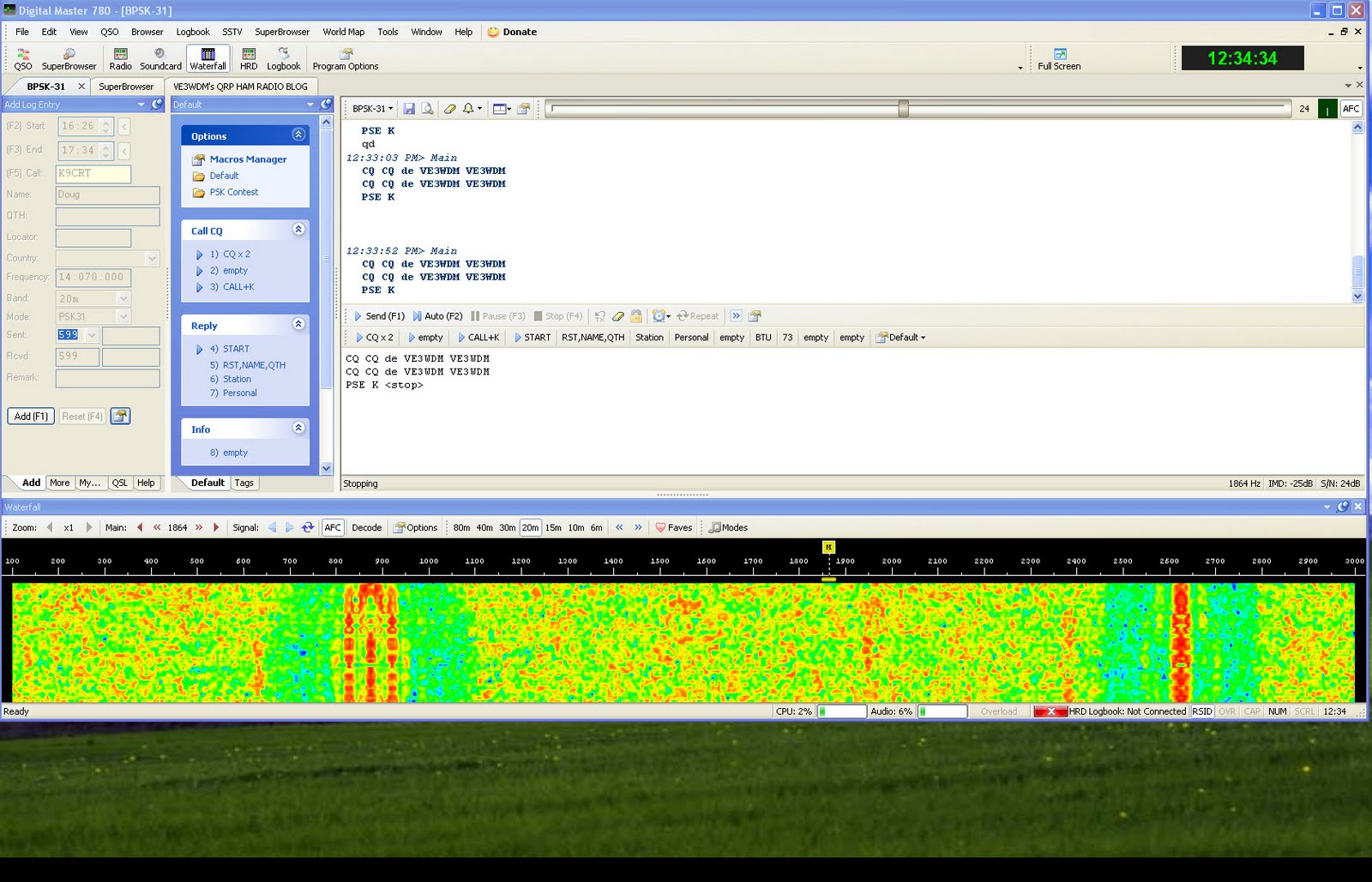 |
| Action on the band |
is not getting out. I do see on my LP-100 watt meter there is 5 watts getting to the antenna but whether it is readable or not I am not sure. Besides I am still getting the hang of PSKreporter as well so it could be operator error at this end. Also today I was involved in the NAQP CW contest but am now just taking a bit of a break. I was calling CQ on 40m CW a short time ago and KC9SNC came back to me. Our QSO was going well and the CW speed was very comfortable for me.......then came the contester's right over our QSO!!! Now they may not have heard us as I was QRP at 5 watts but that brought the QSO to an end. I did email Matt and gave him some more info about my station and that we may have better luck next time. So up to this point I have not been able to make a PSK contact maybe I will give Fldigi a go on Sunday and see if I can bag my first PSK QSO. It's now time to head back to the NAQP CW contest......and try not to QRM anyone who is not involved in the contest!!!

Resting and radio……..
 |
| CT1IUA on the beach |
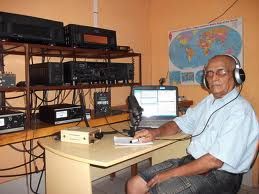 |
| PV8ADI at the desk |

Operatic debut
Nothing to do with Verdi or Rossini, nor the web browser of the same name. OPERA is a new weak signal digital mode that has been developed for use on the amateur LF (500kHz) and VLF (136kHz) bands.
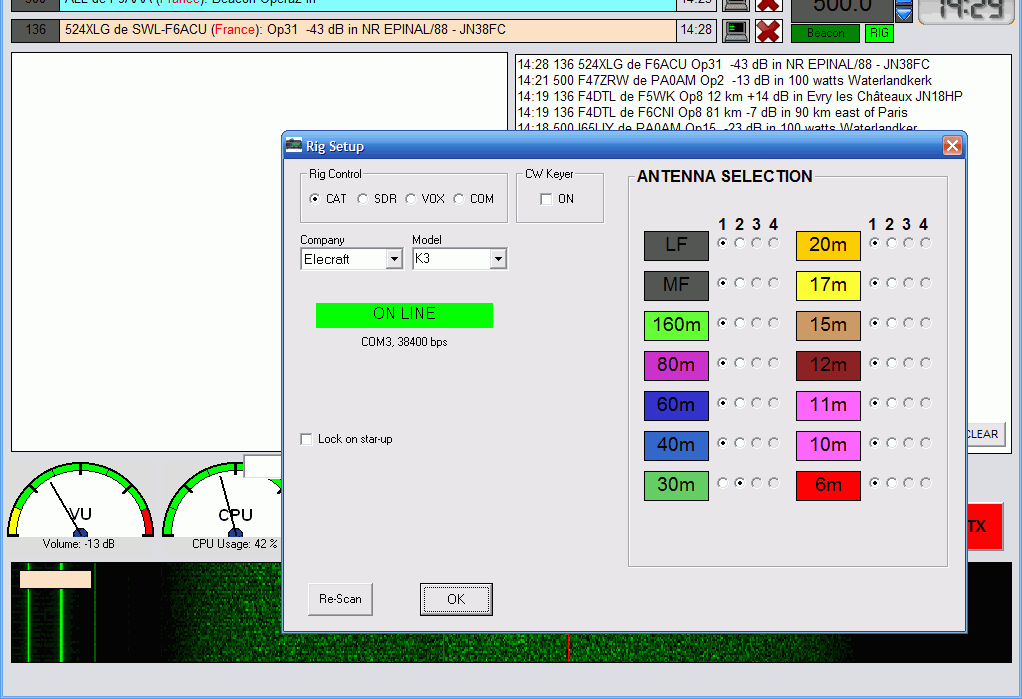
Information about it seems to be a bit hard to come by, but there is an OPERA Yahoo group from where I presume you can download the latest version of the software. I managed to find a copy and was surprised at the sophistication of the program. It already has working CAT support for many transceivers including my Elecraft K2 and K3. It also has a built-in chat system showing reported signals from other users.
Although the new mode is apparently the invention of Graham, G0NBD, the program has been written by Jose Alberto Ros, EA5HVK, author of the ROS digital mode, and there are clear similarities in the user interface. The program supports all amateur bands from VLF to 6m but currently you can only select the frequencies 136kHz and 500kHz.
There are actually two OPERA modes, one of which is claimed to be even better (i.e. work with even weaker signals) than the WSPR mode. What is particularly interesting about OPERA though is that it does not need to use a sound card to send a transmission. Although the sound card is an option – and a convenient one for users already set up for data modes – OPERA actually (if I understand correctly) uses on/off keying, in other words CW (though not Morse code.) This offers the potential for long distance contacts to be made using ultra-simple QRPP (very low power) transmitters designed for QRP CW use – though I imagine that success depends on use of a very narrow bandwidth so you might need to pay more attention to transmitter stability than you would need for Morse code.) If the digital encoding scheme is published then it would also be simple to build microcontroller based beacon transmitters.
As I am not equipped to operate on the 500kHz or 136kHz bands I have been unable to try OPERA out on the air myself. But it certainly looks an interesting mode, especially if it is opened up to allow use on the HF bands where it could be used as an alternative to WSPR and QRSS CW modes.

Making QRP to QRP contacts…..
 |
| VE1BA's shack |
I then called CQ on 14.060 and Mike N0ZH came back to me with a 559 signal. He gave the the same signal report. It was not long before Mike started to fade in and out and very hard to read. So my QSO to Missouri came to a fast end. For this QSO the K3 was at 1 watt with a better miles per watt at 694 miles. I did hear KF5HGL calling CQ I started returning his CQ at 500mW's and climbed all the way up to 5 watts and he was not able to copying me. So either conditions were changing or it was not time for me to make a QSO into New Mexico.
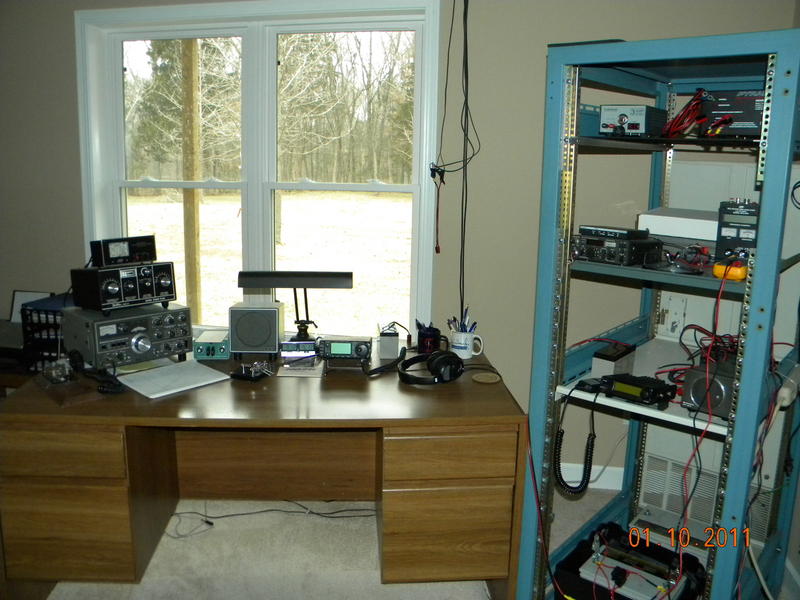 |
| N0ZH's shack |

Simple keyer trouble
It should have been simple. I needed a basic CW keyer that would allow me to use a paddle with my homebrew QRP / QRPP rigs because my shaky hands make sending Morse with a straight key too difficult at the moment. I also needed to be able to record a message and play it once or repeatedly until I heard someone reply or was spotted on the reverse beacon network.
A couple of years ago I built a DC20B QRP transceiver. I didn’t like it very much and eventually sold it on eBay but I did like the keyer built into it which used an ATTiny13 microcontroller. One day, I thought, I would build a keyer using this chip. I got two of the Atmel chips and Steve Weber KD1JV sent me the hex file so I could program them but I never got around to doing anything more until a couple of days ago.
The simple keyer circuit uses only a handful of components but due to my condition it took a lot longer than it would have done pre-tumour to work out a perf board layout and build it. So you can imagine that I was a bit upset when after all that effort the keyer didn’t work. It responded to the dash key and the function button, but not the dot key. Also the sidetone was very high pitched and the Morse speed was about 100wpm!
Thinking I had made a mistake programming the clock setting in the chip I tried programming the other one. This ended up just the same. Unfortunately with the simple keyer program you have to disable the reset pin that is used by the programmer so you only get one chance to write the code to the EPROM. But as I don’t have the source code and so can’t try modifying it that shouldn’t have been a problem. If I hadn’t sold the DC20B I could have tried the keyer chip from that, but now I am now stuck with no idea what to try next.
I have the code for another keyer that uses a PIC12F509A – the K9 from K1EL’s freeware page. But I’d have to start over with the circuit board as the pinouts of the Atmel and Microchip microcontrollers are not compatible. The functionality of the K1EL keyer program is not what I was after either, so I don’t feel much like trying it at the moment.

An afternoon of frustration………
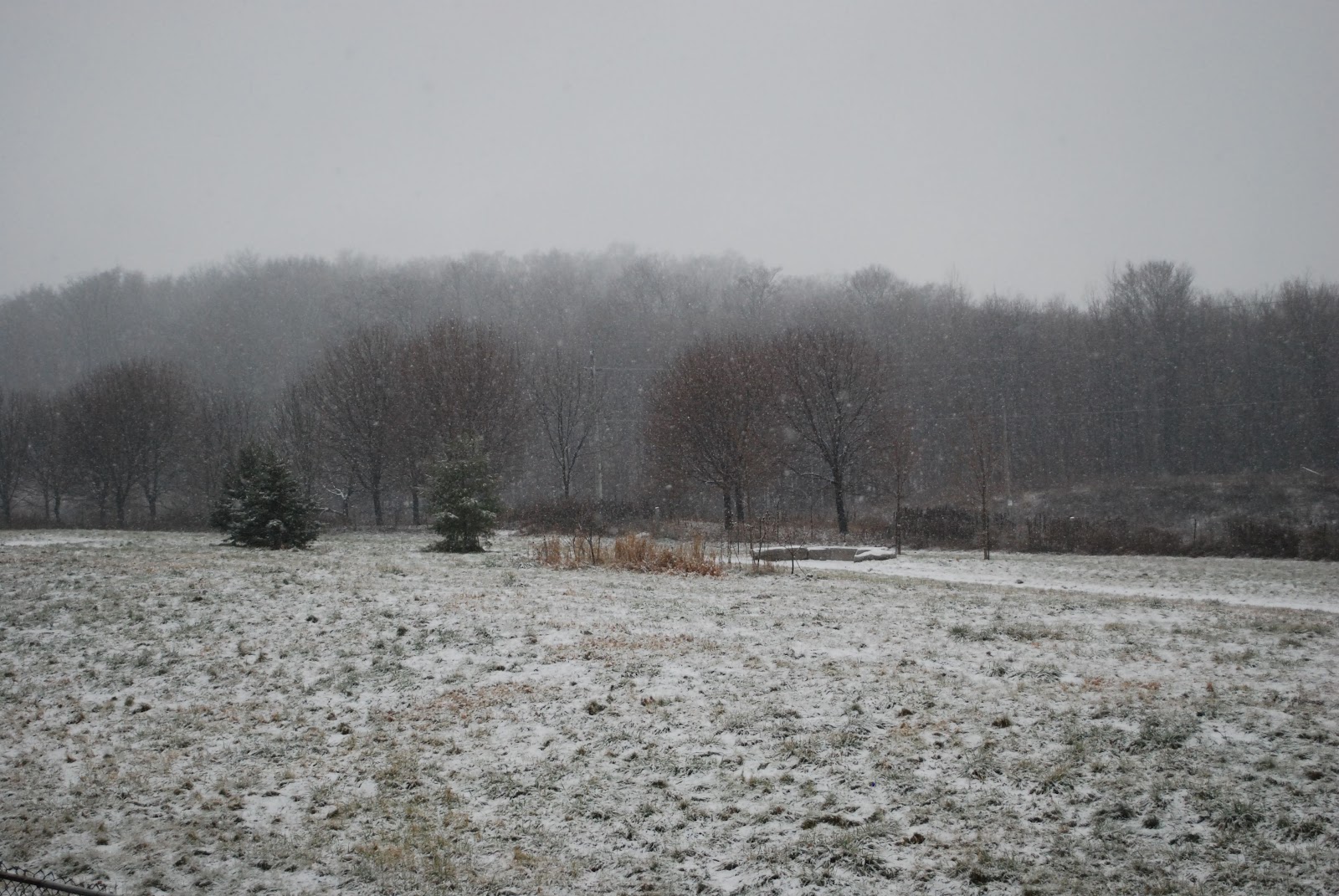 |
| Finally some snow for Christmas...... |
paddle with magnetic return. I played with the adjustments some time ago without testing it....thus the strange behavior of the key. It was time to adjust the key and on the Elecraft K3 you can put the rig into test mode. This way you can adjust the keyer with out transmitting on the air. After adjusting the key it was time to do some WSPR and maybe some PSK31. I wanted to see how the bands were doing so it was WSPR first. I have a sheet of paper on how to set up the radio for WSPR. (soon I am going to make up a macro so setup is just a push of a button on the K3) Well for some reason I was not transmitting a signal!! I checked and rechecked the settings of both the computer, K3 and sound card. All seemed to be good but still no signal so it was off to PSK31. I was able to decode signals on 20 meters and it seemed pretty active. After setting up things for PSK31 I again had no transmit !!!! I tried a little of this and some of that but nothing. Now I was muttering to myself how much a pain in the @#$& the digi modes were. Well it was back to good old CW and they can stick the digi modes for now. Back to CW and about 2 hours wasted playing with the silly digital modes I keyed my trusty Begali key.....NOTHING....I was not transmitting!!! Then it hit me the dam K3 was still in test mode from me adjusting the keyer!!! Sometimes these added features can be a real pain. Next time I will just switch to the dummy load and transmit into that........ like the old days.

Link between radio use and brain tumours?
A news item in the December 2011 CQ magazine caught my attention yesterday. It reported that a Danish study of more than 350,000 people found no evidence of a link between cellphone use and cancer. Cancer rates have not increased during the time that cellphone use has become widespread. “That’s good news” I thought.
However, some websites that reported the story carried the additional information that the Danish researchers found a hint of a link between heavy phone use and the rare but usually fatal glioma brain tumours – exactly the bugger I have. Not such good news after all, then.
Another study by Swedish researchers found an increase in cancer in areas of the brain exposed to microwave energy during a mobile phone call. Most of this data was from users of older analogue phones which run higher power and cause three times the exposure of newer digital systems. However that would still apply to use of VHF and UHF FM hand-helds which are typically operated at a power of 5 watts.
I think you would have to be an extremely active ham radio operator to expose yourself to as much RF as a heavy mobile phone user. But most hams are using much lower frequencies – though potentially higher power levels. Are the frequencies commonly used by hams more or less likely to cause cancer? I don’t think anyone definitively knows the answer to that.
But it is certainly food for thought. I’d be more inclined now to use my HTs on low power or with a speaker mic so as to get the antenna further from the head. And if you must use indoor or stealth antennas that can only be sited a few feet from the operating position, life’s too short for QRO!














