Posts Tagged ‘QRP’
 Anticipation – – – HAMCATION & IDGOTAES
 January 21st, 2011 |
  Author:
Tailgate action as K4UPG buys a MFJ 207
Wahoo! It is that time of year again. I am counting down the days to one of my favorite ham radio activities… Orlando Hamcation is coming on Feb 11-13.
After reading the editorial in the new issue of World Radio Online a cord was struck that resonated with this here ham. I realized that I have a common disease. The article says, “Seems there are a lot of radio amateurs suffering from IDGOTAES.” OH NO… I have it. Throughout the month of December and most all of January, I’ve been sidetracked with other priorities and without realizing it have become afflicted with IDGOTAES. ( “I Don’t Get On the Air Enough Syndrome” ) This is a bad one and only can be cured by some serious outdoor QRP activity if you are a true portable QRP op like me.
Praise the Lord, there’s some good opportunities to get on the air coming up and one cannot find a better place to stock up on goodies than the vendors, swap tables and tailgate are of HAMCATION. So kick off the winter snow-bound blues and git on down here and enjoy with me.

Feeding frenzy at the vendor area of Hamcation!

Tailgate area is HUGE!
We’ll be holding an unofficial gathering of QRP types on Saturday Feb 12, 2011 at Hamcation. Let’s meet up at noon at the QRP ARCI booth and swap stories and get to know one another. Look for the wild eyed guy in the bright yellow cap that says K4UPG on it and his very distinctively white haired partner Jim K4AHO won’t be far away! Be there and let’s get over this dreaded disease together as we plan some Central Florida QRP Group outings for the rest of the year. QNI? Ya hear?
72,
Kelly K4UPG PB #173
WSPRing on 80
A blog post by Roger, G3XBM, about how far he was able to be received running 5mW of WSPR on 80m using a lash-up antenna prompted me to give QRPP WSPR a try. But before I could start, I needed to make an attenuator. The lowest power my K3 or K2 will go down to is 100mW, but not with very much accuracy. I decided to make a 20dB attenuator which would divide my power by 100, so I could run 1W and get 10mW output.
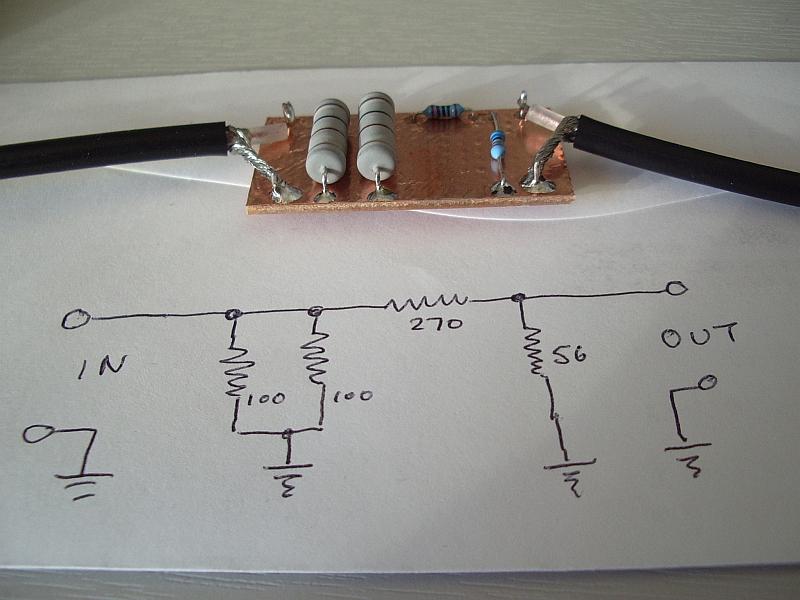
There are numerous websites that will design an attenuator for you given the working impedance and amount of attenuation required. I was not looking for precision – I would be surprised if the output of either of my radios was within 10% of the selected power anyway – and moreover I wanted to build it now using parts from my junk box not have to send off for some exact values and wait for several days for them to arrive. My attenuator was built as shown above and gave a 1.2:1 SWR over the HF range which was good enough for my purposes.
I started yesterday evening running 10mW on 80m into my end loaded attic dipole. I received no spots at all initially. I was puzzled as to why I could hear the WSPR audio using the K3 monitor even though the extension speakers I use with the K3 were switched off. I was about to compose an email to Elecraft enquiring whether the last firmware update had the effect of routing the monitor audio to the internal speaker even when an external speaker is connected when I realized the sound was coming from the computer speakers! Windows had decided to renumber the sound cards since I last used WSPR and although the receive channel was still the same and spots were being decoded the transmit audio wasn’t going to the radio. Doh!
Some time after I began transmitting I received a couple of spots from G3XLW 478km away in the south of the country. But that was all. I decided to leave it running overnight and received spots from David off and on throughout the night. These were augmented in the morning after 0800z by three spots from M0DDT at a distance of 355km to the south east. Not as impressive as Roger’s results. I guess my attic dipole, being very low for an 80m antenna, is a cloud-warmer and sends most of the RF straight up. Roger was loading the feeder of his 10m halo which doesn’t sound like much of an 80m antenna but in effect he had a top loaded vertical which probably has more lower angle radiation. That’s my theory, anyway.
It was an interesting test and I shall try very low power WSPR again on other bands. However I don’t agree with the extremist view held in some circles that people should only use WSPR with such low powers. It’s certainly interesting to discover if you can get to the end of the street on 10uW but higher powers of a few watts will reveal propagation to places lower powers won’t, information that is likely to be more useful when applied to making contacts using other modes.

Warbler exceeds 1000 miles per Watt
This evening conditions were good and I managed to have a nice QSO with Jaume, EA3NE in Terrassa, near Barcelona, Spain on 80m PSK31 using the Warbler. That is nice DX for a such a simple rig as the Warbler, although Jaume’s station clearly helped.

From Greely, ON, Canada to Terrassa, Spain
Copy was good as can be seen in the screenshot below.

Screenshot of QSO with EA3NE
The distance comes in at around 6027 km or 3745 miles. Given the Warbler puts out 3W then this QSO exceeds 1000 miles per Watt. Very pleasing!
Distance calculators can be found using Google Maps, Open Street Maps as well as a useful ‘miles per Watt’ calculator at the QRP ARCI website.


Microlight QRP
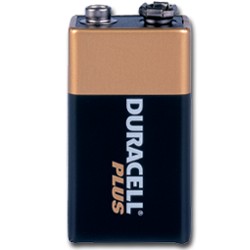
Keen followers of SOTA will have read about this on the SOTA Reflector, but during the last couple of months Richard G3CWI has been activating summits using a 30m transceiver powered by a 9V PP3/MN1604 battery. This apparently is in response to a challenge set by another keen SOTA activator: Kjell, LA1KHA (who visited us in October 2009.)
I couldn’t find many details of the challenge, so I’m just assuming that it was simply to see how many activations could be made using a radio powered by one of these small batteries. Kjell is believed to be using a Small Wonder labs RockMite but Richard built his own transceiver especially for the challenge. The receiver uses a two-crystal ladder filter at the signal frequency, an NE602 mixer, a low noise AF amplifier and active lowpass filter using CMOS op-amps. The transmitter has a crystal oscillator, bipolar buffer, bipolar amplifier and FET class E PA giving 300mW output and an internal Tick1 keyer.
With this transceiver Richard has now activated 10 summits making more than 100 contacts, still using the original PP3 battery! Having established that a PP3-powered transceiver is adequate for reliable activating Richard is now looking for ultra-lightweight HF antennas to get the weight of his portable station down to the absolute minimum.
I think this is a fascinating challenge and hope that Richard will write up the experience in more detail one day, perhaps in his RadCom Portable column or in the G-QRP Club magazine Sprat. This is really what QRP is all about, reducing the equipment to the bare essentials. It also shows the value of CW as the only mode that allows you to use such simple equipment.

Over 2000 miles on 80m with the Warbler

Screenshot of QSO with KG6ASY
Last night was a good night with the Warbler, with five contacts made using PSK31 on 80m. The locations of the contacts were varied; Ontario, Illinois, Kentucky, New Jersey and also Nevada. This last one was a real surprise as checking the distance between myself and KG6ASY in Washoe, NV, revealed it was a little over 2,200 miles. As the power out from the Warbler is 3W, it has not yet reached 1000 miles per watt but it is getting close. Tim, KG6ASY gave me a 549 report and his signal was 579 for me.
There is some DX coming in too on 80m as I saw a French and a Spanish station on the waterfall last night.
The Warbler is proving to be a fun transceiver to use during the night on 80m.

Finished Warbler in box


A quick look at the HB-1A QRP transceiver
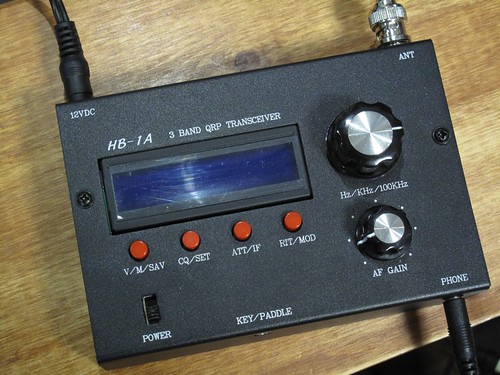
Last Summer Gerry, VA3GLT, and myself attended the first Maplecon QRP convention. At this event Gerry was lucky enough to win one of two HB-1A transceivers that had been kindly donated to the event by Youkits who were in attendance.
Gerry received the transceiver in the post and I recently got to see the rig when he can around to my shack with it. We connected it up and I had a quick investigation of its capabilities.
This is a small form QRP transceiver of the field portable type like the Elecraft KX1, Hendricks PFR 3, the ATS series by KD1JV and the new dual band Ten Tec QRP rigs (which are effectively the same as the HB-1A but only offer 2 bands). The HB-1A covers the 40m, 30m and 20m bands and although it is a CW only rig it does allow listening to SSB. We powered Gerry’s radio from my 13.8V power supply and measure 5W output on 40m and 30m and about 3.75W on 20m. The receive seemed sensitive and comparable to the KX1 and when the audio was routed through some powered computer speakers (there is ony a headphone jack, no speaker in the radio) the audio was good to listen to. The CW filter bandwidth was adjustable from 900Hz to 400Hz.
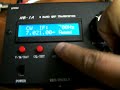
The display was very nice, being a blue LCD as the photograph below shows. The main tuning dial had a positive ‘click’ as it was turned.
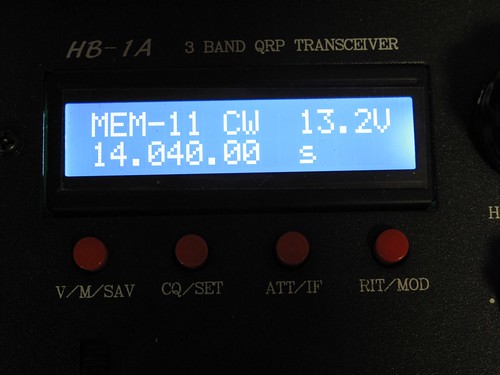
This certainly is not intended to be a review, but I was pleased with what I saw of the performance of the HB-1A and I know Gerry is very happy with it. It is a good addition to the ultra-portable group of transceivers that are out there on the market and worthy of consideration.
I did not make an audio recording when looking at the HB-1A but below is a video showing the performance by JE1TRV. If you watch carefully you will see him adjust the filter bandwidth.
If you want to listen to my recorded interview with Yimin, the founder of Youkits then go to this post.


QRP kits retirement plan
Quite frankly I can’t think of anything worse than choosing QRP Kits to ‘lay down’ as an investment, rather than build. Mind you it doesn’t look like they need to be put in the cellar for very long!













