Posts Tagged ‘Propagation’
 10m open to the north
 May 22nd, 2010 |
  Author:
 Once again, WSPR is revealing the existence of consistent propagation paths every day on 10m between Iceland (TF), the Faroes (OY) and northern Norway (LA/LB) and the UK and north-west Europe when there is no Sporadic-E and no other propagation except over very short distances between closely located stations. This has occurred even during periods of zero sunspots.
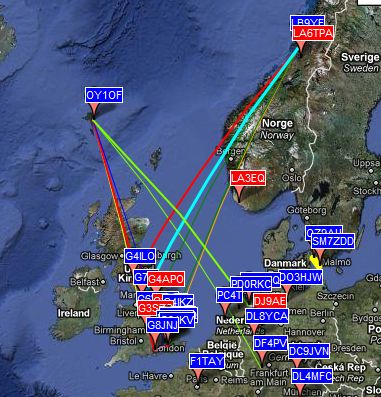 I’m guessing that because we have only in the last few weeks had a large number of WSPR monitors on 10m because of the Sporadic-E season, no-one has previously observed it. But I’m surprised at the lack of comment about it. Perhaps this is a phenomena known to everyone but me, in which case I’d welcome some enlightenment.

Ash scatter?
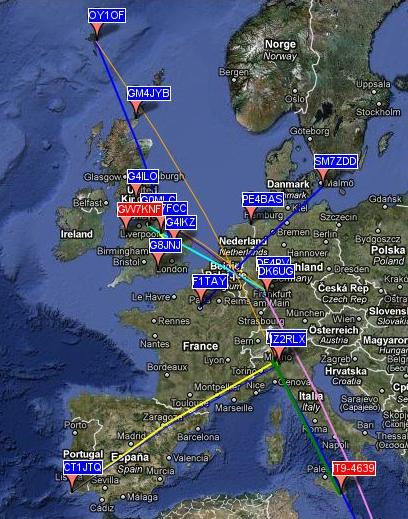 For the last week or so I have been using the K3 for WSPR on 10m to detect the signs of any Sporadic-E openings. Since the opening of May 3rd there has been nothing very exciting to report, though it has been interesting to see spots of stations previously never heard suddenly appear, often at good strength, as a patch of ionization materializes in just the right place.
What has been intriguing over the last few days is the consistent appearance of spots involving OY1OF throughout the day, often with stations in the UK but also with those in Holland, France or Germany.
The distance is too far, obviously, for the ground wave propagation that is often the only propagation reported between closely located stations. The spots are too frequent and too widespread to be Sporadic-E. And they surely cannot be regular F2 layer reflections, as the MUF in this part of the world at this point in the solar cycle is still far too low (the F2 critical frequency is around 4MHz according to the IPS Radiowave Propagation Center.)
Could it be scatter from the ash of the Icelandic volcano?

Detecting Sporadic-E on 2m
We are entering the Sporadic-E season, the favourite time of the year for those who enjoy operating the VHF bands. As Roger G3XBM suggested today, more stations this year will be using WSPR on the 10m and 6m bands, so many openings may be detected that would otherwise be missed. I am WSPRing on 10m at the moment, and will probably move up to 6m later on once 10m starts opening on a regular basis.
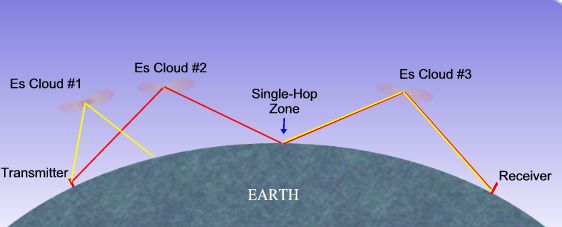 However, my first love will always be 2m. From this QTH surrounded by hills Sporadic-E is the only type of propagation that allows me to work DX on that band. On 2m, Sporadic-E openings are much rarer because much smaller patches of the Sporadic-E clouds are dense enough to reflect signals at this frequency. This makes propagation between two points on 2m much more fleeting. A station can be 59+ one minute and gone the next, which makes it essential to keep QSOs short and sweet: report, locator, and name only if you are sure you have got the time.
Some people are planning to use WSPR on 2m as well, but because of the fleeting nature of propagation I am not convinced that the 2 minute periods of WSPR make it the most appropriate method of detecting propagation on this band. I think it might be more fruitful to monitor 144.8MHz which is the APRS frequency in Europe.
APRS packets take only a second or two to send, so you don’t need propagation to be good for two whole minutes to receive one. Packets do need to be received clearly, but the “strong or gone” nature of Sporadic-E on 2m suits that quite well. The main difficulty is knowing the location of the station that sent the packet you heard, since it could well be a digipeater retransmitting a packet sent from somewhere else.
There used to be a website that displayed a propagation map based on APRS packets received. But in the last few days it appears to have gone QRT, which is rather a shame. But if you are in a location that doesn’t normally hear much APRS activity, even just hearing a number of signals going “braaap” on 144.8MHz could be the alert you need that some unusual propagation is about.
If anyone has any other ideas on how to improve the detection of Sporadic-E on 2m without sitting in front of the receiver listening to band noise for hours on end I’d be interested to hear them. If you aren’t familiar with this mode of propagation and how it works and would like to learn more about it then there is an article about Sporadic-E on my website.

Bye bye Beaconworld
The Beaconworld website will be closing down in May. If you’ve never heard of it before, neither had I until I read about it in M0XPD’s blog. But having visited the site, it seems to be an excellent and comprehensive resource for anyone interested in beacon DXing. It’s a shame that it will disappear even though it is being closed for reasons that I can understand.
Have a look while it’s still here. Perhaps someone will step in and offer to take over the site and carry it on, or at least to preserve the pages as they are.















