Posts Tagged ‘Propagation’
 Beacon monitoring with Faros
 December 8th, 2010 |
  Author:
 Alex, G7KSE wrote recently about monitoring the International Beacon Project beacons on 20, 17, 15, 12 and 10 metres, which gave me the idea to try it again for myself. I did try the Faros beacon monitoring software by VE3NEA a few years ago but being a tightwad I never registered it so the trial came to an end after 30 days. I was also less than enthusiastic about leaving the computer and radio running every day 24/7. Work out the power consumption and it can add a significant amount to the quarterly bill which is unlikely to go unnoticed by the chancellor of the exchequer (the XYL.)
These days the computer is usually running from when I get up (or after breakfast) until when I go to bed in order to run my HF and VHF APRS gateways so it is no extra trouble to do some beacon monitoring as well. I don’t have a spare radio or antenna so I will have to use my main radio (my K3) and antenna for the beacon monitor. This means that if I want to go on the air the beacon monitoring will stop. Currently my enthusiasm for actually making contacts is at a very low ebb so this is not much of a problem. I shall still shut down at night and restart in the morning, at least during the winter months when there is no night time propagation on 20m and up. Apart from the pointless waste of joules, the loud click from the K3 each time Faros changes bands will be a disturbance as the shack is only just across the landing from our bedroom.
The antenna I am using is the short multiband 80plus2 dipole bent to fit into the roof space, with additional 10m and 6m elements. It works fine on 20, 15, 12 and 10m. On 17m I can get a good SWR with the aid of the K3’s built-in tuner (which is the source of the loud clicks) but performance is noticeably down on the magnetic loop. However, the magnetic loop is used by my K2 for the HF APRS gateway so it is not available.
VE3SUN has written a very good article explaining how to set up a system to display the beacon reception charts created by Faros on a web page. It looked easy so I went ahead and set up an IBP Beacon Reception page on G4ILO’s Shack. I found that the WinSCP software that VE3SUN recommends to automate the uploading of the reception charts to the website popped up annoying windows whenever it updates so I used SyncBack SE instead. Unlike WinSCP it isn’t free, but I had purchased a license a few years ago and the code still worked with the latest version.
I converted the JavaScript in VE3SUN’s example page to PHP. This means that I can test for the existence of the beacon monitor graphics and display a friendly message rather than have the browser display a “missing picture” graphic if the monitor has not been running and that day’s GIF image doesn’t exist.
I have added to the page a short list of currently active beacon monitors to make it easy to compare my reception reports with other people’s. It would be nice if, instead of each beacon monitor having his own results on his own web site, there was a central site that collated all the IBP reception reports and displayed them on a map, like WSPR does. Perhaps that would rejuvenate interest in the IBP which seems to have been overshadowed in recent years by WSPR and reverse beacons.

A little RF goes a long way
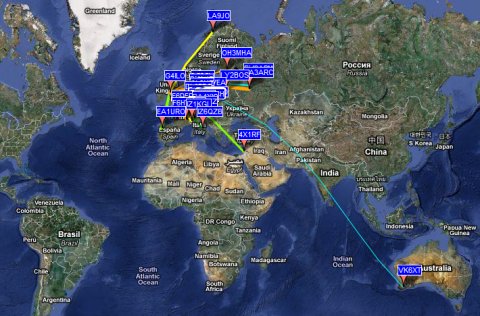
In this case, 5W of WSPR on 40m to a bent attic dipole. Not, perhaps, as impressive as M0XPD’s results with 50mW on 30m. But it’s still nice to be heard on the other side of the planet.

VOACAP Online
I don’t know how long it has been around but I only discovered this online propagation prediction tool using the VOACAP prediction engine today.
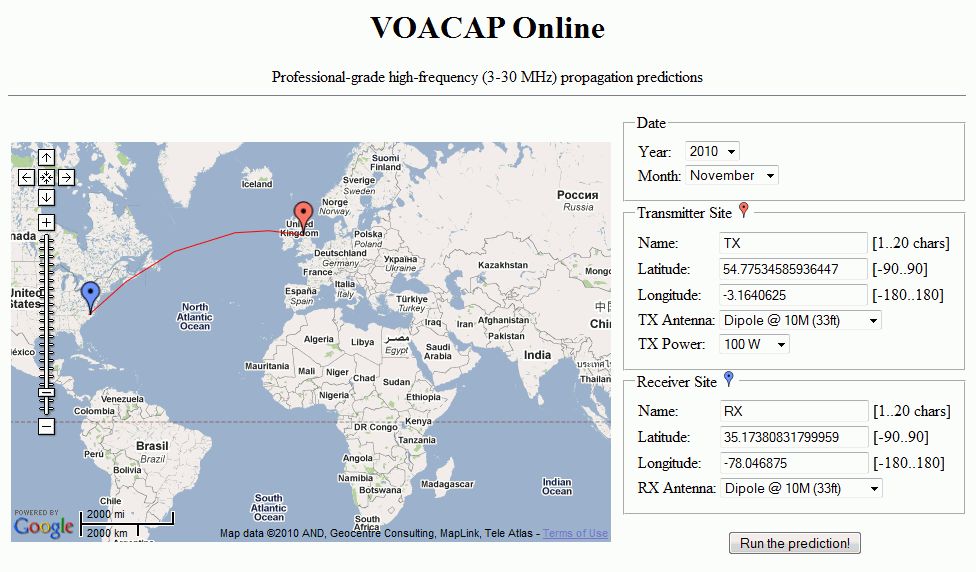
It’s very easy to use, and produces a nice chart showing the best times and frequencies to use to make a contact with a particular region. Of course, the predictions are based on the average expected propagation for the month, it won’t tell you what the bands are like today, which is why it is better not to waste your time on tools like this and turn on the radio.

LHS Episode #051: Careless WSPR
 A short while ago, Canonical released the latest version of Ubuntu: the fabled Maverick Meerkat, 10.10. This is the latest in Ubuntu’s normal release cycle and is not LTS. I had occasion to upgrade a couple of my personal computers running Ubuntu to the wily Meerkat. Find out what’s new in 10.10, and what’s old, in the first segment of LHS #049.
After that, Richard and I tackle the WSPR protocol for ham radio again. When it was discussed the first time around, neither of us had much of an idea what it was or how it worked. Armed with a broader understanding and a lot more experience, we talk about what works and what doesn’t work with WSPR, how to get it up and running on your system and what we like and don’t like about it.
Following that it’s on to witty banter, a passel of badgers, some hijinks, censorship, feedback and more entertainment than you can shake a wet hedgehog at. Thanks for tuning in. We love you all.
73 de The LHS Guys
No more sunspots after 2016?
I have just updated the smoothed sunspot number data file for VOAProp with the latest predicted values up to the year 2020. It’s one of those jobs I still do even though I long ago lost interest in the program, having come to the conclusion that the most interesting thing about HF radio propagation is its unpredictability.
Although NOAA updates its sunspot number predictions every month, I only update the data file every few months as the changes are too insignificant to make any difference to the VOAProp output. Since the last time I updated the file NOAA scientists seem to think that the maximum of the next cycle will occur a little later and be a tad higher than previously predicted, with a maximum SSN of 84.6 in the middle of 2013. They also don’t expect the next minimum at the end of 2019 to be as low as the last one.
This view is not shared by solar astronomers Matthew Penn and William Livingston of the National Solar Observatory in Arizona. They have been studying the magnetic strength of sunspots since 1990 and have observed that in that time it has fallen by nearly a third. If the trend continues, the astronomers believe, then by 2016 it will have fallen to the level below which the formation of sunspots is believed to be impossible. Though this prediction seems far fetched, it becomes a little more believable when writing about it on a day when there are once again no sunspots.
A period with almost no sunspots has occurred before, and not so long ago either, between 1645 and 1715, known as the Maunder Minimum. This period was also known as the Little Ice Age due to the fact that lower than average temperatures occurred in Europe. Time to sell our radios and invest in heating appliances, perhaps?
If nothing else, this example should show us that healthy scepticism, not credulity, is the sensible response to any scientific prediction. If you don’t care for what one bunch of boffins say, don’t worry, another bunch will be along in a few months claiming to prove just the opposite. It’s about time the global warming alarmists woke up to this.

Inconvenient spurious
During the middle of the day here 30m becomes virtually dead and there is nothing to see on HF APRS. I decided to try some digital modes. After a quick tune around I couldn’t hear any digital apart from PSK. These days, if there’s propagation there is PSK activity.
I had quick listen on 15m and even spotted a couple of stations to PSK Reporter, but signals were really weak so I dropped down to 17m. On 17m I have to use the MFJ magnetic loop, which I needed to re-tune from 30m. As I did so I was startled by a loud buzz from the Kenwood TM-D710 on the VHF APRS channel. I turned the volume down, suspecting a spurious but not knowing if it was the fault of the K3 or the Kenwood.

I made several European contacts using PSK31 before lunch including Veljo, ES0OU on Saaremaa Island, which is IOTA EU-034. None of my contacts wanted chat, though you have to realize that English is not the first language for any of these stations, if they speak it at all. I suppose here in Europe we have to be thankful for macros.
After lunch I walked into town with Olga. On my return the receiver was still on 17m and had spotted a long list of stations to PSK Reporter. KU1T, Zibi from Glengary, WV (pictured above) was one of those spotted. I waited and eventually saw his trace appear on the screen. I gave him a call and he replied. Copy was in and out of QSB so it was one of those contacts where a conversation would not have been possible. KComm told me this was my first USA contact on 17m.
Later, a few seconds with the calculator revealed the reason for the strong interference with the VHF APRS frequency. 18.100MHz, the carrier frequency used when operating in the 17m PSK31 band segment, is exactly one eighth of 144.800MHz!

Uranus to blame for poor propagation
 A recently published paper suggests that the peaks of the next two solar cycles are likely to have greatly reduced sunspot activity similar to solar cycles 5 & 6 during the Dalton Minimum of 1790 to 1830. Solar records going back over 11,000 years have been correlated with planetary ephemeris and the results appear to show that solar cycles are affected by the position of the solar system’s outer gas giants Uranus and Neptune.
However I’m not sure what is more depressing: the thought that I’m unlikely to see a solar maximum in which ten metres is wide open for worldwide propagation during my lifetime, or the reaction of some of our fellow amateurs to the news on QRZ.com. “WHY CRY about it? Buy a BIGGER antenna & amp for the bands you enjoy & have FUN!” read one comment. “All the whiners about hams using kilowatt amps will be crying constantly. Life is too short for QRP.” went another.
QRPers have been having fun throughout the extended solar minimum of the last few years and will no doubt continue to do so despite the dearth of sunspots. What is sadder, in my opinion, is the passing of an era when radio amateurs were all thoughtful, intelligent, articulate, considerate and gentlemanly individuals who treated their fellow enthusiasts, whatever their interests, with respect.














