Posts Tagged ‘Propagation’
 Great Propagation forecast but that’s it…..
 April 23rd, 2012 |
  Author:

The Sun and its effects
according to today’s “Red & Rover” comic strip – the Sun affects more than just Hams!
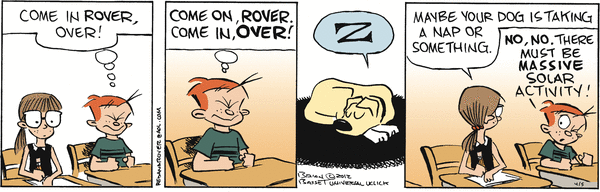
72 de Larry W2LJ
QRP – When you care to send the very least!

Solar news
Under the title “Earth braces for biggest space storm in five years” ABC Australia’s online news reports on the last 24 hours of solar activity.
A NOAA space scientist is quoted “Space weather has gotten very interesting over the past 24 hours”.
Further detail as usual from http://www.spaceweather.com and http://www.swpc.noaa.gov/today.html.
UPDATE: 24 hours later – “Space storm fizzle“!
The bands are alive with the sound of CW
 |
| Action on 20 meters |

Our little sliver of time
All the news sources–I saw it on Yahoo!, of all places–are churning out stories today about the current state of the surface of the sun. Three different “experts” have issued dire predictions about the sleepy sun and what it means for mankind…and not just us hams, who enjoy bouncing signals off an ionized atmosphere.
You know as well as I do that simply saying this cycle is slow to develop is not going to attract much reader interest. But if you say there is the possibility that the dormancy of Ole Sol portends historic implications, that it could reverse the effects of that evil, man-made global warming (or make it even more dire), that there could be unknown but potentially catastrophic weather events as a result…heck, even that we are on the verge of another Maunder Minimum, when the sun went to sleep for 300 years and we entered a “mini-Ice Age!”…then you will get some attention. Attention to your columns, your websites, your blogs, your books, your speeches.
I know it is human nature to see things from a very narrow perspective. Understanding things like climate change that usually take eons to be obvious and drawing conclusions about variations in sunspot minima and maxima that only occur in eleven-year cycles are difficult for us mortals to do. Geologic time and cosmologic time and distance are impossible for us to comprehend in our simple little seven- or eight-decade life spans. That’s why all the junk about rapid climate change (which I consider normal weather variation and based on decidedly short-term data) has found so many who are willing to swallow it, hook, line and sinker.
I admit I know little about sunspots or solar weather, beyond the fact that more spots equal better propagation on the high-frequency radio bands and pretty displays of the Northern Lights. And I appreciate data and scientific observation. But seems to me that it is far too early to say the sun is going to be dozing for the next three centuries simply because cycle 24 is a tad bit slow to get moving. After all, many of these same “experts” were touting what an active cycle this was going to be…and they were doing it only a year or so ago.
Reminds me of the high-tech “weather rock” my wife has in her flower garden. “If this rock is wet, it is raining. If it is dry, it is sunny. If it is white, it is snowing.”
I’m still hoping for an active solar cycle. I have somehow managed to be inactive in my amateur radio activities during each of the past two cycle maxima, and I had high hopes for that “arm-chair” ragchew with the Far East on 10 meters in the middle of the day. But if it doesn’t measure up, so be it. I talked to plenty of guys all over the world at the yawning chasm between the peaks, after all.
But most of all, I’d like to see everyone calm down a bit and not be so myopic. We see only a tiny slice of time in our own existence. Even so-called scientific observations are looking at a pitifully narrow slab of time and only a tiny bit of reliable data.
Put it into perspective before you panic and sell all your ham gear. Or before you stop gazing northward for a glimpse of the aurora borealis.
By the way, I checked. There is nothing we can do about the state of the sun’s surface anyway, so why worry?
Don N4KC
www.n4kc.com
www.donkeith.com
Monitoring Solar Cycle 24
 Now that solar cycle 24 is definitely underway, it’s good to be able to monitor what the sun is doing since as hams, it dramatically affects our ability to communicate. I’ve used dx.qsl.net/propagation/ for a long time as a site that I can go to for a quick overview of what’s going on, but for more in-depth information I’ll stop by solarham.com (aka http://solarcycle24.com). Kevin, VE3EN put this site together in 2006 to track the status of the then-upcoming solar cycle 24, and he’s kept improving it since then. On that site, there’s information about the current solar conditions (flux, sunspots, flares, etc.), historical data (such as the chart I’ve included in this post), solar images, and a message board where there are some fascinating discussions, many by recognized experts in their field. Kevin’s even built a version of his site that’s perfect for viewing on mobile devices, so you can view it while on the go.
Kevin’s been funding this site primarily on his own since it’s inception, although he does have a way to make a donation if you so choose. He’s been very low-key about this, but on a recent visit, I saw that he’s got an impossible-to-miss banner up on his website asking for help. Apparently his full-time job has been “off-shored” and he’s not sure that he’ll be able to keep the site available. If you click on that link it will explain the situation more fully. I have no interest in this site other than as a visitor, but if you find it useful, you might want to consider making a donation to help keep the site (and Kevin) going.

VHF propagation alerts over APRS
I have just set up an ANSRVR notification group (the APRS equivalent of an email reflector) called CDGVHF. The purpose of the group is to alert interested subscribers in the Cumbria, Dumfries and Galloway area to possible openings on the 6m, 4m, 2m and 70cm bands.
The APRS alerts make use of the email alert service of DX Sherlock which sends alerts of possible band openings customized to the subscriber’s location, based on DX Cluster spots and other reverse beacon information. I have set up a subscription to send alerts of possible band openings workable from the IO84 grid locator to a special email address on the G4ILO’s Shack web server. Using a feature of the cPanel web hosting, the email is “piped” to a script written by me in the PHP language. This extracts the subject header of the email which contains a succinct description of the alert, shortens it as much as possible and then sends it as a message to the CDGVHF ANSRVR group, which then forwards it to all interested subscribers.
Why is this better than just subscribing directly to receive the alert emails? Because I can now receive the alerts on my APRS-equipped hand-held, which should greatly reduce the chance of missing a good band opening because I wasn’t in the shack at the right moment.














