Posts Tagged ‘Propagation’

10m WSPR spots 6 Oct 2012

10m WSPR spots @ G4ILO 6 October 2012

10m WSPR spots 29 Sep 2012

10m WSPR spots – 29 Sep 2012

Double-hop Es?

Thursday brought more great 10m propagation. Take a look at the screen-grab below.
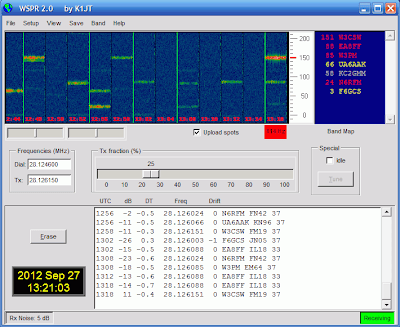
10m WSPR signals received on G4ILO’s attic dipole

The bright trace at the top right is the 10 watt signal of W3CSW at 11dB over noise. That is one of the strongest WSPR traces I’ve ever seen, and definitely the strongest signal from a station outside Europe. I think it has to be double-hop Sporadic-E propagation. It is interesting that my previous spot of the same station was 11dB below the noise. My 2 watts produced a positive result from his side as well.

Tuning around the 10m band and there was not the wall of loud signals that such good propagation would suggest. A couple of good old boys from Mississippi and Tennessee were chewing the rag, oblivious to the fact that their signals were bending S meter needles thousands of miles away. But apart from those few stations there was an absence of signals. A station I worked called CQ with no takers for some time afterwards. I tried CQing myself, with no result. To me this also shows that the enhanced propagation was very selective, supporting the theory that it was Sporadic-E propagation.

10m signals spotted by G4ILO, 27/9/2012

I did make a couple more SSB contacts but once again the digital sector provided the best returns for my efforts.

There is yet more interesting 10m propagation today. I have already spotted stations from VK2 and from Thailand. It’s a shame you can’t WSPR and operate on the same band at the same time. Or rather, it’s a shame that I can’t. So I’ll switch between modes, running WSPR when I’m not actually in the shack and able to use the keyboard or mic.

QRP v QRO – Blood on the Floor?


The mighty, omnipotent sun that our precious emerald and sapphire orb circulates is nearing the crescendo of its eleven year repeat-performance.

For the first time since 2003, I have revisited the high frequencies: the short waves of equal delight and frustration that ebb and flow with the days, seasons and years. Back then, I worked the world with 10 Watts and a rather long wire antenna. I stayed up all night sometimes to listen to the magical waxing and waning of distant continents on 80m. It was like listening to a sublime symphony. Having moved to a new house with more limited prospects for creating a good HF antenna system, I turned my back on these noble frequencies to chase the excitement of VHF and UHF.

Ironically, the drive for portable operation at V/UHF has led me to flirt with HF again. It's the inevitable purchase of arguably one of the best amateur radios ever manufactured, the Yaesu FT-817. Five delightful Watts from top band, all the way to 70cm. MF to UHF. Sea level to mountain top. CW to FM, with all modes in between. What a gem of beautifully packaged, miniaturised happiness.

FT-817. 5W on 10m.
With 5W of HF readily to hand, I’ve hastily run 10m of vertical wire in the back garden to listen to a more contemporary performance of a classic favourite. Happily, 10m has truly sprung into life. This morning I’ve just completed a QSO from home (Wales) to Greece with 5W at both ends. Deep joy. A quick bargain has even brought a Miracle Whip into the ensemble – just experimenting for fun.

But scanning through the bands in general I’m noticing a tendency to transmit at powers of 1kW and above, whatever the band, whatever the conditions. Abrupt reports of 5/9+ are exchanged with a seemingly insatiable appetite to amass as many transient contacts as possible. Then there are the pile-ups. Those ungentlemanly bun-fights where the loudest (or largest bank account and electricity bill) wins. I’m sure that there are whole streets in Palermo where the lights actually dim when DX from Pago Pago is heard on 20m.

We’ll never know if was possible to work Pago Pago with QRP because we were never given the chance. This is on SSB at least. CW operators have a greater appreciation of low power. This is an old argument that will attract equal venom and praise from our electromagnetic community. But I do believe that as technology advances, there is a global drive for efficiency. Low power is in fashion and with solar conditions as they are, we should all be ‘turning the wick down’ a little bit, shouldn’t we?

I do believe that when the sun takes its rest, there is a place for high power, particularly on the more difficult bands. There – you see? I’m not anti-QRO at all. I’m just advocating using (as your exam tells you) the minimum amount of power necessary to maintain a comfortable QSO.

Beacon update

I have updated the beacon data file for VOAProp today. The NCDXF/IARU beacons in Kenya (5Z4B) and Argentina (LU4AA) are back on the air after a long absence.

The thought crossed my mind: Now we have WSPR and remote beacon skimmers covering all bands, does anyone use these beacons any more?

My first 24 hours on WSPR

My first beacon on 30 m, a free-running Ultimate QRSS kit (no GPS) has now been running for a full 24 hours using the Weak Signal Propagation Reporter (WSPR) mode. The figure comes from the WSPRnet page.

With an output power of about 150 mW to an 80 m horizontal loop it has not been possible to reach beyond Europe so far. Perhaps this will happen in the future with better conditions and/or with some more output power.

Added 26.9.2012: I made it for the first time across the Atlantic!
Timestamp           Call       MHz         SNR Drift  Grid      Pwr Reporter   RGrid      km      az
2012-09-26 00:50, LA3ZA, 10.140262, -26,   -2,   JO59fu, 0.2, WB2EEE, FN21xh, 5852, 290

Antarctica!

Interesting conditions on 15m this afternoon.

Amazing where 2 watts of WSPR can end up!


Subscribe FREE to AmateurRadio.com's
Amateur Radio Newsletter

 
We never share your e-mail address.


Do you like to write?
Interesting project to share?
Helpful tips and ideas for other hams?

Submit an article and we will review it for publication on AmateurRadio.com!

Have a ham radio product or service?
Consider advertising on our site.

Are you a reporter covering ham radio?
Find ham radio experts for your story.

How to Set Up a Ham Radio Blog
Get started in less than 15 minutes!


  • Matt W1MST, Managing Editor