Posts Tagged ‘Propagation’
 A lot better today!
 April 22nd, 2015 |
  Author:
 That had me shaking my head even more.
I'm glad I didn't give in to the temptation to chuck it all for today, because I had the best QRP lunch time that I've had in a while - numbers and predictions be damned!
I started out on 17 Meters which seemed to be in great condition. Low noise level and some loud signals. I worked EA6NB, Jaime in the Balearic Islands. From there I wandered around a bit and worked W4B a Special Event Station for Earth Day in Florida.
After that, I switched bands and called CQ near the 20 Meter QRP Watering Hole and was answered by Dick K5TF in Atlanta, GA. Dick had a gorgeous signal. He was pushing 5 Watts out of his K2 to a Hexbeam (secretly, I am lusting for one of these babies. Bob W3BBO and I always dream about getting one for our stations and my good friend and fellow DXer/QRPer Steve WX2S is in the process of installing one). Not only was Dick's signal excellent, but his fist was a dream to copy. The words were appearing in my brain as if I were reading a teleprompter. It was a very enjoyable, but short chat.
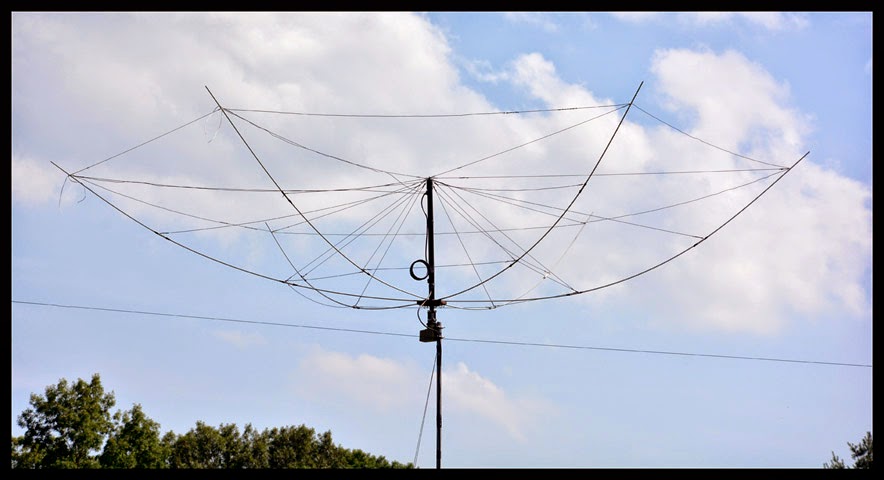
From there, I decided to spend the last bit of time that I could squeeze out of lunch break by calling CQ at the 15 Meter QRP Watering Hole on 21.060 MHz. I was greeted there by Alberto WP4L for another 2X QRP chat. Alberto was pushing 5 Watts out of his Yeasu FT-450 and sounded like he was just down the street. And I might add, another excellent fist that was bliss to copy.
If the flare that Marv e-mailed me about helped provide the kind of band conditions that I experienced today, then I hope we get them all the time! Loud signals, quiet background noise - what more could you want or ask for? The only bad thing was having to stop so that I could come back inside in order to finish the work day out.
72 de Larry W2LJ
QRP - When you care to senf the very least!
New Band For ZS Hams
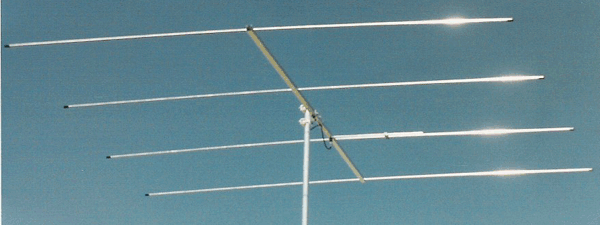 Sharp-eyed Roger, G3XBM, has brought attention to the recent news of a new amateur allocation granted to South Africa's amateur radio community! It's just a small slice of a band but in an exceptionally interesting part of the spectrum ... 40MHz!
 Amateurs have been given 'propagation studies' permission to transmit between 40.675MHz and 40.685MHz as 'primary users' and use up to 26dBW (400Watts) of power ... a healthy assignment.
I'm not sure where the push for this new band has risen from but no doubt from within the amateur radio community of South Africa ... and kudos to the SA radio authority for establishing this unique amateur band.
Myself and others, have often stated that an amateur allocation in the 40MHz region would be a wonderful part of the spectrum in which to experiment. Almost midway between the two "magic bands" (10m and 6m), the propagation opportunities of 40MHz would be most unique and abundant.
With Solar Cycle 24 being such a weak cycle, most of North America and particularly the western half, saw almost no F2 openings of any significance. Absent were the all-day long bone-crushing signals from the east coast, followed by the spotlight propagation-sweep down to South and Central America and finally over to Japan for another few hours of ear-shattering JA signals ... none of this for Cycle 24. Yet, in spite of the lower MUF's, I noted dozens and dozens of days when the F2 MUF would shoot up to the high 43MHz region and hang in for hours and hours ... just as it did on 6m in previous cycles.
Having even a small slice of spectrum at 40MHz would give amateurs a golden opportunity to follow some exceptionally interesting propagation trends during the next few cycles ... all predicted to be stinkers, some saying even worse than '24'. With 40MHz supporting the F2, Es, TEP and Auroral modes, there would be much exciting propagation to support activity in this region.
Maybe it's time North American amateur's start talking about a new slice of the 40MHz pie ... surely there is enough space to share.
A Buzzy Day On The Magic Band
 |
| courtesy: http://www.swpc.noaa.gov/ |
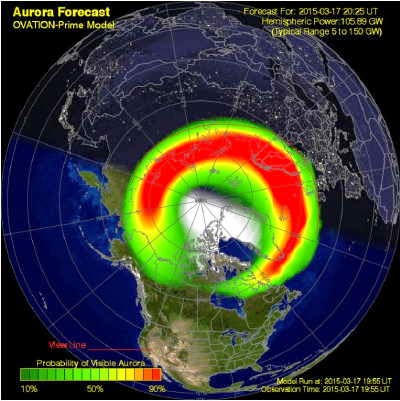
A swift-moving Coronal Mass Ejection (CME) arrived earlier than predicted, slamming into the earth's atmosphere shortly after 0430z yesterday morning. What begin as a small K5 disturbance quickly grew to a K8, signalling the strongest geomagnetic storm of Solar Cycle 24.
 |
| courtesy: http://www.swpc.noaa.gov/ |
It didn't take long for the VHF bands to start filling up with auroral signals as 6m diehards soon discovered that something was amiss.
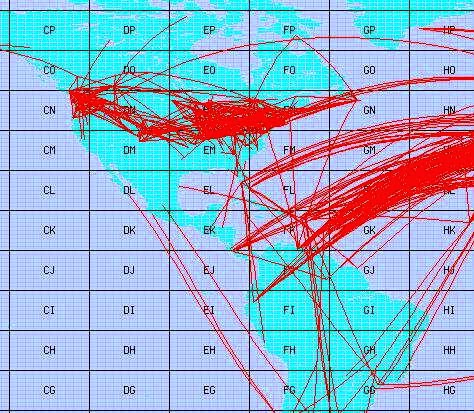
Throughout all of the day, strong auroral signals were copied and many stations were worked from here in SW British Columbia. Having the peak conditions in the middle of a working day meant hearing fewer stations than might normally be expected compared with an evening event, yet dozens of stations, including Colorado, made it out west ... even on 2m!
 |
| courtesy: http://www.on4kst.org/chat/index.php |
Strong auroral events like this, especially at the equinox, can trigger swift rises in the F2 MUF as conditions return to normal. Hopefully 6m will unleash some of its F2 magic for what might be one of the cycle's last big hurrahs.
Follow The Sun!
 |
| Courtesy: http://www.swpc.noaa.gov/ |
Where do you get your propagation information?
If you're anything like the rest of us, you probably have two or three favorite sites that you visit to collect the latest data. The news of NOAA's new solar page has been making the e-mail rounds of late and just in case you've missed it....the "Space Weather Enthusiasts Dashboard" (and what ham isn't a 'space weather enthusiast'?) can be found here.
The new site provides an all-in-one viewing experience, with up-to-the-minute reports on such things as the 'K' index, dynamic solar images from various satellites and at various wavelengths, auroral conditions, CME impact predictions (dynamic), a TEC (Total Electron Count) map, sunspot and Solar Cycle activity graphs and more. I didn't see anything showing the daily solar flux numbers (SFI) but it may be there. There is now a growing belief that the SFI value is not that great an indicator of what will or won't be happening, radio-wise, especially when it comes to 50MHz.
Another feature that would be nice, is a display of the latest DST index. This number, based upon equatorial ring currents, is a valuable indicator for the trend in LF propagation. I use the Kyoto site, which provides a real time look at the numbers. Anything positive, or a positive-going trend, is always a good thing to see.
 |
| Courtesy: http://wdc.kugi.kyoto-u.ac.jp/ |
If you haven't checked these three sites out, have a look...they're well worth a bookmark and a daily visit ... and, you won't have to go to Hawaii to follow the sun.
The Magic Lives
 With the Bz component of the Interplanetary Magnetic Field turning southwards yesterday, an unexpected incoming stream from the sun was able to interact more intensely with the earth's magentic field , producing some fairly active auroral conditions overnight. The 'K' index numbers rose as high as '7'...a rare event, indicating a major disturbance. By dawn, much of the activity was winding down and the ensuing F2 MUF spike was not far behind.
 |
| Courtesy: http://www.on4kst.com/index.php |
The 6m prop map reveals the unexpected level of mid-winter activity....as of Wednesday evening, the Bz is still pointing south and the K has risen to level 4.
What might Thursday bring?
Review session
After each exam was completed, we went over the tests together as a group. It appears that on both exams, no one got more than six answers incorrect. Since a passing grade allows for nine incorrect answers, it would appear that we are looking at a bunch of new Amateur Radio ops as of next Tuesday night.

To break things up a bit, we showed an Amateur Radio video in between the two exams. In all, I thought last night's session was exceptional. Our class members have proven to be eager, bright, inquisitive, and open to what we have been presenting to them.
It has been an honor and a privilege to work with them, as well as with my two fellow instructors, Marv K2VHW and Drew W2OU. These two are amazing Amateur Radio ops and have an amazing amount of experience behind them. The fact that Marv K2VHW is a retired broadcast engineer from WABC with a couple of Emmy Awards under his belt doesn't hurt, either!
I am looking forward to next week, and I just sent the group a final e-mail, detailing what to bring next week and basically telling how proud of them that we are. It's great to be able to help increase the ranks of Amateur Radio. I also reminded them to relax. This is supposed to be fun, and besides, in the scheme of things, it's not like we're looking to cure cancer or end world hnger.
Oh, and by the way, I did work John K4BAI in Georgia, one of the 40 Meter Foxes last night. I tried to work Kevin W9CF in Arizona, but I think the good props between NJ and AZ were over by the time I got home and wolfed down dinner. I see from his Fox log that Kevin worked some NJ stations, but that was while I was still in class. By the time I was trying to work him, he was 229 - 339 at best and I just couldn't make myself be heard. There is nothing more frustrating than calling a station who is sending a CQ in the clear, only to have them resume calling CQ after you send your call!
72 de Larry W2LJ
QRP - When you care to send the very least!
Largest Sunspot Region (so far) in Sunspot Cycle 24
Look at this huge sunspot, the largest yet of Sunspot Cycle 24! It is about the same diameter as Jupiter! Notice how tiny Earth is, in comparison. Sunspots are regions on the Sun’s photosphere, formed by the “convection” of solar plasma deep inside the Sun, causing the twisting and shifting of magnetic fields. They look like spots on the photosphere because they are cooler than their surrounding solar material, giving them their dark, blemish-like appearance.

Close-up view of NOAA Active sunspot Region AR 12192 (short: 2192)
The sunspot is the largest since November 1990, and is larger than a monster sunspot that spawned a series of major solar flares over Halloween in 2003. AR 2192 was one of the biggest observed sunspots of all time, ranking 33rd largest of 32,908 active regions since 1874, according to NASA scientists C. Alex Young and Dean Pesnell.
Interestingly, this sunspot never released any major coronal mass ejection (CME), because the magnetic fields were too strong to let any significant plasma escape! However, this sunspot group unleashed a fair number of moderate to strong x-ray flares (see one of them in this video at < http://g.nw7us.us/1s7L0vF >). All told, AR 2192 popped off 26 M-class flares, and six X-class flares! Of course, during the last sunspot cycle, Cycle 23, there were many active sunspot regions unleashing flare after flare within hours of each other. That’s typical during the active phase of most sunspot cycles. This cycle, however, is one of the weakest on record, so this large sunspot with its many flares is exciting.

A Close-up of AR 2192
Each sunspot region gets a consecutive number assigned to it by the National Oceanic and Atmospheric Administration (NOAA). This sunspot region is NOAA AR (active region) Nr. 12192 (we often drop the first digit when speaking of a sunspot, so in this case, this region was often referred to as AR 2192).

One of the many x-ray flares originating from Active sunspot Region AR 2192 – this one seen in Extreme Ultraviolet at 131 Angstroms.
This sunspot region increased the ionization of the ionosphere, creating excellent conditions on all of the high frequency spectrum (shortwave, or HF). Even ten meters was alive with world-wide propagation. And, the best news is that this provided an exciting playing field for the CQ WW SSB contest in late October, 2014.
This sunspot region has now rotated away, but may return on about 24 days.
Credit: NASA/SDO/HMI
Check out: http://SunSpotWatch.com
Get the space weather and radio propagation self-study course: http://NW7US.us/swc














