Posts Tagged ‘Portable’
 Hamcation 2013 and QRP
 February 10th, 2013 |
  Author:
 One of my favorite events is the Orlando Hamcation. This year I didn’t really have a “get list” so could enjoy more time with fellow QRP ops. Our Central FL QRP Group regular Jim Diggs K4AHO helped us get a QRP Forum and Jim Stafford W4QO came in from Georgia to help bring a good session about working DXCC with QRP. Wow! Jim also did a lot of recruiting of QRP ops as he manned the QRP ARCI booth and allowed us to hang out and assist. We had quite a good turnout of QRP Ops from FL and all over the US and a few overseas members too!


 Carl AA2JZ brought some of his homebrew masterpieces and along with some QRP rigs W4QO displayed we got a lot if interests and questions on what was in the Altoids tins.
After the QRP Forum, Greg N4KGL gave us a demo of his Alex Loop and KX-3 at a nearby picnic table. The weather and bands were both cooperative and we were all impressed with the way the antenna and rig set up and operated!
Thanks to all who joined in the fun. Check out our Central FL QRP Group blog for details on our outings.
New KD1JV ultralight rig for 80/160
There’s been a higher than usual level of activity on the AT-Sprint email list over the last few days as hints have emerged of a possible new offering of the popular MTR (Mountain Topper Radio) the latest of Steve Weber KD1JV’s radios that define the possibilities of ‘trail friendly’. To get a view of one in action check out this video from G4ISJ shot on a SOTA activation.

Steve KD1JV’s popular MTR ‘a very small, very efficient, two band rig’ is set for another future offering
Steve KD1JV is the designer behind the PFR-3 and a number of other radios offered by Doug Hendricks’ QRP Kits along with the new Tri-bander Transceiver kit. But he also enjoys a passionate following for his high performance but tiny (Altoids tin size) radios in the ATS series where ATS stands for Appalachian Trail Sprint. These radios (especially the ATS-3B and the MTR) are prized by ham hikers and walkers who watch the ounces and milliamps. They are also an example of masterful interface design using small push buttons and minimal LED display. As Steve mentioned recently in a post reflecting his deep field operating experience “Little tiny rigs and knobs don’t work well together”.
During the buzz earlier today about whether he would offer more of the MTR kits (he will), Steve also announced his latest project “An 80/160 dual band rig with direct conversion receiver and a DDS/PLL hybrid VFO using all through hole parts.” (The ATS series made extensive use of microscopic SMD components and lots of the assistance Steve offers via the AT Sprint Yahoo group is concerned with discovering and rectifying makers’ errors assembling these devices.)
His website carries a pretty detailed three-page description of the design thinking behind the new rig which he’s calling the Super Deluxe Direct Conversion Transceiver. Tantalisingly he’s suggested it may be able to work at 500kHz. The new rig also features an “LCD frequency read out, built-in keyer and rotary tuning”.
He’s planning to offer only 50 kits at about US$75 at the end of November. Expect to see them sell out in two minutes! I suspect if he offered 200, they might last an hour or two.
AlexLoop gets an airing
Several of my readers have been patiently waiting to know how the AlexLoop and KX3 have been performing together. I am interested too, but I’m not yet well enough to attempt any outings with a rucksack full of radio gear. Today it was raining and I wouldn’t have wanted to go out anyway. So I decided to operate portable from inside the warm, dry shack instead.
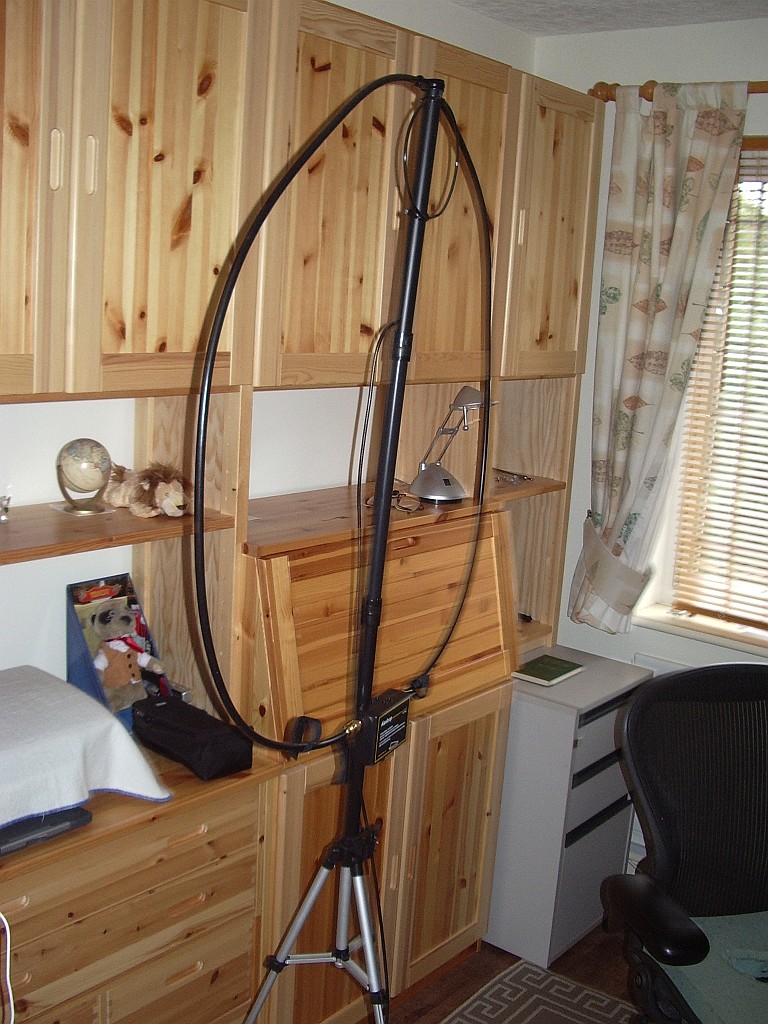
The AlexLoop was assembled, mounted on its tripod and stood in a corner of the shack. The position is far from ideal: my shack is really small and the antenna was too close to the shelves containing books, magazines and equipment. I could only get an SWR of around 5 to 1 on the higher bands. I used the KX3’s built-in AMU to take care of it. That’s not how a magnetic loop is supposed to be used, but in this situation there’s no alternative.
The KX3 was run off the shack power supply so the power out was the full 10 watts. I hope to find a battery that will provide enough volts that I can run 10 watts in the field, but as I don’t yet have one this was a little bit of cheating!
The first band I tried was 12 metres. Here, Valery, ER3ZZ in Moldova came back to my first call and gave me a 5 and 5 report. Easy peasy.
Next stop was 10 metres, where Yakov RA9XAU quickly replied to my call. Another 5 and 5 was logged. Can, TA3GO was next in the log. This time a 5 and 9 was received.
One EA9 didn’t want to talk to me as I wasn’t DX. That would actually have been an all-time new country for me, as I think Ceuta-Melilla is a separate entity from Spain. Victor, RV3RM was working other G stations and gave me a 5 and 8 report.
After lunch I spent some time listening to, and attempting to call, Stateside stations. Some were very strong but I couldn’t be heard over the pile of stations calling them. That would have been quite a scoop – to cross the Atlantic with QRP and a portable antenna. I heard Yuri UT9MZ working Europe so I called him and 5 and 9 reports were exchanged.
I spent some time listening on other bands. Peter I5CTE was a massive signal – genuinely peaking more than S9+20dB on the KX3’s S meter. on 15m. Italy is a good direction for me, for some reason. We had a proper chat lasting several minutes and Peter told me that my QRP signal peaked over 5 and 9 at times.
My very subjective conclusion is that the AlexLoop feels no different in operation than my attic multiband dipole and MFJ magnetic loop. I didn’t even feel at a particular disadvantage from the low power, except perhaps when I was attempting to work USA stations. The AlexLoop is a very good antenna and together with the Elecraft KX3 make for a potent combination, especially if you can take advantage of the KX3’s full 10 watts output.

The Birthplace of the Wind
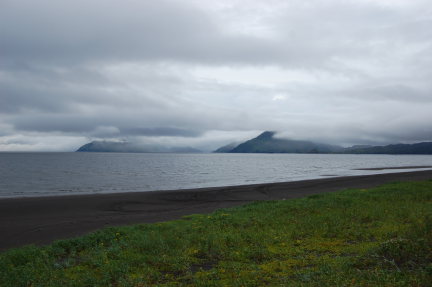
I recently had the good fortune (Sarah and some Alaskan friends might question the use of the adjective “good”) to spend about 10 days on the Aleutian island of Adak for work. In the midst of preparing for the trip, I learned that my fellow travelers Kevin, KJ4OAP, and Nathaniel, W2NAF, were planning to bring ham gear. Of course, I was as well, so we ended up with quite the merry bunch of hams on Adak. I don’t collect IOTAs, but I know it’s popular. So, I checked out Adak Island in the IOTA directory—NA-039, Andreanof Group. Fewer than 20% had claimed it, so it’s not super-rare, but not super-common, either. I was assured by at least one friend that we would be very popular, especially in Europe.
One of the first things you notice about Adak when you get off the plane is the wind. In fact, the locals call Adak “the Birthplace of the Wind.” It’s actually quite poetic considering that the winds are so strong that you don’t leave furniture outside and that the houses shudder with typical gusts. I experienced 75-mph gusts and 60-mph sustained winds during my short visit alone.
Adak is probably best known as the forward base from which the U.S. conducted its counteroffensive against the Japanese invasion of Attu and Siska during World War II. It also played an important role during the Cold War and although the military left some 10 years ago, it retains much of the infrastructure including heavy machinery, a port, and a large airport. The population shrank rapidly from a peak of just over 6000 in the 1990s to around 150 today. Just before the military (principally Navy) pulled out, they were in the process of building new base housing. The housing was completed nevertheless and so there are literally dozens if not a hundred homes that have never been occupied! Some of the others have been converted into a small hotel (this is where we stayed).
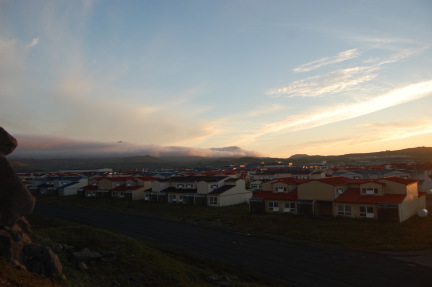
The economy is heavily dependent on fishing and fish canning right now. However, the locals are excited about the possibility of becoming a logistics hub for oil and gas work in the Bering Sea. In fact, the aircraft I came out on (An Alaska Airlines 737-400) had an unprecedented 60+ passengers on it because executives from an oil company were coming to check the place out.
Alaska Airlines operates “regular” flights twice per week.
Due to a fiction of time zones, Adak is only one hour behind Anchorage, despite being some 27 degrees west. So, sunrise and sunset are both very late in local time. It is also very far south, about the same latitude as Vancouver. Although I arrived at 6:30 pm, it was still light out for almost another four hours. So, I quickly put up the vertical on 20 meters just before sunset.
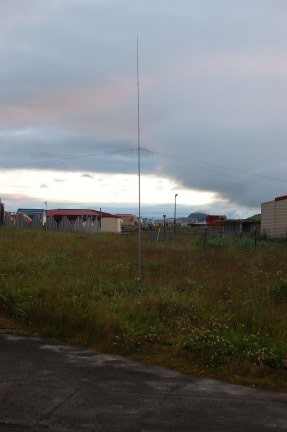
While we were putting up the vertical, Nathaniel met Jeff, KL2HD, who happened to have flown in on the same flight as us and who also happened to have his office and station across the street from my apartment. Neat. He works for U.S. Fish and Wildlife Service and they have field sites throughout the Aleutians. They use HF to communicate with their camps. So, he just plugs into a well-installed folded dipole to do his hamming. Have you ever seen a folded dipole installed between two (yes, two) Rohn 45 towers? Intense. Wind.
Due to our work schedule (8-10 hours per day plus meals), I often did not manage to get on until 0500 UT at the earliest, and sometimes even later. But, when I did, I was greeted with a roaring pileup of the “deserving.” This elicited a little bit of mail from my East Coast friends about getting on the air earlier. It turns out, however, that for most of the trip, 20 and 17 meters were open to the entire U.S. until 0630 UT. Both the skimmers and the QSOs bear this out.
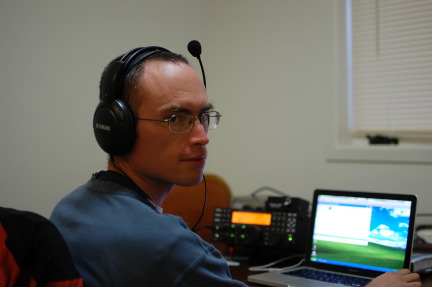
Why yes, I did get a new radio to replace the FT-840. More on this in the future.
It was pretty apparent that I had a lot of callers who couldn’t (for a variety of reasons) copy me. European friends reported a total lidfest on their end the first night I was on the air, although I learned a lot about pileup control on this trip. I have great respect for the “real” DXpeditioners who do this from the rarest locations. This was tremendous fun, though, and I enjoyed working each and every one. Thank you for calling!
There was one night on 17 meters that I CQed dead air for almost a half hour, making just two QSOs with stateside stations. And like a switch, the Europeans came in over the pole. It was incredible: I made 300 QSOs in 2.5 hours that night…mostly Europeans and Japanese.
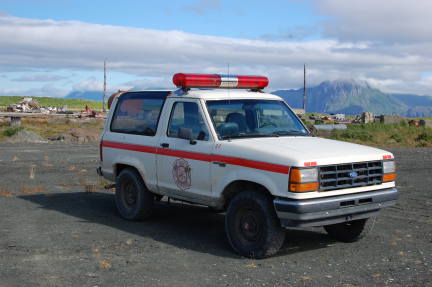
Oh, one more photo…this is one of our rental vehicles on Adak. No, your ARES group cannot buy it. The siren and lights don’t work anyway.
So, I got home on Monday and Sarah is amused by the amount of fan mail (QSL cards) the trip generated. Speaking of QSLing, the log has been uploaded to LoTW and has already generated about a 25% return rate. If you worked KL7/K8GU, you can get a nice photo card by sending an SASE or SAE+green stamp to my callbook address. I also use the bureau. To this point, Kevin and Nathaniel and I have been planning to share a card. They are still there for another week (so, if you missed me, you still have a chance for NA-039) and then we will figure out a card and order them. So, it will be a few weeks until cards can go out.
Portable in Devon
The summer here in the UK may have been the home of the Olympics and Paralympics, in fact I’ve just worked 2O12L, the special event station for the Paralympics. But one thing over everything else has dominated every Englishman’s mind. Just exactly how wet and miserable has the summer been. As I write this it is chucking it down again and the temperature is sliding towards ‘Autumn’. I can confirm that not all the UK is under water, all the time.
That said I have had a lovely week in a small village in Devon called Instow. We rented a small house opposite the beach and did the usual things with the kids. Sand castles, ice creams and cream teas as well as a bit of body boarding (for the kids, not me. I didn’t manage to get a surf board out but that’s probably a good thing). I did manage to sneak in my FT817 and Prowhip antennas fishing rod antenna into the car before the XYL spotted it.
Not many contacts to add into the log but it was nice to hit a US special event station W9IMS in Indianapolis with just a couple of watts. Perhaps it was the overly relaxed operating position.

Double Dip Weekend August 2012

Homebrew Buddipole inspection
Great weekend of QRP Portable fun. Saturday our Central FL QRP group had some new ops join us and we had a good time comparing antennas and rig setups at Sylvan Lake Park in Sanford, FL. As is typical, we did more talking than operating but did manage to sneak a few qso’s in on 20 and 17 meters. The contesters in Europe were hot and heavy on 15 m too so made for a fun day despite the heat and high humidity. I was a bit disappointed to not be able to snag any fellow Polar Bear QRP ops on 30m but the band did not stay open long and the other stations were operating on alternative bands.
Sunday after church was the first annual NJQRP Skeeter Hunt. So glad to work Skeeter Hunt promoter and fellow Polar Bear, Larry, W2LJ before the lightning ran me off. Larry was my last QSO of the day as a thunderstorm started making LOTS of noise and it was my signal to pull down the 31 ft Jackite and wire and get out from under the shade of the 50 ft tall pine trees down by the lake! YIKES… just made it too!
I ran my Sierra at 2.4 watts out into an end fed half wave suspended as a sloper from the 31 ft Jackite pole in a WNW direction. I normally use the trees to get a bit more height for my wire, but the Jackite goes up and down faster and with storms coming, I chose the simple and fast way to git ‘er done. Turned out to be a good choice. Band conditions were pretty good on 20m and I was hearing a good bit of activity. After 1800 the Caribbean, Central and South American SSB stations were causing a good bit of QRM down here in FL. They all seem to run power and gain antennas so we learn to listen through the chatter here in FL. The approaching storm was obvious as QRN increased with distant lightning stirring up the noise and crashes. Nonetheless, the signals were pretty good despite the distractions and there were some SKCC, FISTS and other cw fans out there having fun too which made the band busy.
I built a simple key and am posting a photo of my K4UPG Knee Cap Key. Used the lid of a bulk black peppercorn jar and made a simple non-iambic key with paper clips, standoff and a bit of wire. It actually worked fairly well, but not good enough to use for the whole contest. As a long time CPG (Contest Point Giver) I decided that was a good way to give myself some points so took advantage of the bonus points! It did inspire me to try a more substantial lid and make a strap to use it as a leg key for portable ops.


Umbrellas for the rig and the op!
It was fun to hear so many familiar calls and work a few of our fellow Polar Bear Ops who were out for the fun too. Sure appreciate the effort to put this event on the calendar and process the results. Thanks to the NJQRP group for the support of our niche in the hobby and to you Larry for the time you devote to contests, blogs and getting us all out and on the air.
Here’s my results before the storm drove me for cover:
| Date | Time | Call | Band | Pwr | RST | RCV | SPC | Nr | |
| 8/12/2012 | 17:12 | N0SS | 20 | CW | 2.4 | 559 | 579 | MO | #122 |
| 8/12/2012 | 17:17 | W0EA | 20 | CW | 2.4 | 559 | 559 | IA | #22 |
| 8/12/2012 | 17:23 | NK9G | 20 | CW | 2.4 | 559 | 559 | WI | #75 |
| 8/12/2012 | 17:25 | VE3WDM | 20 | CW | 2.4 | 559 | 559 | ON | #15 |
| 8/12/2012 | 17:37 | KQ2RP | 20 | CW | 2.4 | 449 | 439 | NJ | #27 |
| 8/12/2012 | 17:39 | AB4PP | 20 | CW | 2.4 | 579 | 599 | NC | #79 |
| 8/12/2012 | 17:42 | N0JRN | 20 | CW | 2.4 | 559 | 559 | MO | 5W |
| 8/12/2012 | 17:46 | N3AO | 20 | CW | 2.4 | 449 | 559 | VA | #109 |
| 8/12/2012 | 17:49 | W4MPS | 20 | CW | 2.4 | 599 | 559 | NC | 5W |
| 8/12/2012 | 18:00 | KR9Z | 20 | CW | 2.4 | 449 | 449 | IL | #10 |
| 8/12/2012 | 18:06 | AA4GA | 20 | CW | 2.4 | 579 | 569 | GA | #2 |
| 8/12/2012 | 18:08 | N7UN | 20 | CW | 2.4 | 579 | 559 | NJ | 5W |
| 8/12/2012 | 18:14 | WF4I | 20 | CW | 2.4 | 559 | 559 | NC | #71 |
| 8/12/2012 | 18:18 | K3RLL | 20 | CW | 2.4 | 449 | 339 | PA | #21 |
| 8/12/2012 | 18:31 | KX0R | 20 | CW | 2.4 | 449 | 359 | CO | #69 |
| 8/12/2012 | 18:36 | W2LJ | 20 | CW | 2.4 | 579 | 599 | NJ | #4 |
A good time was had by me!
72,
Kelly K4UPG
A new addition to the shack
I seem to suffer with the same addiction that so many other hams have. One hand held is just not enough.
It was my birthday the other day and seeing as I’m officially really old according to my kids I thought I could treat myself to a 2m hand held that I could happily take with me when I’m out on my mountain bike (Its full suspension, which goes with my old age, apparently!). I’ve never been too keen on taking the excellent Yaesu VX8-G that is my primary summit radio. I don’t regularly come off but I wouldn’t want to come off with that in a back pack. So like many others a Baofeng UV5 was ordered through eBay. After a 3 week wait it landed on my doorstep, out of the XYL’s view and was quickly moved into the garage retreat.
The specs are well known and whilst you shouldn’t expect too much for 30 quid I was quiet surprised when I sneaked it into the car when we had a trip to Mirehouse at the weekend. Even with the short and doubtful antenna I got a good signal report from M0YDH on Robinson from Keswick.
Now then what about one for 4m?













