Posts Tagged ‘portable ops’
 Weather forecast is looking good
 March 16th, 2016 |
  Author:
 The weather is looking good for Saturday for my planned expedition to Morristown National Historical Park (NPOTA HP28) this coming Saturday. Sunny with high temperatures in the upper 40s (9C) Hopefully, there will be no curve balls out of Left field that will preclude me from going.
The plan is to leave the house somewhere around 11:00 AM (1500 UTC) and be up there and on the air by around 12:00 Noon (1600 UTC). I plan on working 40, 20 and 17 Meters - CW around the QRP watering holes. I'll be packing some water and snacks and hope to stay for three or four hours. I am going to see if I can get the PAR END FEDZ 40/20/10 up in a tree in the parking lot. If not, I'll just rely on the Buddistick for 20 and 17 Meters and a Hamstick for 40 Meters.
Last Saturday, I went to the Cherryville hamfest out in Flemington, NJ which is run by the W2CRA, Cherryville Repeater Association. This was the very first hamfest that I ever went to as a newbie Ham back in 1979, and it's always held a special place for me. Unfortunately, over the years (and especially since the dawn of eBay) the Cherryville hamfest seemed to be on the down slope. Like a lot of hamfests, it suffered from poor attendance, lack of vendors, etc was plaguing it - and seemed to be spiraling towards its death knell.
Happily, between last year and this year, that trend seems to be reversed. Attendance is still nowhere near where it used to be, but it's growing. The number of vendors is still down (but again, growing), and for the most part the really bad junk is gone - and by junk I mean non-ham related garbage. I mean really, who wants to buy a roto-tiller at a hamfest? Sure there's still lots of non-Ham stuff to be seen, but it also seems there are more and more treasures to be found.
I purchased some new SO-239 chassis connectors as well as two old butterfly type variable capacitors that I got for five bucks. The capacitors have long stems on them, so they should be useful in my magnetic loop antenna project. I need to clean them up with some contact cleaner, but some initial testing seems to indicate that they are in the 200 pF range. KJI Electronics was there, and I purchased a Diamond antenna for my VHF/UHF handheld. What a difference when you buy the real brand and not a cheap knock-off!
Before I forget ........ I have a friend who has a "hardly used, very good condition" SGC-2020 QRP radio that he wants to sell. I am not privy to the price. But if you're interested, send an e-mail to [email protected] and I will forward it on to him. He's not looking for eBay type money, but he's not interested in getting taken, either.
72 de Larry W2LJ
QRP - When you care to send the very least!
The plan is to leave the house somewhere around 11:00 AM (1500 UTC) and be up there and on the air by around 12:00 Noon (1600 UTC). I plan on working 40, 20 and 17 Meters - CW around the QRP watering holes. I'll be packing some water and snacks and hope to stay for three or four hours. I am going to see if I can get the PAR END FEDZ 40/20/10 up in a tree in the parking lot. If not, I'll just rely on the Buddistick for 20 and 17 Meters and a Hamstick for 40 Meters.
Last Saturday, I went to the Cherryville hamfest out in Flemington, NJ which is run by the W2CRA, Cherryville Repeater Association. This was the very first hamfest that I ever went to as a newbie Ham back in 1979, and it's always held a special place for me. Unfortunately, over the years (and especially since the dawn of eBay) the Cherryville hamfest seemed to be on the down slope. Like a lot of hamfests, it suffered from poor attendance, lack of vendors, etc was plaguing it - and seemed to be spiraling towards its death knell.
Happily, between last year and this year, that trend seems to be reversed. Attendance is still nowhere near where it used to be, but it's growing. The number of vendors is still down (but again, growing), and for the most part the really bad junk is gone - and by junk I mean non-ham related garbage. I mean really, who wants to buy a roto-tiller at a hamfest? Sure there's still lots of non-Ham stuff to be seen, but it also seems there are more and more treasures to be found.
I purchased some new SO-239 chassis connectors as well as two old butterfly type variable capacitors that I got for five bucks. The capacitors have long stems on them, so they should be useful in my magnetic loop antenna project. I need to clean them up with some contact cleaner, but some initial testing seems to indicate that they are in the 200 pF range. KJI Electronics was there, and I purchased a Diamond antenna for my VHF/UHF handheld. What a difference when you buy the real brand and not a cheap knock-off!
Before I forget ........ I have a friend who has a "hardly used, very good condition" SGC-2020 QRP radio that he wants to sell. I am not privy to the price. But if you're interested, send an e-mail to [email protected] and I will forward it on to him. He's not looking for eBay type money, but he's not interested in getting taken, either.
72 de Larry W2LJ
QRP - When you care to send the very least!
Thinking
Even though the long range forecast for Saturday, March 19th is calling for rain and drizzle, I am contemplating doing another NPOTA activation. The weather this time of year is always changing, so I am hoping that next Saturday will actually turn out nice.
This time I have a hankering to go on up to HP28, Morristown National Historical Park, which actually consists of four different areas:
1) The Ford Mansion
2) Washington's Headquarters Museum
3) Jockey Hollow
4) Fort Nonsense
The best area for operating without causing too much undo commotion to anyone else, is from the parking lot at Jockey Hollow. Jockey Hollow is where the Continental Army wintered in 1779-1780 - a winter which turned out to be way more severe than the previous winter, which has become better known as "The Winter at Valley Forge".
That's where Dave KD2FSI activated HP28 back in January (and where I logged for him as he handled his really first big HF pileup). I noticed some pretty tall trees right next to the parking spots (the parking lot is big), so maybe I can quietly throw my PAR END-FEDZ 40/20/10 into one of them. Of course, the main bands for operating will be 40 and 20 Meters. As is always the case for W2LJ, operations will be primarily CW - but I am thinking of perhaps even doing a little QRP SSB if activity on the CW bands gets lax. I'm not sure if HP28 has been activated via CW. Maybe I can be the first.
This weekend, if I get the time, I would like to finally experiment with building a magnetic loop antenna for 40 - 10 Meters. I have some coax in the basement that's too short for anything else and would serve well, I think. I have a 365pF variable cap that I got from eBay. I have been reading some articles lately and it doesn't look like building a rudimentary loop would be all that difficult. If I have success with it, maybe I can eventually come up with a homebrewed version of the AlexLoop WalkHam model that I can use for portable ops. It might prove to be a viable option when I want to be away from the Jeep, and yet I can't hang an EFHW, or doublet.
72 de Larry W2LJ
QRP - When you care to send the very least!
This time I have a hankering to go on up to HP28, Morristown National Historical Park, which actually consists of four different areas:
1) The Ford Mansion
2) Washington's Headquarters Museum
3) Jockey Hollow
4) Fort Nonsense
The best area for operating without causing too much undo commotion to anyone else, is from the parking lot at Jockey Hollow. Jockey Hollow is where the Continental Army wintered in 1779-1780 - a winter which turned out to be way more severe than the previous winter, which has become better known as "The Winter at Valley Forge".
That's where Dave KD2FSI activated HP28 back in January (and where I logged for him as he handled his really first big HF pileup). I noticed some pretty tall trees right next to the parking spots (the parking lot is big), so maybe I can quietly throw my PAR END-FEDZ 40/20/10 into one of them. Of course, the main bands for operating will be 40 and 20 Meters. As is always the case for W2LJ, operations will be primarily CW - but I am thinking of perhaps even doing a little QRP SSB if activity on the CW bands gets lax. I'm not sure if HP28 has been activated via CW. Maybe I can be the first.
This weekend, if I get the time, I would like to finally experiment with building a magnetic loop antenna for 40 - 10 Meters. I have some coax in the basement that's too short for anything else and would serve well, I think. I have a 365pF variable cap that I got from eBay. I have been reading some articles lately and it doesn't look like building a rudimentary loop would be all that difficult. If I have success with it, maybe I can eventually come up with a homebrewed version of the AlexLoop WalkHam model that I can use for portable ops. It might prove to be a viable option when I want to be away from the Jeep, and yet I can't hang an EFHW, or doublet.
72 de Larry W2LJ
QRP - When you care to send the very least!
Thinking
Even though the long range forecast for Saturday, March 19th is calling for rain and drizzle, I am contemplating doing another NPOTA activation. The weather this time of year is always changing, so I am hoping that next Saturday will actually turn out nice.
This time I have a hankering to go on up to HP28, Morristown National Historical Park, which actually consists of four different areas:
1) The Ford Mansion
2) Washington's Headquarters Museum
3) Jockey Hollow
4) Fort Nonsense
The best area for operating without causing too much undo commotion to anyone else, is from the parking lot at Jockey Hollow. Jockey Hollow is where the Continental Army wintered in 1779-1780 - a winter which turned out to be way more severe than the previous winter, which has become better known as "The Winter at Valley Forge".
That's where Dave KD2FSI activated HP28 back in January (and where I logged for him as he handled his really first big HF pileup). I noticed some pretty tall trees right next to the parking spots (the parking lot is big), so maybe I can quietly throw my PAR END-FEDZ 40/20/10 into one of them. Of course, the main bands for operating will be 40 and 20 Meters. As is always the case for W2LJ, operations will be primarily CW - but I am thinking of perhaps even doing a little QRP SSB if activity on the CW bands gets lax. I'm not sure if HP28 has been activated via CW. Maybe I can be the first.
This weekend, if I get the time, I would like to finally experiment with building a magnetic loop antenna for 40 - 10 Meters. I have some coax in the basement that's too short for anything else and would serve well, I think. I have a 365pF variable cap that I got from eBay. I have been reading some articles lately and it doesn't look like building a rudimentary loop would be all that difficult. If I have success with it, maybe I can eventually come up with a homebrewed version of the AlexLoop WalkHam model that I can use for portable ops. It might prove to be a viable option when I want to be away from the Jeep, and yet I can't hang an EFHW, or doublet.
72 de Larry W2LJ
QRP - When you care to send the very least!
This time I have a hankering to go on up to HP28, Morristown National Historical Park, which actually consists of four different areas:
1) The Ford Mansion
2) Washington's Headquarters Museum
3) Jockey Hollow
4) Fort Nonsense
The best area for operating without causing too much undo commotion to anyone else, is from the parking lot at Jockey Hollow. Jockey Hollow is where the Continental Army wintered in 1779-1780 - a winter which turned out to be way more severe than the previous winter, which has become better known as "The Winter at Valley Forge".
That's where Dave KD2FSI activated HP28 back in January (and where I logged for him as he handled his really first big HF pileup). I noticed some pretty tall trees right next to the parking spots (the parking lot is big), so maybe I can quietly throw my PAR END-FEDZ 40/20/10 into one of them. Of course, the main bands for operating will be 40 and 20 Meters. As is always the case for W2LJ, operations will be primarily CW - but I am thinking of perhaps even doing a little QRP SSB if activity on the CW bands gets lax. I'm not sure if HP28 has been activated via CW. Maybe I can be the first.
This weekend, if I get the time, I would like to finally experiment with building a magnetic loop antenna for 40 - 10 Meters. I have some coax in the basement that's too short for anything else and would serve well, I think. I have a 365pF variable cap that I got from eBay. I have been reading some articles lately and it doesn't look like building a rudimentary loop would be all that difficult. If I have success with it, maybe I can eventually come up with a homebrewed version of the AlexLoop WalkHam model that I can use for portable ops. It might prove to be a viable option when I want to be away from the Jeep, and yet I can't hang an EFHW, or doublet.
72 de Larry W2LJ
QRP - When you care to send the very least!
Doctor and patient are doing fine
A few days ago, I went out to the car as I usually do, for some lunchtime QRP. In my haste to get everything put away after I was done, I inadvertently knocked the external battery off the car seat onto the floor. The KX3 started to move, as it was still attached, but a quick hand stopped it, and all was well. Or so I thought.
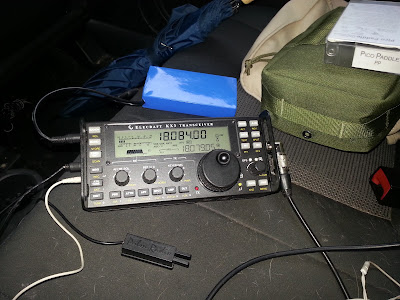
Yesterday, I went out again, and this time the KX3 wouldn't turn on. No problem, I thought to myself, the battery was probably on its way out, as it has been a while since I have given it its last drink. So last evening, while I was attending a CERT class on animal handling during declared emergencies, I had the battery plugged in at home, charging.
When I got home, around 10:00 PM, I tried reconnecting the battery to the KX3 to see if everything was OK. Still no sign of life - my KX3 was still flat lining.. Hmmmmmm ........ could the battery have gone totally bad?
I carried the radio down to the shack 13.8V power supply. Viola! It turned on!
And then immediately turned off.

My brain went into over drive. What the %(#@*#$ was going on ?!?
I dread sending stuff out for repair. Don't know why, I just do. I was in the professional photographic electronics repair biz for over 20 years. I have fixed studio strobes costing well over $12,000.00. I have taken apart digital camera backs that cost more than a Mercedes Benz. I have stared down banks of charged capacitors storing up enough electrons to supply 6,400 Joules of energy in one pop - certainly I should be able to figure out a relatively minor KX3 repair? Right?
I rolled up my sleeves and got down to it. Obviously, this was a power problem. But why was the rig shutting down so quickly? Internal short? Bad connection somewhere? Then I noticed that if I wiggled the power plug a certain way, the radio would stay on. My mind immediately flashed back to the battery falling incident from the other day. I must have done something to the power socket.
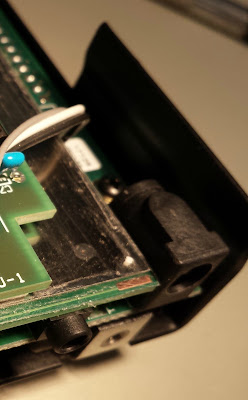
The advantage of building the KX3 (if that's what you want to call it) is that you know how it goes together, so you're not frightened at the prospect of taking it apart. You've seen it in all its naked glory and you lovingly put it together at least once, right? So what's the big deal in taking it apart?
Well, when you built it roughly five years ago, some of the finer details of how it went together get muddled up in the old memory banks. That's why it's good to never toss the build manual! Within about 5 -7 minutes I had it apart and had the display circuit in my hand. A little extra light and a lot of extra magnification from a magnifying glass confirmed my suspicion.
The power socket is a surface mount device, just about like everything else on that display/control circuit board. The weight of the battery tugged the socket enough to unmoor it from its assigned, tinned pads. When I would wiggle the connector "down" towards the circuit board, everything worked. As soon as I let downward pressure go, the connector would break contact from the circuit board again and the radio would appear dead.
I ran upstairs for a pair of scrubs and to wash my hands to prep for surgery. NO! Just kidding!

I changed my soldering station tip to the skinniest one that I have for when I work on SMD devices and I re-soldered that connector onto its pads. I took great care to add just a little "extra" solder just to make sure the connection is good, solid and won't come apart so easily in the future.
I hastily (I'll get back to that in a minute) put everything together and fired the radio up. Fixed! Problem solved! High fives and happy dances all around!
I will have to go back sometime over the weekend to remove the front plexiglass display window, though. In my haste, I wasn't so careful about finger prints. I'll have to go back and clean that up. Yes, I know ...... call me anal. I can't help it!
But as this blog post says - the patient (and more importantly, the doctor) are doing just fine! And even more importantly - no return trip to Aptos!
PROGNOSIS: Excellent! Today's lunchtime QRP session netted the following:
N0TA - SOTA peak W0C/PR-082 (Squaw Mountain) in CO on 20 Meters.
VP5/AC0W - Turks and Caicos Islands on 20 Meters
CT9/OM3RM - Madeira Island on 20 Meters.
PJ2/NF9V - Curacao on 15 Meters.
I chased KH7Y in Hawaii who was absolutely booming into NJ on 15 Meters, but could not make myself heard. Just goes to show, you can't win them all!
72 de Larry W2LJ
QRP - When you care to send the very least!

Gear on the backseat of the Jeep.
Yesterday, I went out again, and this time the KX3 wouldn't turn on. No problem, I thought to myself, the battery was probably on its way out, as it has been a while since I have given it its last drink. So last evening, while I was attending a CERT class on animal handling during declared emergencies, I had the battery plugged in at home, charging.
When I got home, around 10:00 PM, I tried reconnecting the battery to the KX3 to see if everything was OK. Still no sign of life - my KX3 was still flat lining.. Hmmmmmm ........ could the battery have gone totally bad?
I carried the radio down to the shack 13.8V power supply. Viola! It turned on!
And then immediately turned off.

My brain went into over drive. What the %(#@*#$ was going on ?!?
I dread sending stuff out for repair. Don't know why, I just do. I was in the professional photographic electronics repair biz for over 20 years. I have fixed studio strobes costing well over $12,000.00. I have taken apart digital camera backs that cost more than a Mercedes Benz. I have stared down banks of charged capacitors storing up enough electrons to supply 6,400 Joules of energy in one pop - certainly I should be able to figure out a relatively minor KX3 repair? Right?
I rolled up my sleeves and got down to it. Obviously, this was a power problem. But why was the rig shutting down so quickly? Internal short? Bad connection somewhere? Then I noticed that if I wiggled the power plug a certain way, the radio would stay on. My mind immediately flashed back to the battery falling incident from the other day. I must have done something to the power socket.

The power socket is the black, boxy thing to the right.
The advantage of building the KX3 (if that's what you want to call it) is that you know how it goes together, so you're not frightened at the prospect of taking it apart. You've seen it in all its naked glory and you lovingly put it together at least once, right? So what's the big deal in taking it apart?
Well, when you built it roughly five years ago, some of the finer details of how it went together get muddled up in the old memory banks. That's why it's good to never toss the build manual! Within about 5 -7 minutes I had it apart and had the display circuit in my hand. A little extra light and a lot of extra magnification from a magnifying glass confirmed my suspicion.
The power socket is a surface mount device, just about like everything else on that display/control circuit board. The weight of the battery tugged the socket enough to unmoor it from its assigned, tinned pads. When I would wiggle the connector "down" towards the circuit board, everything worked. As soon as I let downward pressure go, the connector would break contact from the circuit board again and the radio would appear dead.
I ran upstairs for a pair of scrubs and to wash my hands to prep for surgery. NO! Just kidding!

I changed my soldering station tip to the skinniest one that I have for when I work on SMD devices and I re-soldered that connector onto its pads. I took great care to add just a little "extra" solder just to make sure the connection is good, solid and won't come apart so easily in the future.
I hastily (I'll get back to that in a minute) put everything together and fired the radio up. Fixed! Problem solved! High fives and happy dances all around!
I will have to go back sometime over the weekend to remove the front plexiglass display window, though. In my haste, I wasn't so careful about finger prints. I'll have to go back and clean that up. Yes, I know ...... call me anal. I can't help it!
But as this blog post says - the patient (and more importantly, the doctor) are doing just fine! And even more importantly - no return trip to Aptos!
PROGNOSIS: Excellent! Today's lunchtime QRP session netted the following:
N0TA - SOTA peak W0C/PR-082 (Squaw Mountain) in CO on 20 Meters.
VP5/AC0W - Turks and Caicos Islands on 20 Meters
CT9/OM3RM - Madeira Island on 20 Meters.
PJ2/NF9V - Curacao on 15 Meters.
I chased KH7Y in Hawaii who was absolutely booming into NJ on 15 Meters, but could not make myself heard. Just goes to show, you can't win them all!
72 de Larry W2LJ
QRP - When you care to send the very least!
Doctor and patient are doing fine
A few days ago, I went out to the car as I usually do, for some lunchtime QRP. In my haste to get everything put away after I was done, I inadvertently knocked the external battery off the car seat onto the floor. The KX3 started to move, as it was still attached, but a quick hand stopped it, and all was well. Or so I thought.
Yesterday, I went out again, and this time the KX3 wouldn't turn on. No problem, I thought to myself, the battery was probably on its way out, as it has been a while since I have given it its last drink. So last evening, while I was attending a CERT class on animal handling during declared emergencies, I had the battery plugged in at home, charging.
When I got home, around 10:00 PM, I tried reconnecting the battery to the KX3 to see if everything was OK. Still no sign of life - my KX3 was still flat lining.. Hmmmmmm ........ could the battery have gone totally bad?
I carried the radio down to the shack 13.8V power supply. Viola! It turned on!
And then immediately turned off.
My brain went into over drive. What the %(#@*#$ was going on ?!?
I dread sending stuff out for repair. Don't know why, I just do. I was in the professional photographic electronics repair biz for over 20 years. I have fixed studio strobes costing well over $12,000.00. I have taken apart digital camera backs that cost more than a Mercedes Benz. I have stared down banks of charged capacitors storing up enough electrons to supply 6,400 Joules of energy in one pop - certainly I should be able to figure out a relatively minor KX3 repair? Right?
I rolled up my sleeves and got down to it. Obviously, this was a power problem. But why was the rig shutting down so quickly? Internal short? Bad connection somewhere? Then I noticed that if I wiggled the power plug a certain way, the radio would stay on. My mind immediately flashed back to the battery falling incident from the other day. I must have done something to the power socket.
The advantage of building the KX3 (if that's what you want to call it) is that you know how it goes together, so you're not frightened at the prospect of taking it apart. You've seen it in all its naked glory and you lovingly put it together at least once, right? So what's the big deal in taking it apart?
Well, when you built it roughly five years ago, some of the finer details of how it went together get muddled up in the old memory banks. That's why it's good to never toss the build manual! Within about 5 -7 minutes I had it apart and had the display circuit in my hand. A little extra light and a lot of extra magnification from a magnifying glass confirmed my suspicion.
The power socket is a surface mount device, just about like everything else on that display/control circuit board. The weight of the battery tugged the socket enough to unmoor it from its assigned, tinned pads. When I would wiggle the connector "down" towards the circuit board, everything worked. As soon as I let downward pressure go, the connector would break contact from the circuit board again and the radio would appear dead.
I ran upstairs for a pair of scrubs and to wash my hands to prep for surgery. NO! Just kidding!
I changed my soldering station tip to the skinniest one that I have for when I work on SMD devices and I re-soldered that connector onto its pads. I took great care to add just a little "extra" solder just to make sure the connection is good, solid and won't come apart so easily in the future.
I hastily (I'll get back to that in a minute) put everything together and fired the radio up. Fixed! Problem solved! High fives and happy dances all around!
I will have to go back sometime over the weekend to remove the front plexiglass display window, though. In my haste, I wasn't so careful about finger prints. I'll have to go back and clean that up. Yes, I know ...... call me anal. I can't help it!
But as this blog post says - the patient (and more importantly, the doctor) are doing just fine! And even more importantly - no return trip to Aptos!
PROGNOSIS: Excellent! Today's lunchtime QRP session netted the following:
N0TA - SOTA peak W0C/PR-082 (Squaw Mountain) in CO on 20 Meters.
VP5/AC0W - Turks and Caicos Islands on 20 Meters
CT9/OM3RM - Madeira Island on 20 Meters.
PJ2/NF9V - Curacao on 15 Meters.
I chased KH7Y in Hawaii who was absolutely booming into NJ on 15 Meters, but could not make myself heard. Just goes to show, you can't win them all!
72 de Larry W2LJ
QRP - When you care to send the very least!
Gear on the backseat of the Jeep.
Yesterday, I went out again, and this time the KX3 wouldn't turn on. No problem, I thought to myself, the battery was probably on its way out, as it has been a while since I have given it its last drink. So last evening, while I was attending a CERT class on animal handling during declared emergencies, I had the battery plugged in at home, charging.
When I got home, around 10:00 PM, I tried reconnecting the battery to the KX3 to see if everything was OK. Still no sign of life - my KX3 was still flat lining.. Hmmmmmm ........ could the battery have gone totally bad?
I carried the radio down to the shack 13.8V power supply. Viola! It turned on!
And then immediately turned off.
My brain went into over drive. What the %(#@*#$ was going on ?!?
I dread sending stuff out for repair. Don't know why, I just do. I was in the professional photographic electronics repair biz for over 20 years. I have fixed studio strobes costing well over $12,000.00. I have taken apart digital camera backs that cost more than a Mercedes Benz. I have stared down banks of charged capacitors storing up enough electrons to supply 6,400 Joules of energy in one pop - certainly I should be able to figure out a relatively minor KX3 repair? Right?
I rolled up my sleeves and got down to it. Obviously, this was a power problem. But why was the rig shutting down so quickly? Internal short? Bad connection somewhere? Then I noticed that if I wiggled the power plug a certain way, the radio would stay on. My mind immediately flashed back to the battery falling incident from the other day. I must have done something to the power socket.
The power socket is the black, boxy thing to the right.
The advantage of building the KX3 (if that's what you want to call it) is that you know how it goes together, so you're not frightened at the prospect of taking it apart. You've seen it in all its naked glory and you lovingly put it together at least once, right? So what's the big deal in taking it apart?
Well, when you built it roughly five years ago, some of the finer details of how it went together get muddled up in the old memory banks. That's why it's good to never toss the build manual! Within about 5 -7 minutes I had it apart and had the display circuit in my hand. A little extra light and a lot of extra magnification from a magnifying glass confirmed my suspicion.
The power socket is a surface mount device, just about like everything else on that display/control circuit board. The weight of the battery tugged the socket enough to unmoor it from its assigned, tinned pads. When I would wiggle the connector "down" towards the circuit board, everything worked. As soon as I let downward pressure go, the connector would break contact from the circuit board again and the radio would appear dead.
I ran upstairs for a pair of scrubs and to wash my hands to prep for surgery. NO! Just kidding!
I changed my soldering station tip to the skinniest one that I have for when I work on SMD devices and I re-soldered that connector onto its pads. I took great care to add just a little "extra" solder just to make sure the connection is good, solid and won't come apart so easily in the future.
I hastily (I'll get back to that in a minute) put everything together and fired the radio up. Fixed! Problem solved! High fives and happy dances all around!
I will have to go back sometime over the weekend to remove the front plexiglass display window, though. In my haste, I wasn't so careful about finger prints. I'll have to go back and clean that up. Yes, I know ...... call me anal. I can't help it!
But as this blog post says - the patient (and more importantly, the doctor) are doing just fine! And even more importantly - no return trip to Aptos!
PROGNOSIS: Excellent! Today's lunchtime QRP session netted the following:
N0TA - SOTA peak W0C/PR-082 (Squaw Mountain) in CO on 20 Meters.
VP5/AC0W - Turks and Caicos Islands on 20 Meters
CT9/OM3RM - Madeira Island on 20 Meters.
PJ2/NF9V - Curacao on 15 Meters.
I chased KH7Y in Hawaii who was absolutely booming into NJ on 15 Meters, but could not make myself heard. Just goes to show, you can't win them all!
72 de Larry W2LJ
QRP - When you care to send the very least!
Smartphones
I was prompted to write this because of the latest poll on eHam. It's about smart phones and Amateur Radio apps. Of course, it devolved from being anything useful into a bunch of curmudgeons blasting the topic to smithereens.
"What do you need a smart phone for anyway? I detest them, they are the mark of the Beast - the Devil's plaything, they are everything that is wrong with society! I use a real radio that has knobs ...... remember what those are?" I am paraphrasing, of course. ;-)
And so on, and so on, and so on. Sigh - heavy sigh.
It's a tool, guys ...... just another tool in the Ham radio arsenal, get it?
I have a pre-owned (sound so much better than "used") Samsung Galaxy S3, which I recently picked up on eBay. It's my first personal 4G cell phone. (I know, forever behind the times.) Even though it's an older model, it's in excellent shape and I'm familiar with the S3, as my work-issued cell phone used to be an S3. For work, they recently upgraded me to an iPhone 5s, which I don't like (or use) - but this post is not about that.
My Galaxy S3 is a great companion for portable QRP ops. It's works much better than the Motorola Droid 2 that I previously used. It has more system memory, so it doesn't lock up or lag on me, like the Droid 2 used to. I have the following Amateur Radio apps on it:
HamLog
SOTAwatch
Morse Trainer by Wolphi
QRZDroid
DX Cluster
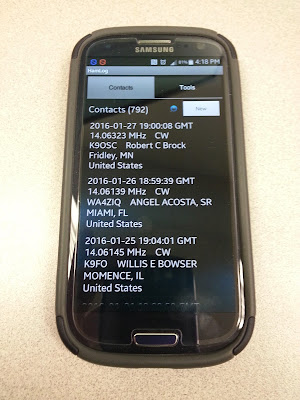
HamLog is great! It's easy to use and has a lot of features. If I'm not in a pileup situation (ragchew mode, or even causal sprint operation), it's easy enough for me to type in my contacts. In a hectic pileup situation (think activating NPOTA or the Skeeter Hunt), where things are happening fast and furious, I get flustered a bit. I can start out logging on the cell phone, but inevitably, I end up getting fumble-fingered and have to resort to old school - paper and pencil. If I'm near a wi-fi source (I have a very limited monthly data allowance, so my data connection is always off), it will even look up the names and QTHs of the operators that I am currently working. I can easily export the log to an ADIF file, so that I can add my portable ops contacts to my main log on Log4OM.
SOTAwatch - turn it on and it shows you the current activations. Call signs, peak, frequency and mode. It has other features which I haven't even explored yet.
Morse Trainer - This is one of the best Morse Code trainers out there IMHO. It will allow Morse to be sent as fast as 60 WPM. I keep mine set to a speed of about 40 WPM and have it send regular words. I try to listen to some code practice several times a week in my never ending goal to become an even more competent CW op. Boy, 25 WPM sure sounds easy-peasy after listening to 40 WPM for a while!
QRZDroid - QRZ.com in an app. Easy call sign look up.
DX Cluster - Very helpful in tracking NPOTA stations. The only drawback with DX Cluster is that you can filter it for either all HF bands or mono-bands. It would be nice if I could filter say, 20 and 17 Meters in one shot. But, hey, if wishes were nickels, I'd be a rich man. Wish I was smart enough to write apps like these, then maybe I would be a rich man!
The bottom line is that a smart phone can be a useful tool to compliment and enhance your overall Amateur Radio experience. It's not a replacement or any other kind of bogeyman. It is what you make of it.
72 de Larry W2LJ
QRP - When you care to send the very least!
"What do you need a smart phone for anyway? I detest them, they are the mark of the Beast - the Devil's plaything, they are everything that is wrong with society! I use a real radio that has knobs ...... remember what those are?" I am paraphrasing, of course. ;-)
And so on, and so on, and so on. Sigh - heavy sigh.
It's a tool, guys ...... just another tool in the Ham radio arsenal, get it?
I have a pre-owned (sound so much better than "used") Samsung Galaxy S3, which I recently picked up on eBay. It's my first personal 4G cell phone. (I know, forever behind the times.) Even though it's an older model, it's in excellent shape and I'm familiar with the S3, as my work-issued cell phone used to be an S3. For work, they recently upgraded me to an iPhone 5s, which I don't like (or use) - but this post is not about that.
My Galaxy S3 is a great companion for portable QRP ops. It's works much better than the Motorola Droid 2 that I previously used. It has more system memory, so it doesn't lock up or lag on me, like the Droid 2 used to. I have the following Amateur Radio apps on it:
HamLog
SOTAwatch
Morse Trainer by Wolphi
QRZDroid
DX Cluster
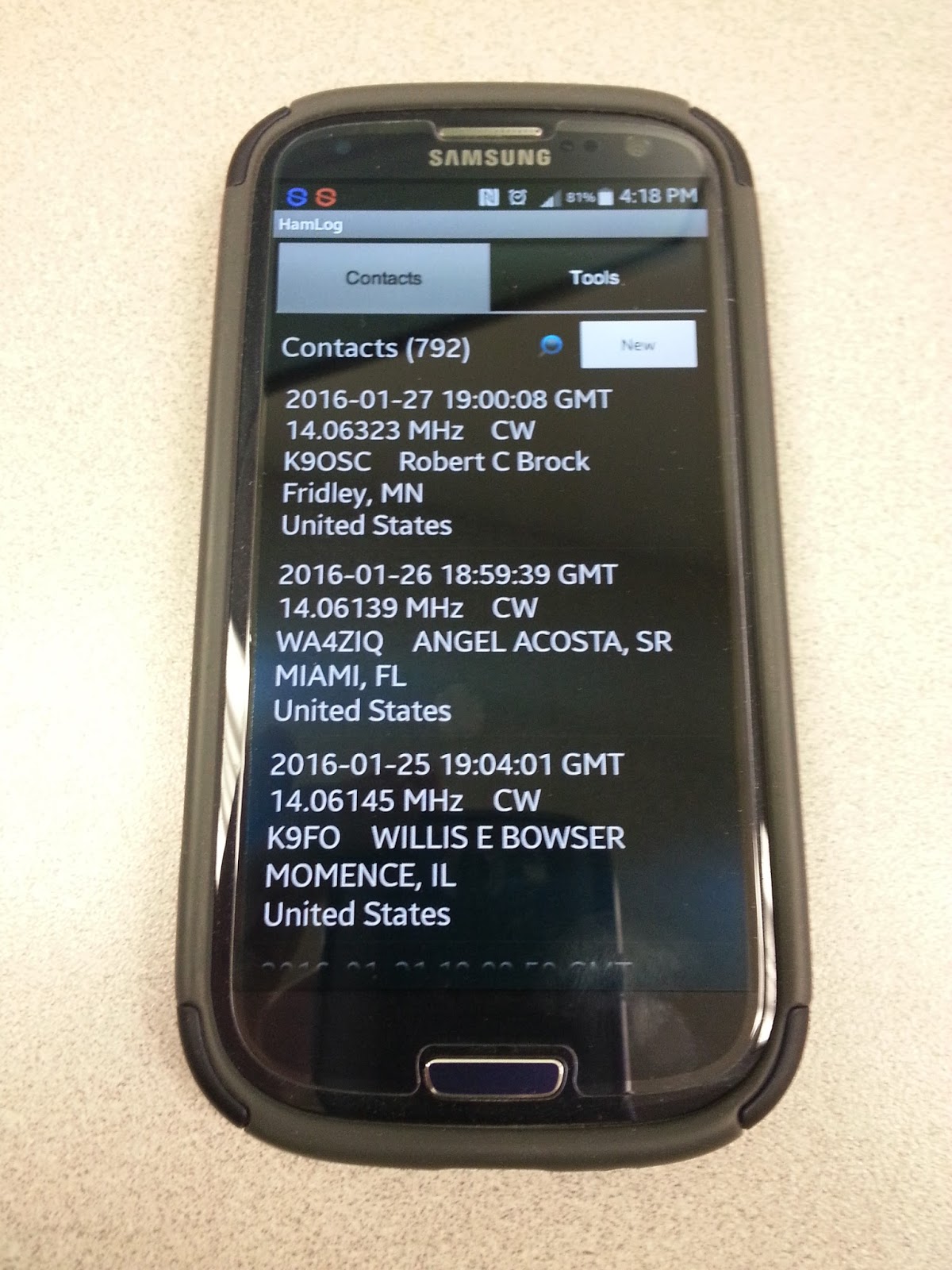
HamLog is great! It's easy to use and has a lot of features. If I'm not in a pileup situation (ragchew mode, or even causal sprint operation), it's easy enough for me to type in my contacts. In a hectic pileup situation (think activating NPOTA or the Skeeter Hunt), where things are happening fast and furious, I get flustered a bit. I can start out logging on the cell phone, but inevitably, I end up getting fumble-fingered and have to resort to old school - paper and pencil. If I'm near a wi-fi source (I have a very limited monthly data allowance, so my data connection is always off), it will even look up the names and QTHs of the operators that I am currently working. I can easily export the log to an ADIF file, so that I can add my portable ops contacts to my main log on Log4OM.
SOTAwatch - turn it on and it shows you the current activations. Call signs, peak, frequency and mode. It has other features which I haven't even explored yet.
Morse Trainer - This is one of the best Morse Code trainers out there IMHO. It will allow Morse to be sent as fast as 60 WPM. I keep mine set to a speed of about 40 WPM and have it send regular words. I try to listen to some code practice several times a week in my never ending goal to become an even more competent CW op. Boy, 25 WPM sure sounds easy-peasy after listening to 40 WPM for a while!
QRZDroid - QRZ.com in an app. Easy call sign look up.
DX Cluster - Very helpful in tracking NPOTA stations. The only drawback with DX Cluster is that you can filter it for either all HF bands or mono-bands. It would be nice if I could filter say, 20 and 17 Meters in one shot. But, hey, if wishes were nickels, I'd be a rich man. Wish I was smart enough to write apps like these, then maybe I would be a rich man!
The bottom line is that a smart phone can be a useful tool to compliment and enhance your overall Amateur Radio experience. It's not a replacement or any other kind of bogeyman. It is what you make of it.
72 de Larry W2LJ
QRP - When you care to send the very least!
Smartphones
I was prompted to write this because of the latest poll on eHam. It's about smart phones and Amateur Radio apps. Of course, it devolved from being anything useful into a bunch of curmudgeons blasting the topic to smithereens.
"What do you need a smart phone for anyway? I detest them, they are the mark of the Beast - the Devil's plaything, they are everything that is wrong with society! I use a real radio that has knobs ...... remember what those are?" I am paraphrasing, of course. ;-)
And so on, and so on, and so on. Sigh - heavy sigh.
It's a tool, guys ...... just another tool in the Ham radio arsenal, get it?
I have a pre-owned (sound so much better than "used") Samsung Galaxy S3, which I recently picked up on eBay. It's my first personal 4G cell phone. (I know, forever behind the times.) Even though it's an older model, it's in excellent shape and I'm familiar with the S3, as my work-issued cell phone used to be an S3. For work, they recently upgraded me to an iPhone 5s, which I don't like (or use) - but this post is not about that.
My Galaxy S3 is a great companion for portable QRP ops. It's works much better than the Motorola Droid 2 that I previously used. It has more system memory, so it doesn't lock up or lag on me, like the Droid 2 used to. I have the following Amateur Radio apps on it:
HamLog
SOTAwatch
Morse Trainer by Wolphi
QRZDroid
DX Cluster
HamLog is great! It's easy to use and has a lot of features. If I'm not in a pileup situation (ragchew mode, or even causal sprint operation), it's easy enough for me to type in my contacts. In a hectic pileup situation (think activating NPOTA or the Skeeter Hunt), where things are happening fast and furious, I get flustered a bit. I can start out logging on the cell phone, but inevitably, I end up getting fumble-fingered and have to resort to old school - paper and pencil. If I'm near a wi-fi source (I have a very limited monthly data allowance, so my data connection is always off), it will even look up the names and QTHs of the operators that I am currently working. I can easily export the log to an ADIF file, so that I can add my portable ops contacts to my main log on Log4OM.
SOTAwatch - turn it on and it shows you the current activations. Call signs, peak, frequency and mode. It has other features which I haven't even explored yet.
Morse Trainer - This is one of the best Morse Code trainers out there IMHO. It will allow Morse to be sent as fast as 60 WPM. I keep mine set to a speed of about 40 WPM and have it send regular words. I try to listen to some code practice several times a week in my never ending goal to become an even more competent CW op. Boy, 25 WPM sure sounds easy-peasy after listening to 40 WPM for a while!
QRZDroid - QRZ.com in an app. Easy call sign look up.
DX Cluster - Very helpful in tracking NPOTA stations. The only drawback with DX Cluster is that you can filter it for either all HF bands or mono-bands. It would be nice if I could filter say, 20 and 17 Meters in one shot. But, hey, if wishes were nickels, I'd be a rich man. Wish I was smart enough to write apps like these, then maybe I would be a rich man!
The bottom line is that a smart phone can be a useful tool to compliment and enhance your overall Amateur Radio experience. It's not a replacement or any other kind of bogeyman. It is what you make of it.
72 de Larry W2LJ
QRP - When you care to send the very least!
"What do you need a smart phone for anyway? I detest them, they are the mark of the Beast - the Devil's plaything, they are everything that is wrong with society! I use a real radio that has knobs ...... remember what those are?" I am paraphrasing, of course. ;-)
And so on, and so on, and so on. Sigh - heavy sigh.
It's a tool, guys ...... just another tool in the Ham radio arsenal, get it?
I have a pre-owned (sound so much better than "used") Samsung Galaxy S3, which I recently picked up on eBay. It's my first personal 4G cell phone. (I know, forever behind the times.) Even though it's an older model, it's in excellent shape and I'm familiar with the S3, as my work-issued cell phone used to be an S3. For work, they recently upgraded me to an iPhone 5s, which I don't like (or use) - but this post is not about that.
My Galaxy S3 is a great companion for portable QRP ops. It's works much better than the Motorola Droid 2 that I previously used. It has more system memory, so it doesn't lock up or lag on me, like the Droid 2 used to. I have the following Amateur Radio apps on it:
HamLog
SOTAwatch
Morse Trainer by Wolphi
QRZDroid
DX Cluster
HamLog is great! It's easy to use and has a lot of features. If I'm not in a pileup situation (ragchew mode, or even causal sprint operation), it's easy enough for me to type in my contacts. In a hectic pileup situation (think activating NPOTA or the Skeeter Hunt), where things are happening fast and furious, I get flustered a bit. I can start out logging on the cell phone, but inevitably, I end up getting fumble-fingered and have to resort to old school - paper and pencil. If I'm near a wi-fi source (I have a very limited monthly data allowance, so my data connection is always off), it will even look up the names and QTHs of the operators that I am currently working. I can easily export the log to an ADIF file, so that I can add my portable ops contacts to my main log on Log4OM.
SOTAwatch - turn it on and it shows you the current activations. Call signs, peak, frequency and mode. It has other features which I haven't even explored yet.
Morse Trainer - This is one of the best Morse Code trainers out there IMHO. It will allow Morse to be sent as fast as 60 WPM. I keep mine set to a speed of about 40 WPM and have it send regular words. I try to listen to some code practice several times a week in my never ending goal to become an even more competent CW op. Boy, 25 WPM sure sounds easy-peasy after listening to 40 WPM for a while!
QRZDroid - QRZ.com in an app. Easy call sign look up.
DX Cluster - Very helpful in tracking NPOTA stations. The only drawback with DX Cluster is that you can filter it for either all HF bands or mono-bands. It would be nice if I could filter say, 20 and 17 Meters in one shot. But, hey, if wishes were nickels, I'd be a rich man. Wish I was smart enough to write apps like these, then maybe I would be a rich man!
The bottom line is that a smart phone can be a useful tool to compliment and enhance your overall Amateur Radio experience. It's not a replacement or any other kind of bogeyman. It is what you make of it.
72 de Larry W2LJ
QRP - When you care to send the very least!













