Posts Tagged ‘portable ops’
 Land (er, FREQUENCY) Grab (Part 1)
 May 30th, 2020 |
 Author:
This article is part one in a multi-part series. Part 2 is located here: One Aspect of Amateur Radio: Good Will Ambassadors to the World. Part 3 is located here: In Response — Can’t We All Just Get Along?
We’ve all heard it at least once: no one owns a frequency.
By law, amateurs must keep the transmissions from their station within the bounds of the allocations granted to license-holding operators–within these bands that are allocated for amateur radio use. Amateurs are expected to follow band-plans, which guide us to which mode can be used in a band.
Subbands — Band Plans
There are many decades of constant refining of the standard operating procedures–perhaps we can call them, traditions–that, for the most part, work out pretty well for most amateur radio operations on our precious allocations in the radio spectrum. Each band–a slice of radio spectrum between a lower frequency and a higher frequency–is made up of subbands. These subbands are slices within a specific band (allocation), in which amateurs participate in two-way communications by using a particular mode of transmission, like single side band or CW.
For instance, Morse code enthusiasts use CW (continuous-wave modulation, i.e., A1A) between 14.000 MHz and 14.150, which is the subband that exists in the larger allocations known as the 20-Meter Band. The 20-Meter Band is 14.000 MHz to 14.350 MHz, and the regulating bodies (such as the FCC in the USA) have directed through law that voice modes cannot be used between those subband frequencies from 14.00 MHz to 14.15 MHz. Voice modes can be used from 14.15 MHz up to 14.35 MHz, with certain license class variations. Read the PDF from the FCC: FCC ONLINE TABLE OF FREQUENCY ALLOCATIONS
CW is not the only mode allowed in the 14.00-MHz-to-14.15-MHz subband. The regulations stipulate that a number of data modes can be used in this subband. There are specific requirements that a mode must meet, in order to comply with regulations–these are known as the authorized emission types.
Gentlemen’s Agreements
Amateur radio operators, decades ago, began discussing, then agreeing to, agreements between all operators as to where specific modes can be used, so those operating the different modes do not trample on each other’s transmissions. These agreements are known as our band-plan gentlemen’s agreements. They exist to help minimize interference–QRM–and to help foster good operating procedures between the different groups.
The band plans that have evolved through the decades are not regulations, and do not mean that any particular group of amateur radio operators own any frequency or subband. A mode does not own a particular subband. Amateur radio operators are not encouraged to start transmitting a mode that is typically found in that subband, if someone else is on that frequency using a mode not expected.
Just because some other operator is using the subband for a mode not in compliance with the gentlemen’s agreement, don’t purposefully try to eject that operator. At the same time, the gentlemen’s agreements exist to help amateurs avoid interference with others that are using different modes. Thus, the operator who has chosen to use a non-standard mode for a subband known to be used for some other mode should move that operation to the subband identified to be for that operator’s current mode of transmitter emissions. In other words, do not QRM another amateur radio operator, and do not cause confusion and frustration by barging into a subband for a mode that you are not intending to use. Use the mode expected in the subband of your current operations.
This concept is especially helpful when we consider weak-signal operations. If a very strong, loud teletype transmission begins in a subband that is set aside for weak-signal propagation modes like WSPR, then it defeats the efforts of the operators making the attempt to have successful weak-signal two-way communications. Thus, the teletype transmission should be made in a subband where teletype operation is expected and acceptable. And, WSPR should stay in the subband where people expect to find WSPR signals.
This concept is also applied to VHF or higher bands. Why? If repeaters are parked on known repeater subbands, then weak-signal single-sideband communications can take place in a subband where repeaters are not allowed. By allowed, though, I mean, by agreement with gentlemen’s agreements. Regulators have stayed out of the amateur radio operations except by creating regulations at a high-level–for instance, the FCC stipulating that voice communications are not allowed between 14.000 MHz and 14.150 MHz, in the 20-Meter band.
The Frequency Grabs by the WSJT Developers, Planners, and Leadership
With several current release candidates of the WSJT-X software by Joe Taylor, the group of developers and leadership have programmed into the WSJT-X software a set of NEW default frequencies. These new frequencies are in addition to their current pre-programmed frequencies that the amateur community now identifies as, The FT8 Subbands.
The new proposed frequencies are right on top of other subbands where other modes have been operating for decades (such as PSK and Olivia, and many others). There was no community discussion, except within the WSJT community. And, when someone protested the take-over of other well-established subbands, those protests were shot down. The stated reasons included, “Well, those other modes are not very active or popular, because spots are not showing up on various spotting networks.” Such reasons break down on deeper consideration–for instance, most spotting networks are not programmed to automatically identify Olivia transmissions. CW, PSK, and FT8 are programmed into scanners, but other modes are ignored.
This behavior, considered rude, arrogant, presumptuous, and anti-gentlemanly (referring to well-established gentlemen’s agreements) has happened before, with the initial release of FT8. They (the WSJT-X developers and leadership) simply picked a frequency slice of each subband, without true collaboration with the wider amateur radio community.
When this columnist and fellow amateur radio community member, attempted a discussion, the retort from an official representative was an absolute dismissal of any protest against the choice and method of frequency options within the WSJT software. While the software marks these frequency as suggestions, only, these defaults are used without question by the operators of said software. And, the mode is so fast that there’s no human way of truly monitoring the frequency before use, to see if some other mode is in operation. Besides, weak-signals that are present but cannot be heard by one’s ear, might well be in operation. Subbands exist to keep QRM from covering up the weak signals of the mode expected at that frequency.
Enter the IARU…
The IARU has decided to step in and join the discussion. “The International Amateur Radio Union has been the worldwide voice of radio amateurs, securing and safeguarding the amateur radio spectrum since 1925.” The IARU guides regulating bodies like the FCC, regarding the administration and rule-making pertaining to amateur radio.
The IARU states, on their website,
The radio spectrum is a priceless natural resource. Because radio waves do not respect borders, the use of the spectrum must be regulated internationally. This is accomplished through the International Telecommunication Union (ITU), a specialized agency of the United Nations. Through World Radiocommunication Conferences (WRCs) held approximately every four years the ITU revises the international Radio Regulations which have the force and effect of a treaty. The Radio Regulations allocate the spectrum to different radiocommunication services such as broadcasting, mobile, radar, and radionavigation (GPS). The most recent WRC was held in October-November 2019. The next one is not yet scheduled but is expected to be held in 2023, so it is usually referred to as WRC-23.
New uses of the spectrum are being developed every day. This puts enormous pressure on incumbent users who are called upon to share their spectrum access with new arrivals. The allocation process is extremely complex, especially when satellite services are involved.
Reportedly, from first-hand communication from one IARU representative,
WSJT-X RC3 has 14074 kHz again for FT8. IARU is intervening. Stay tuned. I am asking for further suggestions.
73 Tom DF5JL
IARU R1 HF Manager
This is very welcomed news!
What ought to take place, as quickly as possible, is to rally the different interested parties, like the Olivia group, the PSK groups, the various CW groups like CWOps, FISTS, and the SKCC, and many others, for ideas and suggestions. A discussion must take place in the hope that new gentlemen’s agreements can be made, that include the FT8 and FT4 operations, without stepping on the subbands of other digital modes.
As Tom says, STAY TUNED.
If you have suggestions, please comment. This columnist will summarize the main ideas of the comments and forward them to Tom. You may also contact the IARU managers and let them know your suggestions.
Discussions in the Olivia community are ongoing, too. Join in at OliviaDigitalMode.net even if you are not yet an Olivia operator.
On Facebook, you may also discuss your thoughts, in either the Olivia Digital Modes on HF group or in the Digital Modes on HF group.
If you use FT8 and FT4, voice your concerns and ideas, too. Open dialog, without declaring war, is welcomed and hopefully will prove productive.
This article is the first in a series focusing on band plans, and gentlemen’s agreements. Please stay tuned for more installments.

Tomas Hood, NW7US, is a regular contributor to AmateurRadio.com and writes from Nebraska, USA. Tomas is the Space Weather and Radio Propagation Contributing Editor to ‘CQ Amateur Radio Magazine’, and ‘The Spectrum Monitor’ magazine.
If you don’t like the weather in NJ
I've been keeping an eye on the long range weather forecast via WeatherUnderground for this coming Saturday - FYBO day.
A couple of days ago, they were calling for a wet weekend. This morning, they were calling for an ice storm in the morning with some showers in the afternoon after a warm up.
NOW it's supposed to be "just" a cloudy day with just a chance of showers. Meanwhile, last night on the news, the local weather prognosticator was calling for a possible Nor'Easter this weekend. It's enough to make your head spin!

That ol’ Summertime Classic
OK, so maybe I'm an Amateur Radio and QRP nerd, but what is more sublime than sitting somewhere in a nice shady spot on a hot summer day, making contact after contact with QRP friends around the USA and the rest of the world? The breeze in your face, the Bumblebees buzzing, the bands hooping with CW?
That's right ....... nothing!
This year, the last Sunday in July falls on July 29th and the contest runs from 1700 to 2100 UTC. So grab your radio, a hunka wire and make like a bee and get out to the field and pollinate those frequency bands! Get out of that musty ol' shack and enjoy the beautiful weather and sunshine. These are the things I dream about while I'm shoveling the pile of frozen over, rock hard slush that the snow plow leaves at the end of my driveway after every big snowfall.
For the rules, please go to http://arsqrp.blogspot.com/
For the roster, please go to https://docs.google.com/spreadsheets/d/1OzR8FvgVX9J2U0BsjPPg7uzqbuv4C93IAmf7hr8_5GY/edit#gid=0
72 de Larry W2LJ - Bumblebee # 12
QRP - When you care to send the very least!
It’s been a long, long time.
There are two of us in my department. Things were easier in Warren, as we both worked from the same (and only) building on campus. We staggered our lunch breaks so that one of us was always on duty. Here, at the new work QTH, we are split between two buildings, each one of us minding our own store, so to speak. Unless you master bi-location, you can't manage both buildings at the same time with one man.
That led towards a hiatus in lunchtime QRP operations as it just seemed not the greatest idea to spend so much time away from the desk. I know, it's time I'm entitled to (it's only an hour) and I really should get away from the desk to remain fresh in the afternoon.
So I decided to take advantage again, beginning this week.
I went out to the car yesterday and hooked up the KX3 to the Buddistick. I heard a lot of stations on 20 Meters, but got no answers to any of my calls. I know the equipment works, I figured it was just a bit of "rust" on my part. But, boy howdy, was it hot yesterday! It reached into the upper 80s (about 30C) here at lunchtime and since I was parked outside, it was hot like an oven in the car. It was a double negative experience - too hot and skunked on contacts.
Not one to be deterred, my little eye spied on something that I had forgotten. This campus has picnic tables! Many of the employees go out to eat outdoors on the nice days. There are plenty of tables, they are spaced widely enough apart where conversations cannot encroach on one another.
It dawned on me that this would be the perfect place to set up the KX3 and the magloop! Sure, I'd probably get some stares from the other lunchers, and maybe from some of the employees who take advantage of their lunch break to walk the perimeter of the campus - but what they heck? Right? It's not like I haven't been stared at before. It's not like people haven't come up to me to ask, "What is that?" before, so tossing self-consciousness into the wind, I decided to set up at one of the tables today.
I chose a table towards the end of the line of tables, the one with no umbrella. Sure, it would be a little hotter with no shade, but it's less than an hour and besides, there's be no metallic umbrella ribs to possibly interact with the magloop.
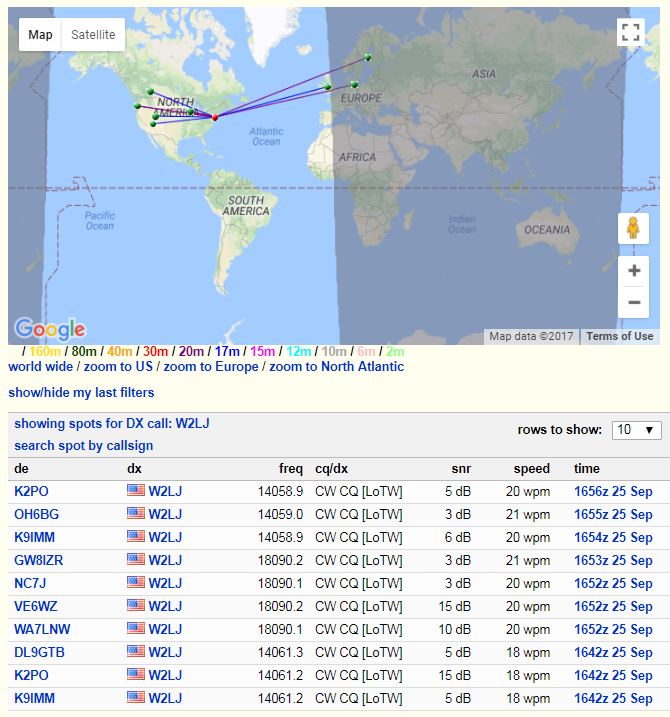
Before hunting for a QSO, I decided to call CQ for a bit on both 20 and 17 Meters. I really didn't expect anyone to answer, although there's no reason why anyone wouldn't. I just wanted to conduct a little Reverse Beacon Network experiment.
Experiment done, I went back to 20 Meters and found the "sweet spot" with the loop's tuning capacitor. (I was able to set up in under four minutes, by they way. Almost as fast as setting up the Buddistick on the car.) Tuning the KX3 around, there were a bunch of loud stations. Finally, I came upon GI4DOH, Rich in Northern Ireland. He had a strong signal and a great fist, so I gave him a call. He came back to me on the first shot! He was 559+ here in NJ, and I got a 559 in return.
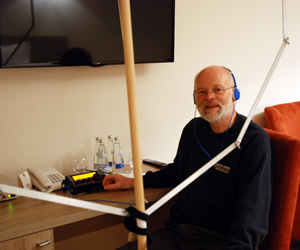
According to his QRZ page, the loop that Rich is using is a receive only loop. This was not a loop to loop QSO.
After working Rich, I popped on up to 17 Meters. There I heard OE3DXA, Wern in Austria calling CQ. Again, loud signal, great fist, so I gave him a call. Just as with GI4DOH, I gave him a 599+ report but this time I got a 599 in return. Both QSOs were solid with no repeats asked for with regard to info, so I am assuming I was at or near Q5 copy. (Even if the 599 in return wasn't exactly accurate.)

It was time to pack it in, and I was satisfied with the two DX QSOs for the day. With regard to my Reverse Beacon Network experiment, this was where the loop was allowing my signal to be heard:
As for spectators, I did get one guy who stopped to ask, "What is that? And what are you doing?" I explained that it was Amateur Radio and an Amateur Radio antenna. In response, I got the (what seems to be standard) "People still do that?" question.
I went into "pitch" mode and explained that yes, Amateur Radio is alive and well, and that for a lot of people in the Caribbean right now it's the only way they can get word out to their families abroad, that they are OK after the hurricanes.
So it was a successful day, I'm happy and it looks like there might not be rain for the rest of the work week.
72 de Larry W2LJ
QRP - When you care to send the very least!
Do You Travel? Don’t Forget Your Ham Gear! – ETH087

In this episode of the Everything Ham Radio Podcast, we talk with Vance Martin, N3VEM, about how he takes his Ham Radio Equipment with him when he goes on business trips. If you travel at all, you know the boringness of sitting in a hotel room after working all day, right? Maybe it is a new city, or maybe you have to be up early and don’t want to “go out” and be out late so you are able to function the next day.
So why not take your ham radio equipment with you while you travel and use that down time to make some contacts? This can also give you a chance to get out of your shack and get some fresh air and make some contacts to boot.
Vance and I talk about everything from what he does before he leaves, to what to do at the airport to how he operates while he has down time while traveling. Check out the show notes and listen to the episode by following the link below:
FOBB 2017 – ICYMI

To get a Bumblebee number, you have to first to to the Bee database to see what's been assigned:
https://docs.google.com/spreadsheets/d/1r0ICCSjbErmIfRQz2U7hZJkSccuQ5ukHEtVXzmOF5eM/edit#gid=119767365
Send an e-mail to [email protected] and be sure to include your first name, call sign, the field location you plan to operate from and your three top choices for a Bee number.
Keep in mind that you are encouraged to participate in the FOBB as a home station - but only Field Stations can have a Bee #.
After you've sent KI6SN your request, be sure to keep an eye on the roster at the link above. That's where you will be able to determine what number you've been assigned.
The rest of the rules can be found at http://arsqrp.blogspot.com/2017/07/announcing-ars-2017-fobb.html
FOBB is, was, and continues to be the best Summer Outdoor QRP event, bar none. It's the equivalent of the Masters, or Wimbledon or Tour de France of the QRP Summer contest season. Get out there, get some sunshine and some breeze in your hair and have fun!
I can hear wings buzzing already!
72 de Larry W2LJ
QRP - When you care to send the very least!