Posts Tagged ‘MorseCode’
 Echoes of CW: A Signal Corps Tribute to Virginia L. Scott and the WAVES of WWII
 July 7th, 2026 |
  Author:
 Looking at this historic photograph brings back a flood of memories from my own time in the Signal Corps. It shows WAVE operator Virginia L. Scott in March 1943, sitting in the Code Room of the U.S. Navy Radio School in Madison, Wisconsin.
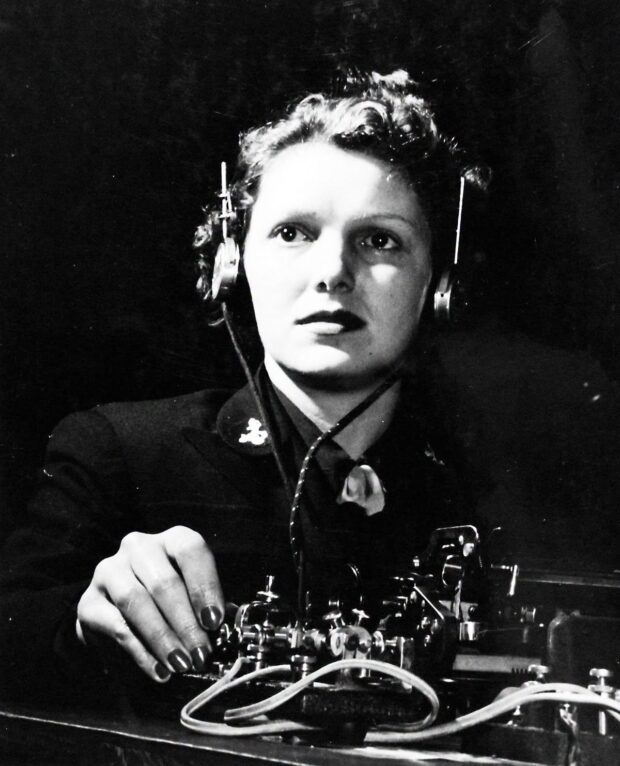
WAVE operator Virginia L. Scott in March 1943, sitting in the Code Room of the U.S. Navy Radio School in Madison, Wisconsin.
The photograph, catalogued in the National Archives as 80-G-431533, captures an ordinary phase of the highly technical work carried out by the WAVES during the Second World War. Seeing her at that workstation with her telegraph key, headphones, and operating table under the glare of direct lighting, I can almost hear the familiar rhythm of CW ringing in my own ears. It is a language of its own, and as an amateur radio operator who loves sending and receiving Morse code, I know exactly the kind of deep focus she is holding in that frame.
During World War II, the Women Accepted for Volunteer Emergency Service stepped up to fill critical roles so that men could be sent to combat zones. Virginia Scott was part of that groundbreaking wave of female personnel who took on demanding technical jobs in the Navy. As someone who has served in military communications, I have immense respect for the structured training and standardized procedures these women had to master.
Radiotelegraphy was the primary transmission tool of the era, the absolute lifeline of naval operations across vast and unforgiving oceans. Long before digital uplinks, it was the sheer skill of the operator that pushed the message through the static.
Her hand rests on that bug key in a way any seasoned Morse code operator would recognize immediately. Sending messages via CW is an art form that requires strict physical and mental discipline. You have to maintain a fluid, consistent rhythm so the operator on the other end, perhaps dealing with heavy interference on a ship thousands of miles away, can copy the signal without error. Scott is entirely focused on executing her message while maintaining the standard posture required by her training. It reminds me so much of the pride we took in the Signal Corps, ensuring every dit and dah was sent with perfect clarity. Dealing with secure information meant there was absolutely no room for sloppy sending.
This specific photograph was originally taken by the U.S. Navy for internal use, but it captured something so profound that painter John Philip Falter used it as a direct reference for a Navy recruitment poster. His painting faithfully reproduced the layout of the scene, turning a moment of routine operational work into a powerful piece of public communication. For anyone involved in the history of communications, and certainly for a fellow CW enthusiast like me, this photo represents a concrete example of how vital these women were. They kept the frequencies alive and proved that the steady hand of a skilled operator was an essential weapon in winning the war.
Here is one of the paintings based on this photograph, and served as a recruitment poster for the WAVES program.

This “It’s a Woman’s War Too! Join the WAVES” poster by John Falter was produced around 1942 as a World War II recruitment tool for the United States Naval Reserve.
This “It’s a Woman’s War Too! Join the WAVES” poster by John Falter was produced around 1942 as a World War II recruitment tool for the United States Naval Reserve. The WAVES (Women Accepted for Volunteer Emergency Service) was established in July 1942, allowing women to serve in the Navy in non-combat roles, such as radio operators and clerical staff. Artist John Philip Falter was a well-known American painter who created numerous propaganda posters and Saturday Evening Post covers, often featuring realistic portraits.
Brain Health and Parks on the Air
Got my N3ZN Single-Lever Paddle out of storage, along with most of my POTA station. Despite being homeless and living in the hotel for the last few months (see my personal story on my website), I am trying to keep my brain active and that includes Morse code practice. Why? Besides the health benefit, I want to start getting out into the hotel parking lot and set up to work POTA stations.

Eventually, I will get to an official POTA-registered park, too. We became homeless just as I was planning on activating Ohio parks. Now, I am in Nebraska, and as a disabled veteran, can get into some parks without any big fees.
What is left before I can activate a POTA location? I need to find the antenna and coax assembly that I put together for the whole station. In the meantime, I am practicing to get the cobwebs out of my brain and re-learn that muscle memory. Will also do a lot of receiving practice. Gotta get my brain in gear! Read more about POTA, here. For live POTA on-air spotting, go here.

The Spark in the Wire: How Re-Learning Morse Code Rewires the Brain
There is a unique rhythm to Continuous Wave (CW) amateur radio. As I sit at the key, shaking off the cobwebs and practicing to regain that deep muscle memory, I can feel my brain kicking into a higher gear. It isn’t just about nostalgia or the thrill of making a contact through the static using nothing but tones. There is real, hard science behind why copying and sending Morse code feels like a cognitive tune-up.
In preparing to share this journey, I dove into the research surrounding how learning and practicing CW impacts our neurology. What I discovered confirms what many of us experienced operators have long suspected: Morse code is a powerhouse for brain health and cognitive longevity.
The Cognitive Science of CW
When we sit down for a session of receiving practice, we aren’t just listening to dots and dashes. We are engaging in a complex, multi-sensory cognitive exercise. Research shows that mastering Morse code alters the brain’s structure and functional connectivity in profound ways.
* Neuroplasticity in Action: Studies in neuroimaging have revealed that learning Morse code increases the microstructural integrity of the white matter tracts connecting the auditory and motor cortices. By translating sound directly into physical movement (sending) and physical movement or mental text into meaning (receiving), we are literally forging new neural pathways.
* Bi-Hemispheric Engagement: Unlike ordinary speech, which is heavily localized in the left hemisphere of the brain, processing Morse code recruits areas across both the left and right hemispheres. The left side handles the structural, analytical translation of the code, while the right side processes the rhythmic, musical elements of the pitch and timing.
* Enhancing Working Memory: Receiving CW at higher speeds requires a robust “audio buffer” in your working memory. You must hold the sounds of the characters in your mind, decode them, and write them down or copy them in your head, all while the next characters are already pouring into your ears. This builds tremendous cognitive reserve.
The Koch Method: Training the Brain the Right Way
When I first learned Morse code, and now as I work to bring that muscle memory back, the method of training matters immensely. Trying to count dots and dashes visually or memorizing a chart is a trap. It creates a cognitive bottleneck that falls apart at higher speeds.
That is where the Koch method comes in, a technique that aligns perfectly with how our brains naturally process fast, rhythmic information.
* Full Speed from Day One: Invented by German psychologist Ludwig Koch, this method dictates that you listen to characters at your target speed right from the start, typically 20 words per minute or faster.
* Preventing the “Counting” Habit: By keeping the character speed high, your brain is physically incapable of counting the individual dots and dashes. Instead, you are forced to learn the overall rhythmic “sound basket” or shape of the letter.
* Incremental Success: You start with just two characters. Once you can copy them with 90% accuracy, you add a third, then a fourth. This builds immediate, reflexive muscle memory rather than analytical translation.
CWops, CW Academy, and LICW: Modern Gold Standarda
In my exploration of modern training tools that honor this science, I found that the amateur radio community has perfected this instructional approach. Organizations like CWops, through their renowned CW Academy, have taken the core principles of the Koch method and elevated them for the modern era. Another adaptation from the Koch method is the Long Island CW group (LICW) website and support structure.
* Rhythm and Spacing: CW Academy utilizes effective spacing methods related to the Koch philosophy. They send characters at a high effective speed so your brain learns the correct sound patterns immediately, while widening the space between the characters to give your mind time to process them.
* Structured Discipline: Their programs offer the exact kind of structured environment required to overcome writer’s block or training plateaus. It combines the rigorous discipline of daily practice with the support of a community.
* Interactive Learning: By pairing rigorous receiving practice with peer interaction, they stimulate the social and cognitive centers of the brain simultaneously, maximizing the neuroplastic benefits of the hobby.
Final Thoughts: Getting the Gears Turning
Re-learning CW is more than just a return to a beloved pastime. It is a deliberate act of cognitive preservation. Every evening spent copy-practicing and burning those pathways back into my hands is an investment in focus, memory, and mental sharpness. The science proves it, but sitting at the desk, feeling the cobwebs clear as the code starts to flow naturally once again, is all the proof I truly need.
Here’s just some practice after adjusting the key gap spacing and tension.
What was your first major receiver?
I started in the ham radio and shortwave listening hobby in 1972. By 1975, this was my first real receiver. It heard very well, and ignited my lifelong passion for radio.

The R-366/TRR-5 military receiver.
This old radio, the R-366/TRR-5, which is clearly identified on the faceplate in this picture of the military rig, had great ears. It was what I used to hone my Morse code copying skills and to get the hang of how amateur radio operators conducted communications with each other, with CW, AM, or SSB. I hope someday to own one once again.
The R-366
The R-366/TRR-5 is a significant piece of military history manufactured for the Navy Department Bureau of Ships by the Espey Manufacturing Company. Built during an era when the United States Navy required absolute reliability for ship to shore and ship to ship communications, the unit is a testament to the rugged industrial design of the mid-twentieth century. Often referred to as part of the TRR-5 receiving set, this equipment frequently incorporated high quality components and precision engineering including the gold standard Collins Radio Company designs of that period. These internal components were vital in providing the remarkable stability and selectivity needed to pull weak signals out of the dense electronic noise environment found on a crowded naval vessel. It did have heterodyne squeals on a select few frequencies, which any old tube receiver was prone to have, but those did not detract from the excellent capability of the radio.
The Service
For the sailors and radio operators serving aboard ships in the 1950s and 1960s these receivers were far more than just tools for duty. In the often cramped and isolated conditions of life at sea these radios served as a critical psychological anchor. Access to the bands meant hearing the familiar sounds of home or tuning into MARS stations where amateur radio operators facilitated phone patches that reconnected sailors with their families. This bridge to the outside world was essential for maintaining morale and supporting the mental health of military personnel who were otherwise cut off from the rhythms of civilian life for months at a time. Sitting in the radio shack and slowly tuning that large central dial while listening to the crackle of the ionosphere was a meditative escape from the constant hum of shipboard operations. Many ships would pipe ball games and news shows, or music programs, over the ships intercomms, providing health and morale to the personnel.
Operating the Radio
The tactile experience of operating this specific receiver remains vivid in my memory. The layout with its distinct knobs for selectivity phasing and BFO control was designed for the hands of a professional radio operator who needed to manipulate the signal in real time. It required a disciplined ear and a steady hand to copy Morse code through heavy atmospheric conditions but that struggle made every successful reception feel deeply rewarding. It taught me the patience and technical appreciation that have defined my amateur radio hobby for decades. Owning and using a piece of history like this represented a connection to the generations of operators who stood the watch before me.
Traveling the World…
With this historic military receiver, I discovered an entire world as a child in the mid 1970s. I spent countless nights in the quiet darkness of my room with only the warm orange and yellow glow from the vacuum tubes leaking out of the back and top grills and slots of the radio enclosure, as those hot tubes cast soft light on the ceiling and walls. That radio allowed me to travel the globe from my listening position often sitting cross-legged on the floor in front of this big rig. Those late night listening sessions, when I should have been sleeping, ignited a lifelong passion for understanding the vast and interconnected world of shortwave radio as well as medium-wave DXing. I heard International Shortwave Broadcast stations as well as AM broadcast stations from Europe, Asia, the South Pacific, the Atlantic regions, South America, Central America, and North America–all over the world! I listened to amateur radio operators on Morse code, SSB, and AM modes. Ships at sea, aircraft doing transoceanic flights, fishing vessels comms where fishing captains would chat with other boat captains, and even military communications were all at my fingertips on the dial of the radio as I listened to these exotic places by headphones. I even picked up a station from Peru, South America late one night, on the mediumwave broadcast band. That is how great that receiver could hear. Of course, I had a very excellent outdoor dipole antenna that was cut for 160 meters.
What Receiver Was Your First?
What was your first major receiver? Was it just a receiver, or was it a transceiver? When was that? What did you hear that captured your imagination? Do you still have that radio?
I hope to someday have this R-366/TRR-5, once again.
~ Happy DX!
NW7US
New Book: Learning, Living, and Loving Morse Code…
There is a new book from a fellow Morse code amateur radio operator, Chris Rutkowski (NW6V), about “Learning, Living, and Loving Morse Code (in a Digital World).” NICE!
Title: “The CW Way of Life“
link: https://amzn.to/3Tm3KfD

I received a new book! Here it is, at my radio shack operations desk, at NW7US radio station.
Already, I think it rivals any other book on the topic, including “The Art and Skill of…,” or, “The Zen of…”
It is not, however, meant to replace, but to augment, what is available. But, it is a complete guide, including a “work book” section (nearly half of the book?) on how to improve your skill. Really good stuff, but I’m only in one day.
73 de NW7US dit dit
https://nw7us.us
..













