Posts Tagged ‘Morse’
 Lost treasure
 June 9th, 2011 |
  Author:
 Earlier in the year I was hunting through some folders on my hard drive and discovered an unreleased version of my Morse training program MorseGen. I had no memory at all of having updated it so I had no idea whether I had finished or tested the update. The main changes from the last released version 1.4 appeared to be that there was now a batch mode for creating recordings to play on an MP3 player and a “Common words” mode. This jogged my memory as to the reason for updating the program. A couple of years ago in QST there was an article which suggested that in order to be able to copy Morse at high speed you should learn to recognize the sounds of complete words not just individual letters. So I had added the ability to play random selections from a list of some of the most common words and CW abbreviations.
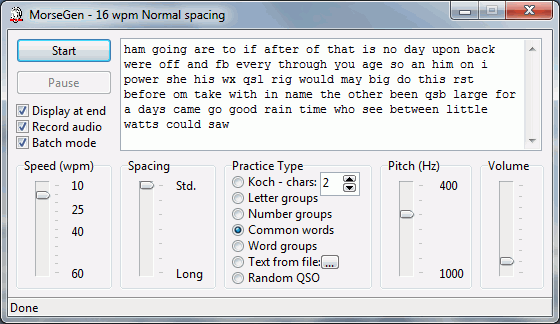
Today I placed this new version of MorseGen on the G4ILO’s Shack website. The previous version is still available to be downloaded in case the new one has problems. My interest in programming has now fallen to absolute zero and I no longer even have the development tools used to compile MorseGen so this is definitely, without argument the last ever version.
This is actually a bit of a nuisance as the new version seems to have a small bug. Occasionally, in Random QSO mode the program will halt with an error message “List index out of bounds.” You have to close the error message and continue. I’m guessing that I added some QSO templates and the random number generator sometimes generates a number that is more than the number of templates. If so, this would be easy to fix if I still had the development tools. But I don’t, so I can’t, so tough luck! But no-one has any grounds for complaint because MorseGen is free!
Despite the bug, I still think MorseGen is a useful program. I often use it whenever I get the urge to try to improve my Morse reading skills. Admittedly it hasn’t done me any good, but I think that is more due to something peculiar to my brain that is just incapable of mastering the code. Over the years since I wrote the first version of MorseGen I’ve had many emails thanking me for it so it appears that it does work for people less Morse-resistant than me!

Microlight QRP
Keen followers of SOTA will have read about this on the SOTA Reflector, but during the last couple of months Richard G3CWI has been activating summits using a 30m transceiver powered by a 9V PP3/MN1604 battery. This apparently is in response to a challenge set by another keen SOTA activator: Kjell, LA1KHA (who visited us in October 2009.)
I couldn’t find many details of the challenge, so I’m just assuming that it was simply to see how many activations could be made using a radio powered by one of these small batteries. Kjell is believed to be using a Small Wonder labs RockMite but Richard built his own transceiver especially for the challenge. The receiver uses a two-crystal ladder filter at the signal frequency, an NE602 mixer, a low noise AF amplifier and active lowpass filter using CMOS op-amps. The transmitter has a crystal oscillator, bipolar buffer, bipolar amplifier and FET class E PA giving 300mW output and an internal Tick1 keyer.
With this transceiver Richard has now activated 10 summits making more than 100 contacts, still using the original PP3 battery! Having established that a PP3-powered transceiver is adequate for reliable activating Richard is now looking for ultra-lightweight HF antennas to get the weight of his portable station down to the absolute minimum.
I think this is a fascinating challenge and hope that Richard will write up the experience in more detail one day, perhaps in his RadCom Portable column or in the G-QRP Club magazine Sprat. This is really what QRP is all about, reducing the equipment to the bare essentials. It also shows the value of CW as the only mode that allows you to use such simple equipment.

LHS Show Notes #052
Episode 50: A milestone!
Announcements:
- Russ talks about his California trip: attending the Large Installation Systems Administration conference (LISA).
- The 50th episode is a milestone – Richard explains why. See also The Internet Archive.
- Lord Drachenblut reminds us of the upcoming Indiana LinuxFest in Indianapolis, Indiana. If you’d like to register, use the promotional code LHSPODCAST50 (all capital letters) and you’ll get a $15.00 discount on the ticket.
- Music in this episode is from 20lb Sounds, fronted by Dan Lynch of Linux Outlaws fame.
Topics:
- Scott, AD7MI, posted an article on his blog about moving to an all-Linux ham shack. Richard and Russ discuss the article, including Shackbox Linux, Ham Radio Deluxe, CQRLog, and more. Ultimately, Fldigi and CQRLog resulted in “100% Linux Nirvana”.
- Scott also asks what we think would be the ideal Linux-based ham shack. Russ describes his shack, which he thinks IS ideal. Our hosts then discuss various soundcard interfaces:
- Most sound cards work fine, and Russ recommends the SoundBlaster series over all, but suggests staying away from the SoundBlaster Audigy SE (model CA0106) sound cards as they don’t seem to work well (or at all) under Linux.
- Richard likes his Yaesu FT-897D. Most modern rigs allow a fixed-audio level connection to the computer sound card, as well as computer rig control. Russ has the Kenwood TS-570D, and it, too, is well-supported in the Linux ham libraries.
- Russ and Richard discuss the fact that most hams don’t log VHF/UHF contacts, other than in contests or toward an award.
- The FCC, created by the Communications Act of 1934, included the requirement to maintain a log book in the rules. Sometime between 1983 and 1986, this requirement was dropped as the FCC determined that the information was of little use to them. (If someone can point us to a reference that identifies when the exact rule change occurred, please let us know. I was unable to find the specific change online. -Ed.)
Feedback:
- Leif, KC8RWR, writes that Internet over EME (earth-moon-earth) isn’t likely to work due to the high latency involved. (This may be in reference to a comment in Episode 48.) NASA and DARPA are involved in a Deep-Space Internet project.
- Leif also asks “Isn’t Morse code dead?” and wasn’t it replaced by “Gerke Code”? Our hosts discuss.
- Craig, KB5UEJ, writes that he thinks Russ’ audio is louder and muddier than Richard’s in episodes 46 and 47. Russ agrees that the audio on a few of the recent episodes did suffer, but should be much improved now.
- Grant, KC9SJQ, comments that he doesn’t see a link to Russ’ screencast about SSL anywhere. Yes, it somehow disappeared, but Russ is working on it. He’ll either find the file or redo it.
- William, KB9TMP, sends his comments about Episode 48 where we discuss KE9V’s article that questioned the relevance of amateur radio.
- Craig, KB5UEJ, commenting about WSPR, says that you can run less than 5W on an FT-897 by reducing the audio drive from the computer to the radio. Richard points out that the reduction is often not uniform across the audio freqeuncies used, so some intelligibility may be lost. He had that problem with packet, but he’ll try it with WSPR.
- Matt wants to know the artist and title of a song in Episode 48. The song was “Endline (Choose Nothing)” by I Am Not Lefthanded from the album “Yes Means No”. Check out the show notes for Episode 48 for a link to the song.
Donations:
- Scott, AD7MI, sent a donation just before we recorded! Thanks, Scott.
- If you’d like to help the podcast, please consider making a donation. It’s easy! Just a click on the Donate button on the web site.
Contact Info:
- Contact Richard at [email protected], Russ at [email protected], or both at the same time at [email protected].
- Listen to the live stream every other Tuesday at 8:00pm Central time. Check the LHS web site for dates.
- Leave us a voice mail at 888-455-0305 or 417-200-4811, or record an introduction to the podcast.
- Sign up for the LHS mailing list.
- Sign up for the MAGNetcon mailing list.
- Thanks to Dave from Gamma Leonis for the theme music.
Music:
- Redemption Song performed by 20lb Sounds.
- Jimmy Carter, also by 20lb Sounds.
Morse USB keyboard
This is a really cool little project.
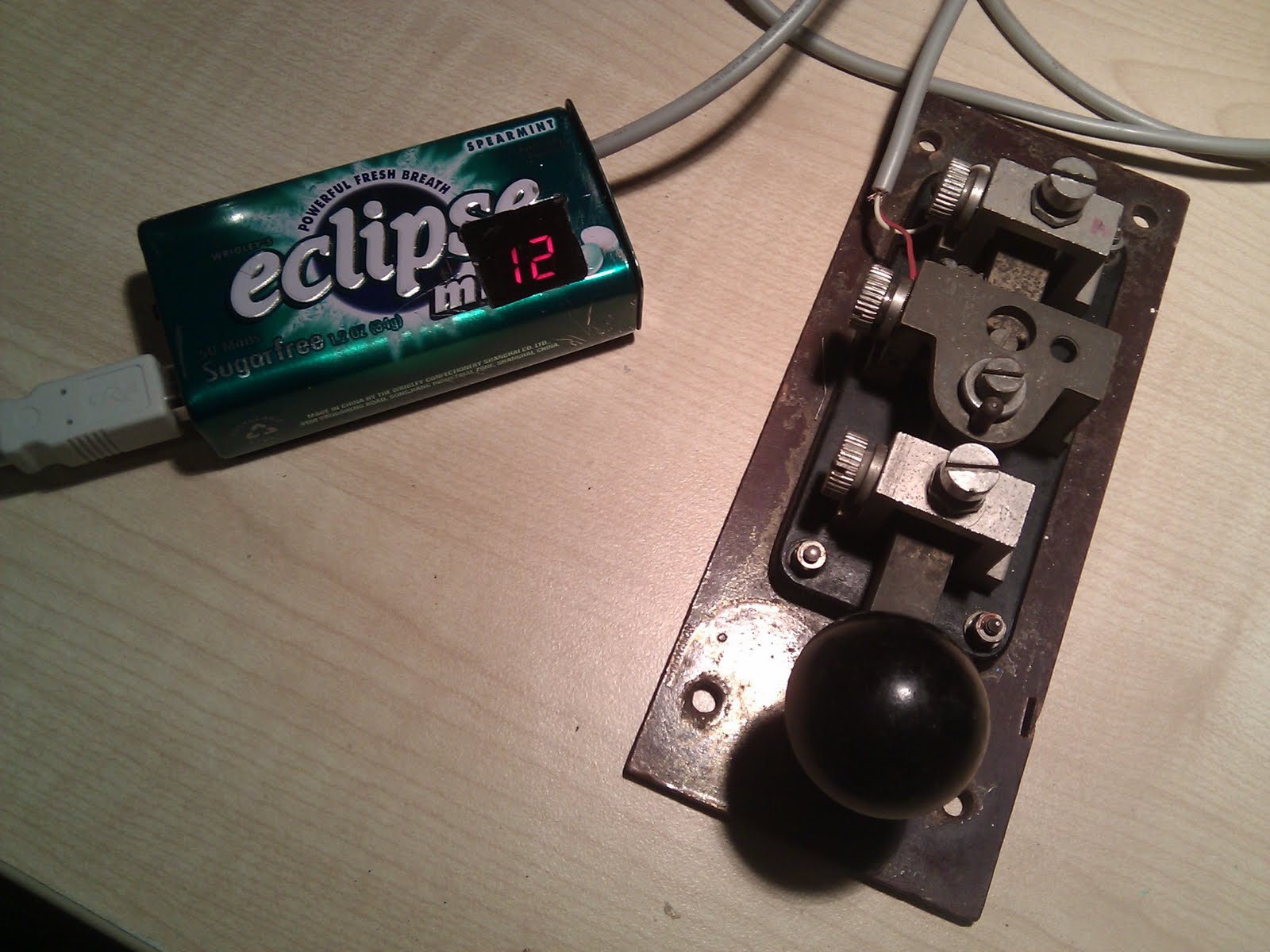 It isn’t clear what it does from the picture, but it’s a device that makes a Morse key look to a computer like a standard USB keyboard. So you can type into your word processor, blog or whatever by sending Morse.
I want one of these. If I had to type all my blog posts using Morse I’m sure I would really get my speed up! Shame it isn’t available as a kit.

Wobbly memory
Kevin, GW0KIG, has just written in his blog about struggling to brush up his Morse. He first learnt the code at the age of 19 and has “memories of a Morse code tutor program on a borrowed ZX81 computer (remember those?)”
 I remember the ZX81 and its wobbly 16KB RAM pack very well. In fact, a Morse tutor was one of the first programs I wrote for it. I wrote an article for Short Wave Magazine which described the program, together with a Morse keyboard with programmable memory and a high-speed Morse sender for meteor-scatter work. It is amusing today to read my conclusion that “it is possible to program the ZX81 to create sophisticated memory keyers.” These primitive programs would hardly seem sophisticated today.
The article was published in the August 1982 issue of Short Wave Magazine. I kept a copy and you can see it here. I wonder if my program was the one Kevin used to learn Morse when he was 19? One of these days I might try downloading a ZX81 emulator and see if these old programs will run on it.














