Posts Tagged ‘Morse Code’
 A day early again!
 June 27th, 2012 |
  Author:
 I got confirmation from Elecraft on Monday that my K3 was shipping UPS 3 Day Select. So you have to figure – Tuesday, Wednesday, and delivery on Thursday. In fact, that’s what the official UPS Tracking Website confirmed for me – delivery by the end of the day on June 28th. So imagine my surprise when I got home to find a big brown box waiting for me. Inside was:
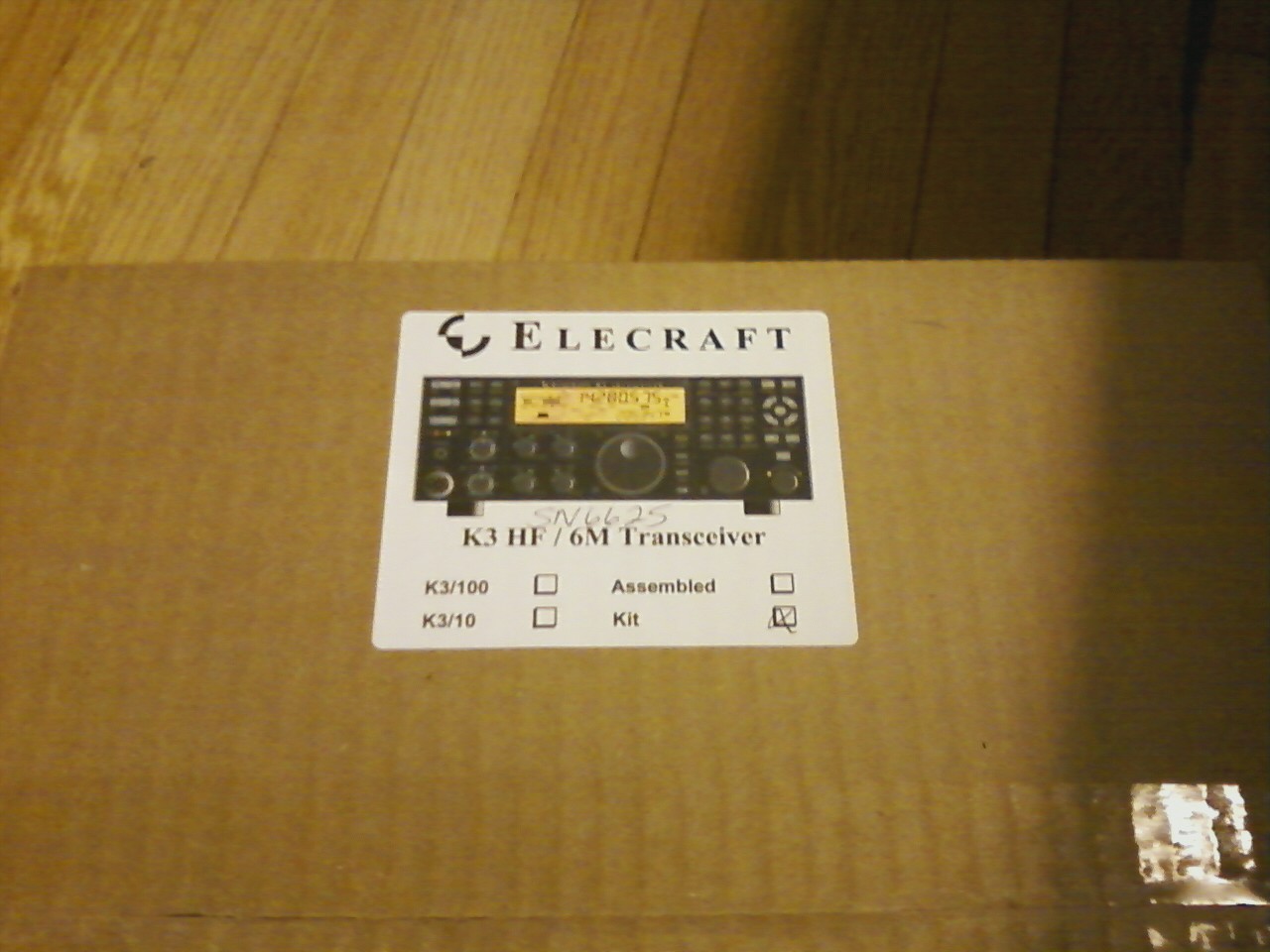
Serial number 6625 – just waiting to be built!
Also included inside are the K3 ATU, the 400Hz, 8 Pole Roofing Filter, and the handheld microphone. I also ordered a microphone for the KX3 while I was at it. And no, before anyone gets all excited, I am not renouncing CW! I got the microphone(s) for two basic reasons.
1) Doing Ham Radio demos. I have found that demos go best when you show folks CW and SSB. There’s nothing like putting a mic into the hands of someone and allowing them to speak with someone halfway around the country, or the globe for that matter. It’s something that THEY can relate to. Morse Code is “cool” as I have been told by a lot of kids – but letting them talk to someone in far off Uzbekafgonalakistan is the ultimate “Wow”. (A note to my lawyer – yes, that is a made up country name).
2) Special Event stations – I really used to like to hunt them. A lot are not on CW at all these days, a lot are phone only. Hence, my decision to buy some microphones. Take for instance the “13 Colonies” Special Event that is held each year around Independence Day. Last year I was able to find exactly ONE state (MA) on CW. Maybe I won’t work many; but at least now I can try.
I really have to tip my hat to you SSB QRP guys. You guys have supernatural patience! Except for the rare instance, I will stick with CW for a 99% majority of my operating time. I don’t have your kind of patience.
Tonight was preoccupied with other matters. Tomorrow night, God willing and the creek don’t rise, I will begin by doing a complete inventory. I don’t expect anything to be missing as K3s are not rushing out the door as the same rate as KX3s.
Oh, and by the way, in case I didn’t mention it ….. the K2 is going NOWHERE! I am NEVER giving that radio up!
Even though the sunspot number is a paltry 28, I had a good night on 20 and 30 Meters. Germany, Lithuania, Ecuador and The Ukraine were all easily reached with 5 Watts. I even managed to bust a mini-pileup to work the Lithuanian on 30 Meters. That felt really good!
72 de Larry W2LJ
QRP – When you care to send the very least!

Done!
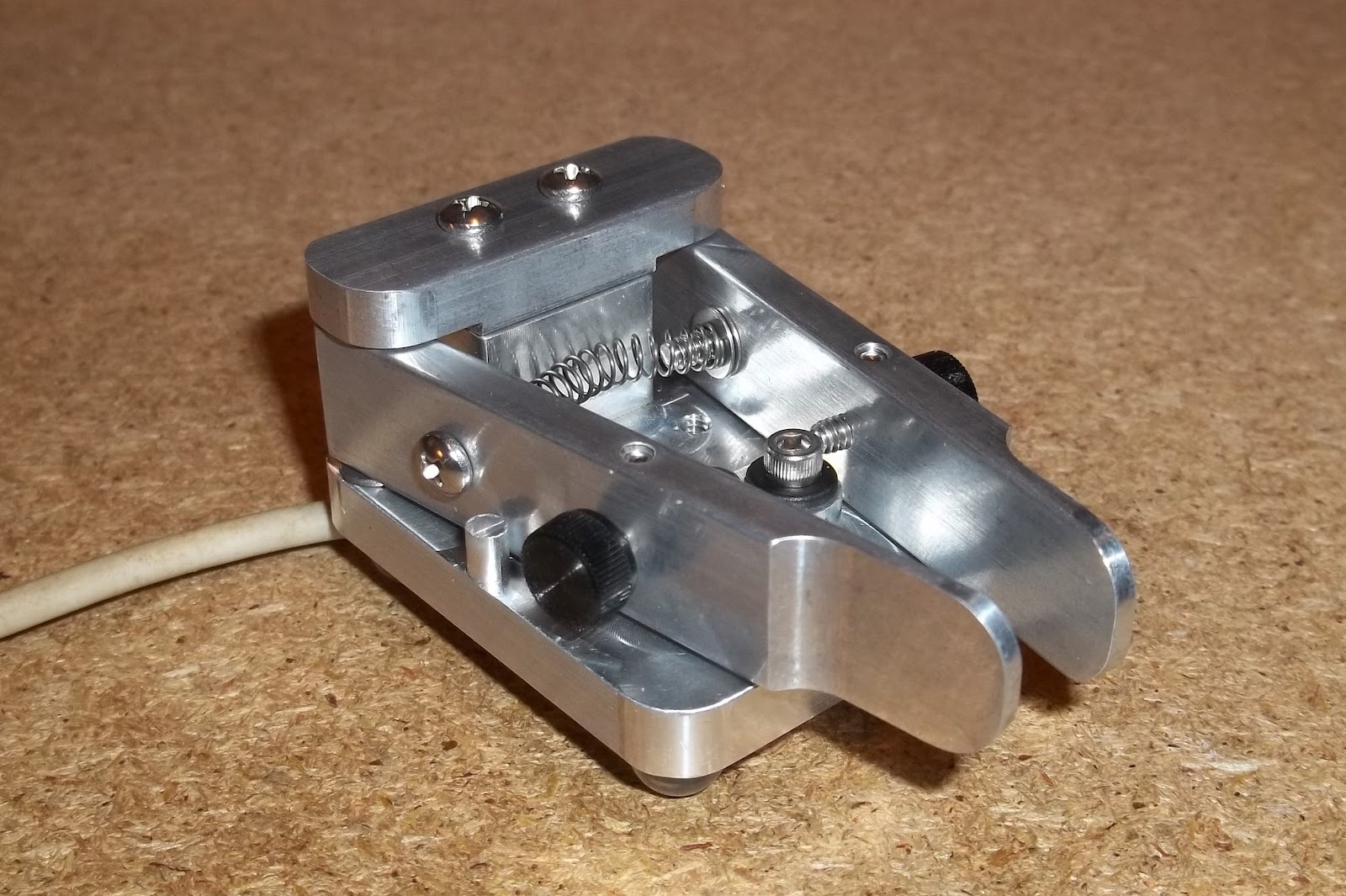
The paddles are done. The assembly was in the class of “Easy-peasy-lemon-squeezy” territory. And assembly time was all of about a 1/2 hour or so.
The instructions provided by Doug Hauff were superb and easy to follow. The hardest part, installing the compression spring was no big deal at all. Slipped one end of the spring over one of the spring retainer screws and used a tweezer to finagle the other end over the other screw. No launching into orbit or getting lost. Viola!
What I like most about these are:
1) Materials – nice grade of aluminum.
2) Weight – minscule.
3) Size – Super small; but yet not to the point where these are difficult to use. And I can be ham fisted, at times.
4) Ease of adjustment – Here’s the best part. I like my paddles to have MINIMUM arm movement. There should be no “clacking” and the closer I can get the feel to compare to a touch keyer the better. I succeeded here with the DCP. The adjustment screws have a fine enough thread pitch where this was easy to attain.
The only thing that I have to say that is negative, is that when you have the paddles attached to your radio (and it is on), you have to be careful about how you pick these up if you want to move them. Your first inclination will be to reach down (or over) and just grab the key with your hand. If you do it that way, you will most likely start inadvertently sending dits and dahs. Like I did – several times. Oops!
That minor inconvenience being noted, I would give these paddles a 5 out of 5 star rating. For their intended use, these paddles will more than fit the bill. Now all I have to do is figure out some kind of leg mounting scheme.
72 de Larry W2LJ
QRP – When you care to send the very least!

Commencement
Not graduation – began working on my American Morse DCP paddles tonight, just as I thought I would.
I spent some time polishing up the aluminum. First, I gave the metal pieces a light scrubbing with one of those copper Chore Boy scrubby pads. Then I used some Noxon metal polish (that I forgot I had!) that I found on a shelf. Lastly, a going over with a polishing wheel on my Dremel.

Not a mirror finish, but a lot shinier than they were originally. All I did was remove the top layer of oxidation. I am sure that with time, the metal will get dull again, but for now, it looks pretty darn nice!
Tomorrow night I will assemble everything – shouldn’t take long at all.
72 de Larry W2LJ
QRP – When you care to send the very least!

Titanic error on my part
I don’t like to “steal” from my fellow bloggers; but I caught this on John N8ZYA’s blog. It is worth sharing with those of you who might not read his blog (You’re cheating yourself if you don’t! Just saying!) This “independent movie” is about 45 minutes long. It’s worth viewing to get an idea on how wireless was situated on seafaring vessels.
Now for the error as described in the post title. I didn’t work any of the Titanic Special Event stations due to some pandemonium that has been enveloping me over the past few days. With this Saturday being a full week past the anniversary day, I doubt any of them remain on the air. Oh well, centennial observances, like the tides, wait for no man.
Oh – before I close. This rule change to QRPTTF appeared on QRP-L today:
~~~~~~~~~~~~~~~~~~~~~~~~~~~~~~~~~~~~~~~~~~~~~~~~~~~~~~~
Gang,
While QRPTTF is open to all QRPers, I have always seen it as a “QRP-L” function. This is where it is administered and the QRPers on this list are those I attempt to satisfy and respond to.
Response to having additional SOTA stations on the air for QRPTTF has generally been positive. However, I underestimated the desire of QRPers to go climb their nearby mountain or feature, whether a SOTA summit or not. A few want to make a camping trip out of it. SOTA began and is headquartered in the UK. There are numerous US chapters. Not all states/call districts have a SOTA chapter, mostly due to no or few summits to survey or activate over 500 feet high. SOTA guidelines state that the minimum “prominence” for a summit is 100M or 300 feet. Sounds good enough for me. Therefore, we will also use this definition.
RULE CHANGE
QRPTTF has been expanded from three to four categories and multipliers
STATION CLASS AND MULTIPLIERS:
X1 HOME station
X2 FIELD HILL station – operating on a hill from 3-300 feet above
average terrain
X3 SUMMIT station – operating from a “hill” or geological feature
300 feet or higher from the average terrain
X4 SOTA Summit – operating from a designated SOTA summit
I have received several emails from those wanting to operate from the largest darn “mountain” in their corner of the state, though not a SOTA summit, which in most cases will require a substantial effort. This rule change will allow you to do this and receive a X3 multiplier for the additional effort. In turn, operating from a designated SOTA summit is now X4.
This rule change has been updated on the website, rules and summary sheet
http://www.zianet.com/qrp/ or direct: http://www.zianet.com/qrp/QRPTTF/ttf.html
So for those of you who want to be a QRP “Mountain man” for the weekend, go
for it!
72, Paul NA5N
PS – Driving out to the VLA site today (54 miles from Socorro), it made me appreciate how we have to drive through or around three different mountain ranges, with numerous peaks from 9,000-12,000 feet. I always took them for granted. Not anymore. Average terrain here is about 4,700 feet, the VLA is at 7,000 feet.
~~~~~~~~~~~~~~~~~~~~~~~~~~~~~~~~~~~~~~~~~~~~~~~~~~~~~~~~~
72 de Larry W2LJ
QRP – When you care to send the very least!

Too bad they consider this an April Fool’s joke!
But even in a joke there’s truth to be found.
“It’s a dot and a dash. To have a conversation with the entire world. It’s great.”
Yes, yes it is.
72 de Larry W2LJ
QRP – When you care to send the very least!

Whetting my appetite
The weather has been phenomenal this winter, as you all know. Due to Arctic air staying way up north, we’ve had one of the warmer Winters that we’ve had in a while. Who would’ve thought last Halloween, when we had that early snow, that Winter was going to turn out the way it did?
The early warmth and early blooming and budding is playing havoc with my head, though. My nose is all stopped up and my eyes are itchy and watery. Allergies are no fun; but this too shall pass.
So when my friend Rem K6BBQ posted about another video from last year, it’s gotten me all torqued up for portable operating for this coming Spring and Summer outdoor operating season. Shorts and T-shirt weather may not be immediately imminent; but I dare say it’s closer than father away!
72 de Larry W2LJ
QRP – When you care to send the very least!

Morsemail and LCWO.net
The time has come when I can’t put off learning Morse code any longer, With an interest in vintage amateur radio and the impending restoration of a Heathkit AT-1 I’m going to need to use CW sooner or later.
So I have been checking out resources for learning Morse code and stumbled across two that really intrigue me.
The first is LCWO.net, a web browser based Morse code learning tool that is usable on any internet connected computer. It is available free of charge and there is no software to install. LCWO.net keeps track of where you are in your lessons and where you need to concentrate your effort. The Koch method is the primary tool available but they also offer code group practice, callsign and plain text training modes along with a service to convert text to Morse MP3s for download and use offline.
Once you are on the way to CW proficiency and want to communicate with others you can always fire up a rig and get on the air … What if you don’t have a rig or need a confidence boost before ‘going live’?
Well, you could always send Morsemail using the Morsemail client from http://brasspounder.com:8873/.
Morsemail is, “A simple text format that encodes mark and space times to make it possible to send Morse coded messages via email” but a recently added feature allows for QSOs using a internet repeater hosted on brasspounder.com. You can use a mouse or actual key wired to the mouse or joystick buttons to send CW which can be emailed or sent through the repeater live.
Now I just have to carve out the time to sit down and use these resources!