Posts Tagged ‘magicband’
 Summertime CBer
 June 12th, 2015 |
  Author:
As much as I hate to admit it, for a few short weeks every summer, I become ... get ready for it now ... a CBer! Now I'm not talking about what might typically come to mind when thinking about CBers ... for me it's more of a love-hate relationship. You see, the 27MHz CB band, and 27.385MHz in particular, happens to make one of the best indicators of Sporadic-e openings on the face of the planet. Unlike the vast empty wasteland that 10m becomes during the summer, the 11 meter band is jam-packed full, with thousands of operators ... and some days it seems as if they are all on the 27.385 MHz (LSB) calling frequency.
With my receiver quietly running in the shack, the frequency can suddenly jump to life, with hundreds of stations calling each other in a matter of seconds. Sometimes it's like a switch has suddenly been thrown to 'ON'. This is not too hard to understand as the present suspected cause of Es is sudden high speed wind-shear within the E-layer. Have a quick listen to what the calling frequency can suddenly sound like:
Now the beautiful thing is that strong Es on 11 meters usually heralds the possibility of 6m also opening via the same mode ... usually 30 minutes or so later if it's going to happen. Often a CQ on a seemingly 'dead' 6m band in the direction of the 11m Es, will produce a response from an equally surprised operator at the other end.
I don't think I've ever heard Es on the 6m calling frequency without hearing Es on 11 meters beforehand. It's been my experience that the band always opens from low to high, in terms of frequency, so it just makes sense to listen lower (11m) to get a heads-up for what is likely soon to follow on the magic band. As well, knowing that there is 'zero' Es on 11m, can let you rest assured that nothing will be happening on 6m via Es ... at least for the time being.
If you haven't already tried it and have a second receiver that can be put to use as an 'Es-monitor', you might be pleasantly rewarded. Even though knowing that the band will soon open might rub a bit of the magic away, I think it's still well worth it!
Where’s The Magic?
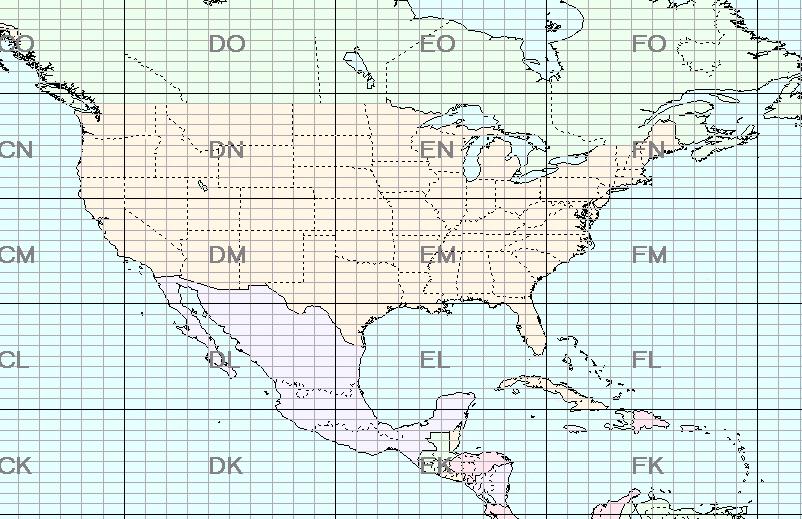 |
| courtesy: http://www.dxmaps.com/ |
Most 6m diehards understand that the cause of summer Es is high-speed wind shear events, way up in the E layer region but a new theory suggests otherwise:
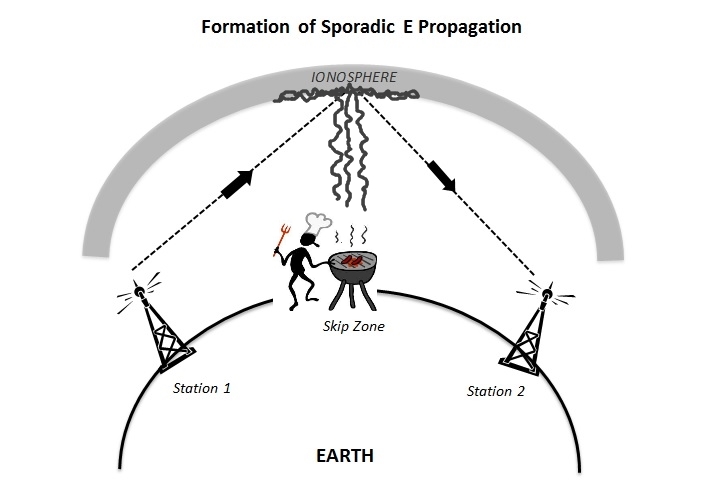 |
| courtesy: nz3m.com |
More Magic
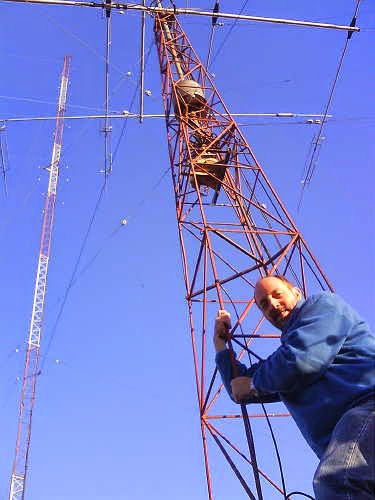 |
| LU6QI |
For the third day in a row, someone has sprinkled 6m magic-dust over the Pacific Northwest with more long-haul propagation into southern South America. The openings have been characterized by their very small footprints and today, unlike the previous two days, the footprint locked-in on my own QTH for over an hour.
For the most part, signals were in the 559 range but at times would build up to true 599 levels, reminiscent of the previous cycle's F2 north-south openings in the afternoon.
During the entire opening, strong sporadic -e signals from California, Arizona and Nevada were present so I suspect that the propagation mode was Es to TEP and from there to southern SA who knows! I doubt there was any F2 involved (unless it was ver SA) as the solar flux just doesn't seem to be high enough to support that mode. In all likelihood, the present coronal hole stream that is impacting the ionosphere has been the trigger for these unheralded openings.
 |
| courtesy: https://maps.google.ca/ |
During the opening, the following stations were worked, mostly on CW but some on SSB as their signals were very loud at times:
CX90IARU, LW6DG, LU6QI, CE2AWW, CX3AL, LU5FF, CX1DDO, LU4FPZ, CX6DRA and CE3SX.
As mentioned in my last blog ... who knows what this cycle will do next as the surprises just keep coming!
Is there enough dust left for a fourth day in a row?
Persistent Cycle 24
If you've wondered why the bands have been so volatile of late, it's because Cycle 24 just won't go away quietly. It seems that for the past several months, our planet has been besieged by one solar bombardment after another. Most of it seems to be coming via Coronal Hole Streams.
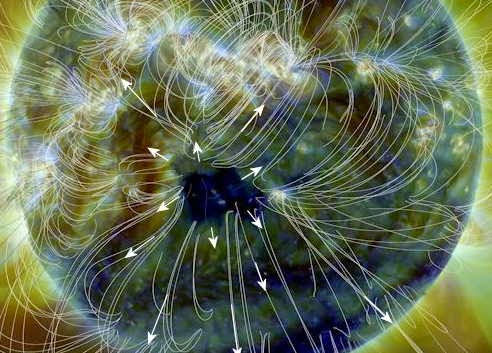
This UV image from NASA's Solar Dynamics Observatory satellite clearly shows the large coronal hole presently facing earth. The arrowed vectors represent material spewing from the hole, with much of it earth-bound. The material from this hole is expected to arrive between April 21-22, possibly causing more auroral activity.
Our Sun's latest rotation is showing several new large sunspot groupings, all very capable of unleashing a new round of solar flares and associated disruption ... if nothing else, Cycle 24 is persistent!
Peeks at the geomagnetic activity for April 16th illustrate just how active things have been of late ... making the high HF bands sound like the middle of the night as well as making LF and MW propagation depressing.

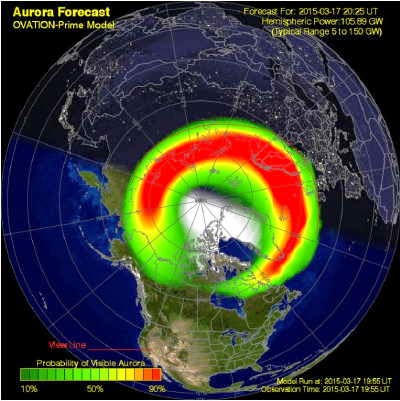
The software gurus at NOAA have been busy once again, this time revamping several of their visual models to an 'animated' mode. The Ovation Auroral map is particularly interesting when run in this mode as it shows the auroral field's activity visually over the past 24 hours. The display gives one a new appreciation for the dynamics of such large scale events:
An auroral event on Thursday evening gave 6m conditions a bit of a kick in the backside on Friday afternoon with signals from southern South America making it into various regions of the U.S. including the PNW, usually left out of such affairs. At one point, CE2AWW was hearing / working both the west coast (W7's) and the east coast (VO1's). Sporadic-e was definitely involved on the west coast end as the band was open to California / Nevada for most of the day.
No one can be certain of what lies ahead for Cycle 24 but it's certainly not going away with a whimper!
 |
| courtesy: http://sdo.gsfc.nasa.gov/ |
Our Sun's latest rotation is showing several new large sunspot groupings, all very capable of unleashing a new round of solar flares and associated disruption ... if nothing else, Cycle 24 is persistent!
 |
| courtesy: http://sdo.gsfc.nasa.gov/data/ |
 |
| courtesy: http://www.swpc.noaa.gov/ |
The software gurus at NOAA have been busy once again, this time revamping several of their visual models to an 'animated' mode. The Ovation Auroral map is particularly interesting when run in this mode as it shows the auroral field's activity visually over the past 24 hours. The display gives one a new appreciation for the dynamics of such large scale events:
 |
| courtesy: http://www.swpc.noaa.gov/communities/radio-communications |
 |
| courtesy: http://www.dxmaps.com/ |
New Band For ZS Hams
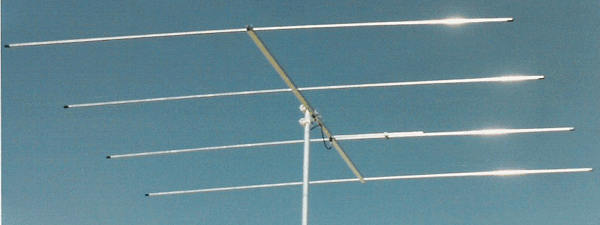 Sharp-eyed Roger, G3XBM, has brought attention to the recent news of a new amateur allocation granted to South Africa's amateur radio community! It's just a small slice of a band but in an exceptionally interesting part of the spectrum ... 40MHz!
 Amateurs have been given 'propagation studies' permission to transmit between 40.675MHz and 40.685MHz as 'primary users' and use up to 26dBW (400Watts) of power ... a healthy assignment.
I'm not sure where the push for this new band has risen from but no doubt from within the amateur radio community of South Africa ... and kudos to the SA radio authority for establishing this unique amateur band.
Myself and others, have often stated that an amateur allocation in the 40MHz region would be a wonderful part of the spectrum in which to experiment. Almost midway between the two "magic bands" (10m and 6m), the propagation opportunities of 40MHz would be most unique and abundant.
With Solar Cycle 24 being such a weak cycle, most of North America and particularly the western half, saw almost no F2 openings of any significance. Absent were the all-day long bone-crushing signals from the east coast, followed by the spotlight propagation-sweep down to South and Central America and finally over to Japan for another few hours of ear-shattering JA signals ... none of this for Cycle 24. Yet, in spite of the lower MUF's, I noted dozens and dozens of days when the F2 MUF would shoot up to the high 43MHz region and hang in for hours and hours ... just as it did on 6m in previous cycles.
Having even a small slice of spectrum at 40MHz would give amateurs a golden opportunity to follow some exceptionally interesting propagation trends during the next few cycles ... all predicted to be stinkers, some saying even worse than '24'. With 40MHz supporting the F2, Es, TEP and Auroral modes, there would be much exciting propagation to support activity in this region.
Maybe it's time North American amateur's start talking about a new slice of the 40MHz pie ... surely there is enough space to share.
A Buzzy Day On The Magic Band
 |
| courtesy: http://www.swpc.noaa.gov/ |
A swift-moving Coronal Mass Ejection (CME) arrived earlier than predicted, slamming into the earth's atmosphere shortly after 0430z yesterday morning. What begin as a small K5 disturbance quickly grew to a K8, signalling the strongest geomagnetic storm of Solar Cycle 24.
 |
| courtesy: http://www.swpc.noaa.gov/ |
It didn't take long for the VHF bands to start filling up with auroral signals as 6m diehards soon discovered that something was amiss.
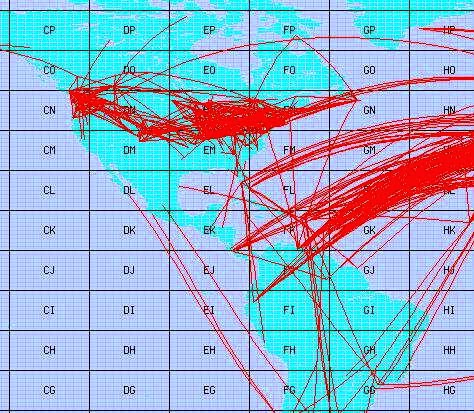
Throughout all of the day, strong auroral signals were copied and many stations were worked from here in SW British Columbia. Having the peak conditions in the middle of a working day meant hearing fewer stations than might normally be expected compared with an evening event, yet dozens of stations, including Colorado, made it out west ... even on 2m!
 |
| courtesy: http://www.on4kst.org/chat/index.php |
Strong auroral events like this, especially at the equinox, can trigger swift rises in the F2 MUF as conditions return to normal. Hopefully 6m will unleash some of its F2 magic for what might be one of the cycle's last big hurrahs.
The Boys of Summer
 This past week, Les Rayburn (N1LF), compared his yearn for the start of spring baseball to the late spring return of summer VHF openings, with this delightfully nostalgic post to the VHF reflector.
It occurred to me this morning that being a VHF operator is a lot like being a baseball fan. It was warm and sunny here yesterday, and this morning the air has that first touch of Spring in it.
Sure, there arestill cold days ahead--but you just have that feeling that we've turned the corner on Winter. The days are getting a bit longer, and the sun doesn't set quite so early anymore.
And like baseball fans, we start to look forward to those first
rumblings out of the Spring league.
For me, that means the confident voice of August, K5HCT. Nothing heralds
the arrival of the season like those first faint signals and the
familiar refrain..."Here Comes Texas!". This is nearly always the first
call I hear in the season, and the last remaining on the band at it's end.
In my boyhood days, I loved listening to baseball on the radio at night.
Those far away places, and the crack of the bat---mixed with the static
and pops of Summer storms. It was like a magic carpet that could
transport me thousands of miles away...The rest of the year, I still
enjoyed tuning the dial during the overnight hours--maybe listening to
the Herb Jepko Nightcap show from Salt Lake, or Larry King---but radio
wasn't the same without baseball. And those months between the World
Series and Opening Day were the longest of the year.
All these years later, things haven't changed much. I still love
listening to baseball on the radio---but now while waiting for opening
day, I find myself turning another dial...listening hard in the static
to see if I can hear that faint signal on the calling frequency. A deep,
rich, confident voice calling "This K5HCT, Here Comes Texas!".
Somebody press play on that MP3 player or I-Phone---cue up Don Henley's
"Boys of Summer"...I'll hum along and wait for Spring.
--
--
73,
Les Rayburn, N1LF
121 Mayfair Park
Maylene, AL 35114
EM63nf













