Posts Tagged ‘FCC’
 LF and MF Now Very Close For U.S. Amateurs!
 March 31st, 2017 |
  Author:
For U.S. amateurs anxiously awaiting implementation of the new 630m and 2200m bands, the wait seems to be almost over!
Good news came down late yesterday in the form of the FCC's "Report and Order" (ET Docket No. 15-99) which lays out the proposed rules and regulations that, barring any further changes, will likely become standard operating procedures once these two bands become finalized.
Highlights of the FCC's document are as follows:
1. Recognition that both Utilities (UTC) and amateurs can co-exist within these parts of the spectrum:
... co existence between PLC systems and amateur radio operations in these bands is possible, and the service rules we adopt in this Order will foster this co existence.
2. Amateurs operating within these bands must be no closer than 1 km from transmission lines that are actively carrying PLC (control) signals:
As proposed, we will permit amateur stations to operate in the 135.7-137.8 kHz and 472-479 kHz bands when separated by a specified distance from electric power transmission lines with PLC systems that use the same bands. To support the operations of both the amateur service and PLC systems in these bands, we adopt a minimum horizontal separation distance of one kilometer between the transmission line and the amateur station when operating in these bands.
We find that a one kilometer separation distance reasonably ensures that PLC systems and amateur radio stations are unlikely to experience interference. In addition, establishing a zone where amateur use is not authorized will simplify and streamline the process for determining whether an amateur station can transmit in these bands when in proximity to transmission lines upon which PLC systems operate.
3. Amateurs must "make notification" to local UTC authorities before commencing operation on either of these two bands:
We will require amateur operators to notify UTC of the location of their proposed station prior to commencing operations, to confirm that the station is not located within the one kilometer separation distance.
The notification requirement will entail notifying UTC of the operator’s call sign and coordinates of the proposed station’s location for confirmation that the location is outside the one kilometer separation distance, or the relevant PLC system is not transmitting on the requested bands. UTC, which maintains a database of PLC systems must respond to the notification within 30 days if it objects. If UTC raises no objection, amateur radio operators may commence operations on the band identified in their notification. The Wireless Telecommunications Bureau will issue a public notice providing the details for filing notifications with UTC.
A simple notification to UTC with a 30-day waiting period does not appear to be burdensome. Amateur operations can commence as soon as that period expires. ARRL claims that UTC should provide access to the PLC database to them or directly to amateurs to assist them in determining whether their notified operations are within the one-kilometer separation distance from transmission lines with PLC systems operating on these bands. ARRL fails to make a persuasive case why it would be a better organization to make those determinations rather than UTC. Further, since UTC has control of the PLC database which can be updated, we find no reason to mandate its release to another party especially considering the sensitive nature of information it contains.
4. Power limits will be expressed in EIRP as well as maximum PEP:
Amateur stations may operate in the 135.7-137.8 kHz band with a maximum radiated power of one watt EIRP ... that amateur stations operating in the 135.7-137.8 kHz band should be subject only to the general Part 97 limit of 1.5 kW peak envelope power (PEP).
We also adopt the power limits proposed in the WRC-12 NPRM for amateur stations operating in the 472-479 kHz band. For such stations, the maximum radiated power will be five watts EIRP, except for stations located in the portion of Alaska that is within 800 kilometers of the Russian Federation, where the EIRP will be limited to one watt. We also limit the transmitter power for amateur radio operations in the 472 479 kHz band to 500 watts PEP; provided, however, that the resulting radiated power does not exceed five watts EIRP. In other words, it may be necessary to reduce transmitter power below 500 watts PEP to avoid exceeding the five watts EIRP limit.
5. Antenna height will be limited:
... we will require that the antennas used to transmit in these bands not exceed 60 meters in height above ground level (AGL), as ARRL proposed.
6. Regarding transmission modes, no bandwidths have been specified in order to encourage experimentation:
Consistent with our proposal in the WRC-12 NPRM, and with the existing rules in Section 97.305 for the frequency bands below 30 MHz, we authorize amateur stations to transmit the following emission types throughout the new amateur bands: CW (international Morse code telegraphy), RTTY (narrow-band direct-printing telegraphy), data, phone, and image emissions. These emission types provide amateur operators with maximum flexibility, and we find that additional restrictions would needlessly hinder experimentation.
7. Experimental stations appear to 'still be in business' but are encouraged to transition to the 'amateur' service:
Finally, we decline to permit previously licensed experimental stations – some of which have been authorized with significantly more radiated power than the adopted EIRP limits for these new amateur service bands – to communicate with amateur stations operating in these bands. Amateur operations in these bands currently authorized under experimental licenses should transition their operations in accordance with the adopted rules and not circumvent such rules by use of experimental licenses.
My understanding of the R&O document is that participating parties may still file a 'Petition For Reconsideration' notification within 30 days of the R&O's publication in the Federal Register. Once these (if any) are dealt with, there are no other roadblocks preventing immediate implementation.
The document contains additional details not discussed here and makes fascinating reading for amateurs that might be looking forward to the new allocations.
This is the news that many U.S. amateurs have been waiting many years to hear! It is also good news for Canadian's operating on these bands to know that they may soon see a large increase in activity south of the border. Let's hope things continue to transpire favorably and that we will finally see the new bands become a reality.
Get those soldering irons out guys and gals!
LHS Episode #185: Second. Worst. Episode. Ever.
 In the latest episode of Linux in the Ham Shack, which is in fact better than the title would suggest, we tackle a bunch of different and interesting topics. There's information on driving while hamming, openness at the FCC, Belarussian nanosats, open-source documentation, Firefox returning to Debian, Chinese Linux distributions, things Linux doesn't have that it should, CW clocks and more. Thank you for listening and please donate and share our Hamvention 2017 funding campaign. Thank you!
73 de The LHS Crew
Got Noise?
 |
| courtesy: ARRL's Utility Noise (RFI) Signatures |
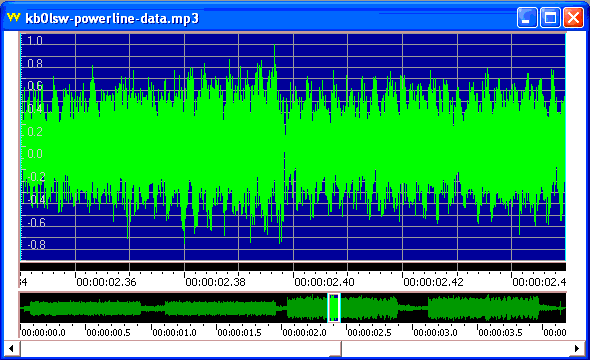
Excuse me if I seem somewhat cynical, but where have they been for the past twenty years as RF pollution, of now unbelievable proportions, has become the norm for most amateurs living in populated regions? In view of the present ubiquitous level of noise pollution, asking this question now is really akin to closing the barn door long after the horses have escaped ... and sadly, they are going to be very difficult, if not impossible, to round-up.
As radio amateurs, we are probably high on the list of those most negatively impacted by unwanted RF crud and were probably the first to bring this issue to the forefront. Many amateurs have watched, and continue to watch helplessly, as their noise floors climb higher and higher. For some, it happened overnight. In major cities and suburbs, it has become increasingly difficult to listen to normal AM radio because of RF noise pollution, so it's not just hams who are affected.
In many cases, the noise is powerline related and although this is part of the inquiry, in most cases this is probably not the main problem. Powerline noise is well acknowledged and here in Canada, RF pollution stemming from powerline radiation is illegal. Hydro authorities are required to clean-up noisy lines by government mandate (Industry Canada) and seem to react positively to complaints by amateurs. I believe a similar mandate is in play south of the border but because of the vast numbers of hydro operators operating in so many jurisdictions, getting action often seems fraught with difficulty.
The inquiry seems focused on the more nefarious types of radiation sources ... those that are not powerline-related, such as RFI caused by switching power supplies, light dimmers, electric motors, high efficiency lighting, computers, portable electronic devices, wireless routers ... generally any type of device radiating unwanted RF emissions.
Presently, complaints about this type of RF noise to governing bodies or to national associations, mostly seem to go without effective response ... solutions to the problem seem to be left to the amateur to "fix" the offending device or to just "accept it", rather than to put responsibilities on the manufacturers creating the problems. I know personally of amateurs who have just given up the hobby or have moved to the countryside because of impossibly-high illegal noise levels. It seemed as if calls for tighter government controls on electronic device emission-levels, especially on inexpensive and poorly-designed imports, largely from the far east, fell upon deaf ears. Some European jurisdictions found a ridiculous solution to the growing complaints by slackening even further, the allowable 'accepted' levels of spurious emissions. Previously illegal noise-making devices became legal overnight!
In the meantime, noisy electronic devices continue to flood the market at exponential levels ... only now, does the FCC pose this mind-boggling question! Equally stunning is their assertion that "... in search for concrete evidence of increased noise floors, we have found limited quantitative data to support this presumption." Perhaps if they had been maintaining vigilance instead of ignoring complaints when the problems were first reported, they would already have a huge body of the 'quantitative data' they are now seeking.
The Technical Advisory Council Noise Floor Inquiry (ET Docket No. 16-191) is well worth reading for any radio amateurs interested in finding solutions to growing noise problems. The three-page document includes a short list of questions to which responses are sought ... your input is vital, especially if hard data can accompany your comments.
Is it too late to turn the tide? There is no doubt that at this late date, it will be a huge uphill climb. The public notification document can be found here and the deadline for submissions, which can be made here, is August 11, 2016.
ARRL Working For LF / MF Future
As the rollout of new LF and MF ham bands grows closer for U.S. amateurs, earlier this month, the ARRL requested the FCC to carefully consider the procedural requirements governing the advance notification of local electric authorities of their intended 630m / 2200m operation. The FCC had suggested that under certain circumstances (mainly the distance to the nearest PLC signal-carrying power lines), amateurs would be required to notify and co-operate with power authorities ... but it was all very vague and seemed to place the conditions under which operating authority would be granted into the hands of the power companies.
In what appears to be a preemptive move to head-off the (possibly) overly onerous and impossible roadblocks suggested by power company representatives, the ARRL filing states:
“ARRL does not object to such a notification requirement, provided that it is appropriately circumscribed, not overbroad in its applicability, and not overly burdensome for radio amateurs to comply with,” the League’s statement asserted.
In addition, the power authority Utility Telecom Council (UTC) has been notably silent on the issue ... slowing the process even further.
"The ARRL noted that comments filed by the Utilities Telecom Council (UTC) called for a system of “quasi-coordination” by radio amateurs before commencing operation on 2200 meters (135.7-137.8 kHz). In its remarks to the FCC, the ARRL pointed out, however, that the UTC has not volunteered any information with respect to how a notification process might work nor offered any PLC database information to the ARRL or to the amateur community so prospective users of the band could determine if their operation might be problematic."
The League took the opportunity to remind the FCC, once again, that the low ERP levels generated by amateurs operating on the new bands would have a low probability of creating any interference and further pointed out that PLC systems operating between 9 and 490 kHz are not subject to protection from licensed services.
The ARRL also indicated that any sort of blanket notification requirement prior to transmitting on 2200 or 630 meters “would be clear regulatory overkill,” and that utility companies should clearly be required to demonstrate how amateur operations would cause harmful interference to their PLC (unlicenced) operations.
It's good to see the ARRL still being proactive with regards to procuring these new frequency allotments on behalf of U.S. amateurs ... hopefully making implementation sooner rather than later. The entire ex parte filing can be read here as well as the ARRL's own news posting of the procedure here.
In the meantime, I'll make yet another call-to-arms to fellow Canadian amateurs, who already have these two new bands but aren't using them ... new activity from the western provinces would be especially welcome as there are a now a number of well-equipped stations in VE7 who would like to work you.
LHS Episode #164: Ancient Antenna Modeling
 We're done with the editing of Episode #164 and here it is for your listening pleasure. In this episode, your hosts tackle topics from Bugbook computers to permanent amateur radio licenses, from Turing phones to Raspberry Pi computers and from antenna modeling software to lobster on pizza. We hope everyone will find something to enjoy. Please let us know by sending us feedback. We'd love to hear from you.
73 de The LHS Crew
Ten Year Trends in US Ham Licenses
In November 2005, I took a look at some statistics on FCC amateur radio licenses. At that time, I compared the number of ham licenses to such things as the US population, number of cell phones in use and the number of birdwatchers in the US. Interesting stuff.
Ten years later, we can take a look at the how the composition of FCC licenses has changed. The total number of licenses has grown to over 733k, increasing 11% over 10 years. This is a small growth rate, only 1% Compound Annual Growth Rate (CAGR).
| Extra | Advanced | General | Technician | Novice | Total | |
| Nov 2005 | 107,177 | 74,351 | 135,023 | 317,839 | 26,882 | 661,272 |
| 16% | 11% | 20% | 48% | 4% | 100% | |
| Nov 2015 | 139,515 | 48,272 | 172,239 | 362,580 | 10,988 | 733,594 |
| 19% | 7% | 23% | 49% | 1% | 100% | |
| % Change | 30% | -35% | 28% | 14% | -59% | 11% |
Source: www.ah0a.org
No surprise that the number of Advanced and Novice licenses has decreased because the FCC stopped issuing those licenses. Technicians represent about half of the licenses, a proportion that has remained steady over the decade, increasing 1 point. The percent of Generals increased by 3 points, to 23%. Similarly, Extra Class licenses increased by 3 points to 19%.
I reported the ARRL membership as approximately 152k in 2005. The 2014 ARRL Annual Report shows 165,663 members resulting in a growth rate of about 9% over 9 years (not ten). I’ll go ahead and “spot them” another point of growth in the tenth year and call it 10% over ten years. So it seems that ARRL membership is roughly keeping pace with the growth in amateur radio licenses, put probably not gaining on it.
Another question is how are amateur radio licenses keeping pace with US population growth? During the period of 2005 to 2015, the US population grew about 9%, which means that the number of FCC licenses is actually growing slightly faster than the overall population. Source: http://www.worldometers.info/world-population/us-population/
At this point, many of us will ask how many of those FCC license holders are actually active in ham radio. Hard to say…perhaps a topic for another post.
73, Bob K0NR
The post Ten Year Trends in US Ham Licenses appeared first on The KØNR Radio Site.
This Spewed Out of the Internet #31
 This is another update on important stuff spewing forth from the interwebz. It has been a while since I’ve done this, so we’ve got some catching up to do.
The KØNR Radio Site has expanded to Facebook. “Like” us there.
There is a statewide email list available to Colorado radio amateurs. Join us there to stay informed about regional events.
Grid locators are important for VHF/UHF operating. I came across this web site that does a good job of mapping the grids. I wrote a Shack Talk article over at HamRadioSchool.com that explains Simplex, Duplex, Offset and Split. Stu WØSTU posted a very helpful article explaing NVIS (Near Vertical Incidence Skywave) Antennas.
In June, Keysight Technologies donated some professional measurement software to the ARRL. Yeah, I had something to do with that.
From the Cheaters Gonna Cheat Department:
- CQ Magazine busts UT5UGR for padding his log in CQ WW contest
- The FCC fines David J. Tolassi, W4BHV, for failing to identify properly
- The FCC also went after Michael Guernsey, KZ8O, with a $22,000 fine. Ouch.
- The FCC also fined Daniel R. Hicks, KB8UYZ, for malicious interference to VHF repeaters.
The Ham Hijinks crew contributed some outstanding literary works to the ham radio community. Recently, they’ve latched onto the theme of hams using cheap radios to not make any contacts on VHF:
- Club Votes: Bob Should Buy New Radio
- No One, Anywhere, Having Good VHF QSOs
- Optimistic 6m DXer Ready for Opening of the Year
- New Ham Unsure If He Really Needs to Stand When Told To Stand By
Dodge uses Morse Code in one of their car commercials. Speaking of cars, check out Wired’s article: Hackers Remotely Kill a Jeep on the Highway.
Steve WGØAT created another SOTA video, this one with Clay NF1R on Mount Herman.
I heard this song by Phil Collins on a the radio recently and I’m convinced its about the heartbreak of trying to work a rare DXpedition. Give a listen.
And then there’s this…a very well done video about ham radio that has lots of people talking.
Well, that’s all for now.
73, Bob K0NR
The post This Spewed Out of the Internet #31 appeared first on The KØNR Radio Site.













