Posts Tagged ‘daisy book’
 Handiham World for 18 July 2012
 July 18th, 2012 |
  Author:
 Welcome to Handiham World.
Bucket list!

Photo: I found the problem. The confabulator gear is stripped. You’ll need a new one if you want this Vega to make it back to Podunk.
Hey, readers and listeners! It is certainly high summer here in North America and the temperature is so high and the humidity so oppressive that we are definitely not thinking clearly. That is why we have come up with this “bucket list” which we hope to complete before we die.
1. Landing a single engine plane on the beach.
2. Changing the transmission in a Chevrolet Vega.
3. Making yogurt from scratch.
4. Setting the tone and frequencies on a mobile radio while driving.
Well, if you are like me you have probably done the first three of these things without any particular problem, but you have never been able to safely program a mobile VHF/UHF radio while driving a car. In fact, programming a radio while driving can be a frighteningly dangerous experience, much worse than sampling that first icky-looking spoonful of homemade yogurt or dropping a Vega transmission on your toes. That is why the radio programming is not checked off my bucket list. In fact, programming a radio while driving instead of watching the road is a good way to assure that you will probably die before completing most of the items on your bucket list.
I started thinking about this particular problem when I read the correspondence section of the August QST wherein astute letter writer K2GW talks about making the programming process for VHF/UHF radios more user-friendly. The use of subaudible tones on repeater systems is so common as to be expected, and most of us will have to admit that these systems do an excellent job of preventing the repeater from ever actually being used for anything, but mostly from ever being successfully accessed by anyone trying to keep a car between the ditches while traveling through the area supposedly served by the repeater.
Of course the subaudible tones might be necessary to prevent interference from distant repeaters should there be a band opening or from other nearby RF sources or an alien invasion where the flying saucers transmit on the repeater input. I get that. But the problem remains that unless you are able to preprogram your radio for the repeaters along your route, you are likely going to be out of luck when you try to simply access them by punching a receive frequency into the VFO and letting the radio’s built-in offset function set the transmit frequency according to the band plan. One possible workaround is to listen for activity on the repeater in question and then punch the tone scan function button to try to locate the correct subaudible tone. If this works and you do not end up in the ditch (especially dangerous in Florida where hungry alligators find the ditches quite attractive), then you might be in business. The more likely outcome is that you will drive entirely through the repeater’s coverage zone without hearing any activity.
The ARRL TravelPlus® repeater directory on CD-ROM does provide a way to map and program radios along a planned route, so it is a good resource that allows you to program your radio well in advance of your trip. Programming your radio while sitting in the driveway is one heck of a lot safer than meeting an alligator for lunch. Still, you may need to program a radio while in motion. The safe way to do this is for you to pay full attention to the radio by letting someone else do the driving. When my wife and I take car trips, I feel safe enough fiddling with the radio while she pilots the car. While this division of labor keeps the car out of the ditch, it does not necessarily ensure that one will be able to access or make a contact on a repeater.
One time, on a trip through alligator-free central Illinois, I tried a repeater that I really, really wanted to use and that was programmed into my radio already, because I had looked it up in my repeater directory. I heard the repeater identify and decided to throw out my call sign.
Silence.
Okay, so I upped the power and tried again.
Silence.
Obviously, the subaudible tone that I had programmed was incorrect. So I set the radio to tone scan and hoped for someone to transmit on the repeater. Well, that didn’t happen. I guess I probably could have gone through every possible subaudible tone while kerchunking the repeater and throwing my call sign out, but somehow that didn’t seem to be worthwhile. Instead, I switched to VFO mode and 146.52 MHz where I had a nice QSO with a truck driver who was passing through. The subaudible tone system had certainly done its job of preventing interference and any actual use by mobile stations, that’s for sure. Later, after we got back home from vacation, I discovered that the subaudible tone for that particular repeater was incorrectly listed in the directory.
I’m not sure what the answer to this partly technological and partly behavioral issue is with VHF/UHF repeater systems. All I know is that you cannot make things that difficult to use because prospective users have many other alternative means to communicate and they will vote with their feet and go somewhere else. For example, I can easily bring up the node of my favorite repeater on my Android phone by using the EchoLink application. I recommend doing this while you are sitting in the passenger seat rather than trying to steer the car. Once I am connected on EchoLink, all I need for reliable communications is a cell phone data signal. I can talk to my friends who are regulars on my preferred EchoLink-enabled repeater system.
Would I prefer to use the radio in my car to make a local contact? Certainly! But hey, repeater owners out there – you might consider connecting your repeaters with the world via IRLP or EchoLink and make sure that your frequency and tone information are correctly listed in repeater databases and on your club website. And if any of you local stations are listening on the repeater and hear a mobile station give a call, take a minute to have a short conversation and make a new friend! Maybe the technology will improve to the point that radios will be easy enough to use while driving so that one day I will be able to actually use repeaters I encounter along my mobile route.
Today’s safety tip: Don’t feed the alligators. Also, but not safety-related, the QST audio digest in DAISY format is now available for our blind members in the DAISY section. You can hear me read the correspondence section with the K2GW letter.
The long-range forecast: Speaking of Podunk, localism is an endangered species. As applications for mobile devices like smartphones proliferate, people will listen to the broadcast stations they prefer, avoiding the local stations – especially when they are on the move, traveling by car. When the typical car driver would one time tune around for the local yokel stations along the route, the trend will favor simply staying tuned to the internet station they have always liked. Satellite radio is already making such inroads into localism. The same thing is going to happen to local repeater systems. If the repeater system is not linked, it may be doomed to obscurity. Repeater owners who think EchoLink “isn’t real radio”, take note.
Handiham World for 11 July 2012 (early release)
Welcome to Handiham World.
The band police
Recently I got an e-mail from a new amateur radio operator who told me about an encounter with an unpleasant character on the bands. This new operator was following all the rules of identification while enjoying an EchoLink contact with a DX station. Someone jumped in and told him he should get off the air if he wasn’t going to identify. Interestingly enough, the guy with this unsolicited advice didn’t identify his station at all. The whole incident confused and worried our new amateur radio operator. It wasn’t exactly a way to feel welcomed on the amateur radio bands, was it?
Let’s deconstruct this incident.
First off, our new amateur radio operator says that he was following all of the rules of identification and I believe him. Because it was an EchoLink contact, it is possible that because of delays in the various interconnected systems and possible packet loss, the station that broke in with the comment about identification may not have been able to hear all of the conversation. So there could be a technical issue here, but there is certainly no need to break into a conversation to rudely chastise someone with unsolicited advice. After all, all identifications were being done properly and sometimes band conditions or Internet connectivity can change what a third station might hear. Even if there is a compelling need to break in, the best way to do so is with one’s callsign, not with an unidentified scold.
What our new amateur radio operator had the misfortune to experience was a visit from one of the lower life forms on the amateur radio bands: the band police. Who knows if they even hold valid amateur radio licenses? If they do, do they think the rules about identification do not apply to them when they are busy butting into another conversation to complain about something they don’t like? Well, I suspect that these “band police” are pretty under socialized in other respects. I’d be willing to bet they are blowhard know it all’s at the Field Day site and at the radio club meetings. For them it’s “my way or the highway”, and that probably extends to other areas of life aside from amateur radio!
We all know that there are unpleasant and even downright toxic personalities out there, so in amateur radio as in the rest of life we need to have a strategy. Just as you would avoid contact as much as possible with an unpleasant and unreasonable neighbor or a pushy bully at the office, you can devise a strategy to minimize your contact with unpleasant people on the amateur radio bands. You may wonder how this is possible when they break in with unsolicited comments, but the best advice is the long-standing recommendation from experienced operators: simply ignore them. Don’t acknowledge them. Like Internet trolls, they like to interrupt and disrupt with off-topic and controversial or unsolicited comments. The more you engage them, the more you feed their egos. Ignoring the band police may not be as satisfying as telling them to mind their own business, but if you go down that road you are asking for trouble. Yes, there may be times when the situation gets so bad that you may need to escalate it by bringing it to the attention of the ARRL official observers in your area. One thing you should NOT do is let an incident like this spoil your enjoyment of the amateur radio bands. Almost all amateur radio operators are friendly, helpful, and understanding – and especially so when it comes to welcoming new amateur radio operators to a lifetime of fun on the bands.
This is a reminder that the Handiham office is open only with very limited services and hours this week. No renewals or new membership requests can be processed until July 16.
Email me at [email protected] with your questions & comments.
Patrick Tice, WA0TDA
Handiham Manager
Handiham remote base stations up & running, but…
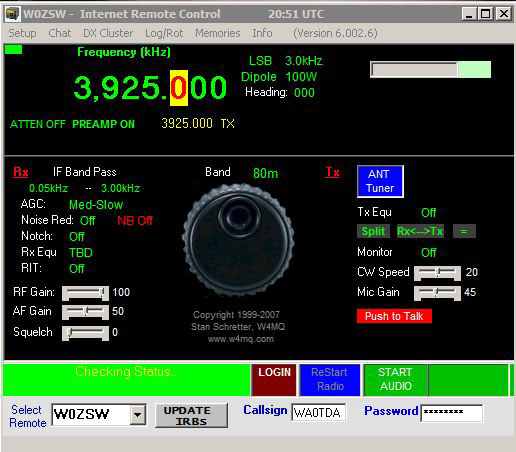
…there are a couple of issues.
While W0EQO has returned to complete service following severe storms which took down over 20 trees at Courage North, W0ZSW remains only marginally useful. The problem is the internet connectivity and network problems at the Handiham headquarters office at Camp Courage. I do plan to spend some time working on these problems this week, which unfortunately means even less time to answer phone calls and emails or to work on the new Extra Class lecture series. Both stations remain accessible via Echolink for receive, but with occasional dropouts on W0ZSW.
Handiham World for 04 July 2012
Welcome to Handiham World.
We wish our USA members a happy Independence Day, and our Canadian members a belated Canada Day.
High summer here in North America isn’t exactly the best time to explore the HF bands, given the constant parade of interference-generating thunderstorms marching across the continent. While bands like 160 and 75 meters may seem like wall-to-wall noise, there are always some intrepid operators sticking to their usual schedules. The best time on both bands is usually early morning before solar heating and convection starts cooking up more lightning and thunder and before absorption becomes too odious, a real problem for propagation as the sun climbs higher in the sky. Summer is the traditional sporadic-E skip time of year, so it doesn’t hurt to keep checking out the VHF bands. A clue is that you might hear repeater identifiers that you don’t recognize because they are far outside the usual repeater coverage area. If you hear stations on 10 meters, you might also check out the 6 meter band. You never know – perhaps there is an opening, and if you are trying to work all states, such openings can be pure gold.
Summer, especially post-Field Day, is often considered the least active time of the ham radio year. Radio clubs may shut down for a few months in the summer – usually June, July, and August – and resume operations in September. The conventional wisdom is that people are busy doing summer stuff like taking vacations, working in the yard, boating, fishing – you name it, ANYTHING but sitting inside at the radio! But summer weather might chase you indoors with its heat and humidity. Maybe it wouldn’t be a bad time to get on the air after all. Besides, summer is a good time to get antenna projects done. Let’s list some summer ham radio activities:
- Put up or repair your antenna system.
- Check out VHF propagation on 6 and 2 meters. Try SSB on both bands. Log your contacts and send us a brag about your farthest contact so that we can publish it and make you famous.
- Go bicycle mobile!
- Take ham radio on vacation with you, both as a mobile station in the family car and as a portable station.
- Check into the daily Handiham Echolink net. If you have a smart phone, try checking in via the Echolink app. (Android and iPhone)
- Try out the Handiham HF remote base stations. Say hello to the folks on the always-friendly PICONET on 3.925 MHz.
- Build a kit.
- Study for a license or upgrade.
- Try setting up your own EchoLink or IRLP node.
- Take your handheld radio with you on a walk and find out how many contacts you can make on local repeaters.
- Set a goal to work as many stations as possible on 10 meters. Log all your contacts.
- What?!! You don’t have a logging program? Install XMLog and learn to use it. http://www.xmlog.com (Yes, it is blind-friendly, and it’s free.)
- On the water? Take ham radio with you on the boat. Don’t drop the radio in the water.
- New to blind-accessible technology? Try downloading DAISY book software and reading a DAISY book with it. Make it a ham radio book from the Handiham website. (More on this in a minute.)
I could go on and on (maybe I already have), but you get the idea. Now let’s get out there and have some ham radio fun!
This is a reminder that the Handiham office is closed this week and open only with very limited services and hours next week.
Email me at [email protected] with your questions & comments.
Patrick Tice, WA0TDA
Handiham Manager
Storms sideline Handiham remote base stations:
Severe storms in northern Minnesota last night had disrupted internet service to W0EQO at Courage North. The station returned to service around 12:50 PM on 3 July 2012.
W0ZSW is still offline following storm damage and power outages that disrupted our internet and networking equipment at Camp Courage. It was the first time in the history of our double remote system that both stations have been offline at the same time due to storms. Due to limited staffing at this time, we are unable to resolve the problems quickly.
Solar Activity Forecast: Solar activity is expected to be moderate during the period (03 – 05 July) with M-class flares expected from Regions 1513 and 1515.
Geophysical Activity Forecast: Geomagnetic field activity is expected to remain at unsettled to active levels on day 1 (02 July) as CH HSS effects persist. Activity is expected to decrease to quiet to unsettled levels during days 2 – 3 (04 – 05 July) as CH HSS effects gradually subside. The CME associated with today’s M5/2b flare is not expected to disturb the field during the forecast period.
Handiham World for 27 June 2012
Welcome to Handiham World.
Net wrangler WA6DKS starts us out with a Field Day report:
A wonderful Field Day was had by all on the Handiham conference server on Saturday, June 23 and Sunday June 24, 2012 whether you were using Echolink, IRLP, ICQ, WIRES®, cell Phones, the internet, or plain old RF radios. During the two-day period, we had over 500 contacts which included over 12 countries and all 50 of the U.S. states.
The Handiham Field Day ran longer than the official ARRL event, but a good time was had by all whether it was net control operators, backups, check-ins, or just listeners.
Now, isn’t this what the ham radio hobby is all about? Contacts were made with stations from Azerbaijan to China, Nova Scotia to South Africa, and of course Canada and the United States. Wonderful discussions on many topics added to the fun during the two-day event. It was all about laughter, interaction, and fun times. A very special contact occurred with a station in the State of Florida that was “bicycle mobile” using one tenth of a watt of power! (Did I say QRP?!!)
Many of our Net Control Operators and Assistant Net control operators supported each other by recording all of the contacts with the names, callsigns and locations while at the same time making sure that the text box information was recorded during the day and the night. SouthCARS connected to Handiham Conference Server and the Van-IRLP throughout the two-day period after their own net sessions concluded.
This was our second Field Day, and the credit should be attributed to three individuals –Ken Schwartz (W6KHS), Pat Tice (WA0TDA), and Susi White (WA6DKS). The decision among these individuals was that there are lots of ham radio operators throughout the world who do not have an opportunity to attend an ARRL sanctioned Field Day. Therefore, an opportunity should be provided to those who would like to experience the event because (after all) there should never be a distinction made between “able-bodied” and people with challenges not being able to communicate.
All methods of communication were used so that we were assured of making as many state and country contacts by simply sending out e-mails, connecting to other conference servers through the internet, and having the help of Southcars and The Coffee Shop by using their e-mail membership lists and help in sending e-mails to those in that particular region and requesting contacts.
The Handiham organization wishes to thank everyone who participated in our successful 2012 Field Day event whether you were a net control operator, a backup, from Southcars, The Coffee Shop, The World, or any other conference we contacted . Without those of you helping in the background or even checking in, we could not have had a successful event without YOU. The success of the 2012 Handiham Field event is owed to each and every one who helped and we all look forward to next year.
Thank you to Susi, WA6DKS, for that report.
Email me at [email protected] with your questions & comments.
Patrick Tice, WA0TDA
Handiham Manager
Station Check at Camp Courage North
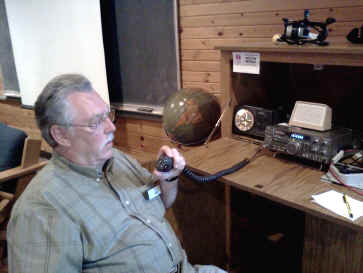
Bill, N0CIC, checks out the Kenwood TS-440 station that has been stored several years, since our last Courage North Radio Camp in late 2009. We were pleased to find that the rig worked perfectly and the G5RV and beam antennas were all operational. The rotator also worked and trees were still well clear of the antenna’s rotating radius. An Icom dual band FM rig did not work because of a faulty microphone, so that unit was packed up and brought back to the Twin Cities for assessment and possible repair by a volunteer. Bill and I (WA0TDA) opened the station at Courage North as part of a Veterans open house weekend. While there, I also gave remote base station W0EQO a once-over and found it to be in excellent condition. Our thanks to Bill for his help at Courage North. If you look carefully, on the top of the radio cabinet you will see Bill’s golf ball slingshot, used to launch antenna wires up into the trees. We didn’t have to use it, though.
Speaking of trees, several of you have asked if the tree we planted in memory of Dick Chrisman, AB7HW, is alive and well. Indeed it is, so here is a photo of me (WA0TDA) standing by the once tiny tree which now towers to over twice my height. I sure look like a doofus in this picture, but the tree looks great. We sure miss Dick and Scotty, the Wonder Guide Dog. This photo was taken last Saturday. The tree is just outside the main Dining Hall at Courage North.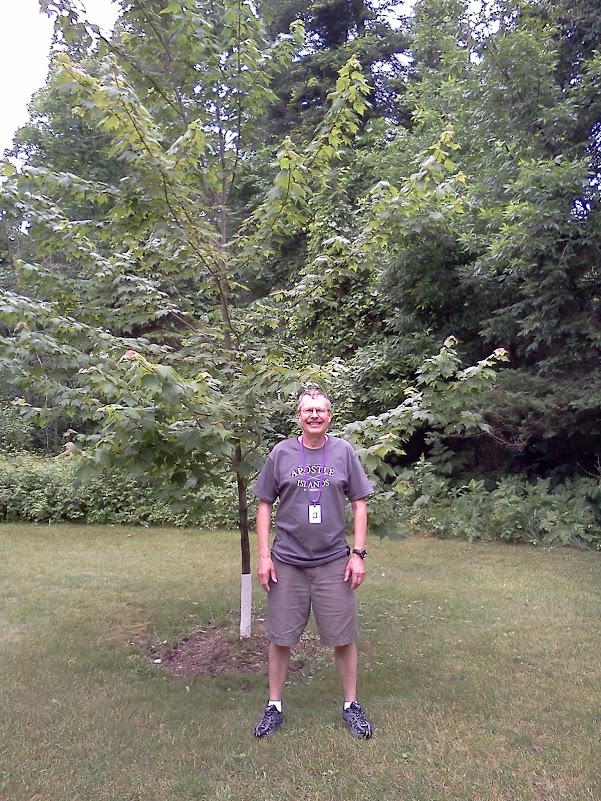
Handiham World for 20 June 2012
Welcome to Handiham World.
2012 ARRL Field Day is coming up this next weekend. It is always the last FULL weekend in June, which is Saturday and Sunday June 23 and 24.
Summer begins in the Northern Hemisphere on June 20, 2012, at 6:09 P.M. USA Central Daylight Time. Of course this means that our hours of daylight are at their maximum around this time of the year, and that always helps with getting set up for Field Day. There is always a lot of antenna work and temporary infrastructure to be set up at a multiple station club Field Day site. Having those extra hours of daylight can make it a little easier to get to the site and get things ready to go. On the other hand, more hours of daylight are likely to mean more absorption of signals on the lower frequency HF bands such as the 75 m band and – it goes without saying – more thunderstorm activity since thunderstorms are driven by convection and that takes place when you have long, hot, sunny days.
Field Day is different things to different participants. Some clubs are highly competitive, and this goes for individual participants as well. They are in it for the points and there is nothing wrong with that approach because if that is what you like and enjoy, then that is what you should do!
My feeling is that Field Day should ALWAYS be about having fun. I know that I have mentioned this before, but it certainly bears repeating: it is up to you to find a radio club Field Day that matches your expectations for what you expect the day to be all about. A mismatch between your expectations and the type of operating that is going on at the Field Day site will probably result in a disappointing experience for you and a bit of consternation on the part of the event organizers. If your idea of having fun is to get on the air and operate a highly competitive Morse code station to rack up hundreds and hundreds of points, you need to find a club Field Day whose goal matches yours. If you would rather spend most of the day socializing, greeting visitors to the Field Day site, helping newcomers get on the air, or experimenting with different modes of operation, then you should try to find a club that emphasizes those things over highly competitive operations.
If I hear from someone that they did not have a good experience on Field Day, I like to try to find out what went wrong. After talking with them for a while, I usually find out that there was a mismatch of expectations. They expected to do one thing at Field Day while the club’s event organizers had arranged for something entirely different. That is why you need to do a little bit of research to find the kind of Field Day operation that will suit you. If you do this, you are almost guaranteed to have an excellent time during what many of us consider the highlight of the amateur radio calendar – ARRL Field Day.
Incidentally, you do not have to feel as if you are all on your own when trying to find a club that will meet your Field Day expectations. ARRL Field Day sites across your state are probably going to be visited by your local League Section Manager. If you drop your Section Manager an e-mail or call him or her on the telephone, you can ask which Field Day sites they have visited and which they might recommend to a person like you with your expectations. Local League officials are a good resource to help you get connected with the right radio club as well. You can find lots of information on the ARRL website, which you can link to from the Handiham website.
Email me at [email protected] with your questions & comments.
Patrick Tice, WA0TDA
Handiham Manager

Handiham World for 13 June 2012
Welcome to Handiham World.
We are back after a week at Radio Camp. There are lessons to be learned.
But first, I want to take you back to the early 1990’s, when interest in public service communications saw a real growth following the 9/11 attacks. Ham radio operators dusted off their VHF/UHF handheld radios and headed to training sessions. It was at one such event that many of us in my own local radio club found out how little we actually knew about operating our radios. In an embarrassing exercise that really only called for some very simple operations to be performed on the handheld radios, we discovered that many – maybe most – of us didn’t know how to enter frequencies, set offsets, and enter subaudible tones. In a real public communications emergency all of these things might leap to the fore as necessary skills. After all, plans change, interference happens, and repeaters can fail. We have to be ready to deal with all of these things – and more.
Photo: Matt, KA0PQW, talks on an HT while Phil, K9HI, leads a critique of the emergency communications exercise.
Now fast forward to Handiham Radio Camp 2012. Our scripted emergency exercise, written and led by volunteer Phil Temples, K9HI, called for a post-tornado communications response. Handheld radios and one mobile rig (for the net control station) were programmed and ready to go. Unbeknownst to the participants, a scheduled “repeater failure” took the camp repeater off the air mid-exercise. There was a good deal of scrambling to figure out a workaround during that part of the exercise. As a result, the mobile rig at the net control position was so out of whack from random button-pushing that it required a hard reset to return it to the original factory settings. Some participants had not programmed their handheld radios at all prior to the exercise and were left scratching their heads or borrowing radios from someone else.
This happens at virtually every camp, so we came up with an idea to test for HT skills. (Thanks, AB8WF.) We will be letting you know what is going to be involved in this skills test, more about which will be featured in the August Worldradio Online. In addition, we also are mulling over an operating skills exam in written format and an HF skills exam. This would give our Handiham members some new goals to work toward. We would provide an actual certificate for each “element” of our new skills testing. It would be fun to earn each certificate, but it would also help operators to focus on really learning their equipment.
We also had a VE session at camp, so here’s a photo of Rachel, KC0VBV, receiving her certificate of successful completion of examination from Dr. Dave Justis, KN0S. Congrats, Rachel! Our thanks to the Stillwater Amateur Radio Association (SARA) for fielding the VE team, and to VE Team Leader Shel Mann, N0DRX, and all the VEs. Following the VE session Shel and XYL Mary, N0DXH, stuck around to help us take down the wire antennas.
Photo: Rachel, KC0VBV, receives her certificate of successful completion of examination from Dr. Dave Justis, KN0S. 
Photo: Bill, K9BV, teaches the General Class. Here he points out a sine wave. “What goes up must come down.” 
Photo: Lucinda, AB8WF, taught one on one computer lessons and brought computers up to date, which included installing Microsoft Security Essentials. She also taught remote base operation with JAWS. Lucinda also suggested the operating skills certification and will continue to work with us on the lessons and testing.
Of course old man Murphy is not ever far from any antenna project, so the center insulator and 450 ohm feedline got REALLY stuck in the tree we used as the dipole antenna’s center support. We did have some wind during the week, so we will blame it on that rather than any of our expert antenna wranglers! Here is a photo of Dr. Dave attaching the remnants of the 450 ohm line to the back of my Honda CRV so that I can drag the feedline out of the clutches of the greedy tree with some serious horsepower. This proved successful, and although the feedline was somewhat the worse for wear Dr. Dave did collect the pieces for use back at his home QTH. He isn’t afraid of splicing the somewhat ragged pieces together!
Photo: No, we are not going to run 450 ohm open-wire ladder line to a mobile W0OXB Special antenna!
Although we foiled Murphy’s antenna tangle, he wasn’t through with his mischief. On Thursday evening I discovered that the Drupal-powered Handiham.org website had gone down and that problem persisted through Friday and the weekend. Here’s the story:
Handiham.org returns to service following SQL failure
The database failure at Handiham.org has been resolved. Our thanks to the kind technical support people at Network Solutions for their assistance.
The SQL database required by Drupal failed due to a problem with the table structure. This proved to be a bit beyond the pay grade and capabilities of your humble Handiham Manager to figure out, so I had to ask the folks at Network Solutions, our hosting service, for assistance.
The problem surfaced on Thursday, June 7, while we were at Handiham Radio Camp and as a result of being very busy at camp I didn’t notice that anything was wrong until very late Thursday night. Friday was travel day, so everyone was getting their travel back home underway and there was really no time to think about the website until later on Friday afternoon when I myself got back home. By that time it was quite late in the week and when I called Network Solutions I knew it would probably mean a weekend wait for a regular business day crew to be back on board – unless the staff could help me with a relatively simple problem. I spoke to my tech support guy, another ham who of course knew all about us, and we scheduled the service for this week. I am happy to report that the site has been restored to service as of this Tuesday morning, right on schedule. Good work, Netsol!
Of course we apologize for any confusion or inconvenience this outage may have caused. I guess one good thing about it happening in the summer was that everyone seems to be so preoccupied with summer outdoor activities that not too many people noticed!
*HANDIHAM* Echolink node guy visits camp!
Photo: Left to right – Matt, KA0PQW; Susan Tice; Pat, WA0TDA, and Handiham volunteer Mike, N0VZC, who hosts the excellent *HANDIHAM* conference which makes the worldwide Handiham net run smoothly on a single high-capacity node. Mike and Don, N0BVE (not pictured) visited to help the camp with some networking. I think he’s the guy who took this photo.
Post-camp cute puppy alert!
Photo: Jasper takes a well-deserved snooze after a week at Handiham Radio Camp. He was an enormous hit among the campers and staff, probably due to his overwhelming super- cuteness. Thankfully he only uses his amazing powers for good.
Email me at [email protected] with your questions & comments.
Patrick Tice, WA0TDA
Handiham Manager

Handiham World for 23 May 2012
Welcome to Handiham World.
You can do it!
Today, just as we did last week, we are going to begin with Troubleshooting 101 as part of our initiative to help new ham radio operators (and even some of us older ones) learn how to do some basic troubleshooting for ourselves. Yes, it can be tempting to ask someone else to do things for us. This can become a bad habit when it keeps us from learning new things, especially things that we could – with a bit of practice – learn to do for ourselves. Knowing these basic things can serve us well in the future when no help is available.
Troubleshooting 101

Let’s get to today’s troubleshooting question:
Question: This question has to do with my workshop. Let me explain; over the years I have collected quite a few electronic parts and lots of hardware used in electronics and computers. While I have built some projects in the past and have done some repairs on various pieces of equipment, it seems like I seldom use many of these parts that I have saved up. My wife told me that the basement is getting to be kind of a mess and that I should clean out some of the “extra junk” from my shop. My question is, “How does one decide what to keep and what to throw away?”
Interestingly enough, I was just thinking about this very problem recently. It seems like whenever I have to work on something in my own shop, almost invariably I will have to go out and buy something to complete the repair or project. I am almost never able to pick something out of my junk box and make it work. Since I have been an amateur radio operator for decades, I have saved up a collection of really good stuff that I am possibly going to use some day – for something. The problem is that I have stuff that has been in the same place in the shop for 20 years and has never been touched. Now, you may be thinking that my workshop is such a mess that I just can’t find anything. That is not the case. I pretty much know where things are, but I just don’t seem to ever need them for a project or repair even though that is the reason I am keeping them.
Does any of this sound familiar?
I’ll bet it does; just about every other amateur radio operator does exactly the same thing. We might find an interesting treasure at a hamfest or swap meet, but we really don’t know what we would do with it other than use it for a project that never seems to materialize. So to answer the question, you need to come to terms with the reality of the situation. Let’s lay it out and be as honest as possible:
- Technology advancement: Technology has marched on, but your junk box collection has not. The fact of the matter is that most of the stuff you have collected might have been good for fixing electronic equipment that was in vogue 20 years ago or more. Today’s electronics use different kinds of parts and sometimes are not even user-repairable. Those vacuum tubes and wire wound resistors in that box underneath the workbench are probably not going to be much good to anyone but a person who restores old radios. If you are not such a person, then it is time to get rid of those kinds of parts. I could go on about other parts for radios and computers, but you get the general idea. If it is not likely to be used in current technology, get rid of it.
- Time is limited: Be honest about your time. You do not have unlimited time. You’re busy, perhaps busier than you have ever been, especially if you are still in your working years and are raising a family. Do you really have time to work on projects that will take many hours or even weeks or months to complete? It may be better to pare down your collection of project parts and keep only the most essential. Your reward for doing this is a tidier shop and less clutter. This will make it easier to do the projects that you do actually have time to complete.
- Your interests have changed: At one time you were interested in packet radio and by gosh, you still have that old terminal node controller on the shelf. Along with that, there is an old computer that used to run DOS and that would be “perfect” for your packet station. After seeing a club program about rhombic antennas, you decided to start collecting wire to make that rhombic antenna someday. Of course, you are also interested in getting several of those old computers you have saved back into service. Maybe you can put Linux on them. Well, guess what? If you haven’t done anything with these items for several years, your interests have probably changed and you are not likely to get around to any of these projects – ever. Give as much of this stuff away as possible and recycle the rest. Most counties and municipalities have some kind of recycling program for computers and electronics.
Just how honest can you be with yourself? After years of collecting all this junk, it can be difficult to admit that you are never going to get around to using any of it and that you are better off just getting the workshop cleaned out and tidied up so that you will have more space to work and less clutter.
Over the years I have seen some real junk collections. A few of them have been jaw-droppingly amazingly enormous collections worthy of being a swap meet in and of themselves. I could never imagine how anyone could have deluded themselves to the point that they actually believed all of this stuff would someday be useful! It would’ve been impossible for the person to use half of this stuff in two lifetimes, let alone one lifetime. One guy, an elderly gentleman, had a basement full of shelves arranged in rows, all stacked with equipment and parts at least 30 years old. Another had a basement and an additional storage building with row upon row of shelves holding old parts and radio gear. It is not as uncommon as you might think.
We have to face up to the fact that keeping things simple, actually expedites project-building and troubleshooting. When you have too much stuff, you waste time moving it around or digging through it to find some little part you think you might have. This is usually not worth the time and effort. You are better off buying a new part that will be exactly the right one when you need it. Furthermore, too much junk and clutter can make you prone to simply putting off a troubleshooting project because it is too much effort to work in your shop. If that is the case, you REALLY need to do some serious organizing.
At Radio Camp we will be talking about the essentials of a good, efficient home workbench. We won’t go into this lean and mean list of shop basics right now, but I will reveal that it is surprising how little one needs to have a really effective troubleshooting and project space.
Email me at [email protected] with your questions & comments.
Patrick Tice, WA0TDA
Handiham Manager
A dip in the pool

It’s time to test our knowledge by taking a dip in the pool – the question pool, that is!
Today we are taking a question from the Extra Class pool:
E4C09 asks: “Which of the following is most likely to be the limiting condition for sensitivity in a modern communications receiver operating at 14 MHz?”
Possible answers are:
A. The noise figure of the RF amplifier
B. Mixer noise
C. Conversion noise
D. Atmospheric noise
Long ago, when receivers used vacuum tubes and discrete components and when a VFO could drift like a rowboat in a hurricane, we reveled in the “good old days” of radio. Yes, these were the times when we sometimes listened with our hand on the tuning knob, either to follow a drifting signal or to try to find a sweet spot where we might hear a signal through all the noise. In retrospect, they were really “the bad old days”, because our equipment is so much better now. Receivers are so good that they have noise figures below noise that would occur naturally in the atmosphere and stability that rivals crystal control. Thanks to these advances atmospheric noise is now the biggest worry, so answer D is correct. In essence, engineers have done everything possible to the receiver itself to eliminate internally generated noise. It’s hard to do much about atmospheric noise, but now modes of operation have evolved to fight back against poor conditions. PSK-31, for example, is amazing – it works even on days when you would be hard pressed to hear a CW signal. As far as receivers go, if you are looking for the good old days, we are living in them right now!














