Posts Tagged ‘Contests’
 NS Ladder (20 August 2010)
 August 20th, 2010 |
  Author:
 I used to be an ardent participant in the NCCC Sprint Ladder competition when I lived in the Central time zone. Now that I’m back in the Eastern time zone, 10:30 pm local is a little late for me. But, W9RE conned me into doing it. After some fits and starts last night (including using the NAQP module for TR instead of the Sprint module, which caused me to QLF my first two serial numbers), I had a good time. Here are the numbers:
NCCC Sprint Ladder - Aug 20

 Call: K8GU
 Operator(s): K8GU
 Station: K8GU

 Class: Single Op LP
 QTH: MD
 Operating Time (hrs): 0.5
 Radios: SO2R

 Summary:
 Band  QSOs  Mults
 -------------------
 160:
 80:   9      7
 40:   8      7
 20:  12      9
 15:
 10:
 -------------------
 Total:  29     23  Total Score = 667

 Club: Potomac Valley Radio Club
So, I have some work to do. I was getting up into the 40s of QSOs when I left off two years ago. More sprints!
It’s all down to your ears
There was a lot of excitement on the Elecraft email reflector over the fact that the majority of participants in the World Radio Team Championship 2010 (WRTC 2010) were using Elecraft K3s. There was even more glee when it was discovered that Scott Robbins W4PA, former Ten-Tec product manager, and Tim Duffy K3LR of Team Icom had taken K3s. This was like the President of Coca Cola serving Pepsi at his anniversary party!
 There have not been many comments now the results are out, which show that the top two teams, from Russia and Estonia respectively, were using FT-1000MPs. The USA team of N6MJ and KL9A in third place used K3s, as did K5ZD and W2SC who came fifth, but the fourth placed S50A and S57AW again used FT-1000MPs as did the Lithuanian entry in seventh place.
So let’s get this straight: the winning stations and several others in the top ten used a now obsolete radio that was introduced in 1996 which has frequently been criticized as inferior to the K3? I suspect the fact that many international competitors took K3s may have more to do with the fact that the Elecraft radio is small enough and light enough to be taken on an aircraft as hand baggage. And I suspect that the reason for the success of the stations using FT-1000MPs is that there is more to winning a contest than having a receiver with the best performance numbers.
Anyone want to swap an Elecraft K3 for an FT-1000MP? (Only joking.)

VHF NFD washout
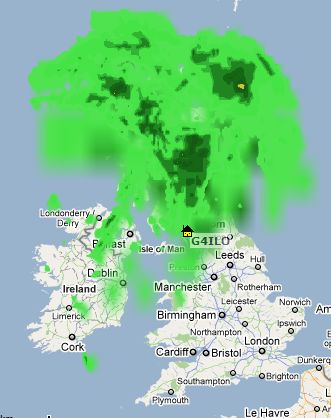 Conditions could hardly have been worse for the RSGB’s VHF Field Day contest this weekend. Yesterday I worked a few southern Scottish portables on 2m and 6m, plus the Lincoln Radio Club station G5FZ/P on 2m, and that was that. There did not appear to be a shred of Sporadic-E on either 2m or 6m, according to DX Sherlock. 6m was so quiet my K3 S-meter wasn’t even moving.
Today when I turned on the radio I tuned both 2m and 6m without hearing a single signal. The map on the right probably shows why. We awoke to heavy rain and gale force winds, and I immediately thought of those poor guys on hilltop sites with their guyed poles supporting their beam antennas. If the wind didn’t force them to take the antennas down I dare say the rain and the poor propagation made them decide they might just as well give up.
This has been a really disappointing year for me too, VHF-wise. After working Spain and Portugal on 2m on two separate occasions last year – the last being exactly one year ago – I improved my antenna by 3dB and my output power by 6dB in the hope of doing better during this year’s season. But I have worked nothing and as far as I know the sporadic-E this year has hardly been heard this far north. DX Sherlock showed that a couple of well-sited northerly stations managed to make a few contacts a few weeks ago and I fleetingly heard a station from Romania complete a contact and call CQ at that time, but that was that.
Something is becoming clear to me that I never realized when I lived in the south, which is that just a couple of degrees of latitude can make a huge difference to the amount of Sporadic-E you get. The season isn’t over now but it must be on the wane and I’m soon going to be away from the radio for a couple of weeks, so it’s looking as if 2010 is going to pass for me without any 2m Sporadic-E DX.

Back to front
 Last night for the first time in a very long time I operated RTTY. I made ten contacts in the BARTG RTTY 75 contest. The reason was that Elecraft had released a beta version of firmware for the K3 that enhances the built-in DSP modems to support the 75baud RTTY mode that was being used in the contest. Now that the K3 also supports a way to get decoded text into a computer program I thought it would be fun to give it a try.
For those unfamiliar with the K3, the transceiver boasts a built-in Morse decoder plus DSP based modems (encoders and decoders) for PSK31, standard 45.5baud RTTY and now 75baud RTTY. As the K3 doesn’t allow direct input from a keyboard, the usual way to use this facility is to send text using a Morse paddle and read received text on a scrolling 7-character window of the K3 display. However, using a program like KComm it is possible to send and receive text using software commands over the CAT interface as well. Since, like most things that require good motor skills, I’m hopeless with a paddle (or key) at anything much above 12wpm, that’s what I did.
I installed the new firmware and it decoded 75baud RTTY signals perfectly, so I waited for the contest to begin. After it did, I soon found that although people were hearing me they weren’t decoding me. I got lots of QRZ?, ??????? and SRI NO PRINT. I started to get frustrated and began thinking that RTTY is an obsolete mode that has no place in the 21st century because I know I could have made contact with these stations easily using PSK31 and a fraction of the power.
I decided to switch to soundcard mode and use Fldigi to try to make some contest contacts, and then found that people were replying to me on the first call! So clearly there was something wrong with the RTTY being generated by my K3.
This morning I tried receiving some of my transmitted RTTY using the FT-817 and Fldigi on my NC-10 netbook. When the RTTY was generated by Fldigi it was received perfectly. However when it was generated by the K3 I received gibberish unless I switched the K3 to REV DATA mode (i.e. reverse sideband.) Since I was receiving the RTTY perfectly OK using the normal sideband I presume that the K3’s transmitted RTTY was reversed. I have reported it to Wayne and await comments.
Unfortunately I did have some problems with KComm as well. After a while, it started aborting the transmission of any macro after the first few diddles. Like many programs, it has grown to the point where it is hard to understand what is going on any more and my interest in programming has fallen off a cliff in the last few months. I don’t know if I will ever get around to fixing the problems and releasing the final version. I do like using it, and KComm is the only program that really supports the K2 and K3 properly because it doesn’t treat them like a Kenwood TS2000 (whose command set it nominally shares) but was written to take account of the way these radios actually work.

Daft contest exchanges
I just got round to checking the Sport Radio page of the May RadCom so as to transfer to my wall calendar the dates and details of any contests I might be interested in making some contacts in this month. I happened to notice that the exchange for the 144MHz Contest on 15/16 May is RS(T), serial number, grid locator and post code.
Post Code??? What’s the point of that? And what if you are operating portable from a hill somewhere and don’t have a post code? Daft idea if ever I saw one.

LHS Episode #037: Riders on the Storm
 There are good things coming up in the world of GNOME and Linux in the Ham Shack has some of the scoop. In this episode we had the good fortune to interview Stormy Peters, the executive director over at the GNOME Foundation. We’d love to tell you all the stuff she told us, but that’s what downloading the episode is all about. We wouldn’t want to spoil any surprises.
We are currently in migration from Hostican to our new hosting, which includes a mix of BlueCows Technical Services and GoDaddy. During this process, some of the Web site features may come and go, but rest assured everything will be back online eventually. I believe most everything is working now except for the OGG feed and I am working on that. It is very important that everyone switch over to the new RSS feeds in your podcatcher of choice. We wouldn’t want you to miss a single episode. Click or hover over the RSS Feed links on the left-hand side of the main Web page for the correct new URLs. And remember, our new e-mail address is info at lhspodcast dot info. That will go to both of us.
Don’t forget about the current contests. Don’t forget to show up at the Texas Linux Fest in April, the Southeast Linux Fest in June and the Ohio Linux Fest in September. Don’t forget to tell 200 of your closest friends about the podcast. Don’t forget to donate to the noise gate fund. And don’t forget to have fun listening to the show!
73,
The LHS Guys
Weekend ups and downs
Many people have blogged about their activities over the weekend during the ARRL DX CW contest. I had planned to spend some time making some Stateside contacts, to see how many different states I could work and perhaps make enough contacts to be worth submitting an entry, even though I had no intention to win anything. Alas it was not to be. After just over an hour on Saturday afternoon, during which I had made 17 contacts on 15m, Olga learned that her sister in Ukraine was in intensive care in hospital. It would have been inappropriate to carry on making contacts on the radio, even if I had still felt like it after receiving that news. So that was the end of my participation in the ARRL contest.
Olga felt she would have to go urgently to Ukraine to see her sister, which made me depressed and anxious. Kharkov isn’t the easiest place to get to from here, even without snow both here and there making the journey more difficult. However on Sunday Olga received some better news about her sister, including the advice that there was little she could do if she went now and it would be better to wait until she was out of hospital before visiting. I’m still depressed at the thought of being without my wife and soulmate for a bit, but at least I will have more time to get used to the idea before it happens.
My interest in the contest didn’t recover after this, but I did read about a couple of new pieces of digital radio software which I tried out and wrote about yesterday. Both of these programs are very interesting, and I think I shall have more to say about them in the near future.














