Posts Tagged ‘Contests’
 Mirage Active Bias mod, Part 1
 June 10th, 2011 |
  Author: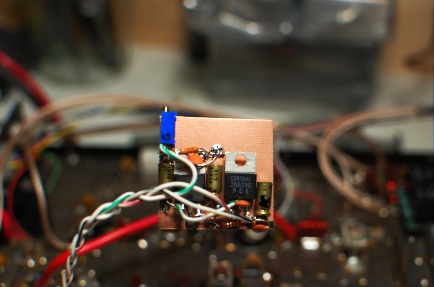
After chatting with Terry, W8ZN, about whether to keep or sell the AM-6155s (which I did sell to finance a tower), he suggested that I apply the N1DPM “Active Bias” modification to my elderly “160-watt” Mirage 2-meter amplifier. I contacted Fred, N1DPM, and he sent me a copy of his paper Linearization of Solid State “Brick” Amplifiers from the 21st Eastern VHF/UHF Conference (1995), along with some additional notes from his notebook. It’s pretty eye-opening how non-linear the amp is without the modification! I finally gathered the parts and hacked it together last night. Hope to test it soon with a “dummy” transistor and then live on the amp. The braided wires go to the thermal compensation transistor which is thermally bonded to one of the RF power transistors.
It probably won’t be ready for the ARRL June VHF this weekend, though. So, I’ll only be using the amp on CW. That’s no matter since I haven’t hung the low-loss cable (LMR and Heliax), nor have I received a D1010 432-MHz amp that will be on its way to me soon. Everything seems to take longer than it ought to!
RYRYRY O RLY?
A few readers of this blog may have been surprised to contact me on a new mode last night…RTTY. I’ve tried radioteletype once before in the past (also in the NAQP contest) but rather unsuccessfully the first time. The second outing was a bit better. I suppose with practice it becomes fun, but the primary motivation here is ARRL’s Triple Play award for contacting all 50 states each three times, using CW, SSB, and digital. CW was, of course, easy. And, I’m making good progress on the SSB totals. So, I figured I would stop putting RTTY off and give it a shot.
As you are probably well familiar, I normally contest with two TS-930s. Their prior owners (who were CW contest/DX types like myself) made various “improvements” to them, most of which I appreciate, but I have no idea how they affect FSK. One radio simply does not work on FSK (need to look into this) and the other has the passband shifted about 50-100 Hz off-center of the normal RTTY frequencies. So, when I was running AFC in MMTTY, it would “walk” to the point that having a lock on the other station would put me at the edge of their passband. I had a terrible time making QSOs for the first hour until K0TI told me I was off-frequency (thanks, Dan!!!) and then I started paying attention to all of the numbers in MMTTY and turned off the AFC, which had some deleterious effects that I overcame thanks to the occasional repeat. Typical analog op becomes digital lid op.
I sent the MacBook (our “home” computer) with Sarah to a conference yesterday. Since that’s the only place I have LoTW’s Trusted QSL installed and I failed to export a .p12 file, I’ll have to hold tight for a couple of days until they return. (This is not entirely true, I have an old .p12 file, but I haven’t backed it up again since I renewed the certificate a few weeks ago. Bad backup practices…although I just got a new external drive so the old drive can be used to do a Time Machine back up…finally. Another day, another project.)
This post mostly mirrors my 3830 post, but here are the numbers for the curious. My grepping missed one QSO on 80 meters when I did the totals (N1MM rounded the frequency up to 3600 kHz) for 3830. So, these numbers are right, aside from log-checking discounts:
Call: K8GU
Operator(s): K8GU
Station: K8GU

Class: Single Op LP
QTH: MD
Operating Time (hrs): ~3

Summary:
 Band  QSOs  Mults
-------------------
   80:   37    21
   40:   58    27
   20:   35    18
   15:
   10:
-------------------
Total:  130    66  Total Score = 8,580

Club: Potomac Valley Radio Club

Team: PVRC #1
NA Sprints, ARRL DX, and other notes
February, like November, is a busy month for contesting: the CW edition of the NA Sprint leads off the month (along with the Minnesota QSO Party), followed by the phone edition of the NA Sprint the second weekend, and of course, the ARRL DX CW contest on the third weekend.
In short…
NA Sprint CW SO-LP: claimed 162 x 38 = 6156, preliminary 158 x 38 = 6004. Four busted QSOs is actually better than I felt at the end. So, that is good. Still not happy with the numbers, though.
NA Sprint Phone SO-LP: claimed 28 x 16 = 448 in 1 hour operating time. As KE3X told me, his NS score was higher that week! The phone Sprint is more fun from a bigger station, but really suffers from lack of participation.
ARRL DX SOAB-LP: claimed 544 x 243 = 396,576 in 14 hours. This should have been a bit better, but I got sucked into trying to make myself heard in EU on 160 before their sunrise. Killed almost 60 minutes on 15 QSOs there. Also only operated about 1-2 hours during prime EU time on each of Sat/Sun morning. Efforts at getting a run started were a complete failure. Need. More. Firepower. I was very pleased to work ZM1A on 10 meters, though.
Other notes…
After 17ish years of amateur radio, I finally installed my first 30-meter antenna—a dipole at 35ish feet. First QSO was ST2AR, so I guess it’s working alright.
A box full of goodies arrived from Down East Microwave this week and I started working on buttoning up the 1296-MHz W1GHZ transverter. Massive thanks to Ben, N3UM, who lives nearby for sharing his construction notes with me. Not too far along other than punching and tapping a few holes in a diecast box. The DEMI box also included a couple of LNA boards that I hope to tune up for 432.
High winds (90 km/h gusts, according the forecast) from Friday night through Saturday night did not manage to topple my FO12 and A50-3S from their perch on the chimney. I haven’t checked the rotator to see if they still turn, though. This antenna situation needs to change eventually.
Finally, I also managed to score about 250 feet of RG-213 and 10 feet of LMR-600 from a dumpster-diving excursion. The LMR will make nice jumpers from the 903 and 1296 transverters to their respective antennas and I can use the RG-213 to replace the RG-8X on some of my HF antennas.
Recent tinkerings (9 Jan 2011 edition)
Several people have commented over the years that I should “write more” on the blog. I usually respond that I could spend my free time tinkering/hamming or blogging, but not both. Here are a month’s worth of blog posts as freestyle poetry:
- A section on my workshop has been added to k8gu.com under Engineering.
- Discovered that although the SoftRock VHF Ensemble II won’t fit (barely) into the Bud CU-473 diecast box I bought for it, it will fit into an extruded enclosure that housed an ancient X-band radar detector I picked up at Dayton in 2002 in hopes of stripping the Gunn diode assembly and getting on 10 GHz. Bonus points for thriftiness. Photos will follow once I finish the project.
- Did not observe Quadrantid meteor pings with the SoftRock VHF Ensemble II, but did notice something interesting about the W3APL beacon. Need to investigate.
- Have more CE/K8GU QSL cards again, finally. Tonight, I might finish the bureau (and, ashamedly one direct) cards languishing. Some K8GU (and AA8UP, no kidding) bureau cards are sitting here staring at me, too. Not a big project, though.
- Operated the NAQP CW on Saturday (8 January 2011) for four hours and twenty minutes and made 318 QSOs x 128 multipliers for 40,740 points before log-checking discounts. This total is pleasing to me especially considering that it was almost all leap-frogging SO2R search-and-pounce, which can be very fatiguing. It’s fun to see the rate meter stay over 100 when you’re S&Ping. Good Sprint practice.
- Still the best 30 minutes on the radio every week: I operated the NS Ladder on Thursday (6 January) night and made my customary 30 QSOs x 24 multipliers for 720 points. Hopefully, adding 160 will give me some momentum to increase this score back over 1000.
- We had a spell of 50F (10C) weather on New Years’ Eve. So, I put the 2-meter beam back up on the chimney. It was formerly mounted on a steel mast that was ratchet-strapped to the chimney. A strong wind (>50 mph gusts) before Christmas bent the mast (actually a fence top-rail) and I had removed it. I cut the bent lower portion of the mast off and attached the remaining top portion with rotator to a “girder” constructed from two pieces of treated 2″ x 4″ x 10′ lumber joined with a half-dozen lag screws. Again, I ratchet-strapped the entire assembly to the chimney. The present configuration is much stronger and less prone to damage. The 3-element 50-MHz Yagi is still on the ground until I actually get the transverter finished, which should be soon (as it has been for 12 months now).
- Repaired a SoftRock v6.2 downconverter for WF1L and learned that you can solder leads back onto SOIC packages if you’re careful.
- Have had delightful exchanges with KN6X and ZL1CDP about repairing the TS-930S. Some of these discussions (and their fruits) may make it onto the site at some point.
- Back in December, I started integrating the W1GHZ transverters using UT-141 semirigid jumpers with pre-installed SMA connectors obtained on attractive terms from Max-Gain Systems. Mitsubishi RA18H1213G (1296 MHz) and RA30H0608M (50 MHz) modules arrived from RF Parts. May have a lead on something less expensive with more gain for 903 MHz via HA1AG. The big remaining tasks in all three transverter projects are the sequencer and IF interfacing.
- Also in December, I had dinner with NS Ladder father Bill, N6ZFO, in San Francisco at the Hyde Street Seafood House & Raw Bar, which is a favorite of NA Sprint father, Rusty, W6OAT. Yes, I did feel that I was in the presence of greatness. (I had their excellent pork chops since I’m not into seafood, especially raw seafood.) Like most contesters, Bill’s a super, fascinating guy apart from his radio contesting interests.
CW Sweepstakes 2010
(Image credit: via contesting.com)
After missing the two contests that I hoped would kick off my contest season, ARRL Sweepstakes was next on the list. I managed a decent showing that would have won the MDC certificate for A-power last year, provided the log-checkers don’t take too much.
Highlights (“Wins,” as we like to say on #wwyc):
- 80 meters was awesome. Good conditions and the K9AY helped me keep the noise under control.
- Everything worked for the most part and everything still works after the contest is over.
- SO2R CW with TRLog.
- Working lots of old friends from my time in MRRC, MWA, and SMC.
- Working lots of new friends from PVRC.
- Getting my receiver crushed on all bands when I tuned across W4EE who lives less than a mile away.
Lowlights (Fails):
- RFI to the CO detector waking Sarah up in the middle of the night. KA9FOX and AA9DY have had this problem.
- Not spending enough time on 15 meters and missing VY0JA and VY1EI there. Missed the sweep by 1.
- Not being able to answer people responding to my main radio CQ while working someone on the second radio. This only happened about five times. But, one of these was my Bureau sorter! Sorry!
- Getting confused for K1GU a few times.
Here are the numbers…thanks to all for the QSOs. See you again in two weeks on phone with a different callsign.
ARRL Sweepstakes Contest, CW

Call: K8GU
Operator(s): K8GU
Station: K8GU

Class: Single Op LP
QTH: MDC
Operating Time (hrs): 17
Radios: SO2R

Summary:
 Band  QSOs
------------
  160:
   80:  367
   40:  243
   20:  100
   15:    0
   10:
------------
Total:  710  Sections = 79  Total Score = 111,548

Club: Potomac Valley Radio Club
Taking part
On Saturday I blew the dust (literally!) off my K3’s microphone. After I had finished sneezing, I started making some contacts in the CQ WorldWide SSB DX Contest.
This was not intended to be a serious competitive effort. My intention was to spend all of the time I could spare that weekend making contest contacts and see how many stations I could work. I spent about an hour on Saturday morning before going with Olga to the garden centre, and a couple of hours in the afternoon. On Sunday I was up earlier than normal because the clocks went back overnight, so I operated for about three hours in the morning before lunch. I had intended to do some operating in the afternoon as well but the three hours in the morning had left me feeling a bit tired and stiff so I went for a walk after lunch and then fell asleep on my return home. Getting old is my excuse!
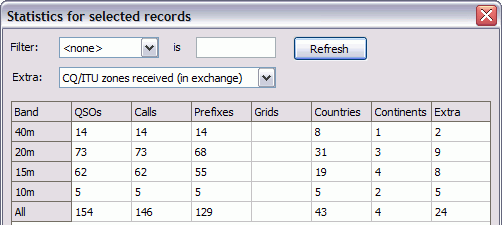
I made a total of 154 contacts in 43 different countries and 4 continents during my six hours or so of operating. The detailed breakdown, for those interested, is shown in the screen grab of the contest statistics dialog from KComm (the Extra field shows the number of CQ zones.) This would give me a claimed score of 17,487 points if my calculations are correct, which by comparison with last year’s results would place me well down the second half of the All Band Single Operator Low Power Unassisted results table.
This was the first time I had made such an effort for an SSB contest. Until now I hated turning on the radio during big SSB contests because the bands sounded like bedlam. But I had never tried with the K3 before. Instead of a mush of intermod, splatter and AGC pumping I could hear everything clearly. Sometimes I could hear two or three stations on the same frequency simultaneously, one in the foreground and a couple in the background. And the superb DSP filtering made it easy to shut out close-by stations so I could copy a weaker one. I often had the passband down to 1.8kHz and copy was still crystal clear.
Initially I started off just working the loud ones because I didn’t want to waste the serious contesters’ time by making them struggle to hear my call. But I found there was no hard and fast rule relating how strong a station was with whether they heard me. One Finnish station, 10dB over 9 with me, just kept on calling as if I wasn’t there. But many weaker ones came right back to my first call.
Frustratingly, a significant number of stations came back to me as “Golf 4 Lima India Oscar” – exactly the same error that was made when I ordered my QRSS beacon kit a couple of weeks ago. What is it about my call? This doesn’t happen on CW (though I used to get replied to as G3ILO very often as the holder of that call is a well known QRP CW operator.)
Conditions didn’t appear to be very good this weekend. I’d hoped to hear some interesting DX on 10m but I heard hardly anyone at all on the band. As always, 20m was the liveliest band, but I made almost as many contacts on 15m, probably because the QRM was less making it easier to make contacts.
I didn’t work any DX and I only worked one all time new DXCC entity – Svalbard, JW5E. I did hear a VK on 15m on Sunday morning but he had a big pileup going and after trying for about five minutes I decided not to waste any more time and move on.
Despite my unspectacular results I thoroughly enjoyed my few hours in the CQ WW DX SSB contest. No doubt QRZ.com and other online forums will be full of grumbles about contests taking over the band for the entire weekend, the only time working people can get on the air etc etc. But if you can’t beat them, why not join them?
My feeling is that contesting is one of the many different activities you can pursue and to get the most from the hobby you should try as many of those different activities as you can. As this post has hopefully shown, having indoor antennas is no obstacle to working a decent number of stations and earning a respectable score for the time spent. It’s not the winning, it’s the taking part that counts. I certainly felt like a real participant in this radiosport event and I look forward to seeing my call in the results table next year.

Undecodable mode alert
If you’re operating the PSK digimode on the weekend of 18th-19th September and suddenly find your screen full of PSK63 signals that you can’t decode, don’t be worried that there is something wrong with your radio or your computer. You are hearing the 7th CIS DX QPSK63 Contest 2010. Yes, it’s QPSK63, that mode you’ve seen on your menu and never been able to get a reply to when you tried it. If you were ever frustrated by this, now’s your chance to get satisfaction!
Starting at 1200UTC on the Saturday and continuing until 1200UTC the following day, the object is to make as many contacts as possible using QPSK63 (and only QPSK63) between stations in the Commonwealth of Independent States (known to many of us as the Former Soviet Union) and stations who are somewhere else. For more information see the contest website.
If you prefer SSB to digimodes, look for the upcoming 1st DX Esperanto Contest. It’s a contest for phone operators, where all the contacts must be made using Esperanto.














