Posts Tagged ‘Contesting’
 NCJ: What’s the Best Contest Rig?
 March 9th, 2010 |
  Author:
 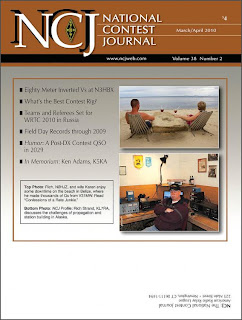 The March/April 2010 National Contest Journal arrived yesterday, torn and tattered as always (thanks again, US Postal Service!), and with it the results of K3MD’s informal poll of top contesters asking, “What’s the best contest rig?” It’s by no means a scientific survey, nor all-inclusive, but many of the Big Guns you’d expect participated.
NAQP RTTY – Feb 2010

- QSOs: 160
- US States: 35
- VE Provinces: 5
- Total Mults: 71
- Score: 11,360 pts.
- 15m: 34 QSOs, 10 states, 2 provinces
- 20m: 42 QSOs, 22 states, 2 provinces
- 40m: 84 QSOs, 30 states, 5 provinces
BARTG Sprint 2010
Spent a few hours Saturday handing out QSO points on 20 and 40. No new ones for me, and I had a hard time working DX. Some weirdness with the K3 (see next post) has me scratching my increasingly balding head…
- QSOs: 65
- US States: 35
- VE Provinces: 3
- Total Mults: 23
- Total Continents: 3
- Score: 4,485 pts.
- 20m: 40 QSOs, 18 states, 4 provinces, 5 DX
- 40m: 25 QSOs, 15 states, 5 DX
NAQP SSB – Jan 2010
- QSOs: 154
- US States: 37
- VE Provinces: 3
- Total Mults: 84
- Score: 12,936 pts.
- 15m: 4 QSOs, 3 states
- 20m: 46 QSOs, 23 states, 3 provinces
- 40m: 64 QSOs, 30 states
- 80m: 40 QSOs, 25 states
PSKFest 2010
- QSOs: 82
- US States: 32
- Can. Prov.: 2
- DXCC: 9
- Score: 3526
RTTY Roundup 2010
 First contest of the year for me but was only able to put in 7 about hours on 40m (0244-0952 UTC) and logged 103 QSOs.
My first 160m contest
If you asked me a couple of years ago whether I’d ever participate in a contest on 160 meters I’m sure I would have said no. If you’d asked me two weeks ago, I would have said no. In fact, I did say no, answering the weekly ARRL website survey. It turns out that I was mistaken.
The main reason why I never expected to participate in a contest on 160m is because I really don’t use the 160m band very much. The two reasons why I tend to stay away are because I don’t really have a very good antenna for that band, and because the relatively few times that I’ve been on it’s always been horribly noisy (mostly from atmospheric noise, though perhaps there’s some man-made electronic noise there as well.) The reason for the lack of a decent antenna is that antennas for that band tend to be very, very long. As a reminder, 160 meters is about 525 feet. Although you don’t need an antenna that long to transmit on the band, what I do have in place (my G5RV antenna) is really too short to operate properly on that band. I can use the antenna tuner in my radio to cause the radio to think that the antenna is suitable for use on that band, but in reality there’s a lot of loss and my signal just isn’t very strong. Despite the relatively short antenna length, I do manage to pick up an awful lot of noise.
160m is primarily a nighttime band. Although you can make groundwave (those that don’t bounce off the ionosphere) contacts during the day, the band is even noiser during the day and it’s just not practical to try to make a lot of contacts. (That’s not to say that the hardcore contesters aren’t out there trying.) The fact that it’s a late-night band worked to my benefit, since I’m a nightowl.
The 160m contest starts at 5PM local time on a Friday and ends at 11AM local Sunday morning. I was chatting with my friend Larry, N4VA Friday afternoon, and he suggested that I try to make a few contacts in the contest. I was going to be home anyway (my son was recovering from a minor surgical procedure) so I figured that I’d at least listen and see if I could hear anything other than static.
By the time I started to listen, it was around 5:30PM local time, which is after dark at this time of the year and 30 minutes past the contest starting time. I was surprised to hear that not only were there a lot of strong signals, but where nobody was transmiting, the band was actually relatively quiet. I figured that I’d see if I could get the antenna to tune and maybe make a few contacts, “giving out points” to others in the contest.
I was surprised that for the first hour, I made around 20 contacts (and that includes a break for dinner; as I mentioned, I wasn’t really expecting to spend a lot of time in the contest.) What was even more surprising was that for the 4th hour of the contest, I was up to 33 contacts for that hour and 30 the next hour. (All those contacts were “search & pounce”, I wasn’t going to attempt to run stations.) While this isn’t “super-station rate”, those 63 contacts are 3 more contacts than I’d made in total on the 160m band prior to the contest. I continued to operate for a while, taking a few breaks and turned in relatively early Friday night. (I’d been up since 6:30 AM for my son’s procedure).
Late Saturday afternoon, I made another handful of contacts, and then, after we came back from dinner with friends, I got back on the air at 1AM (now Sunday morning) and picked up another 17 stations in that hour. At that point, tuning up and down the band all I was hearing for the most part were stations that I’d already worked, which meant it was tough to find “fresh meat” to work. I figured that I’d try to find a frequency to “run” stations, which means that instead of me trying to find stations who are calling CQ, I’d find a frequency and call CQ myself.
If you’re not a contester yourself, I should explain that in most contests, it’s generally the “big guns” (more powerful stations) that “run” other stations. For one thing, it’s generally easier to hear their signals, and for another, it’s a lot tougher for another station to just jump on top of them and start CQing, “stealing” their frequency. Having your frequency “stolen” is unethical and could theoretically be illegal. For US hams, the FCC says that you cannot intentionally interfere with another station, but in a contest, it’s very difficult to prove (especially for a weak station) since when a stronger station “takes over” your frequency they can simply say they never heard you. That might or might not be true, but it’s hard to prove. The simple thing to do, for a “little pistol” station like me, is to simply move elsewhere.
Fortunately me for me, for the 2AM (local time) hour, I was lucky enough to get a frequency pretty low in the band (1808 mHz) and actually keep that frequency for over an hour. (Lower in the frequency is better, usually, since other operators who get on the band to make a few contacts typically start at the lower end of the band and work their way up.) Remember that his is now 2AM local, and most of the stations that I was working were relatively local, within a timezone or two of me. While I didn’t set any rate records, over the next hour I worked almost 30 stations, which was just for me a lot of fun. I probably could have kept going, but at about 3:15 AM I decided that I’d had enough fun and shut down the radio.
Overall, I wound up working 251 stations (plus 2 “dupes” who I’d previously worked but who called me when I was “running”). Most of the stations that I worked were in the US or Canada, but I did work stations in Jamaica (6Y), the Bahamas (C6), Netherlands Anitilles (PJ), Turks and Caico (VP6) and possibly (the contact was a little “iffy”, hopefully I am in his log) Martinique (FM). In total, I worked stations in 43 ARRL or RAC sections pluss the 5 other countries), which I thought was pretty respectable.
My final claimed score looks like this:
    Band    QSOs    Pts  Sec
    1.8     251     517   48

   Score : 24,816
I don’t think I’m going to win any awards, but I’ve very pleased with my results. And, as I’ve said in the past, the most important thing is that I had a lot of fun.














