Posts Tagged ‘Contesting’
 One on one with the PC………
 December 7th, 2011 |
  Author:
was able to multi-task during the contest between two computers using two nice LCD monitors. The next day after the contest the net-book was snuggled in it's case and it was time to use
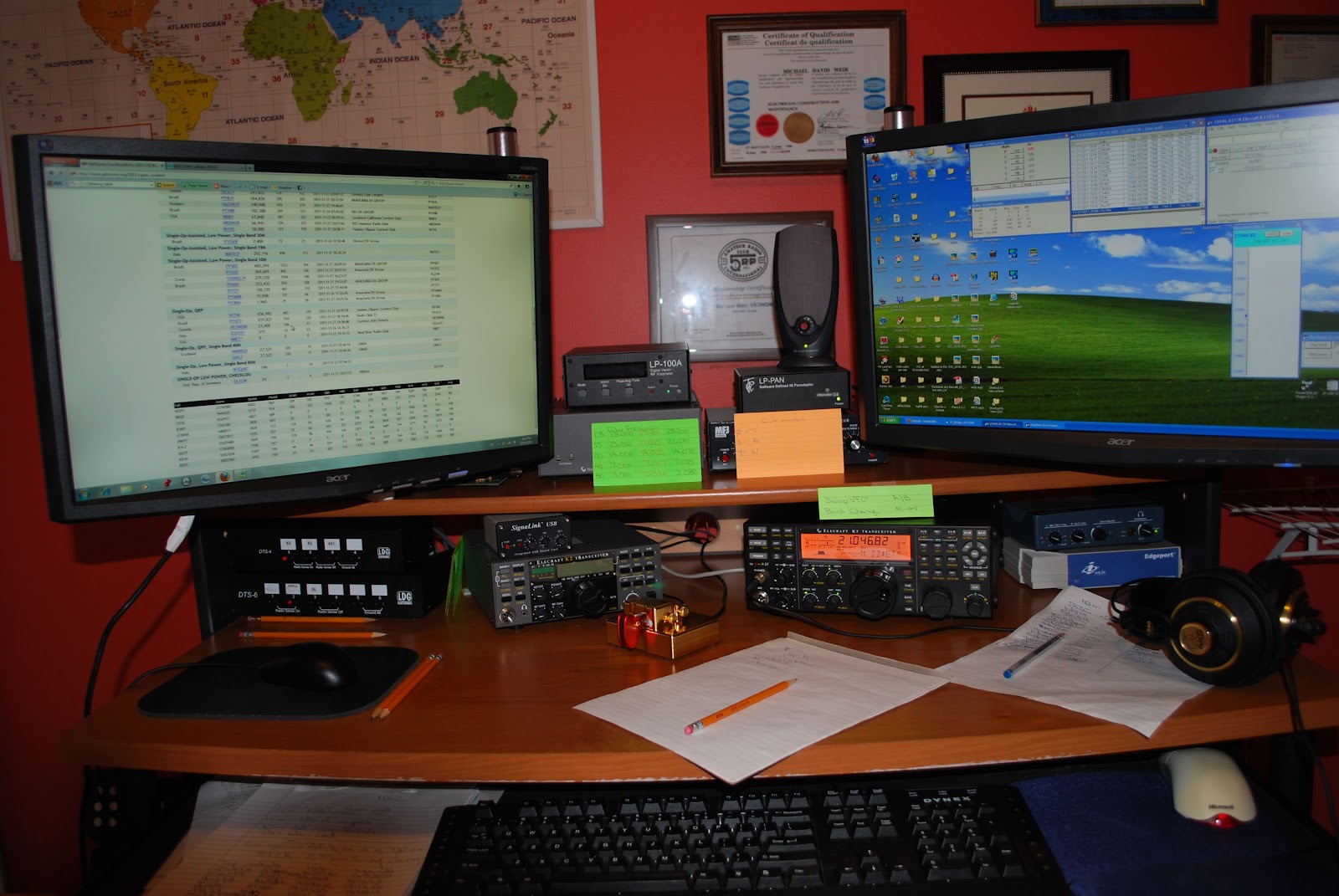 |
| During the contest with both monitors |
both LCD monitors on the main PC as it always had been done....As the PC booted up the one monitor display read "not connected". I then preceded to connect reconnect and change out the video cables but nothing had worked. I was still getting the "not connected" message floating around. I then in WinXP had a look at my video card. Maybe I just had to tell the PC to recognize the other monitor again. In the process of trying a dual monitor setting I did not read the warning that was counting down from 15 seconds. I just said "ok". Well now both monitors were blank with the message "not connected" Well that went well!!! It was off to Google to solve my troubles. Seems the net-book could had changed the monitor refresh rate and or resolution settings. Settings the main PC was not able to recognize and thus the message "not connected". According the the advice derived from Google searches I have to boot in VGA only mode. It was simple, I was told "wait for the Windows logo to appear and press F8". Easy if both monitors were not blank!!! So began the many restarts guessing when to press F8. Well in time I was successful and was able to get into VGA mode and repair both monitors. All is working well now and lesson learned. It turns out the net-book changed both the refresh rate and the resolution.

CQWW CW at 500mW’s
|
| Contest time |
1. Relax and have fun contacting hams all over the world.
2. Run most if not all the contest QRPp at 500mW's.
3. As I finish a contact check out the ham on QRZ.COM and learn about them and their station as I cruz for another contact.
4. Beat my miles per watt record of 8325 miles per watt.
5. Try to beat the 300 contact wall.........never stood a chance as I was doing to much of goal number 1 and 3!!!
contact Miles Miles per watt (.5 watts) Kilo's
1. ZS4TX 8368 16737.20 26935.91
2. EM2T 4742 9484 15263.91
3. 4O3RR 4695.2 9390.32 15112.26
4. IR8C 4568 9137.34 14705.12
5. HG1S 4415 8831.18 14212.41
6. 9A1P 4360.22 8721.85 14036.46
7. S50K 4358.0 8717.05 14028.74
8. IR8C 4290.22 8580.43 13808.86
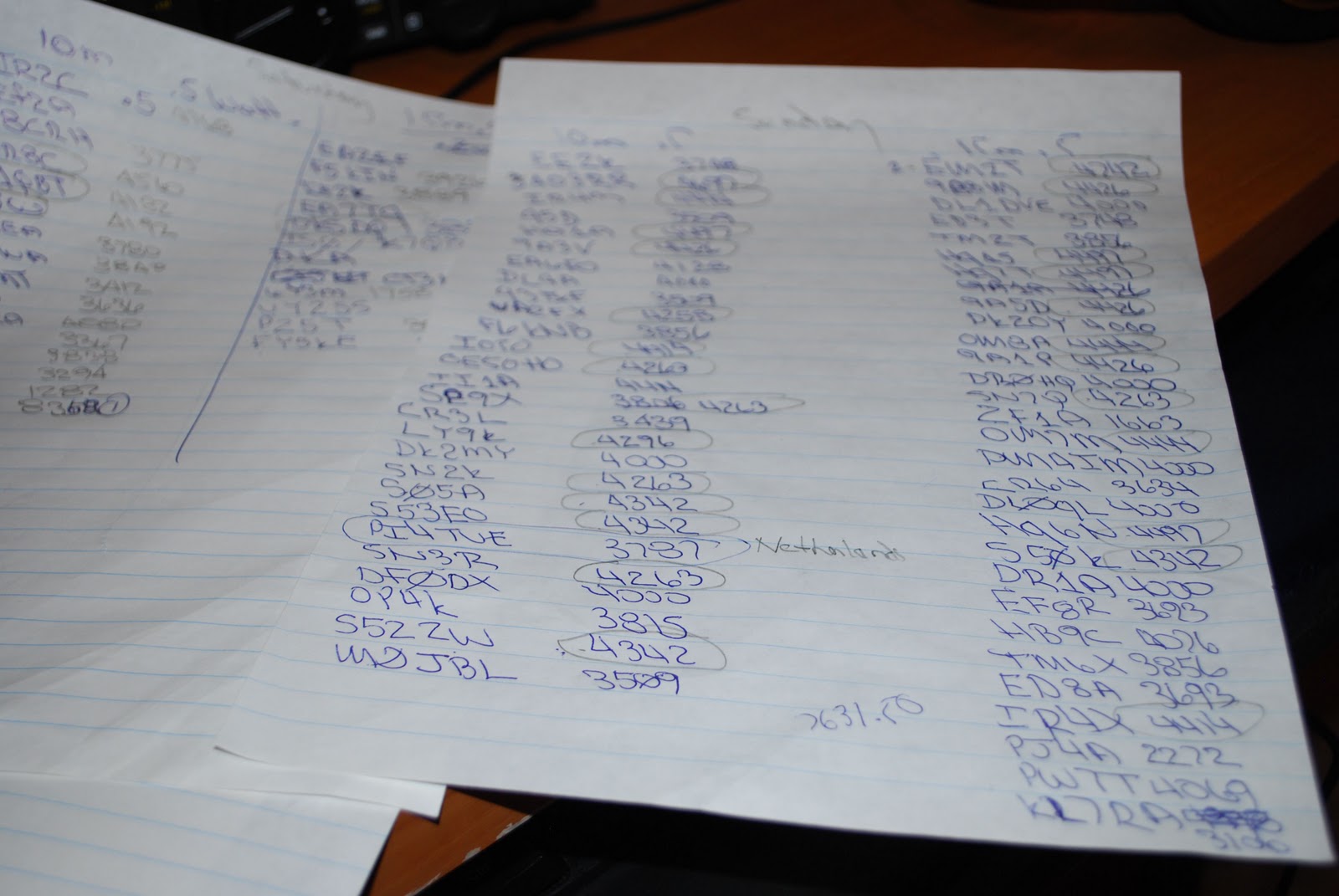 |
| Keeping track of mileage |
Over all I made 106 contacts out of that 84 contacts were made with 500mW's 21 with 5 watts and one contact on 40 meters with 50 watts. It seems that on 40m I just was not cutting it and to make a contact I had to raise the power to 50 watts. So that was the last contact on 40 meters. As for beating records I was thrilled to contact ZS4TX which got me 16737.20 miles per watt!!!!! Not only that in this contest I was able to make 30 contacts that topped my 8325 watt per mile record. Now running 500mW's did bring my QSO count down as there was lots of repeats I had to do. I just want to thank the op's out there who stuck with me and asked over and over again for my call instead of just moving on.
Earlier I did say that I was never going to win a contest but in closing I have said this before in the blog..............there should be a QRPp category. There is QRP but running 5 watts is different from pumping out Milli-watts. Well change does take time and maybe in time there will be a spot just for QRPp.

Post-Thanksgiving Leftovers
As most folks know, we had the Thanksgiving holiday here in the US last week. It’s a tradition to not only eat turkey with “all the fixin’s” but also have have some leftovers for a few days after that. I’ve got the same for my blog mostly with respect to things that were still around after Thanksgiving. So, in no particular order:
I did my usual “playing around” in the big CQ World Wide DX contest this past weekend. This is one of the “main events” in the ham radio contesting world, and while I didn’t really have time for more than just a few hours of making contacts, I did note a few interesting/amusing/annoying things. In this contest, you get points for working stations in other countries (not your own) with what’s called a “multiplier” based on the country and something called a zone. (The term “DX” refers to a station from another country.) Without going into too much detail, it’s relevant to know that there are 3 zones within the US. Your score is calculated by multiplying your points (number of contacts with stations outside your country) by the zone and country multipliers. You are allowed to work stations in your own country for the multiplier value, you just get zero points for doing so. It’s important to note that while you can get the 3 zone multipliers that are available for the US by working stations in Canada, if you want the country multiplier credit for working the US you must work a station in the US. Since it’s a zero-point contact, what I try to do is to find a US station that’s not busy and work them, since I don’t want to take them away from working their DX. Most operators understand this and have no problem with it, but on at least one occasion I called a US station who was CQing (repeatedly) with no responses only to have him respond “SRI ONLY DX”. In other words, he was telling me that he would not make a contact with me.
As noted, I only work US stations when they aren’t busy which was the case here. A complete contact with both stations exchanging information during a CW contest (which this was) takes around 20 seconds or less. So instead of helping me out by just completing the contact, he probably saved maybe 10 seconds by sending that other information. So much for good sportsmanship. (For what it’s worth, I noted his call and will avoid making contact with that station in the future, even in contests where non-DX contacts “count”.)
Also during the contest, I was working stations on 20 meters just calling stations and tuning up the band to find the next station. It’s not unusual, while doing this, to have another station that is doing the same as you are, and depending on what band you are on and the propagation conditions, you’ll sometimes be able to hear the other station. Sometimes, you wind up moving with that other station (sometimes more than one) and working the next station up the band either just before or just after that station repeatedly. Normally this isn’t a big deal, but I got stuck behind the equivalent of tractor-trailer truck on small road doing 20mph below the speed limit:
There was a station that would usually call the DX station before me and work him first. No problem. However, unlike the normal orderly contact sequence (which for this contest is very simple: a signal report, normally 599, then your zone, which is 5 for me, meaning my half of the exchange is send in CW as “TU 5NN 5”, with “TU” meaning Thank You, acknowledging that I got the contact information from the other station) he’d send something like “TU 5NN 4 4 4 TU DE (his callsign) (his callsign) (his callsign) 73″. You might send your callsign if you think the DX station didn’t get it, but the accepted way of doing it is prior to the other information and only if you think the other station might not have gotten it correctly. What wound up happening is that the DX station (who is normally working stations very quickly; remember that I mentioned it normally takes 20 seconds or less to complete a full contact) would hear the “TU 5NN 4 4” then assume that the other guy was through sending and send his “TU QRZ?” (meaning he got your info and is moving on), only to realize the guy was still sending. In one case I heard the DX start to send his final sequence 3 times “TU … TU … TU” before the other guy finished.
The problem with doing this is that you slow everyone down, and while it’s not against the rules to do this, it’s another example of poor sportsmanship. The station doing this had to know that he was slowing everyone down. (And before everyone jumps on me, this was definitely not a new contester, so it wasn’t a case of “not knowing better”.) I’m not sure why he was doing this, but finally I just gave up and jumped far enough up the band so that he was no longer “in front of me” anymore. (In fact, I went way up the band and started tuning down, meaning that while I might cross paths once more, it would be in opposite directions.
I’ve got a few more leftovers to go, but I think I’ll just put them back in the ‘fridge for next time.
Update on CQ WW CW contest
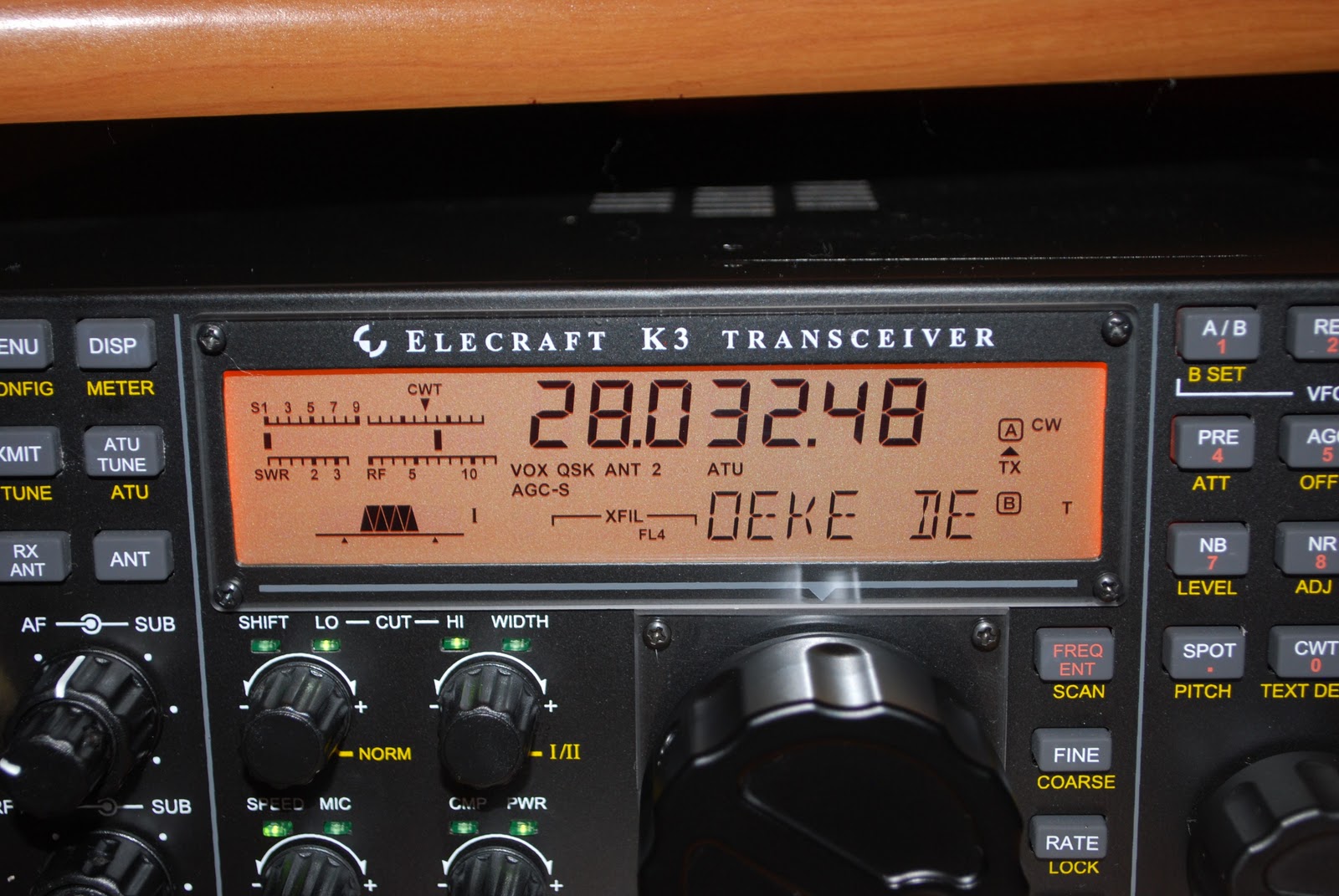 |
| The Elecraft K3 in action |

Another CW contest in the books…….

2011 ARRL DX CW Contest
This past weekend was the ARRL DX CW Contest, one of the biggest contests in all of radiosport. The object of this contest is for stations in the US and Canada to contact stations anywhere else. (In this particular contest, there is no credit for US & Canadian stations to work either country). Contestants may use 6 different bands, 10m, 15m, 20m, 40m, 80m, and 160m. As you might have guessed from the name, this is a CW (morse code) only contest. I’ve done this contest a few times in the past years, and as I’ve become more comfortable with using CW, I’ve participated more. The band conditions for this year looked to be pretty good, with the sun finally starting to wake up from the very long trough between solar cycles 23 and 24. The solar flux remained over 100 for the entire contest, and the sunspot number was over 100 as well for a time, then dropped back to around 79. (This will all be gibberish for non-hams, but for contesters and DXers, this is great news.) I figured that I’d try to spend a reasonable amount of time operating this year, and I wound up spending 17 hours (out of the 48 possible) in front of the radio.
I usually try to set some kind of goal to keep me going, though as I’ve admitted in the past, I tend to do it on the fly; I’ll see where I am at some given point and decide “ok, I can make another 30 contacts before turning in for the night” or “I think I can beat last year’s score”. I really did a lot of “on-the-fly” this year, though I decided after about 3 or 4 hours of operating that I wanted to be sure to beat my score from last year. Last year I wound up with a score of around 160,000 points after deductions for errors, and based on the early going I figured I’d be able to beat that. Not only did I beat it, but I actually doubled it (before error deductions, of course).
Band  QSOs  Mults
-------------------
  160:    5     5
   80:   53    36
   40:  189    67
   20:  172    68
   15:   81    47
   10:   25    19
-------------------
Total:  525   242  Total Score = 381,150
I should note that this year I entered in the new Single Operator All-Band Assisted Low Power Category (previously any assistance required you to be considered High Power), so comparing this to last year might not be 100% accurate, but I’m still pleased with my showing. I used the packet clusters to help find DX for me, and using the N1MM contesting program, I could easily move from station to station with a couple of keystrokes (or mouse clicks). There was enough activity and the band conditions were good enough that I didn’t have to tune for stations which, while perhaps a bit more “pure” (to some) in terms of the contest, dramatically slows things down in a busy contest like this, where I have to find a station, listen to get a callsign and then decide if I need to work that station. (I should say that I always use the packet cluster spots as a guide, since they are notorious for incorrectly identifying stations. If you log the wrong station callsign, it’s not only bad for you but also for the station that you contacted.)
The nice thing about the good band conditions were that for the most part, once I could hear a station I had little trouble working them. For some of the big stations that attract a lot of callers, it could be difficult, but I’ve learned that those guys will be around for the whole contest and it’s easier to just move off and work someone else, then come back when things are quieter. This is in contrast to a year or two ago when conditions were so bad that even when the other station heard me, or heard “something”, it could take several tries until we were able to both get the correct information that makes up the contact. This time for the most part once the station started a contact with me, we were able to complete it relatively easily. The most significant exception to this was with one station (who I’ll put in here when I can figure out who it was ) who spent almost 4 minutes working with me late at night on 80m to complete the contact. (A normal contact takes anywhere from 15 to 30 seconds, tops.)
Although I didn’t work any “all-time” new countries, I did pick up a few new band-countries: PJ2, V4, XE, and OM on 160, EU on 80, and J5 on 10. (Interestingly, as I was writing this on Sunday evening, the J5, which is Guinea-Bissau, was spotted on 80m and I was able to work him there as well, post-contest.) I was a little surprised that I only worked 87 different countries given the number of overall contacts that I made, but part of that is accounted for by the fact that I worked many, many stations on 2, 3, 4, 5, and even 6 different bands. (I worked PJ2T and V48M on all six, and I believe that’s the first time I’ve ever worked any station on all six contest bands.)
I did have a small visit from Murphy of course: We’ve had a couple of very windy days here, and Sharon commented that she thought she hear my antenna (it’s actually where the ladder line connects to the coaxial feed line) hitting the roof. (That particular portion of the roof is over the room where the TV is.) Sunday morning I took a look outside and realize that my G5RV had dropped about 10 feet from where it should be, the result of the winds blowing. I have it connected via bungee cords in such a way that they’ll take up some slack, but after a while it will drop a bit from the constant “pulling”. Fortunately, it was easy to fix and just required a quick trip up the ladder to both ends of the antenna to pull it back up and things were back to normal.
So, now that I’ve completed this blog entry, that wraps up my post-contest activities, having submitted my log to the ARRL, uploaded my contacts to Logbook of the World, eqsl, and Clublog, and submitted my score to the 3830 contesting reflector.

LHS Episode #053: Windows in the Ham Shack?
 Hello, everyone. We're coming to the end of another year and the world is aglow with holiday spirit. With that in mind, we bring you the second-to-last episode of Linux in the Ham Shack for 2010. We will have one more recording and release before the end of the year, so don't miss out on our holiday extravaganza.
We no longer broadcast video via Ustream, but we do have a live audio feed. Just point your streaming audio player at http://stream.lhspodcast.info:8008/lhslive starting about 30 minutes prior to air time (8:15pm CT). You can join in the chat room scene as well with your favorite IRC client. We are at irc.freenode.net in channel #lhspodcast. The channel is available 24/7, even when we're not doing a live show. Join in when you can and chat with other LHS listeners. During the live show, #lhspodcast becomes our chat room and our live connection with YOU.
Cheers and 73 from the LHS Guys













