Posts Tagged ‘assistive technology’
 September 19th, 2012 |
  Author:
  Handiham World for 25 July 2012
Welcome to Handiham World.
Troubleshooting 101
Here is an interesting little problem that showed up in my own ham shack just a few weeks ago. It’s funny how we can run into things that seem not quite right but then sort of just shrug them off and say, “Oh, well.”
The problem showed up when I was using my shack’s two meter rig, which is powered by a switching power supply. It’s the one that’s typically used for the Handiham net each day. I’m located some distance from the N0BVE repeater system. (It’s in the western part of the Twin Cities Metro while I am in the east.) That means my reception of the N0BVE signal is not exactly perfect. I can hear an annoying hiss in the background when the repeater is active, but that’s easily eliminated with a flip of the switch on my external ClearSpeech speaker. This handy device has almost magical properties – really a very smart algorithm – that digitally cleans up the signal, virtually eliminating the noise. I don’t like to leave it turned on all the time because I also enjoy listening to Minnesota Public Radio with the extended receive feature of the transceiver, and MPR has enough signal to be rock-solid perfect. It sounds best with the external ClearSpeech speaker’s processing turned off.
One day I encountered an interesting problem. I had been listening to MPR when I last used the radio, and when I turned it on, that’s the station I heard. Since I wanted to monitor the repeater instead, I flipped the memory to the stored two meter channel. Then, noticing that the ClearSpeech speaker was turned off, I slid its power switch to “on”. At that very moment, the radio went dead – no power. I pushed the power button on the radio and everything was back to normal. I put up with this for weeks before finally getting the gumption to track it down.
Can you guess what was going on?
Email me at [email protected] with your questions & comments.
Patrick Tice, WA0TDA
Handiham Manager
Handiham remote base station report
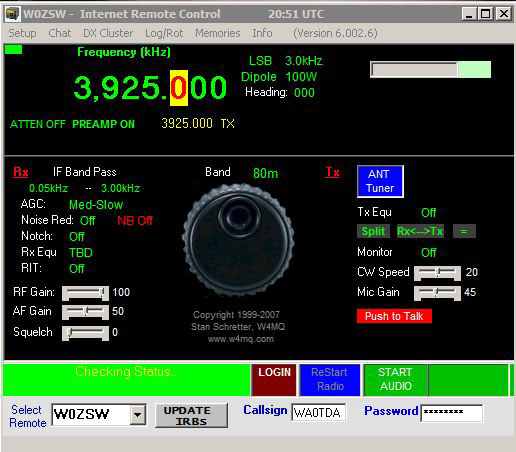
W0EQO at Courage North is in service and performing well. W0ZSW is off line due to internet connectivity issues that make it too unreliable to use. I hope to address this issue soon. Luckily, propagation has been excellent via W0EQO for PICONET, a regional HF 75 meter net on 3.925 MHz.
Handiham World for 04 July 2012
Welcome to Handiham World.
We wish our USA members a happy Independence Day, and our Canadian members a belated Canada Day.
High summer here in North America isn’t exactly the best time to explore the HF bands, given the constant parade of interference-generating thunderstorms marching across the continent. While bands like 160 and 75 meters may seem like wall-to-wall noise, there are always some intrepid operators sticking to their usual schedules. The best time on both bands is usually early morning before solar heating and convection starts cooking up more lightning and thunder and before absorption becomes too odious, a real problem for propagation as the sun climbs higher in the sky. Summer is the traditional sporadic-E skip time of year, so it doesn’t hurt to keep checking out the VHF bands. A clue is that you might hear repeater identifiers that you don’t recognize because they are far outside the usual repeater coverage area. If you hear stations on 10 meters, you might also check out the 6 meter band. You never know – perhaps there is an opening, and if you are trying to work all states, such openings can be pure gold.
Summer, especially post-Field Day, is often considered the least active time of the ham radio year. Radio clubs may shut down for a few months in the summer – usually June, July, and August – and resume operations in September. The conventional wisdom is that people are busy doing summer stuff like taking vacations, working in the yard, boating, fishing – you name it, ANYTHING but sitting inside at the radio! But summer weather might chase you indoors with its heat and humidity. Maybe it wouldn’t be a bad time to get on the air after all. Besides, summer is a good time to get antenna projects done. Let’s list some summer ham radio activities:
- Put up or repair your antenna system.
- Check out VHF propagation on 6 and 2 meters. Try SSB on both bands. Log your contacts and send us a brag about your farthest contact so that we can publish it and make you famous.
- Go bicycle mobile!
- Take ham radio on vacation with you, both as a mobile station in the family car and as a portable station.
- Check into the daily Handiham Echolink net. If you have a smart phone, try checking in via the Echolink app. (Android and iPhone)
- Try out the Handiham HF remote base stations. Say hello to the folks on the always-friendly PICONET on 3.925 MHz.
- Build a kit.
- Study for a license or upgrade.
- Try setting up your own EchoLink or IRLP node.
- Take your handheld radio with you on a walk and find out how many contacts you can make on local repeaters.
- Set a goal to work as many stations as possible on 10 meters. Log all your contacts.
- What?!! You don’t have a logging program? Install XMLog and learn to use it. http://www.xmlog.com (Yes, it is blind-friendly, and it’s free.)
- On the water? Take ham radio with you on the boat. Don’t drop the radio in the water.
- New to blind-accessible technology? Try downloading DAISY book software and reading a DAISY book with it. Make it a ham radio book from the Handiham website. (More on this in a minute.)
I could go on and on (maybe I already have), but you get the idea. Now let’s get out there and have some ham radio fun!
This is a reminder that the Handiham office is closed this week and open only with very limited services and hours next week.
Email me at [email protected] with your questions & comments.
Patrick Tice, WA0TDA
Handiham Manager
Storms sideline Handiham remote base stations:
Severe storms in northern Minnesota last night had disrupted internet service to W0EQO at Courage North. The station returned to service around 12:50 PM on 3 July 2012.
W0ZSW is still offline following storm damage and power outages that disrupted our internet and networking equipment at Camp Courage. It was the first time in the history of our double remote system that both stations have been offline at the same time due to storms. Due to limited staffing at this time, we are unable to resolve the problems quickly.
Solar Activity Forecast: Solar activity is expected to be moderate during the period (03 – 05 July) with M-class flares expected from Regions 1513 and 1515.
Geophysical Activity Forecast: Geomagnetic field activity is expected to remain at unsettled to active levels on day 1 (02 July) as CH HSS effects persist. Activity is expected to decrease to quiet to unsettled levels during days 2 – 3 (04 – 05 July) as CH HSS effects gradually subside. The CME associated with today’s M5/2b flare is not expected to disturb the field during the forecast period.
Handiham World for 27 June 2012
Welcome to Handiham World.
Net wrangler WA6DKS starts us out with a Field Day report:
A wonderful Field Day was had by all on the Handiham conference server on Saturday, June 23 and Sunday June 24, 2012 whether you were using Echolink, IRLP, ICQ, WIRES®, cell Phones, the internet, or plain old RF radios. During the two-day period, we had over 500 contacts which included over 12 countries and all 50 of the U.S. states.
The Handiham Field Day ran longer than the official ARRL event, but a good time was had by all whether it was net control operators, backups, check-ins, or just listeners.
Now, isn’t this what the ham radio hobby is all about? Contacts were made with stations from Azerbaijan to China, Nova Scotia to South Africa, and of course Canada and the United States. Wonderful discussions on many topics added to the fun during the two-day event. It was all about laughter, interaction, and fun times. A very special contact occurred with a station in the State of Florida that was “bicycle mobile” using one tenth of a watt of power! (Did I say QRP?!!)
Many of our Net Control Operators and Assistant Net control operators supported each other by recording all of the contacts with the names, callsigns and locations while at the same time making sure that the text box information was recorded during the day and the night. SouthCARS connected to Handiham Conference Server and the Van-IRLP throughout the two-day period after their own net sessions concluded.
This was our second Field Day, and the credit should be attributed to three individuals –Ken Schwartz (W6KHS), Pat Tice (WA0TDA), and Susi White (WA6DKS). The decision among these individuals was that there are lots of ham radio operators throughout the world who do not have an opportunity to attend an ARRL sanctioned Field Day. Therefore, an opportunity should be provided to those who would like to experience the event because (after all) there should never be a distinction made between “able-bodied” and people with challenges not being able to communicate.
All methods of communication were used so that we were assured of making as many state and country contacts by simply sending out e-mails, connecting to other conference servers through the internet, and having the help of Southcars and The Coffee Shop by using their e-mail membership lists and help in sending e-mails to those in that particular region and requesting contacts.
The Handiham organization wishes to thank everyone who participated in our successful 2012 Field Day event whether you were a net control operator, a backup, from Southcars, The Coffee Shop, The World, or any other conference we contacted . Without those of you helping in the background or even checking in, we could not have had a successful event without YOU. The success of the 2012 Handiham Field event is owed to each and every one who helped and we all look forward to next year.
Thank you to Susi, WA6DKS, for that report.
Email me at [email protected] with your questions & comments.
Patrick Tice, WA0TDA
Handiham Manager
Station Check at Camp Courage North
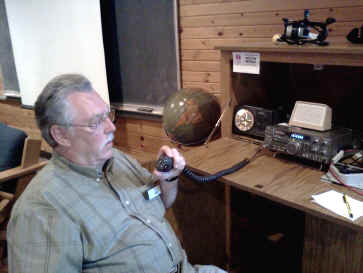
Bill, N0CIC, checks out the Kenwood TS-440 station that has been stored several years, since our last Courage North Radio Camp in late 2009. We were pleased to find that the rig worked perfectly and the G5RV and beam antennas were all operational. The rotator also worked and trees were still well clear of the antenna’s rotating radius. An Icom dual band FM rig did not work because of a faulty microphone, so that unit was packed up and brought back to the Twin Cities for assessment and possible repair by a volunteer. Bill and I (WA0TDA) opened the station at Courage North as part of a Veterans open house weekend. While there, I also gave remote base station W0EQO a once-over and found it to be in excellent condition. Our thanks to Bill for his help at Courage North. If you look carefully, on the top of the radio cabinet you will see Bill’s golf ball slingshot, used to launch antenna wires up into the trees. We didn’t have to use it, though.
Speaking of trees, several of you have asked if the tree we planted in memory of Dick Chrisman, AB7HW, is alive and well. Indeed it is, so here is a photo of me (WA0TDA) standing by the once tiny tree which now towers to over twice my height. I sure look like a doofus in this picture, but the tree looks great. We sure miss Dick and Scotty, the Wonder Guide Dog. This photo was taken last Saturday. The tree is just outside the main Dining Hall at Courage North.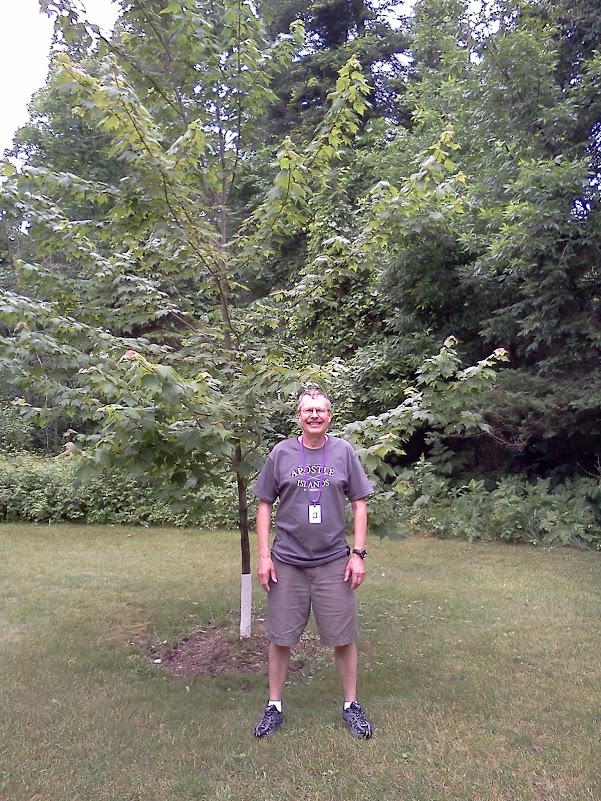
Handiham World for 20 June 2012
Welcome to Handiham World.
2012 ARRL Field Day is coming up this next weekend. It is always the last FULL weekend in June, which is Saturday and Sunday June 23 and 24.
Summer begins in the Northern Hemisphere on June 20, 2012, at 6:09 P.M. USA Central Daylight Time. Of course this means that our hours of daylight are at their maximum around this time of the year, and that always helps with getting set up for Field Day. There is always a lot of antenna work and temporary infrastructure to be set up at a multiple station club Field Day site. Having those extra hours of daylight can make it a little easier to get to the site and get things ready to go. On the other hand, more hours of daylight are likely to mean more absorption of signals on the lower frequency HF bands such as the 75 m band and – it goes without saying – more thunderstorm activity since thunderstorms are driven by convection and that takes place when you have long, hot, sunny days.
Field Day is different things to different participants. Some clubs are highly competitive, and this goes for individual participants as well. They are in it for the points and there is nothing wrong with that approach because if that is what you like and enjoy, then that is what you should do!
My feeling is that Field Day should ALWAYS be about having fun. I know that I have mentioned this before, but it certainly bears repeating: it is up to you to find a radio club Field Day that matches your expectations for what you expect the day to be all about. A mismatch between your expectations and the type of operating that is going on at the Field Day site will probably result in a disappointing experience for you and a bit of consternation on the part of the event organizers. If your idea of having fun is to get on the air and operate a highly competitive Morse code station to rack up hundreds and hundreds of points, you need to find a club Field Day whose goal matches yours. If you would rather spend most of the day socializing, greeting visitors to the Field Day site, helping newcomers get on the air, or experimenting with different modes of operation, then you should try to find a club that emphasizes those things over highly competitive operations.
If I hear from someone that they did not have a good experience on Field Day, I like to try to find out what went wrong. After talking with them for a while, I usually find out that there was a mismatch of expectations. They expected to do one thing at Field Day while the club’s event organizers had arranged for something entirely different. That is why you need to do a little bit of research to find the kind of Field Day operation that will suit you. If you do this, you are almost guaranteed to have an excellent time during what many of us consider the highlight of the amateur radio calendar – ARRL Field Day.
Incidentally, you do not have to feel as if you are all on your own when trying to find a club that will meet your Field Day expectations. ARRL Field Day sites across your state are probably going to be visited by your local League Section Manager. If you drop your Section Manager an e-mail or call him or her on the telephone, you can ask which Field Day sites they have visited and which they might recommend to a person like you with your expectations. Local League officials are a good resource to help you get connected with the right radio club as well. You can find lots of information on the ARRL website, which you can link to from the Handiham website.
Email me at [email protected] with your questions & comments.
Patrick Tice, WA0TDA
Handiham Manager

Handiham World for 02 May 2012
Welcome to Handiham World.
You can do it!
Today, just as we did last week, we are going to begin with Troubleshooting 101 as part of our initiative to help new ham radio operators (and even some of us older ones) learn how to do some basic troubleshooting for ourselves. Yes, it can be tempting to ask someone else to do things for us. This can become a bad habit when it keeps us from learning new things, especially things that we could – with a bit of practice – learn to do for ourselves. Knowing these basic things can serve us well in the future when no help is available. This next simple exercise is one that we will be practicing at this summer’s Radio Camp. You can do it yourself once you learn a few basics.
Troubleshooting 101

I have my General Class license now, so I decided to put up a vertical antenna, which I ground-mounted, in my back yard. I have checked the SWR (standing wave ratio) and it is practically one to one. It is grounded with a ground rod right near the feedpoint, and I have kept the grounding wire short. I am putting out plenty of power with my 100 watt rig, but I am having a hard time making contacts? What is wrong here?
Vertical antennas have long been the subject of derision in many amateur radio circles. It is practically an article of faith that “a vertical antenna is one that transmits equally poorly in all directions”. These operators have either tried vertical antennas themselves and had a poor experience or (more likely) they have heard some know-it-all pontificating on the awfulness of verticals and the awesomeness of just about any antenna other than a vertical.
Yes, the poor old vertical has gotten a pretty bad reputation. But is it justified?
I say no! And here’s why.
The most common vertical antenna design is an electrical quarter-wave long. This means that a simple 20 meter vertical will be on the order of 16 to 17 feet tall (5 meters). There is no problem ground-mounting a vertical in most locations, and this kind of antenna is sometimes disguised as a flagpole in places where there are restrictions on traditional antennas. A ground-mounted vertical will certainly have other advantages, too. It will not require an expensive tower or other supporting structure. It will be easy to install and work on if it needs maintenance or adjustment because you can reach it without any climbing. You can trench the coaxial feedline under the ground to keep it out of the way. If it is mounted in the back yard, it will probably not even be visible from the street. No wonder this simple antenna seems so attractive!
But let’s get back to your troubleshooting question. You have done well with your vertical antenna installation as far as it goes, but you have made a common mistake. You have assumed that a ground rod would suffice as a complete grounding system – but it won’t. When we work with RF (radio frequency) energy, we must remember that RF grounding is not the same as providing a simple electrical ground for low-frequency AC, DC, or lightning protection. Yes, a good electrical ground is an essential part of a well-designed antenna and feedline system. Now it is time to complete your vertical antenna installation with a good RF ground. That means installing radial wires extending from the base of the antenna outward in all directions. The ground rod should work as a common connection point. The coax braid is connected to the ground rod or the antenna’s mounting post, both of which are tied together with a stout, solid conductor.
What is happening in your antenna system is that lots of current is flowing in the vertical element right near the feedpoint. This is normal and expected. There is also a lot of current flowing in the ground beneath and around the antenna, outward in all directions. That is because a quarter-wave vertical is like one side of a dipole system, except that the ground makes up the other half of the dipole. If you recall your General Class studies, you will remember that current in a half wave dipole flows most strongly right near the feedpoint.
Now, answer me this: If you put up a dipole with one leg made of a fully-extended wire and the other a very short wire connected to a big resistor, do you think that dipole would work as well as a dipole with both legs made of wire?
No? Why not?
“Well”, you say, “It is obvious that the dipole with a big resistor in it will not work as well because there will be power lost in the resistor. The resistor will heat up, just like a dummy antenna.”
Yes, you are right! In fact, dummy load antennas are really nothing more than resistors designed to dissipate RF energy to keep it off the air while you run tests on a transmitter. A dummy load will have a near-perfect SWR, even though it is a resistor. Just because it has a low SWR does not mean that it is a good antenna. The problem with your vertical antenna system is that it is like that dipole with a resistor in one leg. The ground beneath the antenna has resistance to the flow of RF energy outward in all directions. The soil does have some conductivity, but it depends on moisture and composition. So the ground can be like a resistor. The ground rod you have installed goes straight down and does nothing to help RF flow in all compass directions outward near the surface of the ground.
The fix: A good radial system.
Radial wires are installed like the spokes of a wheel, outward from the grounded side of your antenna’s feedpoint. They can be cut to a quarter-wave length for every band you plan to operate (if your antenna is a multiband vertical) or – and this is more practical – to whatever length is convenient to fit into the space you have. Mind you, this goes only for a ground-mounted vertical in an area with normal to good soil conductivity. If you are mounting a vertical over quartz rock with almost no soil, the tuned radials might be necessary. If you are in the USA Midwest with its rich soil, you can probably get by with random length radials in your ground-mounted system. The reason is that conductive soil pretty much detunes the radials anyway, so there is nothing to be gained by carefully measuring them. In fact, since most of the RF current will be flowing right near the feedpoint, it makes sense to provide it with a low resistance path there, close to the antenna.
Why? Think of the formula power dissipated = current squared times resistance. The higher the resistance in the ground, the more power will be dissipated as heat. You don’t want that! What you want is for most of the power to be used to make contacts with other stations. The earthworms will be happier, too, because they don’t need the extra heat. If most of the current flows in the ground near the antenna, then THAT is where you need to put the most radial wire. I have always simplified this concept when teaching about vertical antennas by using the following practical example:
You have a coil of wire to use for radials. It is 100 feet long and will provide the radial system for your 20 meter band quarter-wave vertical. The question is which of these choices would be better:
A. One long radial that uses all 100 feet of wire.
B. Two 50 foot radials running in opposite directions.
C. Three 33 foot radials spaced 120 degrees apart.
D. Five 20 foot radials spaced at 72 degrees apart.
If you were thinking about losses near the feedpoint, you would probably pick answer D. The reason is that you are putting more wire near where the loss is actually happening! In fact, the thing with radials is “the more, the better”, not “the longer the better”. Of course you would not want to go to extremes and assume that 100 one-foot radials would work. But in the real world, you want to get more wire down in the ground near the feedpoint. A dozen radials work better than four.
Installing and testing the system:
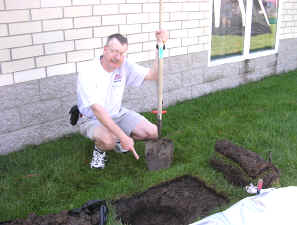
Stomp the grass back down and you are good to go. Repeat for each radial. If you can go out 33 feet in one direction and only 15 in another, that’s okay. Just make sure that the final installation is solidly connected to the ground rod and coax braid and all of the wires are out of the way of the lawn mower. The insulated wire will last longer in the ground than non-insulated wire. Once you get a taste of a hands-and-knees radial installation, you will not be eager to repeat it to replace rotted out wire any more than you have to. And if you tried to install springy radial wire, well, you know what that is like. Push one part in, another part pops out.
Email me at [email protected] with your questions & comments.
Patrick Tice, WA0TDA
Handiham Manager














