Posts Tagged ‘amateurradio.com’
 Want a crowd
 March 30th, 2015 |
  Author: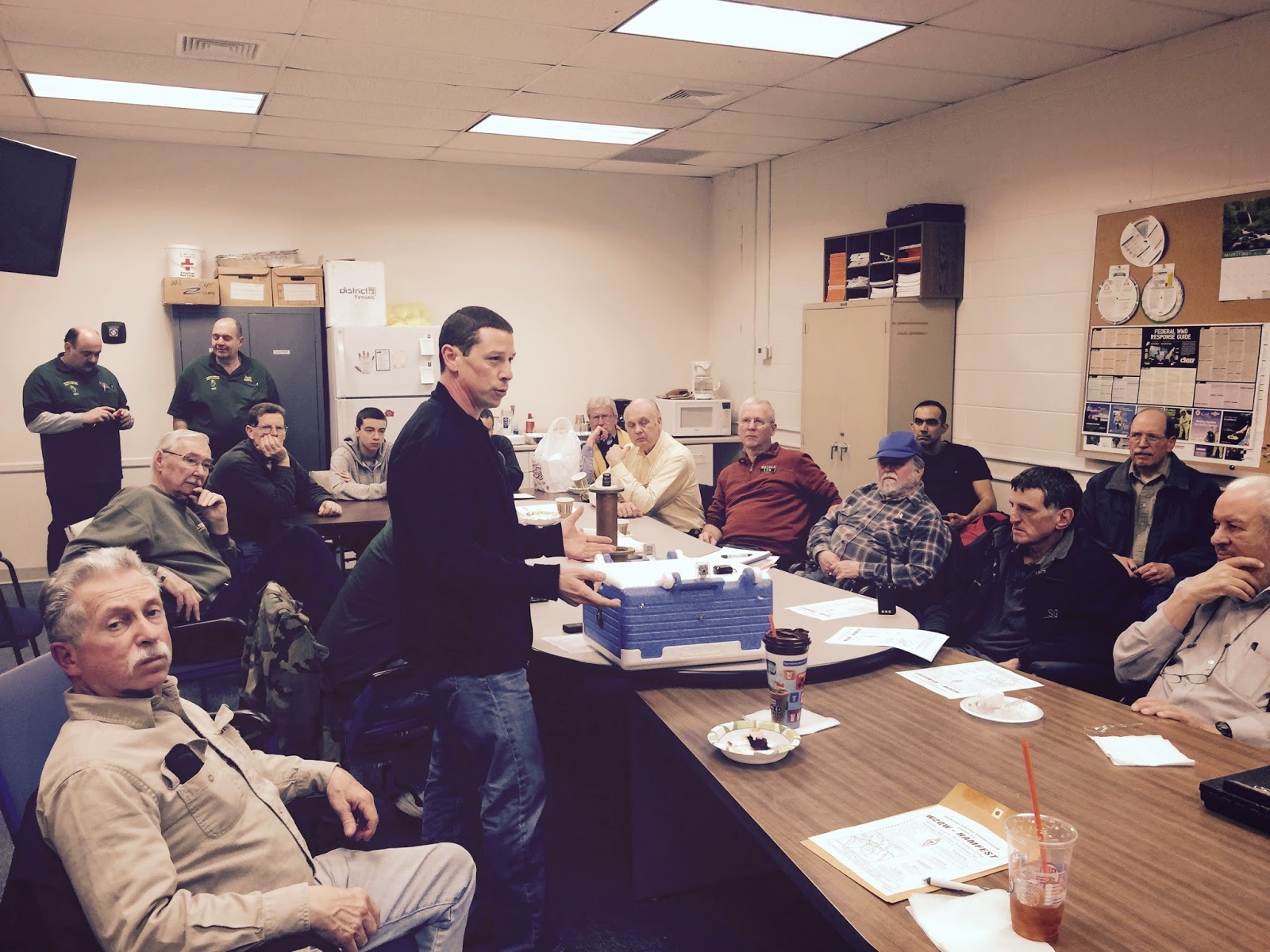
Thanks to Drew Moore W2OU for arranging for Mike Terruso WA4LOQ to come to our ETS of NJ meeting last Friday evening to talk about his high altitude ballooning experiments. What started out as a science project for his son is turning into a combination of ballooning and Amateur Radio for Mike. In fact, ballooning is what got Mike in gear to earn his Amateur Radio license, as he realized it's potential to help him in his endeavors.
The technology that he uses is interesting. A combination of radios, cameras, Raspberry Pi's, GPS devices, temperature and humidity sensors - it was all fantastic to listen to. I've embedded his YouTube video which is a compilation of stills (taken at 5 second intervals) of his maiden launch last October. The balloon was released near Lebanon, PA and landed in Boonton, NJ. It's an hour long video, but you can skip around it if you wish to see the "near space" photos which clearly show the black sky of space and the curvature of the earth's horizon. As Mr. Spock would say - "Fascinating!"
Mike is a "maker" in the sense that he did all his own research and started his project from scratch using materials purchased and/or cobbled together on his own. His next launch is scheduled for sometime in May. He is going to add Amateur Radio to the mix this time and will be getting cooperation from the local radio clubs in tracking and recovery.
‘USA 1776’ DMR Talk Group
 One of the nice things of D-Star and DMR is the ability to talk all over the world without the need of an HF rig and a bunch of big antennas. While this largely reduces a radio to a simple Internet-driven communication tool – just like Skype or other VoIP apps – it’s definitely nice to use.
There are a few problems surrounding DMR, one of which is the lack of more than two time slots. For example, if hams are using the Dutch Hytera network and occupying talk group 204 on slot 1, World Wide (which uses the same time slot) will be unavailable. Because 204-1 is a busy place, world wide QSOs are often impossible. It’s one of the reasons I thought of dumping DMR all together — I can talk to the same Dutch guys on analog while enjoying a much better quality audio.
There are reasons to keep DMR too. DMR is maturing; there are more than enough possibilities to put less pressure on the nation-wide network by going local. Now if only hams would do that…. but most don’t. Another reason to keep DMR for now is the gateway we recently added, which connects D-Star to our DMR network.
Not available on the Motorola network, sorry — some people responsible for that network appear to be so scared of such innovations that they will ban a repeater from the network if such a gateway is detected.
Talk group ‘USA 1776’ could add to the appeal of DMR. It’s unclear on which network this talk group will reside, but my best guess is that it will be the Motorola network. MITCON writes:
The “USA 1776″ (English preferred) Talk Group will be distributed worldwide to DMR networks upon request. The spirit of “1776” is to continue the Amateur Radio tradition of international friendship and to push the boundaries of technology in the new frontier of digital communications.
 USA 1776 is intended to be a flexible, politically neutral, unrestricted Talk Group that can be used as Push-To-Talk (PTT) or Full-Time (FT) to meet the operating requirements of a DMR Network. DMR subscribers are welcome to use 1776 as a universal meeting place to “Rag Chew” or as a jumping off point and QSY to an alternative Talk Group if desired. To add USA 1776 to your DMR Network please contact us to schedule a time for configuration & testing.


‘USA 1776′ DMR Talk Group
One of the nice things of D-Star and DMR is the ability to talk all over the world without the need of an HF rig and a bunch of big antennas. While this largely reduces a radio to a simple Internet-driven communication tool – just like Skype or other VoIP apps – it’s definitely nice to use.
There are a few problems surrounding DMR, one of which is the lack of more than two time slots. For example, if hams are using the Dutch Hytera network and occupying talk group 204 on slot 1, World Wide (which uses the same time slot) will be unavailable. Because 204-1 is a busy place, world wide QSOs are often impossible. It’s one of the reasons I thought of dumping DMR all together — I can talk to the same Dutch guys on analog while enjoying a much better quality audio.
There are reasons to keep DMR too. DMR is maturing; there are more than enough possibilities to put less pressure on the nation-wide network by going local. Now if only hams would do that…. but most don’t. Another reason to keep DMR for now is the gateway we recently added, which connects D-Star to our DMR network.
Not available on the Motorola network, sorry — some people responsible for that network appear to be so scared of such innovations that they will ban a repeater from the network if such a gateway is detected.
Talk group ‘USA 1776′ could add to the appeal of DMR. It’s unclear on which network this talk group will reside, but my best guess is that it will be the Motorola network. MITCON writes:
The “USA 1776″ (English preferred) Talk Group will be distributed worldwide to DMR networks upon request. The spirit of “1776” is to continue the Amateur Radio tradition of international friendship and to push the boundaries of technology in the new frontier of digital communications.
USA 1776 is intended to be a flexible, politically neutral, unrestricted Talk Group that can be used as Push-To-Talk (PTT) or Full-Time (FT) to meet the operating requirements of a DMR Network. DMR subscribers are welcome to use 1776 as a universal meeting place to “Rag Chew” or as a jumping off point and QSY to an alternative Talk Group if desired. To add USA 1776 to your DMR Network please contact us to schedule a time for configuration & testing.
FT-450D First impressions
So last month I succumbed to temptation and ordered a Yaesu FT-450D. While it is still an entry level rig I had heard good things about it and liked the look and feel of it. Martin Lynch & Sons had them at a low price and combined with Yaesu's 'Late Winter Warmer 2015' cash-back promotion made it an opportunity I didn't want to miss.
It arrived last week but I only got to properly have a play this weekend even then not for as long as I really would have wanted. I know people might detest HF contests but I was quite glad of the CQ WPX to try out the radio with plenty of contacts on 10/15/20 and 40m while keeping the output below 50W.
I have still to work out all the settings and the DSP functions but first impressions are of an excellent receiver with good tone and clear audio from the internal speaker. Being a very popular contest the bands were crowded at the weekend but I had no trouble picking out weaker stations even with very strong adjacent stations. Using the supplied microphone and the default processing settings I had no issue getting out either, working nearly all of the stations I called.
I have previously used a manual ATU and found the internal ATU is a nice feature when switching bands and it did a excellent job of fine tuning the M0CVO OCFD. It couldn't tune it on 40m directly as the VSWR was greater than 3:1 so had to revert back to the external ATU.
Only very minor gripe I had was the CAT connection, In my research I noted it was a standard RS232C 9-pin connector and assumed I would just plug in a standard PC serial lead, but I hadn't spotted the radio had a male connector not female!
I wanted to try out the CAT but hadn't got a gender changer or connectors in the shack to make up a lead. I did have a number of commercial RS232 extension leads moulded male connector one end, female the other, so chopped up two and spliced the appropriate halves together. It works fine with a USB-Serial adapter in Ham Radio Deluxe but refused to work with the Omnirig control used by PZTLog until I disabled the hardware handshaking.
Still early days and I do need to read the manual but more than happy with it.
Review Pofung (Baofeng) GT-1
I didn’t pay much attention to the GT-1 because I assumed it was just old wine in a new bottle. Time to rectify this, due to popular demand.
We all know the Baofeng BF-666S / BF-777S / BF-888S radios: 16 UHF channels, no display, low power output, a receiver which can be overloaded by snapping your fingers, but they are dirt cheap. The GT-1, co-developed by SainSonic, promises to improve on this concept by adding FM radio, a higher capacity battery and higher power output.
Look & feel
When it comes to looks, the GT-1 looks a bit more modern than its predecessors. The radio is slightly taller and less deep. All in all the GT-1 looks and feels nice. The basic concept didn’t change: 16 programmable UHF channels between 400 MHz and 470 MHz, scramble (voice inversion), a on/off/volume pot, a 16-step rotary encoder and a flashlight. Apart from emitting a steady beam of light the flashlight now offers an ‘SOS- mode: three short, three long and three short pulses.
You can order the radio with side keys in different colors: yellow, orange or green. The (of reasonable quality) manual comes in three languages: English, French and German. Nice touch.
 Battery
 According to the specs printed on the battery the nominal voltage is 7.4 Volts @ 1800 mAh, the same capacity as the UV-5R battery. Such a capacity would be in line with the higher power output promised on the radio label: a solid 5 Watts instead of ‘less or equal to 5 Watts’ printed on a BF-888S (which proved to be 2 Watts only).
The first hint of something being terribly wrong was the weight of the battery. It felt so light that I was afraid that it might end up at the other end of the living room if I had a nasty cough. Time to to take a closer look at things. Let’s take a look at the weight first as more cells always translates into a heavier battery. The amount of plastic used plays a role too, of course. So while this is not a 100% reliable method, it does give you an indication.
Battery weight comparison
Pofung GT-1: 47 grams
Baofeng BF-666S: 54 grams
Baofeng UV-5R: 80 grams
Anytone NSTIG-8R: 96 grams
As you can see the weight of the GT-1 and BF-666S batteries are close. The UV-5R and NSTIG-8R batteries are too, both proven to be 7.4 Volts @ 1800 mAh. The GT-1 battery seems just too light to be in the same 7.4 Volts / 1800 mAh league.
I took my multimeter and checked the GT-1 battery. Not to my surprise it only measured 4.0 Volts (freshly charged), so the nominal voltage is 3.7 Volts only, just like the BF-666S battery. The capacity will likely be the same too, somewhere between 1000 mAh and 1500 mAh.
 Transmitter
After finding out that the battery might even be inferior to the one supplied with its predecessor I didn’t expect the GT-1 to be able to reach 5 Watts output at all. That proved to be correct. Two samples measured the same: between 1.5 – 2 Watts, depending on the frequency.
TX Audio
A bit brighter and slightly louder than my BF series, which is a plus.
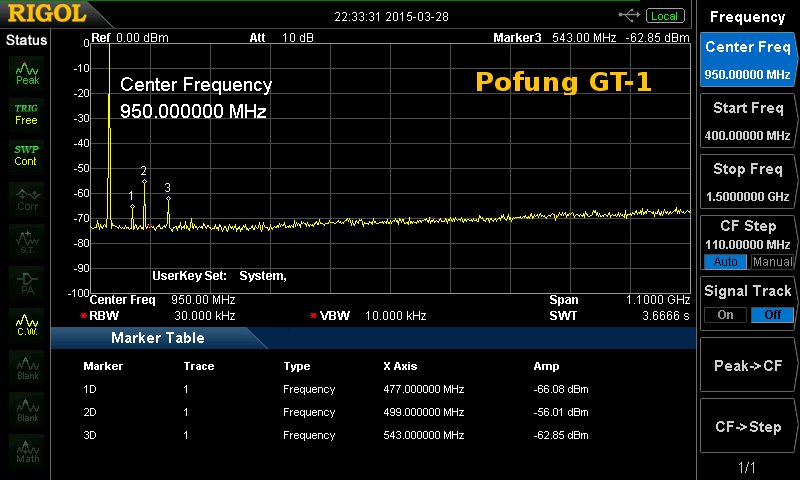
Phase noise and harmonics
Less phase noise than the BF series. There are some unusual peaks visible, but nothing scary.
 Receiver
At -126 dBm the GT-1 is sensitive enough, but that won’t help you much. It doesn’t take much of an out-of-band signal to make the radio as deaf as a post. Even the local repeater can’t be received in my city center; only if I’m about 3 kilometers away from the center the receiver comes to life.
FM Radio
By holding the upper side key while switching on the radio, the GT-1 will switch to FM radio, something the BF series don’t offer. There doesn’t appear to be a way to tune to a preferred station though; it randomly tunes into stations it finds. This makes the feature of limited use.
Edit: pressing the upper side key shortly will make the radio switch from station to station. Some in-house interference made the system fail when I tested it. The interference caused the scan to stop when encountering these false positives.
RX Audio
A bit raw, just like with the BF series, but more tinny. Audio distorts quickly if you crank up the volume.
Software
The GT-1 can be programmed with the same software developed for the BF series. CHIRP works too, but lacks a few options such as switching on scramble. Changing power output from ‘High’ to ‘Low’ in the software still doesn’t work; the radio just ignores that setting.
The verdict
After being confronted with all the lies surrounding the Pofung GT-1 there’s no way I can justify a diplomatic way of saying things. The GT-1 is just old wine in a new bottle, the battery voltage / capacity is one big lie and so is the promised power output.
The receiver is still disappointing unless you live in the proverbial ‘middle of nowhere’. To make matters worse the GT-1 is more expensive than a Baofeng BF-666S / BF-777S / BF-888S.
In short: don’t buy one unless you’re a notorious masochist. Go for a UV-5R instead or, if you like/need this particular concept, buy the superior Anytone ANILE-8R.


Review Pofung (Baofeng) GT-1
I didn’t pay much attention to the GT-1 because I assumed it was just old wine in a new bottle. Time to rectify this, due to popular demand.
We all know the Baofeng BF-666S / BF-777S / BF-888S radios: 16 UHF channels, no display, low power output, a receiver which can be overloaded by snapping your fingers, but they are dirt cheap. The GT-1, co-developed by SainSonic, promises to improve on this concept by adding FM radio, a higher capacity battery and higher power output.
Look & feel
When it comes to looks, the GT-1 looks a bit more modern than its predecessors. The radio is slightly taller and less deep. All in all the GT-1 looks and feels nice. The basic concept didn’t change: 16 programmable UHF channels between 400 MHz and 470 MHz, scramble (voice inversion), a on/off/volume pot, a 16-step rotary encoder and a flashlight. Apart from emitting a steady beam of light the flashlight now offers an ‘SOS- mode: three short, three long and three short pulses.
You can order the radio with side keys in different colors: yellow, orange or green. The (of reasonable quality) manual comes in three languages: English, French and German. Nice touch.
Battery
According to the specs printed on the battery the nominal voltage is 7.4 Volts @ 1800 mAh, the same capacity as the UV-5R battery. Such a capacity would be in line with the higher power output promised on the radio label: a solid 5 Watts instead of ‘less or equal to 5 Watts’ printed on a BF-888S (which proved to be 2 Watts only).
The first hint of something being terribly wrong was the weight of the battery. It felt so light that I was afraid that it might end up at the other end of the living room if I had a nasty cough. Time to to take a closer look at things. Let’s take a look at the weight first as more cells always translates into a heavier battery. The amount of plastic used plays a role too, of course. So while this is not a 100% reliable method, it does give you an indication.
Battery weight comparison
Pofung GT-1: 47 grams
Baofeng BF-666S: 54 grams
Baofeng UV-5R: 80 grams
Anytone NSTIG-8R: 96 grams
As you can see the weight of the GT-1 and BF-666S batteries are close. The UV-5R and NSTIG-8R batteries are too, both proven to be 7.4 Volts @ 1800 mAh. The GT-1 battery seems just too light to be in the same 7.4 Volts / 1800 mAh league.
I took my multimeter and checked the GT-1 battery. Not to my surprise it only measured 4.0 Volts (freshly charged), so the nominal voltage is 3.7 Volts only, just like the BF-666S battery. The capacity will likely be the same too, somewhere between 1000 mAh and 1500 mAh.
Transmitter
After finding out that the battery might even be inferior to the one supplied with its predecessor I didn’t expect the GT-1 to be able to reach 5 Watts output at all. That proved to be correct. Two samples measured the same: between 1.5 – 2 Watts, depending on the frequency.
TX Audio
A bit brighter and slightly louder than my BF series, which is a plus.
Phase noise and harmonics
Less phase noise than the BF series. There are some unusual peaks visible, but nothing scary.
Receiver
At -126 dBm the GT-1 is sensitive enough, but that won’t help you much. It doesn’t take much of an out-of-band signal to make the radio as deaf as a post. Even the local repeater can’t be received in my city center; only if I’m about 3 kilometers away from the center the receiver comes to life.
FM Radio
By holding the upper side key while switching on the radio, the GT-1 will switch to FM radio, something the BF series don’t offer. There doesn’t appear to to be a way to tune to a preferred station though; it randomly tunes into stations it finds. This makes the feature of limited use.
RX Audio
A bit raw, just like with the BF series, but more tinny. Audio distorts quickly if you crank up the volume.
Software
The GT-1 can be programmed with the same software developed for the BF series. CHIRP works too, but lacks a few options such as switching on scramble. Changing power output from ‘High’ to ‘Low’ in the software still doesn’t work; the radio just ignores that setting.
The verdict
After being confronted with all the lies surrounding the Pofung GT-1 there’s no way I can justify a diplomatic way of saying things. The GT-1 is just old wine in a new bottle, the battery voltage / capacity is one big lie and so is the promised power output.
The receiver is still disappointing unless you live in the proverbial ‘middle of nowhere’. To make matters worse the GT-1 is more expensive than a Baofeng BF-666S / BF-777S / BF-888S.
In short: don’t buy one unless you’re a notorious masochist. Go for a UV-5R instead or, if you like/need this particular concept, buy the superior Anytone ANILE-8R.
QRPTTF 2015 – First Announcement!
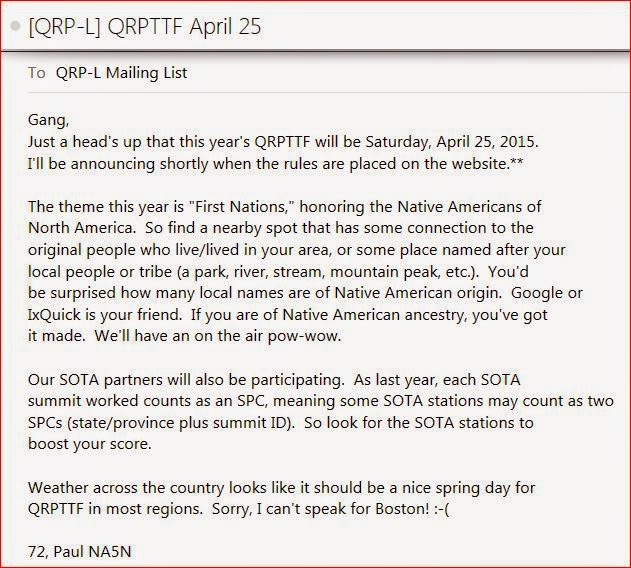
Living in New Jersey makes filling the requirements of this theme a snap!
Right off the bat, I'm thinking that I could go to Johnson Park in either Highland Park or New Brunswick and operate right on the banks of the Raritan River, which according to Wikipedia:
"The river has served an important water transportation route since the Pre-Columbian era. The name Raritan is also applied to the Raritan people, an Algonquian tribe that inhabited Staten Island, near the river's mouth."
Or perhaps I could go over to Piscataway Township and operate from there:
"The name Piscataway may stem from the area's original Native American residents, transplants from near the Piscataqua River defining the coastal border between New Hampshire and Maine, whose name derives from peske (branch) and tegwe (tidal river),[18] or alternatively from pisgeu (meaning "dark night") and awa ("Place of")[19] or from a Lenape language word meaning "Great Deer".
Or, I could even go to one of my favorite spots, Washington Rock State Park, as it is on the first ridge of the Watchung Mountains, which according to Wikipedia (again):
"The original inhabitants of the Watchungs, the Lenape, referred to the mountains as the Wach Unks, or ‘high hills’.[9][10] Evidence of the Lenape presence in the Watchungs can be seen in numerous camps sites that have been uncovered, mainly along the rivers coursing through mountains and in the small caves abundant in the volcanic rock. It is thought the Lenape favored the Watchungs for their profusion of natural resources, including abundant freshwater rivers and streams, a variety of forests, and plentiful fish and game.[11] They also took advantage of the rich soils and maintained many farm areas where they raised a variety of seasonal crops."
So I have plenty of places to choose from. Sometimes the themes that Paul comes up with can be somewhat of a challenge - for example, last year's "Cinco de Mayo" theme. There's not much in New Jersey that has a true Mexican connection.
This year's theme is pretty easy to comply with.
72 de Larry W2LJ
QRP - When you care to send the very least!













