Posts Tagged ‘amateurradio.com’
 Benchduino: It’s Gonna Be BIG, for Builders
 May 11th, 2019 |
  Author:
Far more than will admit, amateur electronic builders tend to have a prototype that looks more like a Rube Goldberg cartoon than something designed by Hewlett Packard (when they were building). Me, too. There’s just a lot of wires, connectors, rigged-up jigs, and so forth when you’re trying to get a circuit to work like it’s ‘sposed to. And, put a microcprocessor or small PC board into the mix, aye yai yai!
There are breadboards, even sophisticated ones, that help with this. And, there are design boards to facilitate with some PIC development as well as ones that help with Arduino or Raspberry Pi projects. That’s good. But I’ve seen nothing like a workbench platform for most all of these with hardware and software hooks to keep Rube Goldberg in Collier’s Magazine. Until now.
George Zafiropoulos KJ6VU of the Ham Radio Workbench Podcast team has put together what he calls the Benchduino. George has an Internet group on the project at Groups.io here. You can follow the beta development there by joining. But you can get more meat on the bones by listening to a recent episode of the HRW podcast on the Benchduino. If you build using microprocessors, you will not be disappointed.
This product will be BIG for builders. You can download the interim documentation file here. Here’s what it looks like, taken from the website page. There are multiple add-on boards to connect to Arduino Mega, Raspberry Pi Zero, PIC – 40 pin 18F series processor, Adafruit Feather, Xbee data radio socket (built-in). George has pre-loaded shopping carts for necessary parts at Digi-Key for various boards. To channel the comedian Martin Short: I must say, I must say!

Taken from the HRW website page:
The BenchDuino is a development platform for building projects based on the Arduino, Raspberry Pi and PIC microcontrollers. The platform defines a common foot print for processor and expansion boards to make it easy to expand the functionality of the system. The BenchDuino motherboard includes many commonly used peripherals which can be connected to the CPU pins with jumper wires or plug in shunts. The BenchDuino is an open platform and we encourage the development of plug-in CPU and expansion boards.
https://www.hamradioworkbench.com/benchduino.html
Now, this is quite dramatic for prototype development using various microprocessor boards. But the pièce de résistance, IMHO, comes via the header on the top edge of the Benchduino as shown in the photograph above. Need several pieces of test equipment, including a logic analyzer, to check out whether your code makes the light blink (or whatever)? Use the Analog Discovery 2 USB-based test workbench directly connected to the Benchduino! I love mine, including the latest add-on Impedance Measurement Board (~$20). The HRW Podcast has a $100 off discount code for the AD2 product through their website which takes you to Digilent.
So, in brief, your project doesn’t have to be a Rube Goldberg cartoon that you’d just not like your builder buddies to see before it’s completed. Your project may not get Bob’s Your Uncle status upon first execution, but it will likely be Bob’s Cousin with the Benchduino and the Analog Discovery 2. The latter has multi-platform free software for the hardware which makes it a Swiss Army Knife of test equipment.
I’m buying my Benchduino boards from the Ham Radio Workbench booth at Hamvention this year. George is giving a Forum talk / demo on the Benchduino too. (Digilent will also be at Xenia with the HRW discount. Get the Impedance Analyzer Board while you’re at it.) Let George know you’re coming via Twitter: @kj6vu
Bummer: Work Howard Event Canceled
A solid 1960’s saying for disappointing but not tragic events was … bummer! That’s fitting for this announcement from the ARRL with the ICQ Podcast’s endorsement. We’d certainly not want an event, no matter how exciting, to get the W1AW station license in dutch with Part 97. After all, the League should lead by setting examples of following the rules.

“Put Howard to Work” Event Canceled
05/03/2019
Earlier this week, ARRL announced that ARRL CEO Howard Michel, WB2ITX, would be on the air at W1AW on Monday, May 13, giving ARRL members a chance to chat with the CEO and get to know him better as a ham. An issue was raised, however, that this event may pose a potential FCC rule violation.
The particular rule is §97.113: “A station is also not allowed to transmit communication in which the station licensee or control operator has a pecuniary interest, including communications on behalf of an employer.”
Given that ARRL is Michel’s employer and that an effort was made to publicize an event at which members of the organization could chat with the CEO, such an event could be perceived as a benefit to the organization. So, out of an abundance of caution and to avoid any potential violation of FCC rules, or even the appearance of a violation, Michel has decided to cancel plans for the “Put Howard to Work” event.
“I’ve operated W1AW before and will continue to do so in the future,” Michel said. “I hope to meet many of you on the air, but only as part of my regular ham radio activities and not as part of an ARRL-promoted event.”
The “Put Howard to Work!” event was conceived by the ICQ Amateur/Ham Radio Podcast, on which Michel was a guest on March 31. “We are disappointed, of course, at this turn of events but fully understand and endorse ARRL’s decision,” said ICQ Podcast Presenter Frank Howell K4FMH.
Put That ARRL CEO to Work, Would Ya?
In a recent episode of the ICQ Podcast, I had Howard Michel WB2ITX as my interview guest. He’s the CEO of the American Radio Relay League as of late last year. It was important that Howard get interviewed about League matters as he was hired after a brief misfire to replace the legendary CEO David Sumner K1ZZ. As I told ARRL President Rick Roderick in the Q&A session with him a year or so ago at the Mississippi Section Convention in Jackson, MS, “You guys made a mistake in hiring someone from Wall Street to be CEO of a membership non-profit organization. Don’t make one again.” My Division Director, David Norris K5UZ, was seated in the row in front of me, nodded his head and turned to give me a knowing look. From my interview with Howard Michel, and from what else I’ve seen coming from him, they did not make a mistake.
One of the strategic matters that this new CEO faces is the common perception that Chief Executives are walled-off from the organization’s customers or just come out of their catacombs to glad-hand, smile, and ask for something.
Indeed, if you listen to my interview with him here, I think you’ll find that he has a clear but not tight-fisted vision for making the Headquarters more customer service oriented, inclusive, and modern in it’s business operations. This should yield better service experiences for members. Perhaps equally important, it may attract new members to the League as the 150,000 or so current members pale by comparison to the 750,000 licensed hams in the U.S.
One of the strategic matters that this new CEO faces is the common perception that Chief Executives are walled-off from the organization’s customers or just come out of their catacombs to glad-hand, smile, and ask for something. As error prone as this perception is, there is enough of an everyday reality that validates it to the rank-and-file customer base to make it the default mental setting, so to speak. In addition, there’s the “We’re the ARRL. And You’re Not!” barrier (apologies to the comedian Chevy Chase of Saturday Night Live fame).
As I was listening to Howard respond to my questions, I was pondering these matters. It hit me that it might be informative for all involved if there were opportunities to interact with Howard as just another ham operator so as to “see” him that way as opposed to a mostly a face with a monthly column in QST or on the pages of the ARRL’s website. An idea was formulated on the spot: get him on the air in a mini-event so as to work Howard on the air at W1AW!

(original photo courtesy of ARRL. Graphic rendering by Frank K4FMH
So I sprang this on him without any real sense of how he would respond by asking a one of my final questions: How’d you like to make some news? I proposed that we set up a date and time to appear on W1AW’s station on 20 meters and let the ICQ Podcast team promote it as a joint mini-event where hams could “put the CEO to work” by working WB2ITX on the air. He immediately caught the humorous pun in this and agreed enthusiastically.
Please put May 13, 2019 at 2:00pm Eastern Time on your calendars. Tune your antennas, rigs, and amplifiers (if you have them) to 14.254+/- and put that CEO to work! Howard promises a special QSL card from the League HQ for worked contacts.
Review – BTech DMR-6X2
by John ‘Miklor’ K3NXU


Several Dual Band DMR handhelds have been introduced into the market in the past few months. Having owned most of them, I would have to place this one toward the very top of the list. The DMR-6X2 is both VHF and UHF, Tier II DMR digital as well as FM analog with most features geared strictly toward ham radio use.
Important Note: The BTech DMR-6X2 is Not made by Baofeng. (see note below). That being said, let’s see what’s…
In the Box
Included with the radio are the:
– Two (2) Li-Ion Batteries (2100 and 3100 mAh)
– Two (2) Belt clips
– Hand Strap
– 37 page User Guide – English
– Charger base & AC adapter
– Antenna – 6.25″ (16cm)
– Programming Cable
– Earphone / Microphone
General Description
– DMR / FM
– VHF / UHF Dual Band
– Size: 5.1 x 2.4 x 1.5″ (129 x 61 x 39mm)
– Weight: 9.9oz (282g) w/ant & 2100 mAh battery
– Weight: 10.8oz (306g) w/ant & 3100 mAh battery
– 136-174 400-480 MHz
– CTCSS/DCS DTMF/2TONE/5TONE
– Digital Simplex Repeater
– <1.0w / 6.0w transmit
– 4000 channel
– 250 Zones (up to 250 channels per zone)
– 10,000 contacts
– 150,000 DMR Database Contacts
– Part 90 compliant – 2AGND-DMR6X2
– N0GSG Contact Manager Compatible
Basic Description (additional features)
The heart of the 6X2 is the proven Anytone D868. Under contract with Anytone, BTech had several addition features exclusively added to the 6X2.
Some of the additional features exclusive to the 6X2 include:
– Multiple Scan Groups
– Priority Scan
– Change TG via Keypad (Adhoc) with Unlimited Hold Timer
– Display Color Options
– Digital Simplex Repeater
– Analog Squelch Level Adjustment
– Start Up Code Plug Compatibility
– Display Hold
– Multiple Scan Groups in Same Channel
The 6X2 allows multiple scan lists to be entered per channel. You are no longer limited to one scan group entry per channel. The scan groups can include and mix of DMR or analog channels.
– Priority Scan
When developing a scan list, up to 2 channels can be assigned as priority. This allows the priority channels to be interwoven in the scan list. As an example:
– Channel 1
– Priority Channel 1
– Channel 2
– Priority Channel 1
– Channel 3
– Priority Channel 1
– Change Group via Keypad (“Unlimited” hold timer)
This is specially nice when using a hot spot. By setting a key function to “Dial” or “Long Press 0”, and the Group Call Hold time to “Unlimited”, you can enter a Talk Group using the number pad and it will remain permanently or until the channel is changed. No longer is the hold time set in seconds or minutes.
– Display Color Options
There are two display color options available. They are White on Black background, and Black on a Powder Blue background. (shown below). They are selectable by either software or keypad menu.
– Analog Squelch Level Adjust
The analog squelch level can now be adjusted using one of the programmable keys.
– Start up Code Plug
To assist with start up, the software was written to initially accept an Anytone D868 code plug. I’ve had a 868 since they first came out, and this was a huge time saver. Everything transferred and I was ready to play radio in minutes.
Note: Due to the extra features in the code plug, a 6X2 CP cannot be transferred back to a D868.
– Digital Simplex Repeater
Not to be confused with a standard repeater, this feature allows the DMR-6X2 to function as a Store and Forward Simplex Repeater. The 6X2 records a transmission and stores it in memory. Immediately after the incoming signal is dropped, the transmitter keys and re-transmits the recorded audio. The re-transmission can be either on the same or different frequency (not necessarily on the same band).
This feature allows the 6X2 to be used as a relay point during events such as marathons, races, etc. where a central relay method is needed and there is no local repeater.
– Display Hold
When a signal is received, the data image (name, call, location, etc) remains on the screen until the next signal is received rather than drop back to a standby screen. There is a Call End indicator at the bottom, but the data remains.

The Technical Side of the 6X2
The Transmitter
The frequency range of the DMR-6X2 is both VHF 136-174 and UHF 400-480 MHz. Along with DMR, the radio also supports analog FM (Wideband and Narrowband)
The power levels hold pretty close to the specifications. There are four power levels with a high of 5.0W and a Turbo mode of 6.5W. I personally run mine in 5W mode. Turbo isn’t going to Make or Break the signal, but it helps the battery.
What I do like is the low power mode is less than 1W. I run a hotspot here and if the power was only 0.3W I would be happy.
My audio reports have been excellent both through a DMR hotspot and the local repeaters. There is a five level microphone gain parameter that allows you to select the microphone gain level that best suited for your voice. I use level 3 (mid-level) for a full smooth audio response. I tried level 5 and found the audio was way too hot.
Power levels are listed below and were taken using a calibrated Bird Termaline wattmeter.

Enclosure
The DMR-6X2 case has a good solid feel and weight, and fits the hand well. It weighs in at 9.9oz (282g) with the standard battery attached and 10.8oz (306g) with the high capacity battery. Battery removal requires a simple push of the release slide located at the top of the battery. No battery sliding or pushing is required.
I found the keypad buttons a bit larger than most with a lighted keypad layout of three across and four down. This puts the zero (0) at the bottom of the keypad where I believe it belongs. The PTT button requires only a light pressure that doesn’t tire the finger to press.

Antenna
The included dual band antenna is 6.25″ which is a fairly common size for a handheld. I found that there was a slight improvement of about 2db by using an NA-771. The 771 is 10″ longer, so a difference would be expected, but I’ll probably stay with the stock antenna.


Receiver and Audio
The receiver sensitivity is very good on both digital and analog. I found the receive audio is amazing with wide and smooth frequency range.
The volume control range is adjustable with the software. Level 1 sets the full range of the volume control to a soft level, even at full volume. Level 8 sets the volume range to very loud at the top end. My preference is level 3 to 5 which is plenty loud, even for mobile operation.
Display
The radio has a two multi-color display options. The high contrast White on Black, and the softer is a Powder Blue with multi-color icons. The color is selectable via software or as a keypad menu option. The screen size is 1.1″ x 1.4″ with excellent resolution .
There are multiple sites where the current DMR User Database can be downloaded. There are various formats available allowing you to view name, call, location, user ID, license class, etc.

.
Software
Along with entering data in the conventional manner, the software allows you to import and export data to ‘csv’ files. Loading in a contact (TG) list, channel list, database, etc. is relatively simple.
I found being able to export to a ‘csv’ file has several advantages. I like having my channel list in sequence. With most software, you can only add new channels to the bottom of the list. Now I can sequence the list so it’s easy to view then load it back into the code plug.
Adding a new repeater can be done in minutes. I just cut and paste a copy of an existing repeater, change the frequencies, and load it back.
Note: The BTECH 6X2 can import a code plug (.rdt) from an Anytone D868UV directly. This is a great way to get your 6X2 on the air. Once loaded, however, due to the expanded parameters, the D868 is not capable of reading a 6X2 code plug.
CSV transfer Caution
Adding large amounts of data, updating and re-sequencing via CSV files is a major plus, but should always be done with Caution. For instance, Talk Group data must always be loaded before or at the same time as the Channel data. If not, improper data attachment may not occur.
Always backup your current code plug before modification.
Firmware
As additional features and future enhancements are developed, the radio can be updated to latest model. A firmware upgrades can be done with a Windows computer in about 5 minutes.
Note: The DMR-6X2 firmware is specific to this radio. It cannot be uploaded to a different model in hopes of adding new features.
Programming Cable
The DMR-6X2 comes with the necessary programming cable. The UART chip inside the radio, so the cable itself is straight through. There is no circuitry inside the cable itself. The driver will load automatically when the cable is attached.
For reference, although the cable appears to be the same as some that have the chip in the cable, those cables are not compatible.


The charger base requires a standard 12vdc wall wart (included). The LED on the front of the charger base is Red when charging, and Green when either fully charged or no radio in the cradle. The battery easily charges to full capacity with an overnight charge.
Battery and Charger
There are two batteries included with the 6X2, a 2100mAh and a high capacity 3100mAh. With battery save on, I can get 2 to 3 days out of the 3100mAh battery before needing a charge.
There are also USB charging cables available with output of 12V. These can also be used in place of the included Wall Wart.

Conclusion
If you think the BTECH DMR-6X2 very closely resembles a D868UV, you are correct, but as shown above, it is definitely not simply a rebadged Anytone. There are features and enhancements that set these two radios apart. I think BTECH was wise to wait for the bugs to be ironed out before introducing the 6X2 to the market.
If you’re waiting for this radio to drop in price, don’t hold your breath. Its features and performance make it well worth the price.
The obvious pros are the following:
– True Tier II DMR
– Same Band and Cross Band digital simplex repeater
– Dual Band VHF/UHF operation
– Multiple Scan Groups per Channel
– Priority Scan
– On the Fly Talk Group Entry
– Built-in Voice Recorder
– 2TONE and 5TONE decoding
– 150K user database capacity
– FCC Part 90 certified for commercial use
– N0GSG Contact Manager Compatible
There are plenty of options geared more for hams than commercial use. It performs well and makes a nice addition to the ham shack.
Available from:  and Amazon
For Clarification
BTech (BaofengTech) is not a division of Baofeng. They are an ODM that partners with OEM manufacturers to spec and build to their own requirements, whether from scratch (UV-5X3) or from an existing product. This 6X2 is an Anytone at heart with additional unique features found only in that model.
Here’s a comparison chart showing the major differences.
Click to enlarge.

Is Your QST App on iOS Busted? Ours is too…
UPDATE 3.25.2019 I received an e-mail from Bob Interbitzen NQ1R at ARRL that the “fixed” updated QST app from PageSuite, Version 5.1, is now available at the Apple App Store. He posted a note on the ARRL website here. It updated on my iPad as usual and I was able to download the April QST issue. I had to download all of the back issues (I’d previously deleted the app trying to see if that would fix the issue to no avail as described below.) The larger issue regarding the reliability of the custom QST app remains.
Oh, at least 15 years or so ago, a university team in the UK came up with an electronic ink (e-ink) technology for an 8″x11″ format thin tablet for office use. It was going to revolutionize photocopying by reducing the need for it. Recall when corporate (and university!) meetings would be held after burning down the photocopier with reams and reams of memos, white papers, and so forth? The team in England had a budding product that would just nip that in the bud. Except, it never got released. It just wasn’t ready for market. The team went back to the drawing board and disappeared from the marketplace.

Reviews of app in iTunes: https://itunes.apple.com/us/app/qst/id531766442 And Android (Google Play): https://play.google.com/store/apps/details?id=com.branded.arrl&hl=enI wrote Bob Interbitzen, NQ1R, the Marketing Director for the ARRL, about the issue. He rightly asked me what make/model/iOS version I was using. I sent that from the Settings menu. His first response was, well, that’s an old iPad from back in 2016. It is. And it was the biggest fastest iPad Pro Apple offered then. Apply still fully supports it. And I read my CQ Magazine (and others) on the Zinio app just fine and dandy. I also read a ton of books and magazines in both my Kindle app and Apple Books app with nary a hitch. So, it really, really couldn’t legitimately be the old “you need a new computer” response. To Bob’s credit, this caused him to research the issue more deeply. Moreover, he said in his e-mail back to me, “I appreciate your concern for this matter. I can assure you it is receiving a priority level of our attention.” I can hardly complain about the communications from the League in response to my report of being blocked out of the digital access that they’ve encouraged subscribers to shift to. (I myself have not opted-out at this point. And, am glad that I haven’t.) In reality, the League has hired a large commercial eDocument company based in the UK, PageSuite, to customize an app for the League’s QST magazine. They do a lot of business and have a US corporate presence in Boston. They provide the software for the host of the Boston Globe and Los Angeles Times newspapers, for instance, and they are fine sites to read, IMHO. PageSuite is launching a new app, called “New Edition,” in which they say “Our new ‘Edition’ solution offers publishers new ways to generate revenue and grow digital audiences.” So the vendor chosen by the ARRL is one that is doing a lot of business. They must have software engineers and coders who are knowledgeable about both iOS and Android (as well as web) platforms, no? The League posted a note to QST subscribers about the issue with the iOS version of the app crashing as Bob took time off for Spring Break. This was dated March 3, 2019:
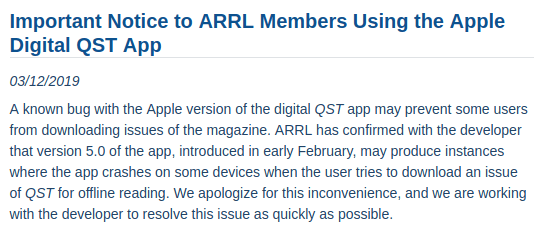
While the bug issue with the new version of the app was the initial problem, this has now become a policy problem. Apple has changed the way they consider QST. The app developer had the fix coded last month, but Apple will not let them upload it. We have investigated all options with both the developer and Apple — including appeals to Apple, largely to assure them that QST is a membership journal and not simply a magazine subscription. A new version of the app meeting Apple’s change in terms is being readied. We have our sights set on a weeks-long (not months) resolution. Additional information will be posted to ARRL News, found on the ARRL website home page and http://www.arrl.org/news”. Bob Interbitzen, NQ1R, ARRL Marketing Director e-mail to K4FMHOK, so now the issue is post-app crashing (for those developers with the app in the SDK) and at the feet of Apple’s iTunes App Store management. The developer (PageSuite) is most certainly a member of the Apple SDK community. This provides such developers with prior versions of iOS releases ahead of when Apple releases it to users. So technically astute developers have the versions of hardware that Apple says their iOS supports (including my 2016 iPad Pro), the new iOS software candidate, and their own QST app code. Well, they should, at least. Everyday, all day activity for development teams. Perhaps. I’ll get to that in a moment. Apple’s management rules for publication are something that the ARRL can’t really negotiate or deal with. It’s the contracted vendor’s turf and, frankly, their obligation to handle. Or, it should be under the terms of the contract with the League. But another issue in PageSuite’s app for ARRL’s delivery of the digital QST is that the app just crashes. When this happens, there is a report automatically generated. This is called, not surprisingly, a “crash analytic report” and the user is given a chance to have it submitted back through the Apple iOS system, ultimately, to developers. However, it is another step in the development process which costs time and, therefore, money. Without it, app Devs are Somewhat Out of Luck (SOL). It’s explained here (emphasis mine):
When an application crashes, a report called “crash report” is created. This will help understand what the problem is and where is it coming from. This will state the condition causing the iOS application to stop without prior warning. Most iOS app developers fail to implement this function during their iOS app development, and when there are no crash reports attached to an iOS app closing unexpectedly, there is little or nothing that one can do to solve the problem. So, it would be wise for an iOS app developer to implement crash analytic to the application during its development to help the application function the best possible way. With this in place, other causes of crashing in iPhone application can be reasonably reduced or stopped. http://blogs.perceptionsystem.com/ios-app-crash-7-reasons-why-an-app-crashes/Cutting to the chase on this, Bob’s done everything that I could expect him to do. I’ve been in software development, funded software development, designed award-winning software licensing models in the GIS industry, and so forth and so on. Bob’s got a difficult challenge here. Especially, since the public reviews have stated repeated and consistent negative issues with PageSuite’s QST app on both the Android and iOS platform since 2014, or for at least five years. It cannot be that PageSuite’s personnel is incompetent, although they do not follow the implementation of a crash report system which is “best practices” from Apple’s point of view. They’re too large and have too many production-driven clients to be incompetent. But what it may well be is that the ARRL’s custom app to just download and digitally manage the rights (DRM) to QST is not a big enough client to warrant the labor devoted to an issue in order to resolve it in a timely fashion. Back in the late 1990s, I was a respective $100,000 customer to ESRI and ERDAS and a $50,000 customer to RSINC annually, all GIS and remote sensing software vendors, on behalf of NASA and the State of Mississippi. Would my contacts at each vendor take my call? Every time! I’m a $100 a year customer to ESRI now as an individual consumer. Will they take my call? No. But I can post a question on their Forum for such small fry customers. That’s just the economics of software support. Is this the situation that the ARRL is in with the QST app produced by PageSuite? Is it that they are just not a big enough fish to get the right technical talent to keep the QST app on either platform working reliably? I do not know for sure but it would be consistent with the observable performance record and the corporate profile of PageSuite. I will close with this. The issues regarding the digital QST app over past five years or so are analogous to the Logbook of the World development. Great idea. Largely built or designed in-house (or something equivalent) at first. It was terrible in performance. But, scaled up, using modern IT designs, hardware, and implementation, LoTW now has over 1 billion QSOs in it’s database. It’s bigger, better and faster. And, the League is taking on business from the CQ Communications, Inc. line of contests! That improvement came about because of the heat that the Division Directors (Board members) received from the membership community. Bear that in mind. Moreover, the Zinio platform is where CQ Magazine has disseminated their digital version, DRM and all, with very few technical issues over the past several years that I’ve been a subscriber. (I had one subscription where my electronic payment wasn’t added to my current account but resulted in a “new” account such that I could not get my back issues. A phone call to Hicksville NY fixed that.) Thus, it just isn’t that getting magazine issues out to subscribed customers is that big of a deal these days. Others, like Apple Books and Kindle, do it at volumes a few magnitudes larger than the QST subscriber base. The Board of Directors, along with the President and CEO, should schedule a review of the contract with PageSuite at the next meeting. I am not pushing Zinio as an option but PageSuite has just not performed. As CEO Michel has gone on record with, adding value to the ARRL member is the mission of the day. Here, the member is not getting value added but value subtracted. This is especially the case for those members who responded positively to the Go Green! call by the League to opt-out of the printed version of the QST magazine. I’m sure they’ll get the April 2019 issue, eventually. But it’s been over a month and only a hope by Bob Interbitzen of a “weeks-long” hiatus that it will be resolved then. If this were a paper cut, a band-aid would be a prudent response. But this five-year run of an unreliable app on both the Apple and Android platforms requires stitches to firmly fix the problem, not a band-aid. If this issue reports to the Programs & Services Committee, here are it’s members:
- Dale Williams, WA8EFK, Great Lakes Division Director, Chairman; [email protected]
- Ria Jairam, N2RJ, Hudson Division Director; [email protected]
- David Norris, K5UZ, Delta Division Director; [email protected]
- Mike Ritz, W7VO, Northwestern Division Director; [email protected]
- Greg Sarratt, W4OZK, Southeastern Division Director; [email protected]
- Kristen McIntyre, K6WX, Pacific Division Vice Director; [email protected]
- Bob Vallio, W6RGG, 2nd Vice President (Officer Liaison); [email protected]
- Norm Fusaro, W3IZ, (Staff Liaison); [email protected]
Free Shipping for ARRL Members? Not Yet…
Obi Wan Kenobi might have uttered, ‘There’s a positive change in The Force’ these days in Newington. It’s no secret that the ARRL has been suffering from the transition of a career long Chief Officer (Dave Sumner) to a new CEO who can effectively lead the non-profit corporation, also a public charity, which declared a $20.5M net asset figure to the IRS for 2017. The failed interim CEO, Mr. Gallagher, tried to execute an executive style which he perhaps found successful in the financial world but a flop at a non-profit like the ARRL. His retirement after only a brief period in Newington was perhaps best for all involved. I wish him well as a fellow amateur radio operator. He just proved to not be a good fit as CEO of the League.

You’re Our Only Hope!
The realization by President Roderick and the changing Board of Directors that this executive style could not bring success to this transition in executive leadership at the headquarters in Newington CT resulted in the hiring of Howard Michel WB2ITX. He had been at the similar, but the far larger IEEE organization, which operates sort of like the ARRL for engineers and other technologists in the United States. It’s net asset declaration to the IRS in 2017, by comparison, was $415M! But he has shown in the brief time he’s been CEO in Newington that he understands the difference between management and executives in the non-profit world. More to come in a future blog post on that distinction.
At the recent ARRL Board Meeting, Mr. Michel was able to get approval for what seems to me to be a fundamental change in the organizational structure and, hopefully, the culture which drives the some 100 employees of the American Radio Relay League. While I may write more about these fundamental changes that the new CEO has put into action on February 11, 2019, here is synopsis from the League’s website:
‘The Board received the report of ARRL CEO Howard Michel, WB2ITX, who outlined plans to reorganize and refocus the activities at ARRL Headquarters. Michel said providing better value to membership is a top priority, and he sees value creation and value delivery as key components to long-term membership retention and growth.’

Better value to membership? Now, that is a mouthful to us members! The operational details of that value proposition will be what members, including former and potential members, will consider and remember. That is, what is the ARRL actually going to do in order for members to see a greater value in their annual dues? They could be convinced with a quick strategic example: offering free shipping & handling on purchases from the ARRL Store to current League members!
Let’s look at this small but important thing of free shipping and handling. As I discussed with Dan Romanchik KB6NU on the ICQ Podcast this week, he and I both are Amazon Prime members. Our British colleague, Martin Rothwell M0SGL, smiled at this recognition during our recording as he works for Amazon across the Pond. Dan and I both stated that we tend to not buy books and related items directly from the ARRL website because of the stiff shipping and handling fees. Instead, Amazon Prime members get free shipping on most items which Dan and I take advantage of with these purchases. So Amazon realizes the retailer’s profit margin from the sale of ARRL products through the Amazon.com website. The League, however, only reaps the wholesaler’s margin.
To be fair, the League does give a few Members Only discounts of, say, $3, off of a $27 book—if the League publishes the book. (Note that the League also resells RSGB publications so they probably have those price arrangements locked in without much margin to discount.) And, there are periodic discounts sent out to members via postcard or email advertisements. I’ve found that they only amount to relieving me of the net shipping charge. I cannot use any other additional discounts such as the annual Birthday Discount that I get during my birthday month. As a certified ARRL Instructor, I get a discount on some purchases but I cannot use any of these other discounts. All of this complexity adds up to the member just using Amazon Prime or just not buying a book or other product on impulse. The moment of excitement passes.
I’m a retired Editor-in-Chief for Springer Media, a very large scientific publisher based in The Netherlands. I ordered all the textbooks in my college bookstore as a student worker back in the early 1970s. In between, I launched two peer-reviewed scientific journals, edited others, and negotiated publication relationships with several major publishers. I’ve been an editorial consultant to a dozen or more textbook publishing houses. So I come at this from decades of experience in the publishing industry, not just the consumer side of publishing. So let’s look at typical publisher (wholesaler) and book reseller (retailer) relationships. Many hams may not realize the pricing structures in place worldwide on book publishing.
But the ARRL will ‘lose’ money by offering free shipping and handling to members, right? I can certainly hear Marketing Manager Bob Interbitzen NQ1R saying that upon hearing this idea. Perhaps not. They may actually make more money. Amazon is a major bookseller (an understatement if there ever was one). The typical wholesale discount to a retail book seller is 55%. Large retailers might get 60% while the independents buying them for 40% of the stated retail price. Thus, the ARRL sells Amazon and perhaps others these books at a greatly reduced wholesale price but not when the point-of-sale is through the ARRL Store on their website.
“The typical wholesale discount to a retail book seller is 55%.”
I do not know what the ARRL’s financial terms with Amazon or other retailers is. But it is highly unlikely that it differs substantially from these industry norms. After all, amateur radio operators are hardly a significant market for Amazon to break with their acquisition norms for retailing. I wish it were different but it’s not. The actual financial relationship that the League has with it’s retailer on books and other items could be something very, very different. I want to acknowledge that. But, if it is, that’s another issue. Moreover, shouldn’t that information be made known to the membership?
So, if the ARRL could do something to stimulate more direct sales to members from their website, they would recoup the wholesale discount to Amazon on each of those sales, right? What could drive more members away from Amazon (especially Prime members) and back to the League’s Store?
If CEO Howard Michel’s intention is to increase value to League members, giving them free shipping and handling because they are members would do that. And, it would do that in a tangible and visible way to the entire membership of some 150,000 out of the 750,000 or so license holders in the U.S. Trading out the typical 55% wholesale discount to Amazon (and other retailers) to increase the value of membership would actually result in a higher profit margin to the League, all things being equal. Mr. Michel would indeed qualify as the Obi Wan Kenobi of the ARRL should he bring this about. The League should, at least, run honest numbers on this change to see what the financial impact might be on current revenue.
“The business of increasing the value of membership in the American Radio Relay League: that would be a good deal. And a good deal for both members and the League itself!”
But it would also be like a lightning strike to ensure that the membership sees and believes that this reorganization of the ARRL Headquarters means business. The business of increasing the value of membership in the American Radio Relay League: that would be a good deal. And a good deal for both members and the League itself!
Will they do this? I don’t know. But your telling CEO Michel and your Division Director that it’s what you want would help get it on their minds. And having the CEO and Board of Directors listening to you hams, whether you’re a current member or not, is definitely a good deal!
MiniTiouner DATV Receiver built
The build was straightforward and there are some instructions by Mike G0MJW but only really referenced them for the commissioning stage, checking voltages etc. I was pleasantly surprised to see a large degree of protection on the board, fuses both filament and poly-fuse, reverse protection and zener diodes in the circuit.
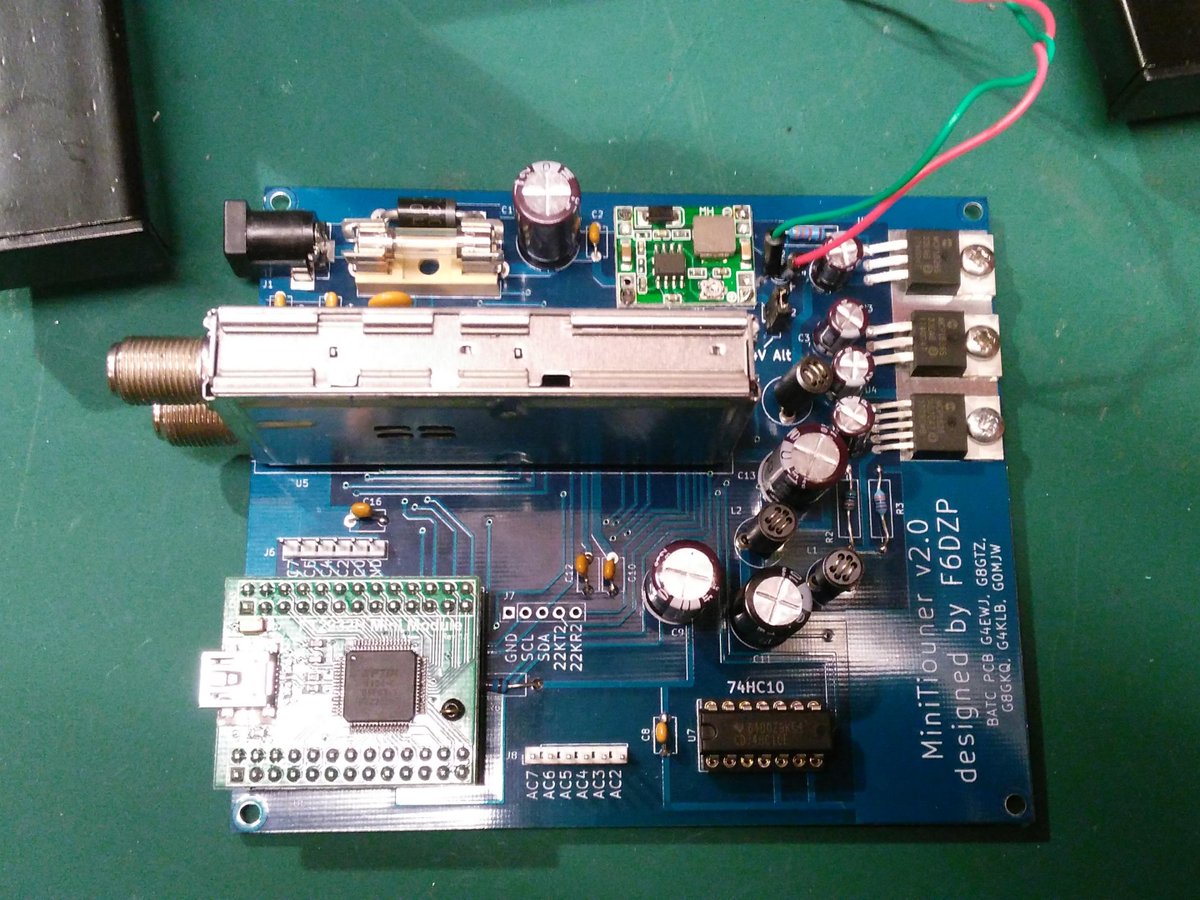
The MiniTiouner uses free to download DVB-S receive and analysis software called "Minitioune" written by F6DZP. The Software is hosted on the VivaDATV forum. So I registered and downloaded the software.
V8.0 of the software requires a pull-down resistor adding to the USB module to identify the type of board, so that was added (not pictured).
Power was connected and then plugged the USB lead into the PC (Windows 7 32bit) and it went off and installed drivers. The documentation said I should see two USB controllers, but I was seeing four?
There are several test programs included in the software package to test drivers and board and they were showing errors.
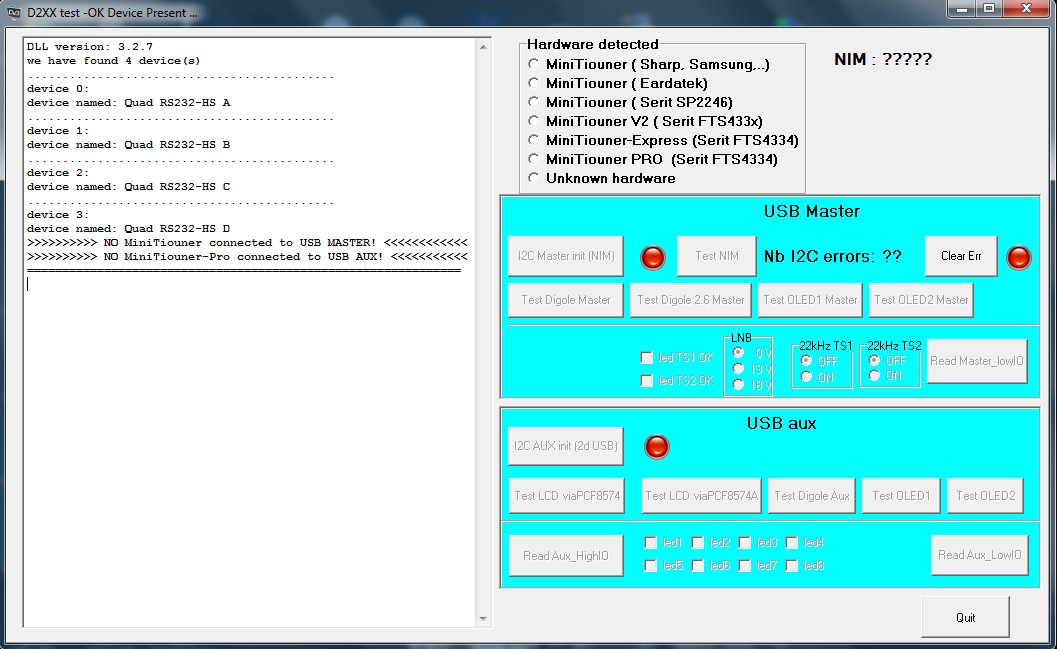

The PC I was using has had no end of serial USB devices plugged in and out over time so suspecting another Microsoft Windows "disappearing up its own backside" driver issue I tried it on another more vanilla machine but had the same problem.
This seemed to point to the USB interface (an FTDI FT2232H Mini Module) perhaps it wasn't programmed? So I downloaded the FTProg utility from FTDI but instead of seeing a FT2232H was showing it as a FT4232H device.
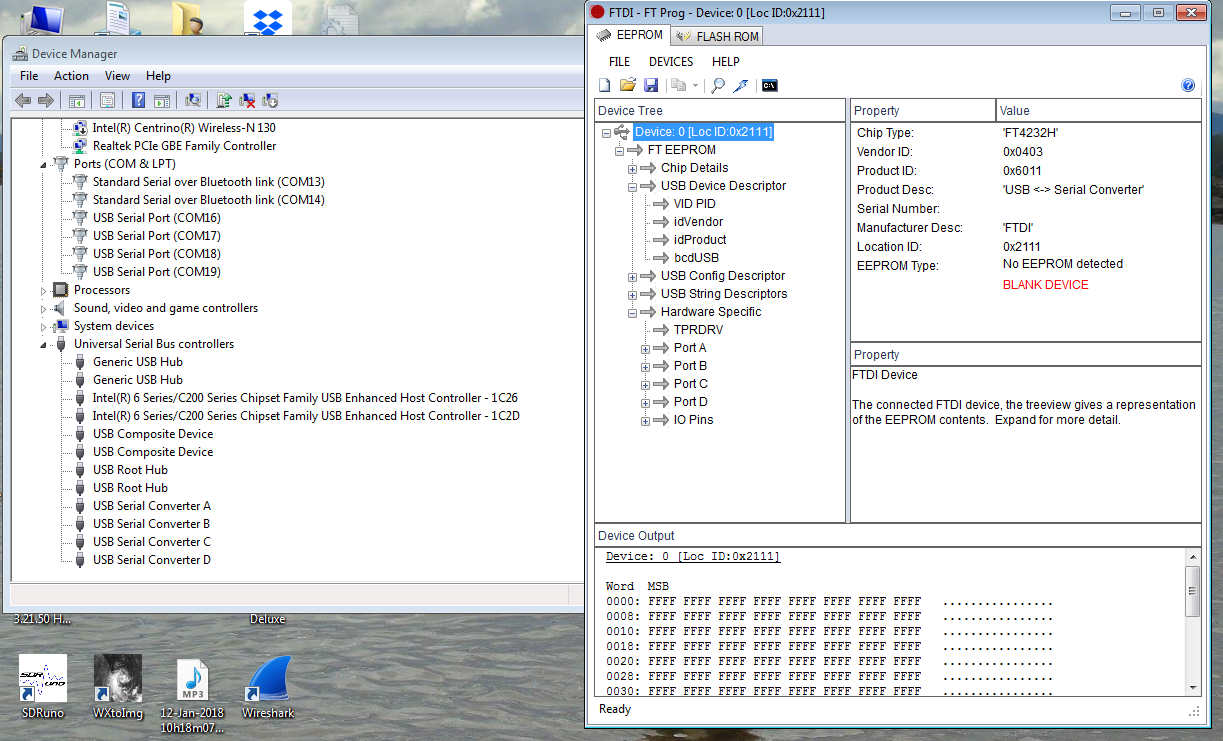
Doing a Google found a reference to the same problem. I downloaded the data-sheet and checking with a meter I could see pins CN2-5 and CN2-11(VIO) on the module didn't have 3.3V for some reason and as the post said if the VIO pin is missing 3.3V it defaults to a FT4232H. In the end I checked my soldering (no fault found) I removed the module from the socket to examine it and after re-seating it the board sprang to life so seems it was just a bad connection.
Eager to test I set up the ADALM-PLUTO SDR running DATVExpress as I'd done previously with the commercial set-top satellite receiver and we had a picture! It was time for a cup of tea!

Now it was working all that was left was to put it in a box.

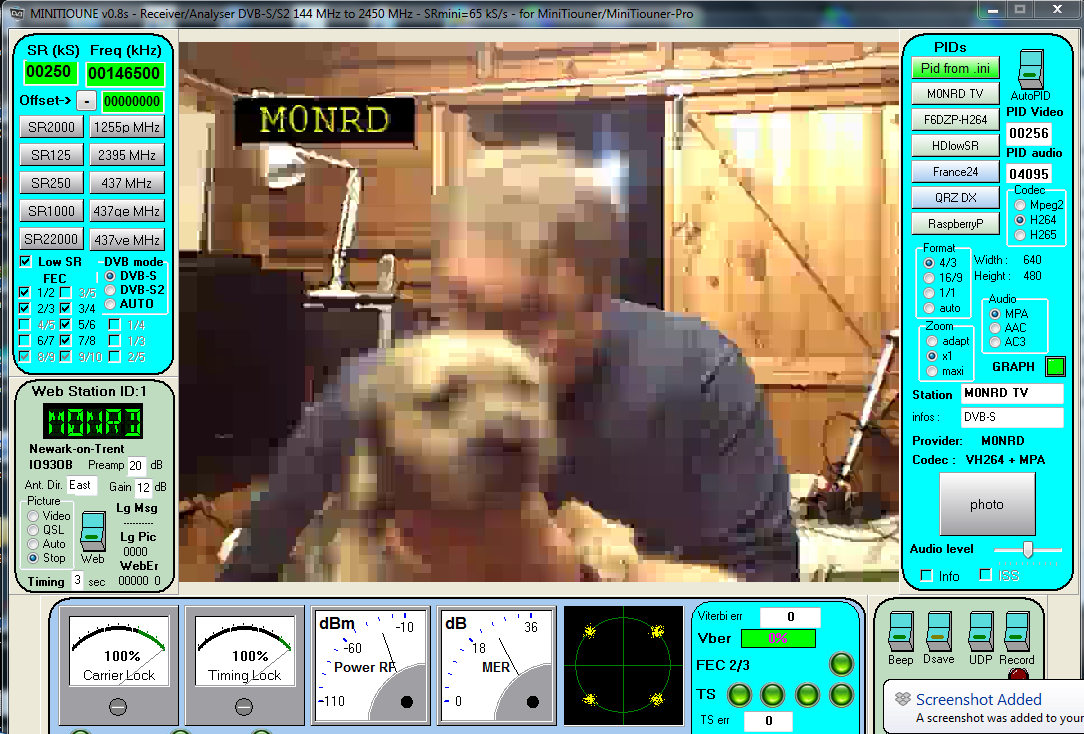
I have only had a brief play with the software since the weekend but was interested to see if I could receive some RB-TV (Reduced bandwidth) So I set the Pluto and DATVExpress to transmit on 146.500MHz using a low symbol rate (250 Ksymbols/s) and it worked! Bertie was wriggling a bit too much for a clear picture but I had now actually used my 146-147MHz NoV. Now just got to learn and understand the various modulations and settings.
I was able to try out another piece of software, the Spectrum Analyser from Steve Andrew for the SDRPlay. It turns the SDR receiver into a handy spectrum analyser with 10MHz bandwidth from 1kHz upto 2GHz and was able to check the output of the Pluto.
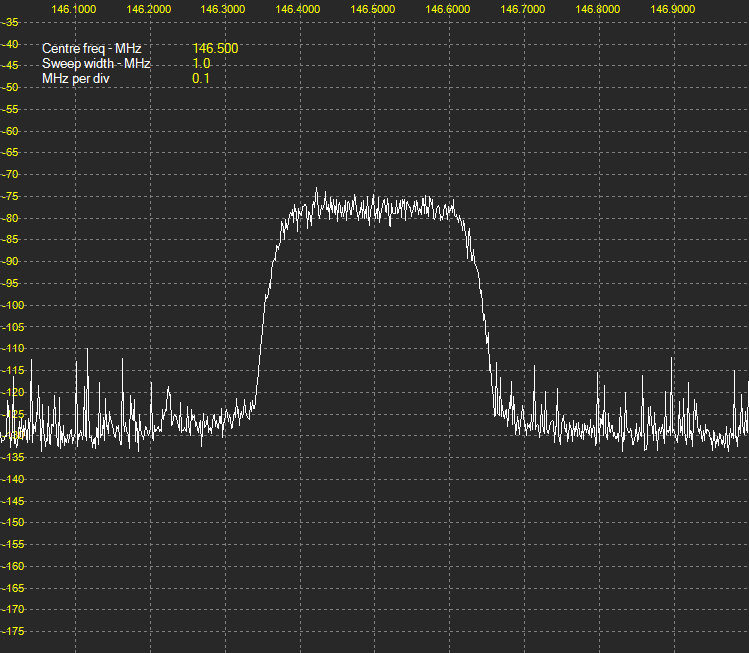
This wasn't a proper test setup by any means, the SDRPlay was still connected to the dual-band collinear outside the shack so the noise is the usual hash I see, but the Pluto was putting out a decent waveform, it did help putting on a proper resonant antenna (a spare mobile magmount) rather than the tiny one supplied.
I plan to do a bit more with the 5.6GHz FPV stuff before the weekend having took delivery of some nice grid antennas and hope to get out to try a contact or some tests with members of SKARS 73













