Posts Tagged ‘amateur radio’
 Handiham World for 04 August 2010
 August 4th, 2010 |
  Author:
 Welcome to Handiham World!
Daisy book version of Handiham World Summer 2010 is released

DAISY books provide spoken word audio that is connected to text. The Summer Handiham World will soon arrive in regular print, but that isn’t much good to our blind members, except for the giving envelope that will be enclosed. We are hoping that our members will help us out with a little extra this summer so that we can keep our services coming.
Now we are offering a Daisy version of the newsletter, and we think you will enjoy it. The print edition of the newsletter doesn’t have the complete set of articles that this Daisy version has. The reason is that a print newsletter is limited to only 4 pages. We can make our Daisy version as long as we want.
Why should you use a Daisy book? Well, that is a good question. You may have been satisfied with cassette tape books for the past 30 years or more, and the tapes played nicely in your Library of Congress audio book player. Indeed, that technology has served our Handiham members very well over the decades, but it has its shortcomings. Tapes would sometimes not be recorded properly. Occasionally parts of the audio would be cut off when the tape wasn’t quite long enough. Once in awhile a tape would break and wind itself around the capstan or rubber drive wheel in the player and really make a mess. The cassettes themselves did not hold much program material, even in the 4-track format used in LOC players. The audio quality was poor, and even worse in 4-track mode where the tape speed was half the normal speed. If you wanted to find a particular article or chapter, you either had to guess which tape it might be on (a typical book had multiple cassettes) and which side and track it might be on. This was seldom a big deal if one was listening to a novel, but if you were reading some kind of a textbook or reference book and wanted to find a particular topic, well, let’s just say you had your work cut out for you.
DAISY is an acronym that stands for “Digital Accessible Information System”. It is properly spelled in all capital letters, but generally when I write articles I capitalize only the D so that Daisy production software will say “Daisy” instead of spelling out each letter. In this article, I have mixed both spellings. Maybe some of our readers who use Jaws or Window-Eyes will let me know if those screen readers differentiate between the two spellings. I do know for sure that the Daisy production software behaves as I said, spelling out Daisy if all the letters are in caps.
That little trick is just one of many that I have learned in producing accessible materials for our Handiham members. Even so, every time I work on another production I learn something new. I could say plenty more about that, but I still haven’t told you about the advantages of reading a Daisy book instead of a cassette tape book. A Daisy book can be played, which means to say listened to, on the new Library of Congress players that are currently being issued. You can also listen to a Daisy book on your computer. Often times the Daisy book can be simply downloaded via the Internet, which allows the user to bypass the time-consuming process of using regular postal mail. Your Library of Congress player can play the Daisy book that you download to your computer if you wish. If you don’t like the Library of Congress player or you think it’s too large to carry around when you are going places, you can buy a commercial Daisy player that will double as an MP3 player.
Since Daisy formatting includes the text of the book, you can use your player to search for a term within the text and skip directly to that part of the book. Or you can browse the book’s contents and go to the section of the book, say a particular article, that you want to read. There is no more fumbling around with a box full of cassette tapes that get mixed up, since a Daisy book can fit on a single USB cartridge or in a single folder on a personal computer.
The audio quality of a Daisy book is very good to start with, and it stays that way no matter how many times you play it. A Daisy book doesn’t wear out, break, and get tangled up like a cassette tape.
Are you ready to learn more?
How to get started:
You will need a DAISY book reader. You can easily read DAISY on your computer, but you need a software program to do so. AMIS is a free of charge, open source DAISY book playback software. Version 3.1 is the latest stable release of AMIS. You can view the release notes, learn the latest news, or download AMIS by visiting Daisy.org.
Next, you will need to download the Daisy book, in this case the Handiham World Summer 2010 newsletter itself. It is a zip file, and you will find it on the Handiham website.
Unzip the file with an unzipping utility (built into later versions of Windows or freely available), and place all the files in a single folder. Then use AMIS to open the book. The file you want AMIS to open is speechgen.opf. All the files from the folder must be in the same folder for AMIS to read the book.
I don’t expect all of our readers and listeners to figure this out without running into a few problems. As with anything that must be learned, being patient is definitely a virtue. If something doesn’t work the first time, go back through the instructions and make sure you didn’t skip some vital step. The DAISY website has a frequently asked questions page just for AMIS.
Hopefully you will find that reading Daisy books is both easy and fun. If you haven’t tried Daisy yet, this is your chance! If there are any volunteers out there who want to help us make books into Daisy format, please let me know. It does not require a huge investment, and you may even have all of the computing equipment you need. I am considering making some tutorials and also teaching Daisy book use at our next Radio Camp session in August, 2011.
Links to the resources mentioned here are available on the Handiham.org website. We don’t include links in the text of these stories because they mess up the podcast production process.
73,
Patrick Tice, WA0TDA
Handiham Manager
[email protected]

Warbler now finished and working
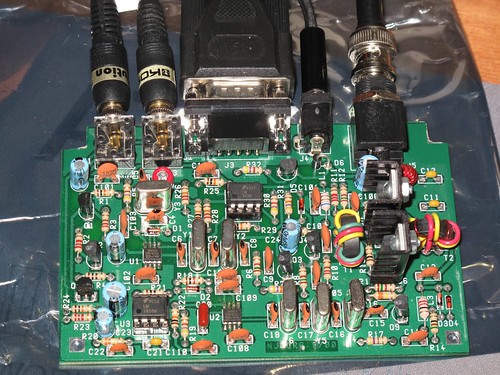
Warbler smoke test
I finally finished my Small Wonder Labs Warbler kit last night. This was started probably two years ago and then was shelved for no particular reason other than I was working on other projects. Last week I decided it was time to get it finished and so have been working on it in the evenings. It is a nice kit with a clever design based around colour burst crystals and the receiver is direct conversion. It was straight forward to build but note there are two SOIC components, the SA612 mixers (look for U1 and U2 in the photo above).
When it came to the smoke test it worked first time. I adjusted the one tuning capacitor (the only adjustment), for frequency alignment and checked power out. Alignment was done as recommended with W1AW which was coming in well (see the screenshot below). On transmit, I get 2W out on my Radio Shack power meter. It is expected that you can get 3 to 4W out of the Warbler. Given the accuracy of the meter I happy with what I measured.

Warbler working and decoding W1AW. Software is Fldigi running on Xubuntu
I have an aluminium enclosure, which is a tight fit for the board, so there is some careful drilling and filing to come. You can see in the photograph I have already cut out the corners to accommodate for the enclosure screw mounts.
Given the simplicity of the transceiver I am very pleased at how well it works. No contacts yet, so will have to see what the IMD is later. Anyone within 100 miles or so of Ottawa want to try a QSO?


Try some Cornbread Road

Image by permission from KE9V
Jeff, KE9V, has recently released a podcast called Cornbread Road. It is quite a different type of amateur radio podcast. It is not a commentary or discussion of amateur radio, it is a story with amateur radio involved in it. The production quality is high and I have found the story captivating. Jeff tells me the next episode, number 6, is out tomorrow (Sunday 1st Aug.). If you have not already sampled Cornbread Road give it a try, I recommend it.


Handiham World for 28 July 2010
Welcome to Handiham World!

Update: Larry Huggins, KA0LSG, Handiham Volunteer, holds the Wouxun HT on cover of Worldradio
Last week’s mention of the Wouxun talking dual band handheld radio created quite a stir, so we are devoting some time to a follow up. I heard from a number of our readers and listeners who said that the PDF online version of the “With the Handihams” article was difficult to read because of the PDF layout. Although the magazine has done a great job making the layout easy to follow for sighted readers, I have heard that there is a need for a more straightforward text version for our blind readers and listeners. I have placed the text of the article on the Handiham website, as well as a link to an audio version of the article read by Bob Zeida, N1BLF, who reads for us and for The Talking Information Center of the Massachusetts Reading network. Since we didn’t specify retailers, we also provide you a link to some sources.
Those of you who listen to this podcast will hear Bob reading “With the Handihams”.
Before we get to those resource links, there is word that Wouxun is interested in developing a talking dual-band base/mobile rig. I read about this on a discussion thread on the Blind-Hams mailing list. At this point, they are interesting in learning what accessibility features are most needed, so this may be a rare opportunity for anyone who wants to have a say in the early design of a radio to get their voice heard. To comment on this, you may email Ed at Wouxun: [email protected]. That is also the address to request a price list and ordering information. The Wouxun.us website states “Due to having minor surgery, I will not be shipping orders between July 26 – Aug 7. During this time I will answer emails and take orders.” With this in mind, I would guess that you may need a bit of patience in communicating with Ed, especially if you have questions. I would urge our readers and listeners to keep the questions simple and don’t ask a bazillion of them. In fact, the website is easily navigated and you can find the answers to your question there. The pricing is under $110 + shipping, and a variety of accessories are available. Remember that you can get this radio in a dual band version that includes 2 meters and either 70 cm (440 MHz) or 1.25 m (222 MHz.) The pricing is the same for either combination.
Please see the Handiham.org website for the story & resource links.
Our thanks to CQ Publications and the Blind Hams Mailing List for helping us get the word out about accessible technology.
For Handiham World, I’m…
Patrick Tice
[email protected]

200 Ohm Feed Point Off-centre Fed Dipole

The off-centre dipole installed on Field Day 2010 (photograph and copyright of Chris Weisner, VA3SM)
As I mentioned in the earlier Field Day 2010 report, the CUARC group built two antennas for the event. In this post I will describe the first one of these, an off-centre fed dipole.
The common place for the feed point of the off-centre fed dipole is at a 1/3 : 2/3 split in the arms. This has the advantage of providing low SWR (with a 4:1 balun) at even harmonic frequencies, such as 20m and 10m for an antenna cut for the fundamental frequency of 40m (around 66ft). Whereas a centre-fed dipole will only have the odd harmonics which for a 40m (7MHz) dipole is 15m (21MHz).
Rather than use the traditional off-centre length split of 1/3 : 2/3 for our Field Day antenna, it was decided to follow the design proposed by Richard Formato, K1POO, in two technical correspondences published in QST 1,2 and followed up with further article with by Dale Gaudier, 3. In this design the feed point is moved closer to the 1/6 point on the short arm, the advantage being stated in the articles that you should get a 200Ω feedpoint there and so a low SWR on 40m, 20m, 15m and 10m bands when using a 4:1 balun, with no need for an antenna tuner unit. The emphasis on the 15m band is intentional as a low SWR on that band is not usually possible with an off-centre fed dipole with the feed at 1/3 : 2/3 and a 4:1 balun. Four bands on one 69 foot wire antenna with no tuner looked very attractive for Field Day.
The antenna was cut carefully prior to Field Day and the end insulators were added. When cutting the antenna the length measurement included the ‘pig-tail’ connections that I have on the 4:1 balun. The diagram below shows the arrangement of the antenna.

The off-centre fed dipole for 40m, 20m, 15m and 10m
On the day the antenna was installed between two trees at about 35ft off the ground. While the second antenna was being constructed (to be featured in a later post) its SWR was measured with my Autek RF-1 antenna analyzer. The results were taken by Maria, VA3MMI and Gil, VE3JRY and are tabulated below.
_______________________________________________
Band (m) 2:1 VSWR Range (MHz) Minimum VSWR
40 3.1 : 1 (at 7.38 MHz)
20 13.29 – 14.65 1.4 : 1
15 21.20 – 22.31 1.5 : 1
10 27.78 – 29.25 1.7 : 1
_______________________________________________

Maria, VA3MMI and Gil, VE3JRY record the SWR (photograph and copyright of David Scott, VE3ZZU)
The overall results were very pleasing, although the 40m band was a little disappointing. This higher than expected SWR on 40m was also encountered by Dale, M0AOP/K4DG, and was reported 3 by him to be due to the severe imbalance in the antenna, so requiring a choke balun to remove the stray RF on the coax. We did not try a choke balun, since we were unlikely to operate on 40m, that was another station’s band of operation. However we had an antenna tuner unit if we needed to try and tame the SWR. It was very good to see the SWR profile observed in reference 3 was repeatable.
On Sunday morning Maria, VA3MMI, returned with a portable analyzer borrowed from work and did a sweep analysis. The response is below and markers have been inserted to show the minimum SWR associated with the bands. Thanks goes to Maria for the measurement and the plot.

Off-centre fed dipole SWR plot, with markers.
It would be interesting to remeasure the SWR response again with a choke balun in place. I expect the SWR will drop below 2:1 within the 40m band as found by the author of reference 3. If this does happen then four bands and no tuner needed makes this antenna one for serious consideration on HF. Even without a low SWR on 40m the antenna offers three bands and it performed well on 15m and 10m for us on Field Day.
As a final note, I should reiterate the warning by Dean Straw, N6BV, at the end of reference 1 where he warns about using the antenna on 30m, 17m or 24m, as a very high SWR could damage the balun at the feedpoint.
References
1. “Improved Feed for the Off-Centre-Fed Dipole” R. A. Formato, K1POO, Technical Correspondance, QST, May 1996 p76.
2. “Off-Centre-Fed Dipole Comments, Part 2″, R. A. Formato, K1POO, Technical Correspondance, QST, October 1996 pp72-73.
3. “Choke the OCFD” D Gaudier, M0AOP/K4DG, Technical Correspondance, QST, September 1997, pp82-83.
Note: all three of the above papers are collected together in “More Wire Antenna Classics Volume 2″ ARRL, (1999).
The Field Day photographs above are from the Ottawa Valley Mobile Radio Club’s photo gallery.


A Tale of Three Field Day Weekends
Since becoming licensed in the Fall of 2007, I’ve participated in every ARRL Field Day event since becoming licensed (2008, 2009 and 2010) and can honestly say I’ve had fun each and every year.
Let me explain, my three field day weekends mention above are not my only field day weekends. As a child I attended at least one FD with my Uncle, K5SOR perhaps more…But one I remember really well.
Anyway, in 2008 I was honored to have the opportunity to spend my first field day as a licensed ham with my Uncle. He and I went down to his childhood home of Cleveland, Texas and participated with the SHARK (Sam Houston Amateur Radio Club). Many of my Uncles friends belong to this club and just about all have been licensed for over 50 years. The 2008 FD event with the SHARK club was a lot of fun. We operated as N5AF, a 1A station in STX.
Last year in 2009 I spent Field Day weekend with my local club here in Denver. We operated as W0TX, a 6A station in CO. We setup out near Hudson, CO at an old AT&T site. The site is literally in the middle of nowhere. It was hot, it was dusty and dry. The Rocky Mountains just west of Denver teased us with every glance. But…it was fun.
As I began thinking about what I wanted to do for Field Day 2010, the thought of a hot, dusty location just didn’t appeal to me. After all, I live in one of the most beautiful states in the lower 48. I kept thinking of all the advantages to having Field Day in the mountains. First, the daytime temps could be anywhere from 10-20 degrees cooler than those down in the city. Second, the elevation difference sure wouldn’t hurt from an operating position. Third, the smell of pine is just incredible. It was decided….my third Field Day….Field Day 2010 would be in the mountains.
I discussed the idea with a few friends and back in the March/April timeframe all thought it was a great idea and everyone was in. At that time there would be three operators. Our number one goal was to have fun. We weren’t out to win anything…just have fun and prove to ourselves we could pull something like this off. We stayed in touch via email and every couple of weeks we would update logistics and add more to the overall planning checklist. We would keep things simple and operate as a class 1 station. The decision of power was yet to be determined.
As we got closer and closer to Field Day weekend, more and more issues began popping up for the three of us. It was pretty clear we would only be able to operate on Saturday as we all started having scheduling issues with Sunday. But that was OK. We planned to operate for 6 hours or so and break down our operation and be back home before dark. Remember, our number one goal was to have fun.
Just a few days prior to Field Day I got the call. One friend had to bail on the plans. And then there were two. But….no sooner as I even thought that….the second friend sent me an email saying he would be unavailable. And then there was one…..ME! Well I wasn’t going to let this ruin my plans and I wasn’t going to change my plans either. I wanted to operate Field Day in the mountains….I wanted to have fun and I wanted to smell pine trees while doing all this.
Now my wife is THE BEST wife a ham can have. She supports me and my hobby and all that goes along with it. She agreed to go with me. Give her a picnic lunch, a comfy chair and a good book and she’s very happy. We’ve gone on picnics before where I take my Yaesu FT-817 and Buddipole and she takes a book and we’re both happy doing what we enjoy for 2-3 hours. I figured the same could be true for Field Day.
All was set, the car was loaded and it was time to head up the hill. We have a favorite little park just up from Evergreen, Colorado. It’s a great site because there is almost no one there and it sits up overlooking the town of Evergreen. We arrived just before 11 AM local time (1700 UTC) and I had an hour to get my station setup. Field Day would start at High Noon.
My wife the day before encouraged me to leave the generator at home and try operating “green” for field day. Now understand, we’re not tree huggers or anything like that. By the way….there is nothing wrong with being a tree hugger. Yes we care about the environment and we do our part to make a difference. I have batteries and I have solar panels. What else do I need?
So we arrived and I began setting up. The forecast was calling for a beautiful day. Of course, I checked the forecast the day before and didn’t bother checking again that morning. Like other places….In Colorado, wait 5 minutes…the weather is sure to change and change it did. We quickly had our meal just before noon and I was setup. About 5 minutes before noon the clouds began to roll in. Hmmmmm, solar panels not working. No worries….this will blow over and as long as it doesn’t rain……
I managed to work about 5 stations and then I felt it. Yep….one single, tiny little rain drop. But you know….where there’s one. Possibly the one piece of equipment I did not take with me (other than a portable sun) was a canopy. So the rain drops turned from one to many and so the gear needed to be packed away. Saint Maximilan Kolbe (the Patron Saint of ham radio operators) was truly looking out for me because no sooner did I close the back of the Ford Escape, the bottom fell out. It rained and it rained some more. Knowing the weather would not clear up for the next few hours, we decided to start heading back to Denver. I finished out my Field Day fun for Saturday afternoon and even a few hours on Sunday morning from a local park with just my buddipole and my Yaesu FT-897.
So….do I have a favorite Field Day weekend from the three? Well…certainly nothing will ever top sharing field day with my Uncle. But I still managed to have fun and as with the two years previous, I did learn a few things. As for Field Day 2011, I’m not sure where or how it will turn out. Field Day in the Rocky Mountains??? It will happen some day.
Until next time,
73 de KD0BIK
Jerry
Handiham World for 21 July 2010
Welcome to Handiham World:
A volunteer summer continues as Larry Huggins, KA0LSG, makes the cover of Worldradio

Larry Huggins, KA0LSG, is right there on the cover of the latest Worldradio magazine. Way to go, Larry!
The photo is from Handiham Radio Camp, where Larry volunteered as an instructor. In the Worldradio article, you can read about the blind-accessible HT that Larry demonstrated to our Operating Skills group. The article is my annual accessible radio roundup, a quick overview of radios and their accessibility features. It is entitled “What’s New for the Operator With Disabilities”, and is a feature of my regular “With the Handihams” column.
“Regular readers know that from time to time I devote a column to what’s new in amateur radio equipment and software that is accessible to people with disabilities. Most of the questions I get have to do with what is blind-accessible, both for radio hardware and computing. Our largest single accessible technology user group is amateur radio operators who have some kind of reading disability, usually blindness or some degree of vision loss. I think this is probably a long-term trend as more baby boomers encounter age-related deterioration of their eyesight. Macular degeneration is relatively common in older folks and because of its onset late in life can catch them off guard and leave them wondering if they can still use a computer or even get on the air effectively anymore.”
There are always questions about accessible handheld radios, so this part of the article is timely:
“Handiham volunteers Larry Huggins, KA0LSG, and Ken Silberman, KB3LLA, both found the new Wouxun 2m/70cm KG-UVD1P HT at Dayton, and Larry actually had his radio along to demonstrate to us at Handiham Radio Camp.”
Read more on the Worldradio website.
Our thanks to CQ Publications for helping us get the word out about accessible technology.
For Handiham World, I’m…
Patrick Tice
[email protected]














