Posts Tagged ‘amateur radio’
 Handiham World for 29 August 2012
 August 29th, 2012 |
  Author:
 Welcome to Handiham World.
New Tech Net Begins Next Week!

It isn’t every day that we launch a new net. The official start date is on Thursday, 6 September 2012. The net will meet at 7:00 PM each Thursday United States Central Time and will remain true to local time throughout the year.
Here are some key things to remember about the new Tech Net:
- It is perfectly okay to simply listen to learn. You are participating just by listening.
- You should check in if you have a comment or question related to a technical topic. (Checking in to get on a net roster is not part of this net.)
- When it is clear that a particular topic is under discussion and the discussion is not finished, please do feel free to add to the discussion if you have additional information on that topic. If you have some other technical question not related to the topic at hand, please wait until the current topic has been discussed and it is time to move on.
- The net will be moderated and the discussion facilitated by the Net Control Station (NCS).
- The Handiham Tech Net will meet each Thursday evening at 7:00 PM USA Central Time and last around an hour.
- The net is heard on the following nodes and links:
HANDIHAM conference server Node 494492 (Our preferred high-capacity node.)
KA0PQW-R, node 267582
KA0PQW-L, node 538131
N0BVE-R, node 89680
IRLP node 9008 (Vancouver BC reflector)
WIRES system number 1427
Email me at [email protected] with your questions & comments.
Patrick Tice, WA0TDA
Handiham Manager
Handiham remote base station report
Thanks to Jose, KK4JZX, we are making some great progress on some of the software issues that our users have been experiencing. One such issue is some pretty noticeable lag in the response of the software to user input. For example, I can press the space bar to toggle the transmit/receive and I have counted delays up to six seconds! Other times the response will be nearly instant, as it should be. This was found to be caused by the code in the software telling it to reference a website that was no longer available. While the software waited for a response from a website that was never going to answer, the delay appeared. Echolink users who regularly use public proxies are familiar with how the application is unresponsive when it is querying a proxy that either does not exist or is already in use. This is a similar deal, so we are working on a way to fix it.
HOSTS file Phone Home fix
Remote Base Update: After a couple of weeks of code analysis, a workaround was found by KK4JZX. It has been found that the W4MQ client wants to “Phone Home” for some reason and, thus, the workaround requires that Handiham remote base users implement the HOSTS file Phone Home fix. Once the Phone Home fix is implemented, the W4MQ client will function much faster for both sighted and non-sighted users. Reports are coming in and we are getting feedback indicating that the experience is a much more rewarding one. The delays encountered with the PTT function are gone and it is now much more responsive. Stay tuned for additional fixes that we plan to release as part of the Handiham remote Base client software bundle!
You may visit the remote base website to download the current installation files, which do not yet contain this fix.
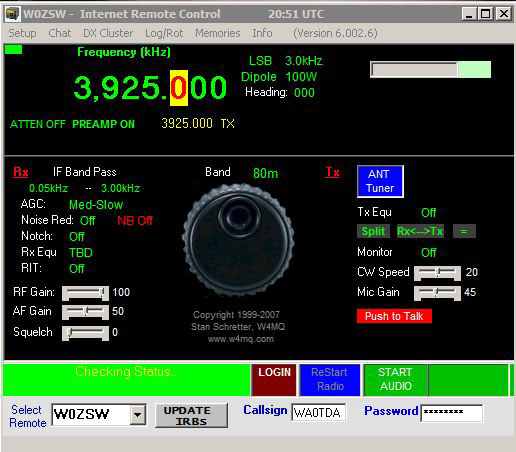
W0EQO at Courage North is in service. W0ZSW is in service.
Solar Activity Forecast: Solar activity is expected to be very low to low with a slight chance for moderate activity for the next three days (29-31 August).
Geophysical Activity Forecast: The geomagnetic field is expected to be predominately quiet for days 1-3 (29-31 August).
Credit: NOAA Space Weather Prediction Center
Please contact me directly at [email protected] if you have a remote base comment.
Planning My New QTH (Ham Radio Station) Part I Of III: Taking Inventory Of My Evolving Interests
We moved to Glade Park, Colorado last November and, unusual for me, I’ve been planning my new QTH before commencing construction (QTH = ham radio ‘Q code’ for ‘location’ which hams use to as a catch all term for their home and ham station). I’ve had pretty big ‘antenna farms’ over the years in Malibu, California, Tiffany, Colorado and East Topsham, Vermont. Each time my enthusiasm to get back on air led me to ‘plan’ as I built. Although each of these stations performed very well on the air, I eventually realized that each station could have been better. So this time, it’s different…
My inspiration to be patient and plan has been the detailed and thoughtful strategic planning that my friend Tom Taormina, K5RC, is employing in the updating of his potent ‘contest station’ (a ham radio station optimized for radio contesting a/k/a ‘radio sport’) near Reno NV. Tom has a club callsign that he uses in contests, W7RN. If you’re a radio contester you no doubt recognize this callsign.
Tom was a NASA executive during the Project Apollo glory days and today is an author and ‘Forensic Business Pathologist’ using his NASA expertise to advise corporations on employing rocket science – literally – to operate their businesses better. Tom’s contest station planning is extraordinary in scope and detail. (Tom’s business Website is www.itwasrocketscience.com and you can learn more about his contest station at www.w7rn.com.)
Since re-entering the amateur radio hobby in 1989 I have spent most of my ‘on air’ time operating radio contests on the HF bands (HF is technically ‘High Frequency’ 3 to 30-Mhz, but most hams consider the Medium Frequency 1.8-MHz ham band to also be part of the HF spectrum) and in between contests making contact with as many countries as I could on each different amateur radio band between 1-MHz (’16o meters’) and 50-Mhz (’6 meters’).
By 2003 I passed 2,800 total ‘band-countries’ (total number of countries contacted on each band added together). 2003 was the year my daughter was born and also when my professional responsibilities – then in the music business – multiplied. Fatherhood and career conspired to soak up my ham radio time and my station, we were living in Vermont at the time, gathered dust for 8 years by which time I had changed careers and moved the family back west.
Most mornings I wake up and gaze at the sun rising east of our 35 high desert acres in Glade Park CO, where we moved late last year. Glade Park is a small community perched on a high plateau west of Grand Junction. Its rural, scenic, private, dry, sunny and as far as I can tell, a great place to ‘grow some aluminum’ and ‘work the world.’ Sipping my morning coffee I frequently wonder what signals are being refracted down all around me from the solar energized ionosphere and ponder what antennas I should build to find out. I’ve also been taking careful of the moon as it traverses the sky above our property, especially moonrises (more on that later). Gradually, day by day as the sun and moon rise and fall, a station plan has come into focus.
The first step in the planning process was taking inventory of my evolving ham radio interests. This hobby is a big tent with close to a million licensees in the U.S.A. alone. Some hams enjoy providing communications as a public service during natural (and man made) disasters – ‘when all else fails amateur radio gets through,’ others enjoy long, ‘rag chew’ conversations with friends old and new around the world, some enjoy building and tinkering with gear, some ‘chase DX’ (make contact with odd bits of geography, the further away and more obscure the better), and some focus their energy on radio contesting.
In the past radio contests and DXing motivated me to get on the air. My years away from operating my station have given me time and space to meditate on exactly why I love this hobby. I eventually realized that it wasn’t so much the contest scores or the growing list of countries contacted, although there was pleasure in these accomplishments, my core interest is my fascination with the physics of what makes a radio signal propagate around the world. Take the energy used by a common household lightbulb, push it down a coax cable connected to a bit of aluminum and, voila! electromagnetic waves are launched into the ether coming back to earth thousands of miles away. This has intrigued me since I was a teen age ham radio operator in the 1960s.
DXing and contesting activities tend to reveal the most extraordinary radiowave propagation; this I have come to realize is why I enjoy DXing and contesting and why I will continue to contest and chase DX but with changed focus – some of the most extraordinary propagation modes and paths are revealed during radio contests and while chasing DX.
My passion for antennas is direct by product of my passion for propagation. Better antennas allow you to explore more exotic propagation modes and paths. At this point perhaps you shouldn’t be surprised to learn that I became a partner in an antenna company last year – InnovAntennas, Ltd. of Canvey Island, England – after becoming enthralled by the groundbreaking antenna designs company founder Justin Johnson (also a ham, callsign G0KSC) was creating. My passion now = my career. (More info: www.InnovAntennas.us for North America and www.InnovAntennas.com for Europe and ROW.)
I’ll now steer this blog entry back to my station planning. The ham radio band with the most exotic propagation is the 50-MHz (6 meter) band. This is adjacent in the electromagnetic spectrum to TV Ch. 2. Can you imagine tuning into 100+ countries and all continents on your living TV set via its rooftop antenna? Well, that’s the challenge of 50-MHz. Most of the time radio waves on this band propagate ground wave, maybe 100 miles, and not much further. Whereas other ham allocations such at the 14-MHz (’20 meter’) band routinely offer up global contacts, long distance contacts on 50-MHz are always special and much of the propagation at this part of the spectrum is not well understood.
There have been midsummer 50-MHz contacts between Japan and the southern USA – nearly half-way around the globe – in recent years and the propagation mechanism for these contacts is not well explained by the known physics of the ionosphere, yet these contacts are real and happening. My friend Dr. Lew Sayre, W7EW, made over a hundred contracts all across Europe on 50-Mhz from Oregon late last June. This is a long, long way and traverses the northern polar regions – usually death for such high frequency radiowaves – how did those radiowaves take that trip? Incredible! Dr. Jim Kennedy, KH6/K6MIO, a physicist and a ham, has been presenting papers on ‘extreme’ 50-MHz propagation at ham radio conventions in recent years which are utterly fascinating due to both what is explained and what remains mysterious.
Thus, my new station will be well-equipped with antennas for 50-MHz. I want to have the capability to access exotic propagation modes that a pedestrian system would never detect. My friend Dennis Motschenbacher, K7BV is building a MASSIVE 50-MHz antenna system at his Turkey, NC home: a stack of six ’11 element LFA Yagi’ antennas (InnovAntennas models, thanks Dennis!) nearly 70-feet long apiece spread across a nearly 200-foot tall radio tower. Dennis and I, it should be obvious, are lucky to married to women who in addition to being beautiful are tolerant of our hobbies. I am thinking about building something similar.
I’m splitting this blog entry into three parts. This first missive shows how I put a big 50-MHz antenna system on the top of my priority list. The next two parts will cover (a) why the new Flex-Radio 6700 transceiver (a device that transmits and receives radio signals) has caused me to put all of my other ham radio transcievers – except for my beloved Elecrafts – for sale and motivated my business partner Justin Johnson to develop a new antenna design which will find a home at my station, and (b) why I have become so interested in the moon and why I will be building at least four antennas systems which will be aimed at our planet’s lone natural satellite.
73
Bill AA7XT
Handiham World for 15 August 2012
Welcome to Handiham World.
Changing times, changing Radio Camp
Radio Camp has been a core part of the Handiham program, but it has not always been the same over the years. How can it change with the times? How is ham radio changing?
For the two decades plus that I have worked for Courage Center, the Handiham Radio Camps have been changing, but they have always included licensing classes and have been around a week long. I think the shortest was five full days; most were seven or even eight if you counted the two halves of the travel days. We offered a California camp and a Minnesota camp each year. The last California session was in 2008, just as the Great Recession was peeking above the horizon. Little did we know at that time how devastating that recession would be and how it would cause us to pull back some of our services. California camp was an early casualty, but we have managed to keep the Minnesota camp intact. Now, with the June 2012 camp session behind us, we must consider what we can do to make Radio Camp successful in 2013.
Before I tell you my ideas, I’d like to take a look at some trends in ham radio and life in general, so bear with me. Remember that what constitutes a “trend” isn’t always easy to define. Sometimes things change gradually over a long period of time – many years or decades, even centuries or millennia – while others change over a matter of months or a few years. It can be hard to tell when something is a short term trend or whether it is “permanent” for all practical purposes. Here are some trends that I have noticed:
- It is harder than ever to get people to commit to club meetings and organized group activities.
- The city parks and playgrounds are often nearly empty on a nice summer day.
- There are many two meter amateur radio repeaters with almost no activity.
- It seems as if every driver I see is talking on a cell phone.
- Two things that are getting hard to find are cassette tapes and photographic film.
- “LOL” has entered the vernacular.
- There is a lot of gray hair at ham club meetings.
- There is a lot of gray hair at lots of non-ham meetings.
- Most of us throw stuff out rather than getting it fixed.
- Social networks like Facebook are growing.
So what do I make of this and how does any of it relate to ham radio today and Radio Camp in particular?
Community:
Consider this: Ham Radio is a social network, and it predates Facebook by nearly a hundred years. It has many of the elements that web-based social networks do, including making friends and communicating with them on a regular basis, sharing news and information about other interests, and building technology. The “Amateur’s Code” was originally written by Paul M. Segal, W9EEA. in 1928. One of its main tenets is that the amateur is “BALANCED… Radio is a hobby never interfering with duties owed to his family, job, school or community.” Even in the early days of Amateur radio, it was observed that one could go overboard and miss out on real life by becoming too engaged in radio. Perhaps this wisdom should be applied to the digital distractions that empty out the city parks and playgrounds, and drain away participation from civic engagement. People are really, really connected these days. They cannot even drive around the block without making a phone call. Children have cell phones, and they communicate through interactive features in video games.
Computers:
Digital technology has married portability with computing. And NOTHING has escaped the long reach of the computer. It has gobbled up technologies like cassette tapes and photographic film and replaced them with digital audio and digital photography. It has transformed most areas of human endeavor. It has even changed our language to accommodate the compactness of texting. And with digital cellular service, all of this is available to nearly everyone near urban areas (which is most of us), at any hour of the day or night.
Overload!
Yes, we are digitized and connected. We can stay in touch with our circle of friends without ever being in the same place.
Is that good?
Well, yes, to a point. But the problem is that we are so connected that we get overloaded. No wonder we don’t look forward to a club meeting or a night out to dinner with friends. No wonder the playground is empty when the kiddos are thumbing away at their video game controllers in the family room. And no wonder the age of amateur radio operators is on the rise – there is lots of competition for engagement by other social networks and our ever-connected culture. Other clubs – not just radio clubs – have also seen their average age go up and up as young people just don’t engage as much as they once did in a pre-digital era.
How has ham radio changed?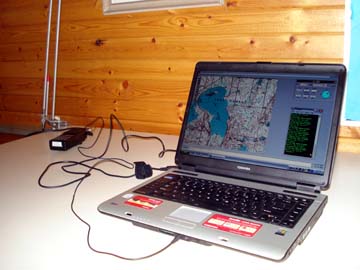
Ham radio is still a social network, but it is augmented by web-based social networks. Every ham radio operator on Facebook or Google Plus eventually uses these networks to discuss ham radio. Computing has transformed ham radio, with rig control, VoIP communications linking repeaters and computer users with smartphone users, and much more – too much to mention here. Digital technology has also made things cheap enough to replace rather than repair – and sometimes even to replace just because the new gear is magnitudes better, even though nothing is wrong with the old rig! All in all, while digital technology has been good to ham radio, it has sometimes been bad for ham radio in that it has buried everyone in constant connectivity that saps our will to participate in yet more communications. This gives us dead repeaters and sometimes poorly-attended meetings and events.
What about Radio Camp?
Radio Camp is quite a commitment for the campers, who have to take a week of their time at sometimes considerable expense if a lot of travel is involved, to attend. The camp session is also expensive to host, considering the preparation and camp rental along with a laundry list of other costs. Volunteers also incur similar expenses. Clearly this is a high-stakes event, so we need to make sure we are understanding the trends here. Is increased ever-connectedness growing and here to stay? It seems so. Is digital technology here to stay, along with increasing miniaturization and consolidation of functions? That seems a solid long-term trend as well. Is the marriage between ham radio and computing going to last? I’d say yes to that one, too. As I type this, I’m listening to 2O12L special event station calling CQ. The signal is being received by the Handiham TS-590S radio, remotely controlled via the internet.
Trending at Radio Camp…
So what seems to be trending at Radio Camp? For at least 10 years we have seen interest in the Operating Skills courses grow while in recent years it has become obvious that licensing courses are struggling. 2012 became a year without anyone attending camp to earn the Extra Class license. Operating Skills campers far outnumbered those who attended to study for a first license or upgrade. Let’s summarize and speculate on two camp trends:
- It is harder to attract campers who are interested in the licensing courses. We have to be careful here because we can’t assume that our Handiham members are no longer interested in licensing and upgrades to higher licenses, but they are less interested in doing so at a camp session and more likely to do it by using the on line audio lectures we offer at Handiham.org.
- There is growing interest in Operating Skills. This is at least a 10 to 15 year trend, and it may be driven by the new technologies and the desire to learn more about them as well as the need to simply meet other Handiham members in person and to have a week of fun. Camp has always been a place to meet old friends and make new ones, and our electronic connectivity can keep us connected after the camp session ends. Campers understand the balance between the real and the virtual and know that virtual cannot be a substitute for the real-life experience of attending camp in person. People are wanting to build real communities again!
A possible response:
So what do we learn from these trends?
Let’s put it this way: “The customer is always right”, as the old saying goes. Smart businesses listen to their customers and give them more of what they want. And what our campers want is more ham radio fun and less studying for licenses. What I propose is this:
- We continue to serve all of our Handiham members with our audio lectures for licensing or upgrades. Even those without computers can get our audio on Library of Congress digital player cartridges.
- This frees us to build and expand Operating Skills in the camp sessions.
- With more classrooms free because we don’t offer licensing classes, we can get our op skills people into separate spaces in small groups that make it easier to use the radios or have a discussion.
- Our instructors don’t have to worry about cramming an entire licensing class into a week and can concentrate on teaching operating procedures.
- We will have more time for traditional camp activities and the pontoon boat, plus field trips.
- We can set up more stations so that people with different skill levels and interests can get on the air more without waiting so long for a seat at the operating position.
- The Technician course would be replaced with a “Technician study group”. This would be a way to include a small number of unlicensed Handiham members in the week of Radio Camp, but it would only be a study group, not a complete course. There would be no more “Go to camp and get your license in a week.” Everyone there would have to be studying elsewhere prior to camp.
- VE Session: Maybe we have one, maybe not. We will see how this idea develops, but dropping the VE session gives us more time on the last day of camp to do our regular activities. The low pass rates in recent years do show that our traditional model of licensing classes is not effective. It might be better to review at camp and send the Tech students home to finish their studies and take the exams from their local VE teams.
- The emphasis will be on having fun through the week and being part of a community of friends. Learning can be fun, so we will learn about new things in Amateur Radio and learn how to be better radio operators.
Email me at [email protected] with your questions & comments.
Patrick Tice, WA0TDA
Handiham Manager
Double Dip Weekend August 2012

Homebrew Buddipole inspection
Great weekend of QRP Portable fun. Saturday our Central FL QRP group had some new ops join us and we had a good time comparing antennas and rig setups at Sylvan Lake Park in Sanford, FL. As is typical, we did more talking than operating but did manage to sneak a few qso’s in on 20 and 17 meters. The contesters in Europe were hot and heavy on 15 m too so made for a fun day despite the heat and high humidity. I was a bit disappointed to not be able to snag any fellow Polar Bear QRP ops on 30m but the band did not stay open long and the other stations were operating on alternative bands.
Sunday after church was the first annual NJQRP Skeeter Hunt. So glad to work Skeeter Hunt promoter and fellow Polar Bear, Larry, W2LJ before the lightning ran me off. Larry was my last QSO of the day as a thunderstorm started making LOTS of noise and it was my signal to pull down the 31 ft Jackite and wire and get out from under the shade of the 50 ft tall pine trees down by the lake! YIKES… just made it too!
I ran my Sierra at 2.4 watts out into an end fed half wave suspended as a sloper from the 31 ft Jackite pole in a WNW direction. I normally use the trees to get a bit more height for my wire, but the Jackite goes up and down faster and with storms coming, I chose the simple and fast way to git ‘er done. Turned out to be a good choice. Band conditions were pretty good on 20m and I was hearing a good bit of activity. After 1800 the Caribbean, Central and South American SSB stations were causing a good bit of QRM down here in FL. They all seem to run power and gain antennas so we learn to listen through the chatter here in FL. The approaching storm was obvious as QRN increased with distant lightning stirring up the noise and crashes. Nonetheless, the signals were pretty good despite the distractions and there were some SKCC, FISTS and other cw fans out there having fun too which made the band busy.
I built a simple key and am posting a photo of my K4UPG Knee Cap Key. Used the lid of a bulk black peppercorn jar and made a simple non-iambic key with paper clips, standoff and a bit of wire. It actually worked fairly well, but not good enough to use for the whole contest. As a long time CPG (Contest Point Giver) I decided that was a good way to give myself some points so took advantage of the bonus points! It did inspire me to try a more substantial lid and make a strap to use it as a leg key for portable ops.


Umbrellas for the rig and the op!
It was fun to hear so many familiar calls and work a few of our fellow Polar Bear Ops who were out for the fun too. Sure appreciate the effort to put this event on the calendar and process the results. Thanks to the NJQRP group for the support of our niche in the hobby and to you Larry for the time you devote to contests, blogs and getting us all out and on the air.
Here’s my results before the storm drove me for cover:
| Date | Time | Call | Band | Pwr | RST | RCV | SPC | Nr | |
| 8/12/2012 | 17:12 | N0SS | 20 | CW | 2.4 | 559 | 579 | MO | #122 |
| 8/12/2012 | 17:17 | W0EA | 20 | CW | 2.4 | 559 | 559 | IA | #22 |
| 8/12/2012 | 17:23 | NK9G | 20 | CW | 2.4 | 559 | 559 | WI | #75 |
| 8/12/2012 | 17:25 | VE3WDM | 20 | CW | 2.4 | 559 | 559 | ON | #15 |
| 8/12/2012 | 17:37 | KQ2RP | 20 | CW | 2.4 | 449 | 439 | NJ | #27 |
| 8/12/2012 | 17:39 | AB4PP | 20 | CW | 2.4 | 579 | 599 | NC | #79 |
| 8/12/2012 | 17:42 | N0JRN | 20 | CW | 2.4 | 559 | 559 | MO | 5W |
| 8/12/2012 | 17:46 | N3AO | 20 | CW | 2.4 | 449 | 559 | VA | #109 |
| 8/12/2012 | 17:49 | W4MPS | 20 | CW | 2.4 | 599 | 559 | NC | 5W |
| 8/12/2012 | 18:00 | KR9Z | 20 | CW | 2.4 | 449 | 449 | IL | #10 |
| 8/12/2012 | 18:06 | AA4GA | 20 | CW | 2.4 | 579 | 569 | GA | #2 |
| 8/12/2012 | 18:08 | N7UN | 20 | CW | 2.4 | 579 | 559 | NJ | 5W |
| 8/12/2012 | 18:14 | WF4I | 20 | CW | 2.4 | 559 | 559 | NC | #71 |
| 8/12/2012 | 18:18 | K3RLL | 20 | CW | 2.4 | 449 | 339 | PA | #21 |
| 8/12/2012 | 18:31 | KX0R | 20 | CW | 2.4 | 449 | 359 | CO | #69 |
| 8/12/2012 | 18:36 | W2LJ | 20 | CW | 2.4 | 579 | 599 | NJ | #4 |
A good time was had by me!
72,
Kelly K4UPG
Handiham World for 08 August 2012
Welcome to Handiham World.
What should you have to know to operate a club station?
Radio clubs usually do not have dedicated meeting space and extra room for a complete club station, but some do. Many clubs do have temporary “club stations” for the duration of club events or Field Day. What all of these club stations have in common is that they are shared resources that can be operated by many club members. For those amateur radio operators who cannot put up antennas at their homes, the club station is a great way to get on the HF bands or to have fun with VHF weak signal operation.
But here’s the problem: The typical home station will be configured by the owner to be exactly what that operator wants. It will have the brand of radio equipment and the accessories preferred by that person, and everything will be laid out in a customized fashion. The club station will be used by many different operators. It may have different equipment than what you are used to, and be configured differently. With all of these different operators, each with different station layouts at home, the club station presents a learning challenge!
Let’s consider some basic skills that might be expected of each club station user. These might be part of a “check ride”, similar to that given to a licensed pilot when being checked out in an airplane for the first time. Although a person may hold a pilot’s license, it is by no means certain that the pilot knows everything about every airplane! The same is true about licensed amateur radio operators and radios. To begin this discussion, I have identified six basic knowledge areas, but you may be able to think of some others:
- License and identification: To operate an amateur radio station, you need a license, so a new user should expect to present his or her license along with some supporting identification (if requested) so that the club’s station manager can determine if the licensee is current and what the operating privileges might be.
- Safety and convenience: Since the club station will be unfamiliar territory to the new user, it is important to go over basic safety topics. These include the emergency power shut off, the location of fire extinguishers and other emergency equipment such as an AED, the location of exits, a telephone, and restrooms, and how to call for emergency help.
- Ergonomics, accessories, and policies: This topic area covers your comfort and safety while operating the station. It will cover how to switch the lighting on and off, where writing materials, a frequency chart, and other commonly used desktop materials are found, seating adjustments, station layout, the ham shack computer (if there is one), and policies related to the use of the station. For example, a policy might include switching the equipment on and off in a certain sequence, no beverages on the operating desk, returning antennas and extendible towers to their nested positions at the end of a session, logging all contacts, using the club callsign, and so on.
- Radio orientation and operation: This will show the new operator what each piece of equipment does and how it operates. It will include all the basics, such as the power switch, tuning, modes, antenna switching and rotor control and use of various accessories such as amplifiers.
- Record-keeping: There may be a sign in/out sheet for users of the station. If logging of contacts is done, there may be a need to explain the procedure, whether it is by computer or in a paper logbook. There may also be a QSL policy and procedure. If a piece of equipment is not working or if a part is broken or missing there is usually a place to make note of it so that the club can remedy the problem.
- Securing at shutdown: After the operating session, the station must be shut down and secured. In some cases, this may include disconnecting the equipment from the power mains and antennas to prevent lightning damage. It is also considered good practice to leave the radio in a more or less “normal” mode of operation, so that the next user will not sit down to a radio that has been left in split frequency mode with the RF gain at zero and every button pressed and knob twisted! If desk accessories are used during the operating session, they should be returned to wherever they were stored so that the operating desk is clear of clutter. The lights should be turned off and the room should be secured in whatever way is described by club policy.
A club station is an excellent resource for all club members, but because it is shared among many users it is wise to have some clear rules about its use and to include an orientation (“check ride”) for each new user.
Email me at [email protected] with your questions & comments.
Patrick Tice, WA0TDA
Handiham Manager
Handiham remote base station report
W0EQO at Courage North is in service. W0ZSW is in service.
Handiham World for 01 August 2012
Welcome to Handiham World.
Troubleshooting 101
Last week’s problem showed up when I was using my shack’s two meter rig, which is powered by a switching power supply. Let’s just recap: It’s the one that’s typically used for the Handiham net each day. I’m located some distance from the N0BVE repeater system. (It’s in the western part of the Twin Cities Metro while I am in the east.) That means my reception of the N0BVE signal is not exactly perfect. I can hear an annoying hiss in the background when the repeater is active, but that’s easily eliminated with a flip of the switch on my external ClearSpeech speaker. This handy device has almost magical properties – really a very smart algorithm – that digitally cleans up the signal, virtually eliminating the noise. I don’t like to leave it turned on all the time because I also enjoy listening to Minnesota Public Radio with the extended receive feature of the transceiver, and MPR has enough signal to be rock-solid perfect. It sounds best with the external ClearSpeech speaker’s processing turned off.
One day I encountered an interesting problem. I had been listening to MPR when I last used the radio, and when I turned it on, that’s the station I heard. Since I wanted to monitor the repeater instead, I flipped the memory to the stored two meter channel. Then, noticing that the ClearSpeech speaker was turned off, I slid its power switch to “on”. At that very moment, the radio went dead – no power. I pushed the power button on the radio and everything was back to normal. I put up with this for weeks before finally getting the gumption to track it down.
The challenge was to guess what was going on. Rick, W0IS, was right on the money when he wrote:
My educated guess is that the negative power lead for the speaker had gotten disconnected, but it still got power because it was grounded through the radio, either through the speaker connection, or just from the two chassis touching somewhere. But my guess is that the radio’s negative power lead does not go directly to the chassis of the radio. There is some electronics between the black power wire and the chassis, and this electronics did not like the current running through it. I don’t remember the details, but I had something similar happen with my FT-817 (or maybe it was a different rig). The black wire came loose, but it was still connected to the negative side of the power supply through the chassis. It worked, but there were some flukes, since the black wire did not go directly to the rig’s chassis. Did I guess right? 73, Rick W0IS
Yes, and it turned out that the fault was in the ground side of one of those popular snap-together connectors in common use today. The connector was probably not properly installed in the first place, or else the spring tension inside was just so weak as to allow the ground side to lose contact if the connector was bumped or the power supply cable got moved in just the wrong way. It’s worth noting that had the powered speaker had a grounded metal cabinet with a common grounding lug and had both the radio and the speaker been grounded to a common station ground, this problem would likely not have even shown up. As it was, the ground had been completed through the speaker’s 3.5 mm audio plug’s grounded side to the radio. Obviously this is not the ideal way to power things! In any case, the fix was as simple as it could be – just repairing the power supply DC cabling fixed the problem.
Station grounding is important, though. Grounding equipment to a common station ground can help eliminate RF circulating in places where it shouldn’t be as well as protecting equipment from static discharges and keeping the gear at the same potential to avoid electrical shock hazards.
Email me at [email protected] with your questions & comments.
Patrick Tice, WA0TDA
Handiham Manager
OK, OK! I Will Write that Ham Radio Book!
Ever since I began writing articles about my hobby of choice–amateur or “ham” radio–for my ham radio web site and several others, people have been asking me when I was going to do an amateur radio book. The truth is, I have just been too darn busy to even think of such a thing. And I also knew, in my heart of hearts, that it be would difficult indeed to get any kind of decent book contract for such a niche book. I presented my idea of a half-fiction/half-nonfiction book to the ARRL and they passed, so that confirmed my feelings. If they had no interest, I doubted anyone else who published books would either.
Fast-forward to July 2012. Things have changed, both in my personal life and in the wild and woolly world of big-time book publishing.
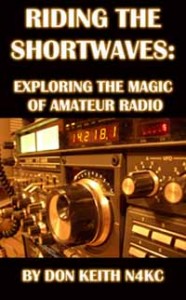
Don Keith N4KC has just published his new book of short stories, articles, advice, and more about ham radio.
First, I retired from my 60-hour-a-week day job back in May. And as I shuffled through the articles I had in the can, several more I was working on, and a few still in my head, I realized I was closer to a book than I had thought. And I truly believed I had something that would be different and could find a readership.
Secondly, as I investigated Kindle Direct Publishing at Amazon.com for the re-issue of a couple of my previous now-out-of-print books, I realized that I should absolutely pull the ham radio book together for that outlet–Kindle and some other e-book readers–at least. Amazon has become a real threat to traditional publishing companies–especially when it comes to e-books–as the old-line publishing houses struggle to figure this newfangled thing out. At the very least, it gives me the opportunity to make my book available at a very reasonable price to those interested in amateur radio. No, I don’t make much money at the price I set, even if I actually sell some downloads of the book, but that is not really the object anyway. As I have said many times, and not totally facetiously, if I wanted to make a fortune writing books, I would write pornography (See FIFTY SHADES OF GREY).
Then, as I considered other options, I realized that Amazon offers a truly unique opportunity for works like this one that allows me to offer the book in a traditional paperback format with minimal investment up front. Remember, I’m retired, on a fixed income these days! Amazon’s is a print-on-demand deal, but they seem to have it down to a science. I ordered some copies as soon as I got the book and cover uploaded and accepted for publication. The very next day I got the email that they were being shipped that day. Wow!
Again, this was with very little upfront cost and minimal hassle. Now, the paperback will be available not only via Amazon.com, but through major distributors, for order by libraries, and even in many European markets. We will see how good the print job is, but believe me on this: the major houses don’t necessarily produce the highest quality book any more either. They have to cut where they can to make a profit and printing, binding, and warehousing is a big drain on them.
Talk about rapid technological change and its effect on society and the media! Broadcast radio, TV, the Internet and telephone communications are not the only things evolving at a dizzying pace. Include the anachronistic business of book publishing in that mix, too!
Realistically, will tons of booksellers and all the Barnes & Noble stores order a box full of the books each? Or will hundreds of thousands of libraries order up a couple dozen copies each? Of course not. The big publishers do have sales staff to encourage that sort of thing. But a) no big publishing house was going to do a contract for RIDING THE SHORTWAVES: EXPLORING THE MAGIC OF AMATEUR RADIO and b) even if they did, it would be somewhere near the bottom of the sales staff’s sample case, so c) Amazon’s various self-publishing options are perfect for this kind of book.
By the way, if you have any interest in the dynamic and rapidly growing hobby of ham radio–believe me, it ain’t your weird uncle’s past-time any more!–then you may want to stop by Amazon.com and take a look “Inside the Book,” read the description, and maybe buy a copy or two…for yourself or someone you know and want to spark the interest in our amazing hobby.
See, right there in that last sentence, I did more publicity for RIDING THE SHORTWAVES than the big publishers do for most of the books they print up and ship out!
73,
Don Keith N4KC
www.donkeith.com www.n4kc.com













