Posts Tagged ‘amateur radio’
 OK, OK! I Will Write that Ham Radio Book!
 July 30th, 2012 |
  Author:
 Ever since I began writing articles about my hobby of choice–amateur or “ham” radio–for my ham radio web site and several others, people have been asking me when I was going to do an amateur radio book. The truth is, I have just been too darn busy to even think of such a thing. And I also knew, in my heart of hearts, that it be would difficult indeed to get any kind of decent book contract for such a niche book. I presented my idea of a half-fiction/half-nonfiction book to the ARRL and they passed, so that confirmed my feelings. If they had no interest, I doubted anyone else who published books would either.
Fast-forward to July 2012. Things have changed, both in my personal life and in the wild and woolly world of big-time book publishing.
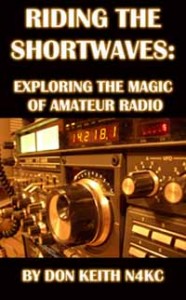
Don Keith N4KC has just published his new book of short stories, articles, advice, and more about ham radio.
First, I retired from my 60-hour-a-week day job back in May. And as I shuffled through the articles I had in the can, several more I was working on, and a few still in my head, I realized I was closer to a book than I had thought. And I truly believed I had something that would be different and could find a readership.
Secondly, as I investigated Kindle Direct Publishing at Amazon.com for the re-issue of a couple of my previous now-out-of-print books, I realized that I should absolutely pull the ham radio book together for that outlet–Kindle and some other e-book readers–at least. Amazon has become a real threat to traditional publishing companies–especially when it comes to e-books–as the old-line publishing houses struggle to figure this newfangled thing out. At the very least, it gives me the opportunity to make my book available at a very reasonable price to those interested in amateur radio. No, I don’t make much money at the price I set, even if I actually sell some downloads of the book, but that is not really the object anyway. As I have said many times, and not totally facetiously, if I wanted to make a fortune writing books, I would write pornography (See FIFTY SHADES OF GREY).
Then, as I considered other options, I realized that Amazon offers a truly unique opportunity for works like this one that allows me to offer the book in a traditional paperback format with minimal investment up front. Remember, I’m retired, on a fixed income these days! Amazon’s is a print-on-demand deal, but they seem to have it down to a science. I ordered some copies as soon as I got the book and cover uploaded and accepted for publication. The very next day I got the email that they were being shipped that day. Wow!
Again, this was with very little upfront cost and minimal hassle. Now, the paperback will be available not only via Amazon.com, but through major distributors, for order by libraries, and even in many European markets. We will see how good the print job is, but believe me on this: the major houses don’t necessarily produce the highest quality book any more either. They have to cut where they can to make a profit and printing, binding, and warehousing is a big drain on them.
Talk about rapid technological change and its effect on society and the media! Broadcast radio, TV, the Internet and telephone communications are not the only things evolving at a dizzying pace. Include the anachronistic business of book publishing in that mix, too!
Realistically, will tons of booksellers and all the Barnes & Noble stores order a box full of the books each? Or will hundreds of thousands of libraries order up a couple dozen copies each? Of course not. The big publishers do have sales staff to encourage that sort of thing. But a) no big publishing house was going to do a contract for RIDING THE SHORTWAVES: EXPLORING THE MAGIC OF AMATEUR RADIO and b) even if they did, it would be somewhere near the bottom of the sales staff’s sample case, so c) Amazon’s various self-publishing options are perfect for this kind of book.
By the way, if you have any interest in the dynamic and rapidly growing hobby of ham radio–believe me, it ain’t your weird uncle’s past-time any more!–then you may want to stop by Amazon.com and take a look “Inside the Book,” read the description, and maybe buy a copy or two…for yourself or someone you know and want to spark the interest in our amazing hobby.
See, right there in that last sentence, I did more publicity for RIDING THE SHORTWAVES than the big publishers do for most of the books they print up and ship out!
73,
Don Keith N4KC
www.donkeith.com www.n4kc.com
Bunny box woes
I belong to a small group of transmitter hunters here on Long Island. My Elmer originally got me involved by having me navigate for him, and as I learned the technique, I graduated to running my own vehicle along with my better half, KD2CHE. The last few hunts, she has been driving while I watch the signal strength and maps.
Most of the hunters use doppler equipment, from various vendors. Jill and I have had great luck just using our maps, and a good assortment of receivers. We watch the signal strength on my best receiver, a Kenwood TR-9000, and then keep two HTs set to different levels of sensitivity. I hang the HTs in locations so that I can hear them come on. One with no antenna at all, and the other with a mismatched stubby antenna. This combination has gotten us to the bunny box before many of the doppler-equipped cars.
Friday night we had a hunt. The box was to be hidden within 3.5 miles from the Republic Airport in Farmingdale, NY. The box itself is managed by my Elmer, WA2CDL. It’s an old Radio Shack HTX-202, controlled by a custom PIC controller, powered by an external rechargeable battery, all contained in a surplus ammo box. We set out in our new Kia Soul, with me in the back seat. I folded half the back seat so as to have a kind of desk next to me. There I had the TR-9000 and a Dell laptop with the RTL-SDR setup, and Google Maps. Internet was provided by a hotspot on my T-Mobile HD7. We waited.
Unfortunately no one could hear the transmitter. It was mentioned that it might be operating on low power, since it had not been charged. So we drove around till we heard it. Each time it transmitted (30 seconds on, 30 seconds off), we would get a signal, and as we drove in the direction I though it would be in, the signal got weaker. As I plotted all of the vectors around the area where we heard the signal, it seemed that it was simply nowhere. Every time we chased the signal, it got weaker.
Eventually we were given a hint, and once found, I have to admire the location (about 15 feet off of a trail, in a nature preserve, up in a tree). Only some of the doppler-equipped cars were able to locate the box. As it turned out, my eternally fading signal was caused by the low battery. WA2CDL did some measuring after the hunt and told me that it was starting out transmitting just over a Watt, and finishing the 30 second transmission with about 250 Milliwatts. That explained why we always seemed to be heading away from it.
In practical use, what does this mean? If we were trying to find a lost hiker, for example, who had a radio with a dying battery, we would need to take the fading signal into account. I think if I had known that the signal was fading out each time we heard it due to the battery running low, I would have altered my technique. I think if we had simply moved at one minute intervals and marked the signal strength at each location just for the beginning of the transmission, I would have been able to plot the location. I guess I need to ask what the charge on the bunny box battery is in advance next time, or stay put for a couple of transmissions, and see if the signal fades.
How did the RTL-SDR do? Well, if we had steady signal, or if I had known to compensate, it would have been fantastic. I could see the signal before we could hear it, and signal strength was more visual. The battery quit before the end of the hunt though, because of the difficulty in finding the box. I hope to try it again.
Handiham World for 25 July 2012
Welcome to Handiham World.
Troubleshooting 101
Here is an interesting little problem that showed up in my own ham shack just a few weeks ago. It’s funny how we can run into things that seem not quite right but then sort of just shrug them off and say, “Oh, well.”
The problem showed up when I was using my shack’s two meter rig, which is powered by a switching power supply. It’s the one that’s typically used for the Handiham net each day. I’m located some distance from the N0BVE repeater system. (It’s in the western part of the Twin Cities Metro while I am in the east.) That means my reception of the N0BVE signal is not exactly perfect. I can hear an annoying hiss in the background when the repeater is active, but that’s easily eliminated with a flip of the switch on my external ClearSpeech speaker. This handy device has almost magical properties – really a very smart algorithm – that digitally cleans up the signal, virtually eliminating the noise. I don’t like to leave it turned on all the time because I also enjoy listening to Minnesota Public Radio with the extended receive feature of the transceiver, and MPR has enough signal to be rock-solid perfect. It sounds best with the external ClearSpeech speaker’s processing turned off.
One day I encountered an interesting problem. I had been listening to MPR when I last used the radio, and when I turned it on, that’s the station I heard. Since I wanted to monitor the repeater instead, I flipped the memory to the stored two meter channel. Then, noticing that the ClearSpeech speaker was turned off, I slid its power switch to “on”. At that very moment, the radio went dead – no power. I pushed the power button on the radio and everything was back to normal. I put up with this for weeks before finally getting the gumption to track it down.
Can you guess what was going on?
Email me at [email protected] with your questions & comments.
Patrick Tice, WA0TDA
Handiham Manager
Handiham remote base station report
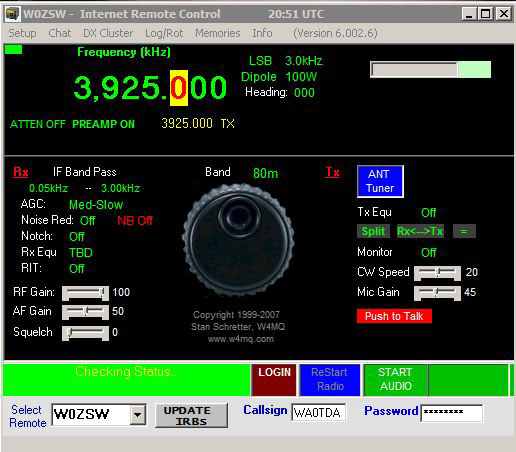
W0EQO at Courage North is in service and performing well. W0ZSW is off line due to internet connectivity issues that make it too unreliable to use. I hope to address this issue soon. Luckily, propagation has been excellent via W0EQO for PICONET, a regional HF 75 meter net on 3.925 MHz.
Handiham World for 18 July 2012
Welcome to Handiham World.
Bucket list!

Photo: I found the problem. The confabulator gear is stripped. You’ll need a new one if you want this Vega to make it back to Podunk.
Hey, readers and listeners! It is certainly high summer here in North America and the temperature is so high and the humidity so oppressive that we are definitely not thinking clearly. That is why we have come up with this “bucket list” which we hope to complete before we die.
1. Landing a single engine plane on the beach.
2. Changing the transmission in a Chevrolet Vega.
3. Making yogurt from scratch.
4. Setting the tone and frequencies on a mobile radio while driving.
Well, if you are like me you have probably done the first three of these things without any particular problem, but you have never been able to safely program a mobile VHF/UHF radio while driving a car. In fact, programming a radio while driving can be a frighteningly dangerous experience, much worse than sampling that first icky-looking spoonful of homemade yogurt or dropping a Vega transmission on your toes. That is why the radio programming is not checked off my bucket list. In fact, programming a radio while driving instead of watching the road is a good way to assure that you will probably die before completing most of the items on your bucket list.
I started thinking about this particular problem when I read the correspondence section of the August QST wherein astute letter writer K2GW talks about making the programming process for VHF/UHF radios more user-friendly. The use of subaudible tones on repeater systems is so common as to be expected, and most of us will have to admit that these systems do an excellent job of preventing the repeater from ever actually being used for anything, but mostly from ever being successfully accessed by anyone trying to keep a car between the ditches while traveling through the area supposedly served by the repeater.
Of course the subaudible tones might be necessary to prevent interference from distant repeaters should there be a band opening or from other nearby RF sources or an alien invasion where the flying saucers transmit on the repeater input. I get that. But the problem remains that unless you are able to preprogram your radio for the repeaters along your route, you are likely going to be out of luck when you try to simply access them by punching a receive frequency into the VFO and letting the radio’s built-in offset function set the transmit frequency according to the band plan. One possible workaround is to listen for activity on the repeater in question and then punch the tone scan function button to try to locate the correct subaudible tone. If this works and you do not end up in the ditch (especially dangerous in Florida where hungry alligators find the ditches quite attractive), then you might be in business. The more likely outcome is that you will drive entirely through the repeater’s coverage zone without hearing any activity.
The ARRL TravelPlus® repeater directory on CD-ROM does provide a way to map and program radios along a planned route, so it is a good resource that allows you to program your radio well in advance of your trip. Programming your radio while sitting in the driveway is one heck of a lot safer than meeting an alligator for lunch. Still, you may need to program a radio while in motion. The safe way to do this is for you to pay full attention to the radio by letting someone else do the driving. When my wife and I take car trips, I feel safe enough fiddling with the radio while she pilots the car. While this division of labor keeps the car out of the ditch, it does not necessarily ensure that one will be able to access or make a contact on a repeater.
One time, on a trip through alligator-free central Illinois, I tried a repeater that I really, really wanted to use and that was programmed into my radio already, because I had looked it up in my repeater directory. I heard the repeater identify and decided to throw out my call sign.
Silence.
Okay, so I upped the power and tried again.
Silence.
Obviously, the subaudible tone that I had programmed was incorrect. So I set the radio to tone scan and hoped for someone to transmit on the repeater. Well, that didn’t happen. I guess I probably could have gone through every possible subaudible tone while kerchunking the repeater and throwing my call sign out, but somehow that didn’t seem to be worthwhile. Instead, I switched to VFO mode and 146.52 MHz where I had a nice QSO with a truck driver who was passing through. The subaudible tone system had certainly done its job of preventing interference and any actual use by mobile stations, that’s for sure. Later, after we got back home from vacation, I discovered that the subaudible tone for that particular repeater was incorrectly listed in the directory.
I’m not sure what the answer to this partly technological and partly behavioral issue is with VHF/UHF repeater systems. All I know is that you cannot make things that difficult to use because prospective users have many other alternative means to communicate and they will vote with their feet and go somewhere else. For example, I can easily bring up the node of my favorite repeater on my Android phone by using the EchoLink application. I recommend doing this while you are sitting in the passenger seat rather than trying to steer the car. Once I am connected on EchoLink, all I need for reliable communications is a cell phone data signal. I can talk to my friends who are regulars on my preferred EchoLink-enabled repeater system.
Would I prefer to use the radio in my car to make a local contact? Certainly! But hey, repeater owners out there – you might consider connecting your repeaters with the world via IRLP or EchoLink and make sure that your frequency and tone information are correctly listed in repeater databases and on your club website. And if any of you local stations are listening on the repeater and hear a mobile station give a call, take a minute to have a short conversation and make a new friend! Maybe the technology will improve to the point that radios will be easy enough to use while driving so that one day I will be able to actually use repeaters I encounter along my mobile route.
Today’s safety tip: Don’t feed the alligators. Also, but not safety-related, the QST audio digest in DAISY format is now available for our blind members in the DAISY section. You can hear me read the correspondence section with the K2GW letter.
The long-range forecast: Speaking of Podunk, localism is an endangered species. As applications for mobile devices like smartphones proliferate, people will listen to the broadcast stations they prefer, avoiding the local stations – especially when they are on the move, traveling by car. When the typical car driver would one time tune around for the local yokel stations along the route, the trend will favor simply staying tuned to the internet station they have always liked. Satellite radio is already making such inroads into localism. The same thing is going to happen to local repeater systems. If the repeater system is not linked, it may be doomed to obscurity. Repeater owners who think EchoLink “isn’t real radio”, take note.
HamRadioSchool.com
 I haven’t blogged in a few weeks. Work has kept me busy and I’m still making solid progress on the new basement ham shack, home office, podcast studio and just general all-round man-cave. I’ll try to get an update on the new ham shack published soon. However, I wanted to take some time to write a quick blog post to tell you about some really fantastic news. A friend of mine and fellow club member, Stu Turner W0STU debuted his HamRadioSchool.com license course system today.
The HamRadioSchool.com license course is an integrated learning system, combining the best of proven traditional methods with new media to provide an overall learning experience never experienced before in amateur radio.
The Book – The HamRadioSchool.com Technician License Course, is honestly the missing book we’ve been looking for. This material contains more than just the public domain questions. When used, the student will actually learn and not just memorize.
The Website – The HamRadioSchool.com interactive website offers a fun and highly informative electronic magazine for new hams. New features and new content will be introduced frequently.
The Apps – The HamRadioSchool.com tablet and smart phone apps provide book-coordinated question pool quizzes and full exam practice from anywhere and at anytime. The HamRadioSchool app will also track progress to ensure the student sees all of the pool questions and remembers areas of weakness so you know exactly where you need to focus your attention.
Yes there are other study materials and methods available, however these often encourage memorization and leave the student without truly understanding the content. The HamRadioSchool.com Technician License Course material promotes true understanding with simplicity in an easy to follow program.
If you are interested in earning your US FCC Technician class amateur radio license, skip the rest and go for the best! Please visit the HamRadioSchool.com website to learn more about the program.
Until next time…
73 de KD0BIK
Handiham World for 11 July 2012 (early release)
Welcome to Handiham World.
The band police
Recently I got an e-mail from a new amateur radio operator who told me about an encounter with an unpleasant character on the bands. This new operator was following all the rules of identification while enjoying an EchoLink contact with a DX station. Someone jumped in and told him he should get off the air if he wasn’t going to identify. Interestingly enough, the guy with this unsolicited advice didn’t identify his station at all. The whole incident confused and worried our new amateur radio operator. It wasn’t exactly a way to feel welcomed on the amateur radio bands, was it?
Let’s deconstruct this incident.
First off, our new amateur radio operator says that he was following all of the rules of identification and I believe him. Because it was an EchoLink contact, it is possible that because of delays in the various interconnected systems and possible packet loss, the station that broke in with the comment about identification may not have been able to hear all of the conversation. So there could be a technical issue here, but there is certainly no need to break into a conversation to rudely chastise someone with unsolicited advice. After all, all identifications were being done properly and sometimes band conditions or Internet connectivity can change what a third station might hear. Even if there is a compelling need to break in, the best way to do so is with one’s callsign, not with an unidentified scold.
What our new amateur radio operator had the misfortune to experience was a visit from one of the lower life forms on the amateur radio bands: the band police. Who knows if they even hold valid amateur radio licenses? If they do, do they think the rules about identification do not apply to them when they are busy butting into another conversation to complain about something they don’t like? Well, I suspect that these “band police” are pretty under socialized in other respects. I’d be willing to bet they are blowhard know it all’s at the Field Day site and at the radio club meetings. For them it’s “my way or the highway”, and that probably extends to other areas of life aside from amateur radio!
We all know that there are unpleasant and even downright toxic personalities out there, so in amateur radio as in the rest of life we need to have a strategy. Just as you would avoid contact as much as possible with an unpleasant and unreasonable neighbor or a pushy bully at the office, you can devise a strategy to minimize your contact with unpleasant people on the amateur radio bands. You may wonder how this is possible when they break in with unsolicited comments, but the best advice is the long-standing recommendation from experienced operators: simply ignore them. Don’t acknowledge them. Like Internet trolls, they like to interrupt and disrupt with off-topic and controversial or unsolicited comments. The more you engage them, the more you feed their egos. Ignoring the band police may not be as satisfying as telling them to mind their own business, but if you go down that road you are asking for trouble. Yes, there may be times when the situation gets so bad that you may need to escalate it by bringing it to the attention of the ARRL official observers in your area. One thing you should NOT do is let an incident like this spoil your enjoyment of the amateur radio bands. Almost all amateur radio operators are friendly, helpful, and understanding – and especially so when it comes to welcoming new amateur radio operators to a lifetime of fun on the bands.
This is a reminder that the Handiham office is open only with very limited services and hours this week. No renewals or new membership requests can be processed until July 16.
Email me at [email protected] with your questions & comments.
Patrick Tice, WA0TDA
Handiham Manager
Handiham remote base stations up & running, but…
…there are a couple of issues.
While W0EQO has returned to complete service following severe storms which took down over 20 trees at Courage North, W0ZSW remains only marginally useful. The problem is the internet connectivity and network problems at the Handiham headquarters office at Camp Courage. I do plan to spend some time working on these problems this week, which unfortunately means even less time to answer phone calls and emails or to work on the new Extra Class lecture series. Both stations remain accessible via Echolink for receive, but with occasional dropouts on W0ZSW.
Handiham World for 04 July 2012
Welcome to Handiham World.
We wish our USA members a happy Independence Day, and our Canadian members a belated Canada Day.
High summer here in North America isn’t exactly the best time to explore the HF bands, given the constant parade of interference-generating thunderstorms marching across the continent. While bands like 160 and 75 meters may seem like wall-to-wall noise, there are always some intrepid operators sticking to their usual schedules. The best time on both bands is usually early morning before solar heating and convection starts cooking up more lightning and thunder and before absorption becomes too odious, a real problem for propagation as the sun climbs higher in the sky. Summer is the traditional sporadic-E skip time of year, so it doesn’t hurt to keep checking out the VHF bands. A clue is that you might hear repeater identifiers that you don’t recognize because they are far outside the usual repeater coverage area. If you hear stations on 10 meters, you might also check out the 6 meter band. You never know – perhaps there is an opening, and if you are trying to work all states, such openings can be pure gold.
Summer, especially post-Field Day, is often considered the least active time of the ham radio year. Radio clubs may shut down for a few months in the summer – usually June, July, and August – and resume operations in September. The conventional wisdom is that people are busy doing summer stuff like taking vacations, working in the yard, boating, fishing – you name it, ANYTHING but sitting inside at the radio! But summer weather might chase you indoors with its heat and humidity. Maybe it wouldn’t be a bad time to get on the air after all. Besides, summer is a good time to get antenna projects done. Let’s list some summer ham radio activities:
- Put up or repair your antenna system.
- Check out VHF propagation on 6 and 2 meters. Try SSB on both bands. Log your contacts and send us a brag about your farthest contact so that we can publish it and make you famous.
- Go bicycle mobile!
- Take ham radio on vacation with you, both as a mobile station in the family car and as a portable station.
- Check into the daily Handiham Echolink net. If you have a smart phone, try checking in via the Echolink app. (Android and iPhone)
- Try out the Handiham HF remote base stations. Say hello to the folks on the always-friendly PICONET on 3.925 MHz.
- Build a kit.
- Study for a license or upgrade.
- Try setting up your own EchoLink or IRLP node.
- Take your handheld radio with you on a walk and find out how many contacts you can make on local repeaters.
- Set a goal to work as many stations as possible on 10 meters. Log all your contacts.
- What?!! You don’t have a logging program? Install XMLog and learn to use it. http://www.xmlog.com (Yes, it is blind-friendly, and it’s free.)
- On the water? Take ham radio with you on the boat. Don’t drop the radio in the water.
- New to blind-accessible technology? Try downloading DAISY book software and reading a DAISY book with it. Make it a ham radio book from the Handiham website. (More on this in a minute.)
I could go on and on (maybe I already have), but you get the idea. Now let’s get out there and have some ham radio fun!
This is a reminder that the Handiham office is closed this week and open only with very limited services and hours next week.
Email me at [email protected] with your questions & comments.
Patrick Tice, WA0TDA
Handiham Manager
Storms sideline Handiham remote base stations:
Severe storms in northern Minnesota last night had disrupted internet service to W0EQO at Courage North. The station returned to service around 12:50 PM on 3 July 2012.
W0ZSW is still offline following storm damage and power outages that disrupted our internet and networking equipment at Camp Courage. It was the first time in the history of our double remote system that both stations have been offline at the same time due to storms. Due to limited staffing at this time, we are unable to resolve the problems quickly.
Solar Activity Forecast: Solar activity is expected to be moderate during the period (03 – 05 July) with M-class flares expected from Regions 1513 and 1515.
Geophysical Activity Forecast: Geomagnetic field activity is expected to remain at unsettled to active levels on day 1 (02 July) as CH HSS effects persist. Activity is expected to decrease to quiet to unsettled levels during days 2 – 3 (04 – 05 July) as CH HSS effects gradually subside. The CME associated with today’s M5/2b flare is not expected to disturb the field during the forecast period.













