Posts Tagged ‘amateur radio’
 Review – BTech AMP-25 series for Analog & DMR
 February 27th, 2018 |
  Author:
 The AMP-25 series VHF / UHF Amplifiers

The recently announced BTech Digital and Analog amplifier series puts a whole new spin on mobile operation. It performs more like a mobile than it does a power amp. The D series are true TDMA Tier2 DMR amplifiers.
Note: This review was done using an Anytone D868UV on both DMR and analog.
In the Box
Included with the 40W Mobile Amp are:
– Mounting Bracket
– 3′ Interface Control Cable (Kenwood K1 connectors)
– 3′ RF connect cable (SMA-M to SMA-F)
– Microphone and Hanger
– All necessary mounting hardware
– User Guide
General Description
– UHF or VHF Power Amplifier
– 2-6W > 20-40W Output
Modes of operation include:
| V25 U25 | V25D U25D |
| Analog (FM) C4FM (Fusion) P25 (Phase 1) NXDN IDAS dPMR MPT1327 | > DMR Tier II (TDMA) > P25 (Phase 2) Analog (FM) C4FM (Fusion) P25 (Phase 1) NXDN IDAS dPMR MPT1327 |
A Different type of Mobile Amplifier
I found these to be much more than a typical power amplifier. Although they can function as a simple ‘In and Out’ power amp, this is about as close to a full mobile as you can get. Although the driving  force was my DMR handheld sitting in my cup holder, the transmit audio was that of the included hand microphone and the receiver audio out was coming through the built in speaker driven by a four watt audio amplifier.
Transmit Power
I tested the power on two different models. The VHF V25 (non TDMA) and the U25D for UHF DMR. The power was tested using the analog side of both into a calibrated Bird Termaline wattmeter. The maximum current drain from my 13.6V 30A power supply was just under 6A. This is low enough for the amp to be powered by the 10A accessory jack in your vehicle.

Enclosure
The basic frame measures 4.6″W x 1.3″H x 5.5″D (excluding the SO-239) and weighs in at 26oz. I was curious to see the internal layout of the amp and to no surprise, there was a 5/8″ finned heat sink spanning the entire length and width of the case along with air vent along the back of the enclosure.
Operating Modes
These are single band amplifiers.
V25(D) = VHF 136-174MHz
U25(D) = UHF 400-480MHz.
Note: The V25D and U25D were designed to include DMR Tier II (TDMA) and P25 Phase 2 along with all other modes. Their operation varies slightly.
V25 / U25
To operate VHF through the UHF (U25) amplifier, or UHF through the VHF (V25) amplifier, simply power off the amplifier. This will allow you to run straight through directly to the antenna without power amplification on that band.
V25D / U25D
These amplifiers will only operate within their specified VHF or UHF range. This is due to the circuit switching design of DMR Tier II and P25 Phase 2.
Hook Up
The simplest configuration is using the included RF cable to attach the radio to the amp. You could add a Spkr/Micr to the handheld, but you would still be bypassing some of the best features.
I use the two included cables. The 3′ RF cable to attach the radio to the amp, and the control cable. This allows me to use the full size hand microphone as well as connecting the four watt audio amp powering the speaker. The power included power cable is compatible with handhelds using the standard two pin Kenwood style connector, such as an MD380, D868, GD77, UV5R, F8HP, UV82, etc.

I use an Anytone D868 on DMR as well as analog with the hookup diagrammed below. Depending on your radios antenna jack, you may need to pickup an SMA-M to SMA-M adapter.
Convenience
All channel selection and volume adjustments are done using the handheld. No duplicate programming or code plugs are necessary. Whatever is in my handheld is what I operate in the mobile
Operating my handheld in the low power position, I still get 22W out on UHF and my handheld’s battery life remains excellent, but high power gives me a solid 39W.
Conclusion
I was glad to see someone finally develop what is a full featured mobile amplifier capable of DMR as well as all other modes including C4FM and D-Star that is small enough to mount in the car, boat, and on top of your computer. This amplifier is Part 90 certified and definitely worth considering.
Available from Amazon: V25 V25D U25 U25D
and 
VHF /UHF
Digital / Analog
Mobile Power Amplifiers

On the Air – SOTA, POTA, BOTA, IOTA and now, COTA
The newest OTA I’ve discovered is the World Castles Award, or COTA – Castles on the Air. Not sure if COTA is official or not, but let’s call it that for now, since it rhymes so well with SOTA, POTA and BOTA. (IOTA is only a half-rhyme).
You might think “We Americans don’t have any castles here; we were settled after the period of castle-building, so how is this relevant to me?” Well, you can think that if you want to, but you might be wrongish. True, we have no castles in North America (or do we? – see below), but we do have other structures that the wise men and women of WCA have recognized as eligible structures of note. Happy Dance! Here’s a new game we can play once we’re all worn out activating all the mountains in SOTA, parks in POTA, and beaches in BOTA.
Here in the Southeast that I inhabit, there are scores of eligible structures. In my own tiny hometown of Decatur, GA, pop. 18,000, I find that we, too, have a castle called Oakhurst Castle. I need to find out what that is, and of course, activate it. Look for me on Dxsummit some day.
Forts, even if not fortified, can qualify, such as Fort Jackson, SC, where I spent three happy months one summer and most if not all other military bases with “Fort” in their title. Also, historic forts like Castillo de San Marcos in St. Augustine, Florida qualifies but the towns of Fort Lauderdale, Fort Myers and Fort Pierce where we can imagine forts once stood, are sadly excluded. However, don’t despair – you can still go to the beach in those towns and activate your suntan via BOTA!
Mansions, or “Stately Homes,” also seem to qualify, such as the indisputably stately Biltmore House in Asheville (raise your hand if you’ve been there). The WCA styles it as “Biltmore Castle.”
Scanning the list I see others in my haunts I can consider activating and some that raise questions such as one on Marco Island known only as “Unknown Castle.”
But there is one I expected to see that has been overlooked – probably the only purpose-build Castle in the United States, and it’s certainly not unknown; of course I’m talking about Cinderella’s Castle at the Magic Kingdom (raise your hand again if you’ve been there). If you are as hurt as I am at this (rather slight) slight, please join me in a letter-writing campaign to the WCA to help right this wrong. We’re Americans – we fought for our freedom, now we must fight for Cinderella’s honor!
Signing off for now, de k4wk, www.hamdom.com. Thanks for listening; you’re in the log.
A Personal Self Defense Weapon, a Utility Hammer, and a DMR #Hamradio, All-in-One
My first impression of my new TYT MD-380 (and Steve, KA4RSZ, felt the same way), was the solid, sturdy feel of the thing. Not at all what you’d expect from an $88 plastic cased electronic device of any sort. We were both quite impressed, and the reason has become clearer as I’ve learned more. This radio or its kin, were built for non-ham, heavy-duty use by folks like security guards and retail store personnel, not dainty and refined hams such as ourselves.
Reading the User’s Manual has been fun, and incidentally makes the bizarre Icom manuals seem lucid. Filled with handy tips, I love where it cautions me on page one “Do not transmit too long, for the radio may heat and hurt the user.” Also advising “if the radio appears smelly or smoke, please shut off…” Great tips for us all.
On page six it is reassuring to be told “wearing the radio in your waist will not make you feel uncomfortable.” I just love Chinglish!
Signing off for now, de k4wk, www.hamdon.com. Thanks for listening; you’re in the log.
Let’s Call CQ – QSO Today Episode 184 with NW7US
I got a Skype call a few weeks ago from Eric, 4Z1UG–the creator and host of the QSO Today Podcast–during which he asked me about how and why I got into amateur radio. Here’s the result.
Eric writes,
We talk a lot about the band conditions due to the Sunspot cycle. Most of it on Facebook and other places is about how “dead” the bands are at this point. We all can’t wait until the cycle starts to rise and we will be making contacts with little effort. I remember in my conversation with Chuck Adams, K7QO in Episode 58, that he really enjoys operating is “Pigrig”, one watt, CW transceiver on 20 meters. When I asked him, (I liberally paraphrase) “but Chuck, the bands are dead. How does that work for you?”. His reply was that while most hams are listening to the bands, he calls CQ until he gets a reply. Works every time.
My QSO this week is with Tomas Hood, NW7US, who has years of expertise in propagation and Solar activity. He is the propagation editor of more than a few radio magazines and websites. In our post-recording conversation we discussed this phenomenon of listening and not calling CQ. I even had this idea that maybe one of the reasons that the digital modes are so successful is because they “beacon”, as part of the whole digital experience, the same as calling CQ. This is why they make contacts. From what I see, looking at PSK Reporter, hams are making lots of contacts worldwide using the digital modes. While SSB may not be working so well, CW and the digital modes seem to work fine.
I like to work on my bench or make the podcast while listening to the bands. Jeff Damm, WA7MLH, in Episode 177, says that he will put his keyer in CQ mode while he is working on a new radio. Invariably, sometimes after many minutes, he gets a reply. Great idea Jeff!
73,
Eric, 4Z1UG
Episode 184 can be found here: https://www.qsotoday.com/podcasts/nw7us
Highlights of Episode 184:
Tomas Hood, NW7US is the propagation editor of a number of shortwave and amateur radio magazines, and has a wide variety of websites, that grew out of his love for all things radio, and for listening on the bands to far off DX and commercial broadcast stations. Tomas shares his understanding of propagation and the lessons we can learn from listening, really listening to the QSOs and exchanges during contest operation.
All of the QSO Today episodes are great. I enjoy hearing about many different hams. Do check out all of the episodes that Eric has published.
73 de NW7US dit dit
ETH096 – School Club Roundup, Hamvention Update and More…Everything Ham Radio
Hello everybody! In this episode of the Everything Ham Radio Podcast, I am stuck by myself talk to yall. I unfortunately didn’t remember that I my next scheduled update was due until 4pm the day before. So I worked all afternoon, while at work, trying to figure out what I was going to talk about. When I got off work at midnight, I ran home and did my couple honey-dos and then went straight to recording the episode.
So what is in this episode?
First off, I made a mistake! Yea, I know, nobody is suppose to make mistakes right? Well, in my last episode I did. In last episode, my semi regular co-host Ian KM4IK and were talking about the big stink that was doing on with some things that the ARRL Board of Directors were going to be voting on. Neither one of us were really up to speed on the whole thing as much as we should be, but we did our best, and we even said that we weren’t. However, after the episode I did receive multiple emails saying that I said something wrong, so I corrected it in this episode.
With that out of the way, I went on to talk about an upcoming event called the School Club Roundup. It is this month only a few days away actually. The event run February 12-16, 2018. It is an event that is geared for school amateur radio clubs to get on the air and make some contacts. Even if you are not in a school club though you can still get on the air and make contact with the school clubs that are on the air and help them make the points.
After that, I moved on to Hamvention. Another correction from last episode. Well I say correction, this time it wasn’t me though. In last episode we talked about how a new building was going to be built and available by this Hamvention. However, this week, the Hamvention committee released that it wouldn’t be started on until later in the year due to a material shortage.
I wrap up the episode reading some emails that I have received over the past few weeks. The last episode of 2017, I told yall what my plans were for 2018 and asked what some of yalls were and also asked some questions about what were yalls opinions on how my show is. I got a few responses, wish I would’ve had more though.
Until Next Time Yall…
73 de Curtis, K5CLM
What Got You Interested in Radio? What Hooked You? (Story Time, with Video)
What got you interested in radio? What hooked you?
I’ve been asked, “What got you interested in radio, space weather, and the science of radio-wave propagation?”
Here’s a short answer as to why (and when) I became a radio enthusiast. It all started…
[embedyt] https://www.youtube.com/watch?v=0XBth62JgwA[/embedyt]
https://www.youtube.com/watch?v=0XBth62JgwA
The following picture is of my first shortwave radio, discovered in my home sometime between 1971 and 1973: a Sony portable transistorized four-band radio receiver. This was my very first shortwave radio (well, truthfully, it was my dad’s). This radio is responsible for my love of radio, electronics, and communications.
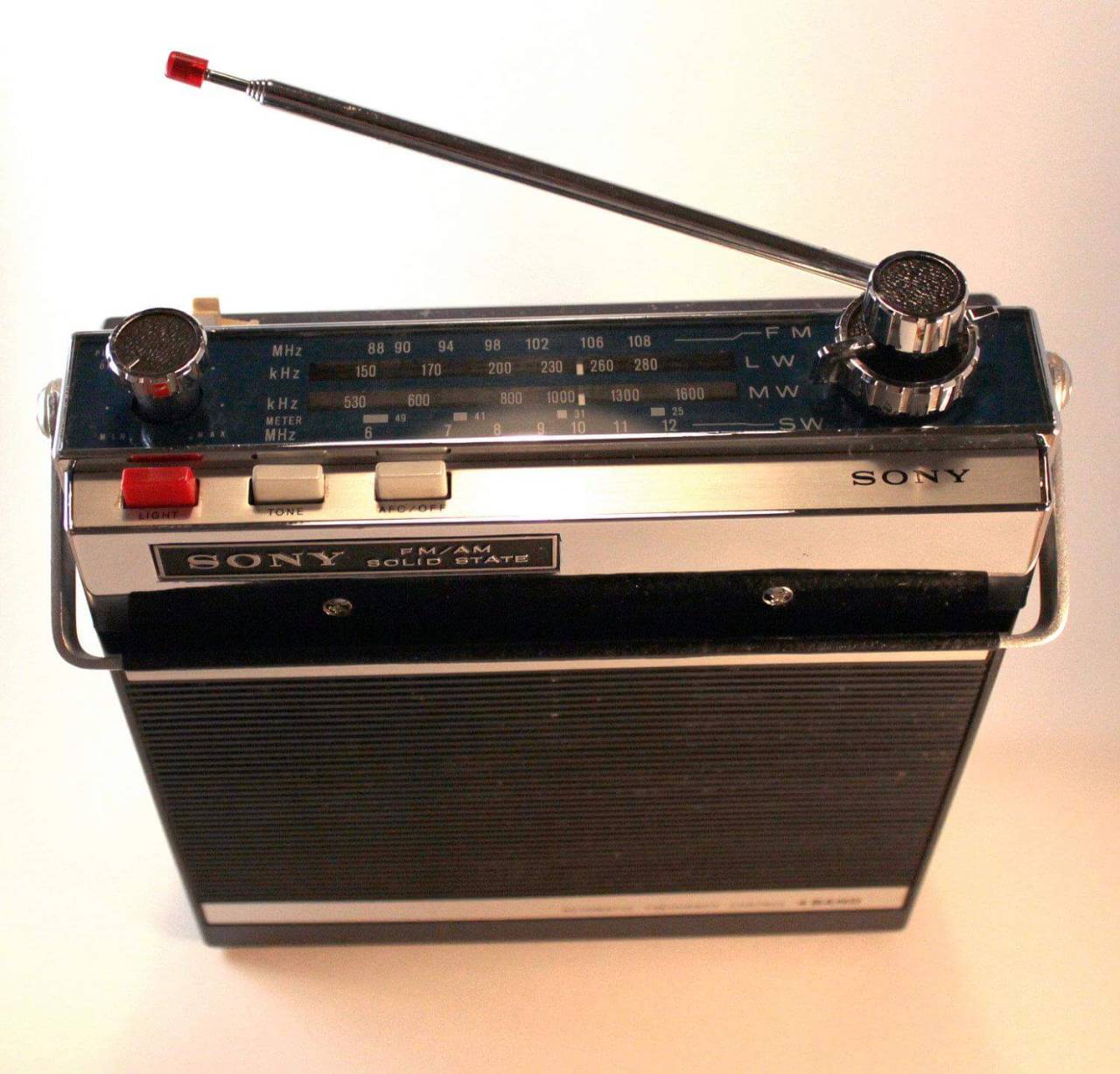
Sony Portable 4-Band Radio – the model 7F-74DL (my First Radio)
I still use this, sometimes, when listening to late-night AM-broadcast-band-radio DX. It is horrible for shortwave radio listening, as it has no noise blanker. For MW (Medium-wave) AM Broadcast DXing at night, it is excellent. The internal bar antenna is very directional so I can rotate the radio around until I get the best reception of some station. Back when I was a child, that made the radio very fun to use.
This next radio is a really capable military surplus radio circa WWII or shortly after (the late 1940s, early 1950s). This radio was my world starting around 1975. From Medium-wave to Shortwave, this radio could hear a pin drop around the world! Many late nights when I was supposed to be sleeping, I was up with the light dimmed and the tubes singing signals from exotic places.
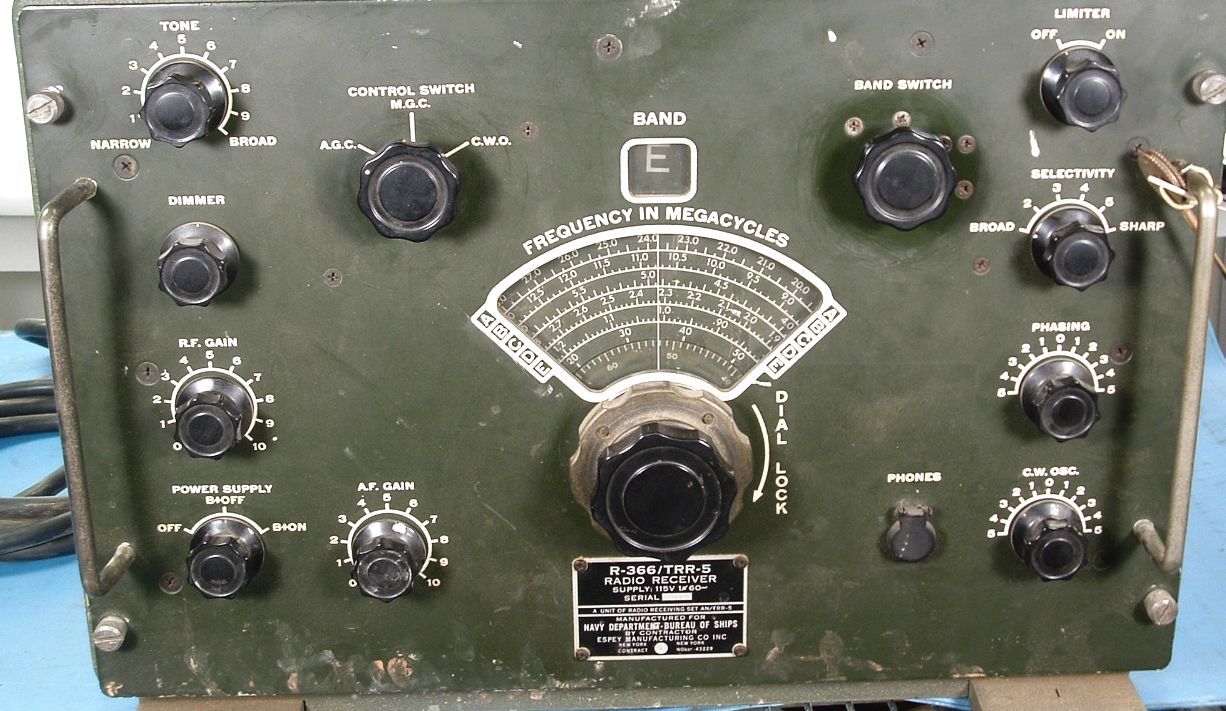
Espey R366 Tube Receiver (my Second Radio)
What is your story?73 de NW7US
Addendum:
https://www.youtube.com/watch?v=y8bBM9Dy38o
[embedyt] https://www.youtube.com/watch?v=y8bBM9Dy38o[/embedyt]
Rest in Peace, David Collingham, K3LP, SK

RIP David Collingham, SK – K3LP is now SK.
My condolences to the family and friends, and to our radio community, for the tragic loss of David Collingham, K3LP.
I am sad and sorry for his loved ones and friends who now grieve this loss.
May his memory echo through the ether like radio waves, reaching the receivers of our hearts.
Passing along a note from Paul, N6PSE:
Dear Friends of David Collingham-K3LP:
I have learned additional information concerning his death.
Last night, during a heavy winter storm, David let his dog outside. David later took his truck to search his 25-acre property when his dog did not return. David found that his dog had fallen into an icy pond that adjoins his property with another property.
David made the heroic decision to go into the pond to try and save his dog.
After some time had passed, David’s wife Rebecca went looking for him. She found his truck at the pond and called 911. Fire personal recovered David’s body as well as his dog. Efforts to resuscitate him were unsuccessful.
David lived his life bold, courageous and heroically and he died trying to save his beloved dog. He will always be a hero in our hearts.
RIP David R. Collingham, age 59.













