Posts Tagged ‘6m’
 The Magic Grows Weaker
 August 8th, 2014 |
  Author:
Recent comments on the ON4KST 6m chat page tend to indicate that the summer's Sporadic-E season is rapidly drawing to a close...."time to move to 160?" ..."how long 'til Es season? " ..... "is that it for the year?". Peaking around early July, I'm always surprised at how rapidly the three-month propagation-party zips by and, as always, leaves us wanting just a little bit more.
Unlike the past several summers, I had no European QSO's this year. The July 27th VE6 - Europe event was as close as it came but who knows what might have been missed during some of those predawn propagation periods when most west coasters are still sawing wood. Ever-vigilant KL7KY was alert enough to find Europeans at 0300 his time, on two separate July occasions, making me wonder if the same thing might happen down here as well? After Kevin's over-the-pole success, I started all day and overnight scans of the northern Canadian beacon segment (50.010 - 50. 050) with the 756PROIII's versatile (non-squelched) scan mode and the yagi pointed at 035 degrees. Even considering my somewhat late-season start, I was surprised at how often the beacons were making an appearance, often popping-up late in the evening or in the middle of the night....without the scan, these conditions would normally go unnoticed. I probably began my scans too late in the season and next summer will begin earlier, about mid-June through mid-July, hopefully giving me a better chance for Europe. John, VE7DAY, has also expressed interest in pursuing this more diligently next summer as well and has even spoken of daily 0300 over-the-pole CQ's during the mid-season's peak period.
 The season highlights for this summer are very few....contacts with LU5FF, BV2DQ, EA8DBM, several dozen JA's and one new U.S. grid for the FFMA struggle.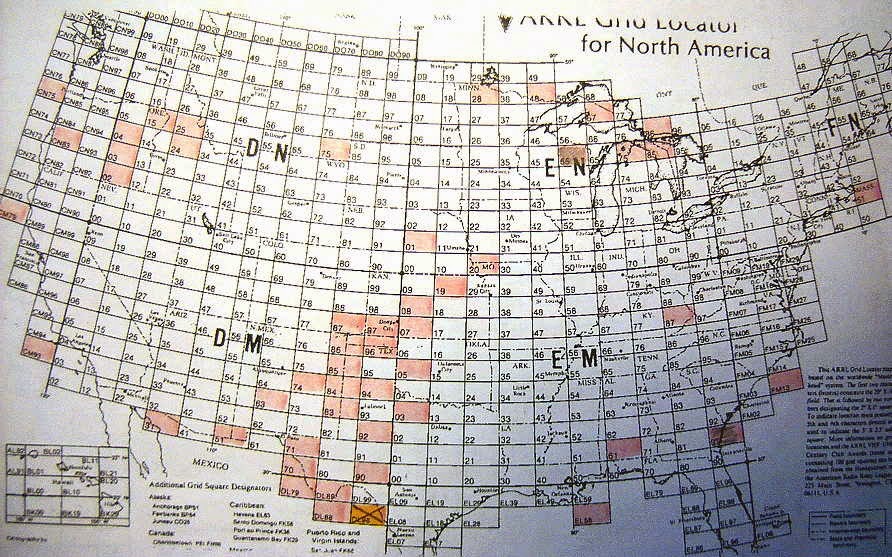
I still need 49 grids to have all 488 continental U.S. grids confirmed but at this year's rate I'll need to live until I'm 115.
Six meters may yet still hold a late-season surprise for us but if the fat-lady hasn't already sung then she's just behind the curtain ....clearing her throat.
The ‘Snowman’ Pays A Summer Visit – VYØSNO That Is!

If it seems like I'm talking a lot these days about 6m, that's probably because it's my main operating interest during the summer sporadic-e (Es) season, which is already starting to wind down. In a couple of weeks it will all be over for another year, allowing me to focus on other radio activities.
But, should you plan to venture forth into the magicband's world, proceed with every caution....there are powerful forces at work there!
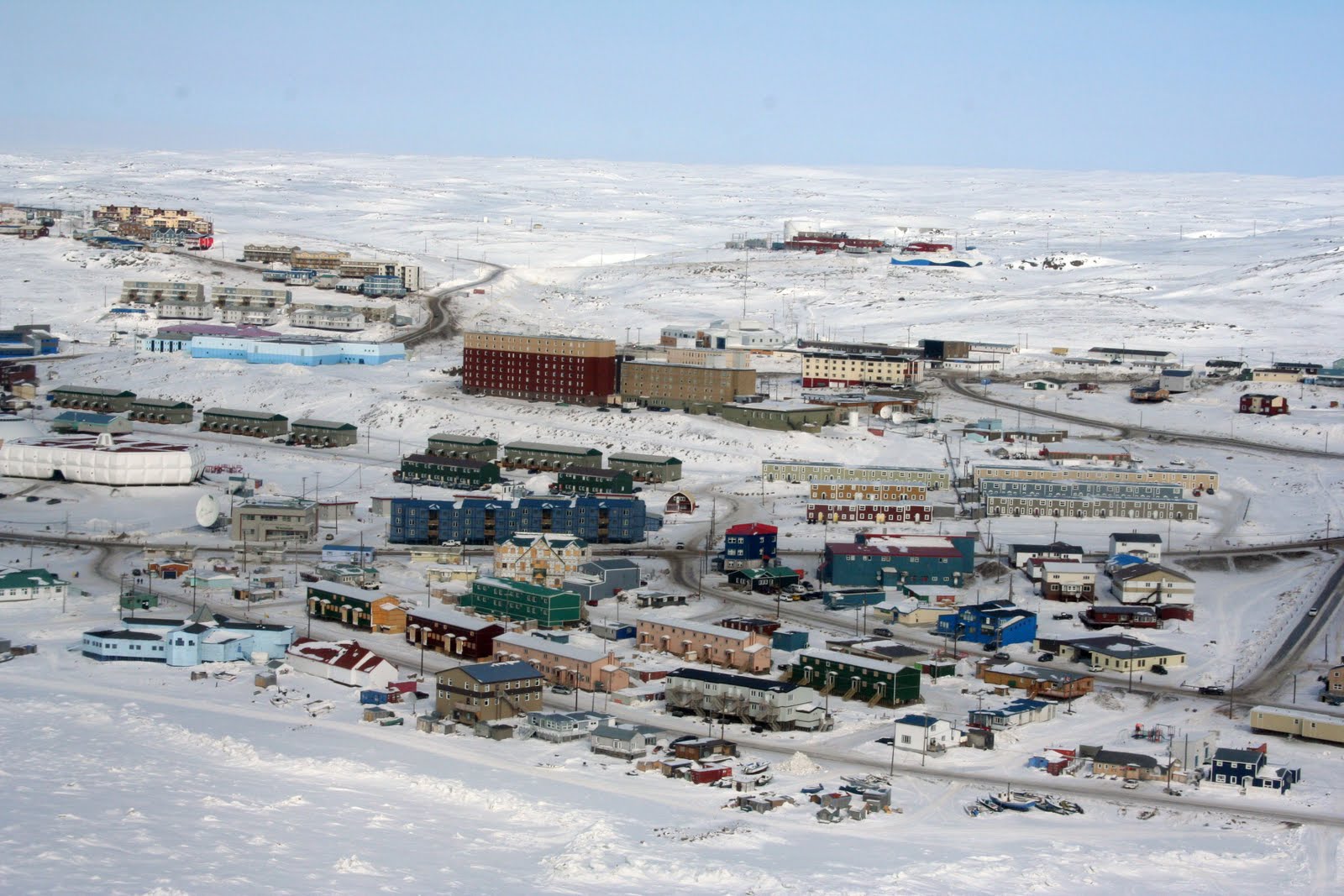
Before this week I had never heard the VYØSNO 25 watt 6m beacon. The 'snowman' is 2,250 miles away and located in the Canadian Arctic town of Iqaluit, Nunavut, the coldest city in Canada....talk about the ideal call!
 | |
| Courtesy: Google Maps |
The beacon has shown up briefly here, twice this week, with both events in the evening and lasting for only 10-15 minutes. Although there are no longer any active 6m hams in VYØ, it is still thrilling to hear these summertime signals from the Arctic....and in this case, directly in line with Europe and better than halfway there!
At one time the beacon had a different call, VE8BY, which I usually heard once or twice each summer. Since the change to a new transmitter and to a new call, for some reason it remained unheard for several seasons...until this week.
The old VE8BY beacon was unique in that its transmitter was frequency-shift-keyed (FSK mode). The dots and dashes were a few hertz higher than the actual carrier frequency. Hearing the melodious keying in combination with the typical Arctic flutter always made the arrival of VE8BY something very special as can be heard in this capture by Kevin, VE3EN....
Unfortunately, Larry (VYØHL), the owner and operator of VYØSNO/b, has moved from Iqaluit and will no longer be able to maintain or repair the beacon should it have a future break down. Hopefully it will continue to run reliably for many more years as E-season would just never be the same without a summer visit from the 'snowman'.
Russian TV…6m’s Little Helpers
 |
| London's Crystal Palace TV Tower |
Parked conveniently close to 6m, the 49MHz multi-kilowatt transmitters combined with large high antennas to pump lots of ERP over the pole. Surprisingly, there are yet a few holdouts of the analog era that are still available as propagation indicators, with most of them being located in western Russia and the middle-east. Far eastern Russia also has a number of the analog relics in Siberia and in the Vladivostok / Kamchatka regions, all of which which make great indicators for possible openings to Japan, China and Taiwan. During good openings to Japan, it is not unusual to hear several different signals all on the same frequency but with different fade rates and tone / sync characteristics. During the past few strong solar cycle peak years, spurs from these Russian transmitters could often be heard at S9 levels well into the 6m band!
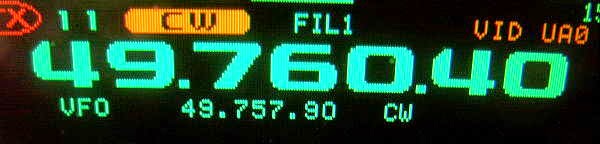
Although there are numerous others, from my own experience the best frequencies to monitor for both European and Asian transmitters have been:
- 49.750
- 49.757.8
- 49.760.4
During Sunday's VE6-Europe 6m opening, several of these signals were heard even though no Europeans were worked from the west coast. Video carriers on 49.750, 49.760 and 49.757 were heard for over an hour, peaking around 1800Z.
The two unique characteristics of these video markers has always been their rapid fade rate and their somewhat raspy video-sync pulses....both can be heard in this short video that I captured during Sunday morning's activity. The stronger 49.757 signal can be heard as well as the weaker 49.750 carrier, while the 49.760 signal has taken a deep fade. I suspect that the louder signal is coming from the Novosokolniki transmitter north of Moscow while the weaker ones may be further to the south. These locations are simply 'best guesses'.
This recording of eastern Russian video carriers, made by JM1SZY, provides a good idea of how these signals sound when they're much stronger. Note also, the number of different frequencies that the different transmitters are using.
It is very difficult to know exactly where the actual transmissions are coming from as there are dozens of transmitters assigned to the same frequency. Most signals do vary from their assigned frequency by measurable amounts and some avid DXers have tried to identify individual sites by accurate frequency measurements.
Since the digital switchover, interest in keeping track of the remaining signal data seems to be falling off and most frequency and location lists are now several years out of date. The most up-to-date lists can be found here on the GØCHE Website and on JB's DX Info site in Germany.
If you're anywhere east of the Great Lakes then you'll hear the European videos a lot more often than they are heard out west but it still astounds me that several times each summer, I am able to hear TV signals from Europe over the North Pole!
The Noise Whisperer

This past Friday, I had a very pleasant visit from Roy Charlesworth from B.C. Hydro. Roy is the Hydro's noise mitigation man for naughty power lines and made his way to Mayne Island on the morning ferry from the mainland.
For the past several years, I have been plagued with severe power line noise to my northwest, virtually killing my opportunity to take part in most 6m openings to Asia. The one or two small rain showers that we might get here in the Gulf Islands during the sporadic-E season, will often wash away enough of the power line crud to quieten things down for a few hours but as soon as the sun is back and the day heats-up, the noise always returns. For the same reason, the lines don't seem to get noisy until around 10 a.m., giving me some early-morning opportunity to listen to a dead-quiet band.
Earlier this spring, I contacted Roy and was added to his list of places to visit. He assured me that he would be over to check out my situation sometime during the summer. Roy is now officially 'retired' from Hydro and was doing similar noise mitigation work at that time. Once retired, Hydro found that his unique skills were still very much in demand and have rehired him on a 'work when you want' contract basis, allowing Hydro to still chip away at the list of complaints.
I recall, not too may years ago, when any complaints to B.C. Hydro about power line noise where just ignored and the only way they would act was if ordered to do so by Industry Canada. With the confusing bureaucratic channels involved, most amateurs just gave up and lived with the noise. Fast track to modern times, where all responsibility for noise mitigation has been placed in Hydro's hands and they are bound by IC mandate to deal with customer noise complaints.
It was apparent when first meeting Roy that he was very familiar with amateur radio 'noise problems' and very knowledgeable about their causes. After demonstrating the noise being heard on 6m on my own receiver, he then deployed a rather unique piece of test gear, a Radar Engineers Model 240 RFI Locator receiver. The 240 tunes from 1.8-1000MHz and is capable of displaying and saving the spectral display of the offending noise signal.
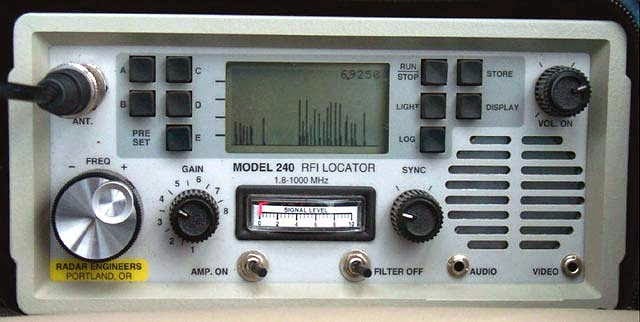
 Being able to see the signature and compare it to the actual suspected source goes a long way in helping to find and cure the problem. Before departing to search the local area, Roy's final check was to check my own house for any possible noise. A quick sweep of the electrical service panel using yet another receiver indicated all was well.
Roy also mentioned that he prefers working with hams since, compared with non-ham noise complainants, they seem very knowledgeable about noise in general and often have narrowed down the source for him...even providing the number of the offending power pole. I had also provided Roy with the numbers of two different poles. I was pretty sure about my number-one candidate pole but not so sure about number-two. Using the sharper pattern of my 9 element 2m Yagi, I was able to get a very good bearing on the noise source.
After being gone for most of the afternoon, Roy returned to explain what he had found. To my delight, he had found three noisy poles within my local neighbourhood, but to my surprise, none were the poles I had suspected! All three however, were on the same bearing as my prime candidate pole, but much further away than I had thought. He also confirmed what I had told him earlier, that all other directions were very quiet. He explained that he would file his findings with Hydro who would create a work order for eventual physical inspection and (hopefully) resolution of the problem. He would also contact me again once that had been done, to see if the noisy poles had been fixed.
I think we are most fortunate, here in B.C., to have a dedicated one-man power line noise mitigation man, in the person of Roy Charlesworth. He is clearly passionate about his task and understands just how devastating power line noise can be for radio amateurs. Unlike many regions in the U.S. where utility companies can stonewall amateurs for years and years, we presently have a very efficient recourse when power lines behave badly.
I sure hope Roy doesn't retire for 'real' anytime soon as I'm not sure he would be easily replaced!
To learn more about power line noise see:
Capricious Cycle 24
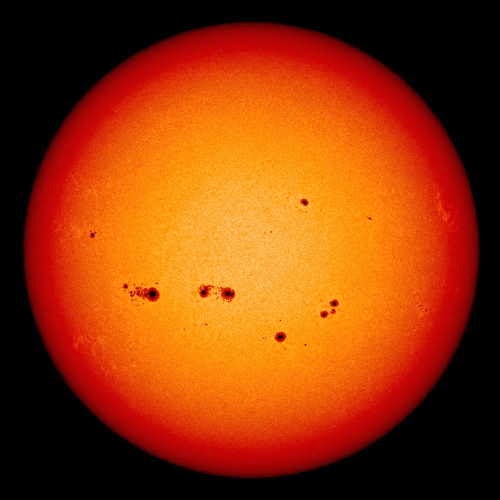 |
| July 6th - Courtesy: nasa.gov |
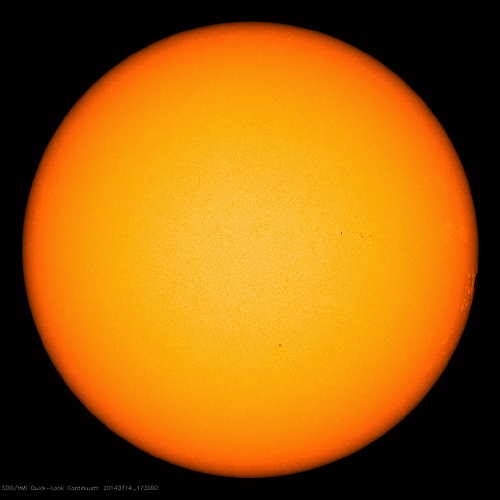 |
| Sun Today - Courtesy: nasa.gov |
What a difference a week can make, even on something the size of the sun! Boasting an SFI of just over 200 on July 6th, today's numbers have fallen to 109 along with the disappearance of most sunspot activity.
It's really too bad that this last surge of activity did not occur in November or December when we would have seen a marked increase in HF F2 conditions, along with a tiny hope of some 6m intercontinental propagation. Normally, here on the west coast, we have at least one or two 6m openings to Europe each summer, lasting from a few minutes to several hours. So far this summer, this transpolar path has been missing and I suspect largely because of the high level of solar activity. The long haul transoceanic openings that we have had (to Japan and to Africa) did not have to traverse the signal-absorbing polar auroral zone as would normally be the case. Whether these transpolar openings in the summer are true Es or something different is a topic for deeper discussion!
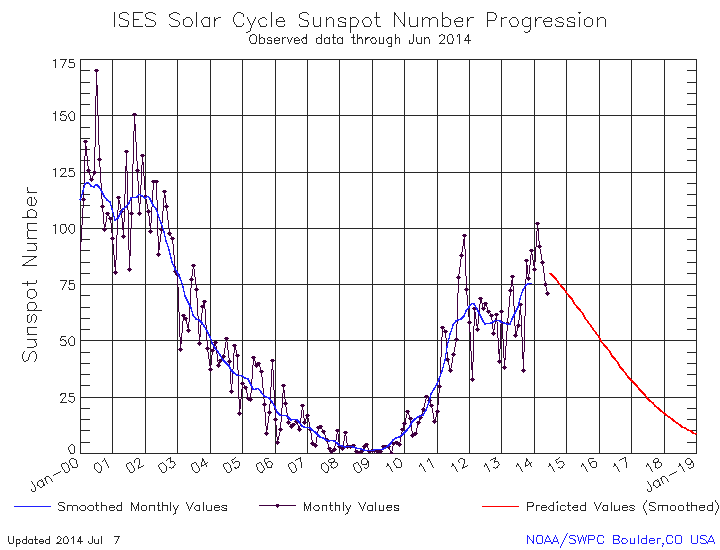 |
| Courtesy: http://www.swpc.noaa.gov/SolarCycle/ |
I'm hoping, and somehow suspect, that this isn't the last hurrah for what has generally been a most unusual solar cycle.
6m Polar Madness
In the wee hours of Wednesday morning, July 09, KL7KY (Kevin) had a massive over-the-pole European opening beginning about 1000Z. He worked at least six stations in Greece and a number of others in western Europe. One wonders how often this 'middle-of-the-night' path might actually be open as most west coast ops are sound asleep at this hour.
Looking at the path on DX Atlas shows an almost all-daylight path from VE7 to Europe, but for the first short hop out of the summer twilight.
Hoping to cash-in on any lingering Es, I ventured out to the shack last night at 1030Z (0330 local) to have a listen over-the-pole...knowing that the first hop into the daylight regions would be needed. Much to my surprise, this is what I first heard when turning the antenna north.
I was soon joined by John, VE7DAY, and we both began to CQ towards the sunlight after alerting several of the European operators via the ON4KST chat page. No 49MHz eastern Europe video signals were heard at all but this is often not a deal breaker. One beacon that always seems to be present when hearing Europe, the VA5MG/b in central Saskatchewan, was not heard either. After 90 minutes of no other indicators I headed back to bed.
In view of the high levels of summer Es in the sunlight-bathed Arctic / northern Canada regions, this crazy night time path might be worth exploring more closely during the last week of June and the first week of July. In view of the ungodly hour however, I fear that it may be some time before 6m reveals more of her secrets.
Looking at the path on DX Atlas shows an almost all-daylight path from VE7 to Europe, but for the first short hop out of the summer twilight.
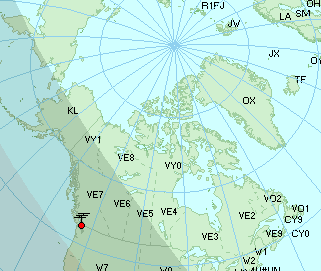 |
| VE7 - EU at 1100Z |
I was soon joined by John, VE7DAY, and we both began to CQ towards the sunlight after alerting several of the European operators via the ON4KST chat page. No 49MHz eastern Europe video signals were heard at all but this is often not a deal breaker. One beacon that always seems to be present when hearing Europe, the VA5MG/b in central Saskatchewan, was not heard either. After 90 minutes of no other indicators I headed back to bed.
In view of the high levels of summer Es in the sunlight-bathed Arctic / northern Canada regions, this crazy night time path might be worth exploring more closely during the last week of June and the first week of July. In view of the ungodly hour however, I fear that it may be some time before 6m reveals more of her secrets.
Wireless Headphone Hell
 For the past several years I have been aware of a very loud wideband FM signal just below the 6m band....about 49.8 MHz. Any time I listened to it, it seemed to be rebroadcasting TV audio so I assumed that it was a set of wireless headphones somewhere in the neighbourhood. I was thankful that it did not cause any problems to my 6m reception, being far enough down the band.
 About two weeks ago, during my normal early-morning band check, I noticed that the FM signal had suddenly shifted much higher and was now approaching the bottom edge of 6m. As the day got longer and the temperature climbed, so did the FM signal! Soon it was inside the band, but right at the bottom end. Within two days, its morning 'start' frequency climbed higher and higher and eventually the signal lodged itself smack dab into the working portion of the band, centering itself at around 50.090, depending on the temperature. Being such a wideband signal, it effectively wiped-out 6m operation for me when its wide raspy carrier was modulated....which was most of the time. Thankfully it would usually be just below the beacon portion of the band until the morning 'European window' time had past.
Two days ago I decided that it was not drifting any higher and had happily entrenched itself on 50.090. It needed to be eliminated.
Two days ago I decided that it was not drifting any higher and had happily entrenched itself on 50.090. It needed to be eliminated.
I constructed a 6m dipole (106") from some scrap aluminum tubing and dug out my Icom IC-R20 handheld scanner.
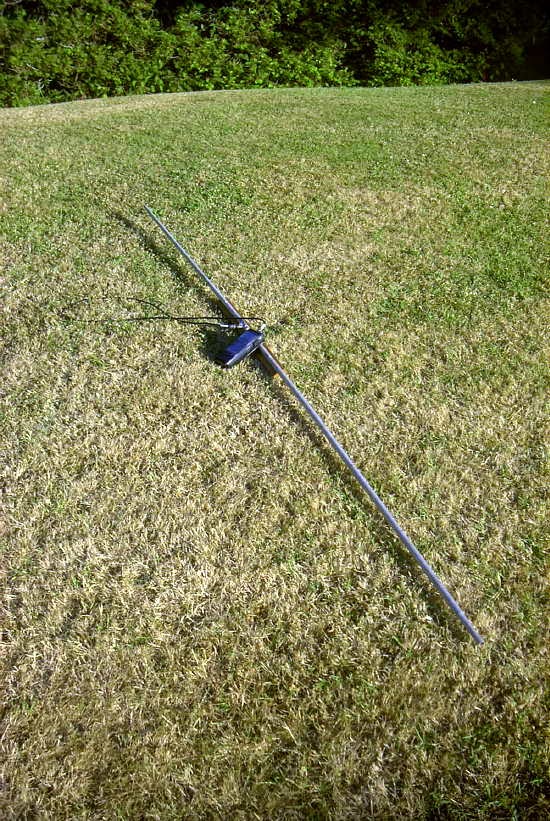
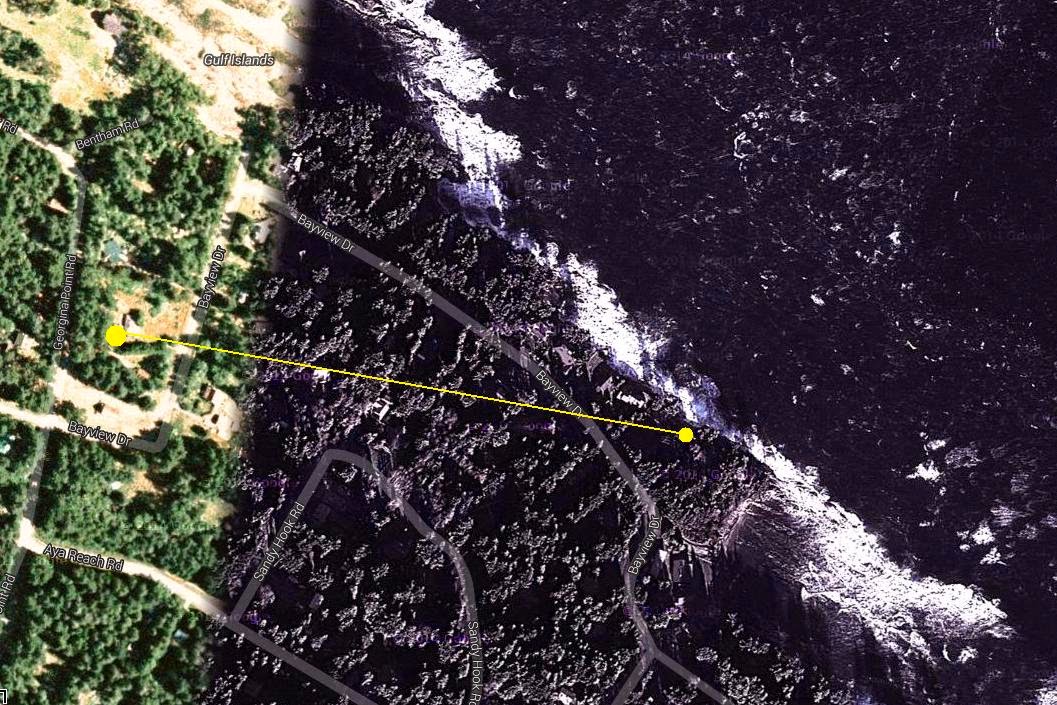
The next day I set about walking around the neighbourhood, taking bearings at various locations, as the signal was easily heard with the dipole. I had earlier determined the rough direction of the signal using my main 6m antenna, a 4 element homebrew Yagi at 55'.
 |
| Courtesy: Google Maps |
The band is wonderfully peaceful once again (except when the power lines start arcing at about noon) and within minutes of the headphone system shut down I was able to work a loud BV2DQ in Taiwan and several JA's, shortly before dinner time.
These amazing early July conditions continue on the magicband.