Posts Tagged ‘6m’
 6m magic
 May 21st, 2011 |
  Author:
 Today was the first really big Sporadic-E opening of the year. Six metres was wide open across the whole of Europe and Scandinavia. There was even a good 2 metre Sporadic-E opening in central Europe though no propagation appeared to reach the UK.
Yesterday I worked a string of Spanish stations on Six but that opening was not as good as today’s. This morning’s fun began with a contact with OK2IEN, then it was mostly Germans with a few other countries until round about lunch time.
I prefer the relaxing pace of Search and Pounce but when most of the stations you pounce on either have a pile-up and don’t hear you or are S&Ping themselves and move away it’s time to call CQ. It’s not something I often do and it’s almost more than my brain can cope with to talk to people while simultaneously typing into the computer their report, locator and call, but I quickly worked a string of stations and often had two or three at once replying to my CQ calls. This isn’t something that happens often when you run a stealth dipole so you have to enjoy it when you can!
In the afternoon, for a break, I tried JT65A. A lot of the interest in monitoring 50.076 seems to have evaporated when conditions were flat but a few stations were on and I made three contacts using the mode, though none were DX I could not have worked on SSB.
Later the propagation seemed to have shifted North to favour Denmark and Sweden and I worked a number of stations from there, many at massive signal strength. In all I made 45 contacts today – probably more than I have ever made during a single day except when playing in a contest.
I love six metres – it really is the magic band!

Life on 6m
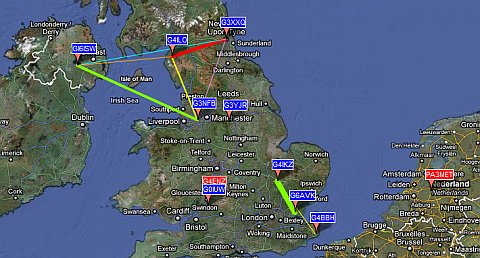
The 6 metre band is showing signs of life, as this map of WSPR activity from this afternoon shows.
However, some of the traces on the WSPR application screen look a bit odd.

I don’t claim to be an expert but I think what I am seeing is the result of doppler shift on the signals being reflected by fast-moving Sporadic-E clouds. In several cases what seems to be a trace has not been decoded.
I’ve said this before, but I wonder if WSPR mode with its 110 second transmit periods and tiny frequency shift encoding is really suitable for detecting Sporadic-E propagation. But no-one has ever commented on this, leaving me to wonder whether they think I’m an idiot who doesn’t know what he is talking about or whether nobody knows.
The digital mode most people seem to use on 6m is JT6M, however this entails using the WSJT program which I find rather confusing. I’m interested in trying JT65A but I’m not sure if it is any more suitable than WSPR for this type of work.
In the absence of any expert advice I’m going to try JT65A using a dial frequency of 50.276MHz. With the JT-Alert accessory to tell me when anyone replies I can leave the rig calling CQ whilst I am otherwise occupied. It will be interesting to see what we can work on 6m with the JT65A mode.

Life on 6m
The 6 metre band is showing signs of life, as this map of WSPR activity from this afternoon shows.
However, some of the traces on the WSPR application screen look a bit odd.
I don’t claim to be an expert but I think what I am seeing is the result of doppler shift on the signals being reflected by fast-moving Sporadic-E clouds. In several cases what seems to be a trace has not been decoded.
I’ve said this before, but I wonder if WSPR mode with its 110 second transmit periods and tiny frequency shift encoding is really suitable for detecting Sporadic-E propagation. But no-one has ever commented on this, leaving me to wonder whether they think I’m an idiot who doesn’t know what he is talking about or whether nobody knows.
The digital mode most people seem to use on 6m is JT6M, however this entails using the WSJT program which I find rather confusing. I’m interested in trying JT65A but I’m not sure if it is any more suitable than WSPR for this type of work.
In the absence of any expert advice I’m going to try JT65A using a dial frequency of 50.276MHz. With the JT-Alert accessory to tell me when anyone replies I can leave the rig calling CQ whilst I am otherwise occupied. It will be interesting to see what we can work on 6m with the JT65A mode.
Sporadic-E on 6m
The first bit of live data I received from my APRS VHF propagation alert reflector was a warning of a possible Sporadic-E opening on six metres. I was rather surprised that there was Sporadic-E this early in the year, but I went to the DX Sherlock website and sure enough contacts had been reported between a station even further north than here and one in the Czech Republic. I then clicked on the map to see the actual contact details and was surprised to find they were WSPR spots!
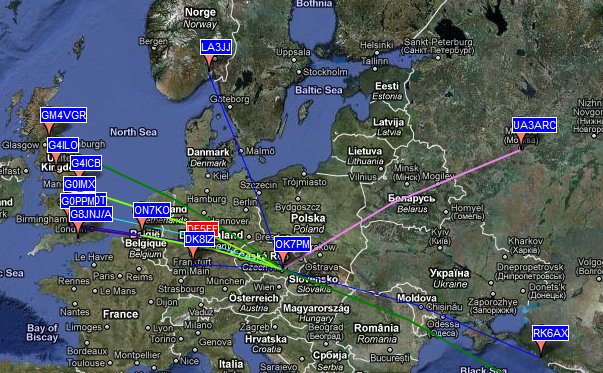
I went to the WSPR website and sure enough the same signals were shown. I decided to fire up WSPR on 6m myself but by then the OK station had gone and no new spots appeared from anywhere.
I have been, and still am, somewhat sceptical of the value of WSPR in showing VHF Sporadic-E propagation. One of the characteristics of Sporadic-E, particularly at the start and end of the season or on the higher frequencies like 2m is that it is very fleeting. A signal can be there for one minute, literally, and gone the next. On the other hand, signals can be really strong when reflected by Sporadic-E. WSPR is designed for detecting weak signals under steady propagation conditions and uses a 2 minute transmit cycle during which the data is transmitted very slowly. It seems to me that what you want to detect Sporadic-E is a mode with short transmit cycles where the data is transmitted quickly, perhaps something more akin to the modes used for meteor-scatter. I wonder if K1JT could come up with something?
Nevertheless I am very interested in anything that helps to detect VHF openings that might otherwise go undetected. I plan on WSPRing more on the 6m band, as long as there are others doing likewise so there is a chance of being received!

Remembering the C6APR team
In case you haven’t already heard, four of the operators of the C6APR station were tragically killed this week in a plane crash on their way to the station. Ward Silver, N0AX posted the following message to the CQ-CONTEST reflector, which I’m going to reprint here.
There have been several suggestions for on-the-air actions to remember the four ops lost on their way to C6APR yesterday. Perhaps a moment of radio silence – at the beginning of the contest or perhaps around the time of their flight. Or look back in your log to find the time of your most recent contact with them and take that moment out then. Maybe call C6APR at some appropriate time and wait for their signal. Putting a C6APR QSO in your log with a zone of 00 is another idea – I know that K7RA used show up in logs from the Pac NW for years after Homer’s untimely demise. Whatever seems appropriate to you, take some time out during the contest to not only remember the team, but to appreciate the other competitors. Let’s try to treat each other with a little extra respect this coming weekend as we’ve all just been reminded of how quickly a log can close.
73, Ward N0AX














