Posts Tagged ‘6m’
 6m WSPR
 June 11th, 2012 |
  Author:
 On 10th June DX Sherlock showed that a big Sporadic E opening was in progress. The red lines showing contact paths stopped tantalizingly short of north-west Cumbria, unfortunately.
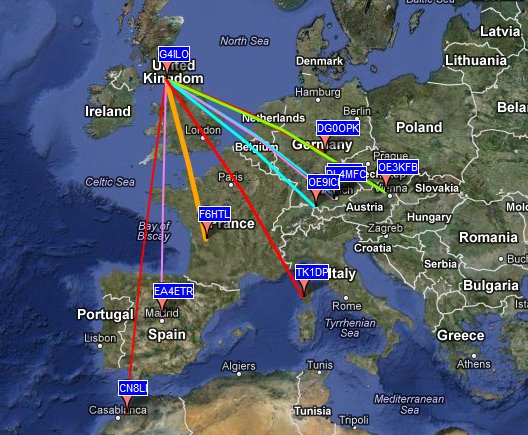
I listened on 10m but I didn’t hear the S9+ signals such an opening would suggest so I thought I would do some WSPR on 10m, moving to 6m if the 10m signals suggested the skip would be short enough. They eventually did, as DX Sherlock indicated the lift was getting stronger. I moved to 6m, running 5W to the attic multi-band dipole, and eventually spotted or was spotted by stations as far afield as Austria, Spain and Morocco.

During the peak of the opening I broke off from WSPR to tune the bands and make a few contacts. On 10m I worked TM210VH – a special call commemorating 210 years since the birth of Victor Hugo. I made contacts into Italy, Switzerland and France on 6m as well.
Seeing some massively strong signals now on 10m WSPR so time to check out 6m I think!

First 6m Sporadic-E
On Sunday afternoon, while the WPX contest was still on, DX Sherlock sent me an email to say that there was a possibility of Sporadic-E propagation on 4m from my location. Getting equipped for 4m is something I’m going to have to leave for another year – right now I’m not steady enough on my feet to go clambering about in the attic making additions to my antenna farm. But I do have a 6m antenna, though it’s only a dipole. The KX3 was plugged into it, so I had a tune around 6m, heard a few stations and managed to work OK2OV with 59 reports both ways. Not bad for 10W to an attic dipole.
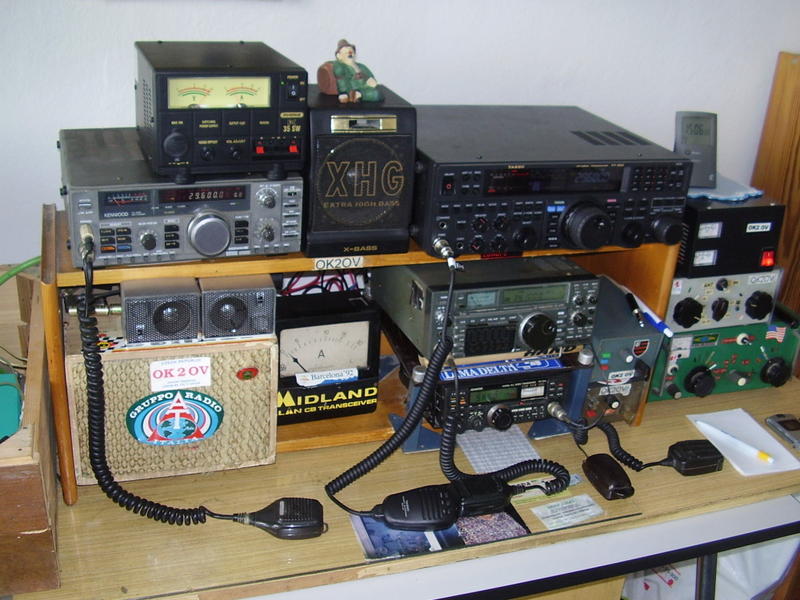 |
| Station of OK2OV, Czech Republic (from qrz.com) |
I was quite tired after my session in the CQ WW WPX contest so I called it a day. The following morning DX Sherlock sent another email alert to say there was possible Sporadic-E on 6m. I quickly switched the KX3 on and sure enough, there was a big Sporadic-E opening in progress. I made 18 contacts in all into France, Spain, Italy and Slovenia and heard OK2OV for a second time. Some of the signals were absolutely enormous and I received 59+ signal reports. This was with 10W of SSB to a dipole, remember.
Hopefully there will be more Sporadic-E fun before the end of summer.

Look, No IP
A couple of years ago we changed our broadband Internet service provider. The new provider did not support a static IP address. I have a QNAP network attached storage device which is primarily used for backup. However, it’s actually a Linux box that runs the LAMP (Linux, Apache, MySQL and PHP) software which I occasionally use as a web server for experimentation. I sometimes need it to be accessible from the internet. So I opened a free account with DynDNS in order to access the server using a host name.

Some time last year after I came out of hospital I started to receive emails from DynDNS informing me that my account was being disabled due to abuse and inviting me to open a paid account. As far as I could tell, the only “abuse” was that my script to inform DynDNS of my current IP address was running more than the number of times DynDNS permitted. I had no idea why it should start misbehaving like that and cynically thought it was just a ploy to convert free users to paid subscriptions. I was in no frame of mind to deal with the problem, nor to dig into my wallet, so I simply closed the account and had done with it. This would have had the effect of breaking some APRS-related functions on my site but I had other things of greater concern to think about.
A few days ago I decided to look into why the CDGVHF ANSRVR group was not sending any messages. ANSRVR is an APRS tool used to send APRS messages to groups of interested people. CDGVHF stands for Cumbria Dumfries and Galloway VHF group and it is intended to disseminate alerts about VHF and UHF openings in the Cumbria, Dumfries and Galloway area (grid square IO84.) It’s essentially a filter that acts on emails sent out by DX Sherlock and converts them to APRS messages addressed to ANSRVR. I could, of course, just have the emails sent to my smartphone. But it’s more fun to make use of ham radio!
I looked for an alternative free service to DynDNS and decided to try No-IP Free. As far as I can tell, No-IP won’t accuse you of abuse for updating your IP address too frequently, in fact its client software appears to do this every few minutes which seems like plenty. It does have a requirement that you confirm your account is being used once a month, which could be a bit annoying, but I’ll see what happens at the next update.
In the meantime, CDGVHF is now sending out propagation alerts again. To receive alerts of VHF and UHF openings in the IO84 area just send an APRS message to ANSRVR with the text CQ CDGVHF. You’ll need to repeat this from time to time as the server unsubscribes you from the group after 8 hours of no activity, unless you are using KJ4ERJ’s APRSISCE software which can maintain your subscription for you.

First Sporadic-E of 2012
A DX Sherlock VHF propagation alert popped into my mailbox this afternoon to warn me about a possible Sporadic-E opening on 6 metres.
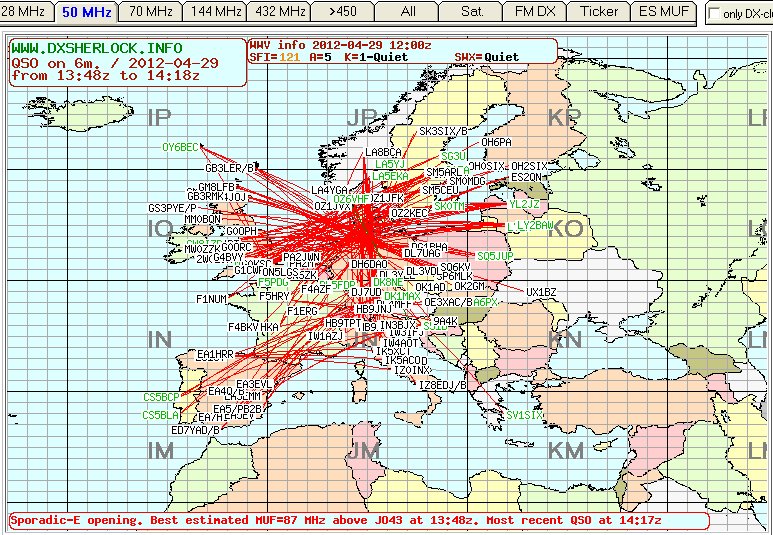 |
| 6m Sporadic-E opening 29 Apr 2012 |
My K3 was WSPRing on 10m at the time and when I went to look several new stations had been spotted indicating the presence of short skip propagation.
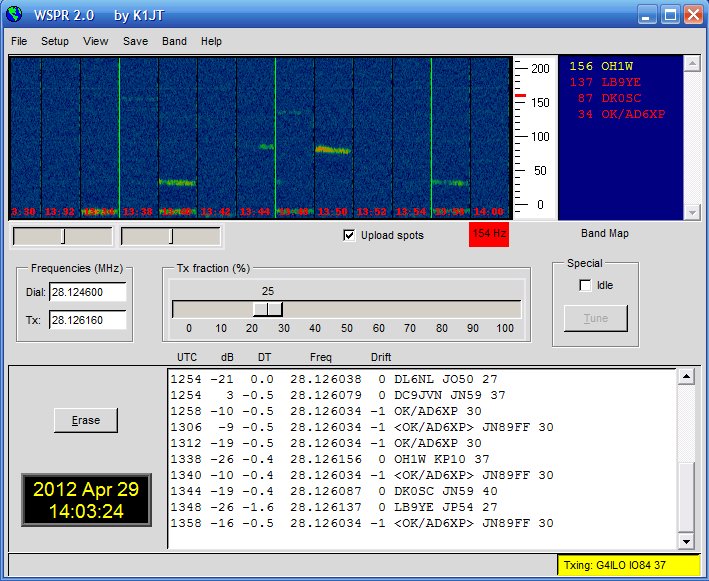 |
| 10m WSPR spots at G4ILO |
I switched to 6m but very few WSPR stations were active and no spots were made or received. I tuned the receiver and heard a weak Polish station on SSB but the opening was over and no contacts were made.
Still, it is good to see some activity on the “magic band.” Things can only get better!

Opera on 6
I haven’t used the Opera digital mode on HF for a bit as it seemed that interest had dropped off and there is not much point in beaconing in no-one is receiving. It seems to be one of those modes where there is a resurgence of interest whenever there is something new to try. This weekend the new thing was some fast Opera modes for use on VHF so I fired up the K3 on 6m (50.700MHz) to see if I could receive anything.
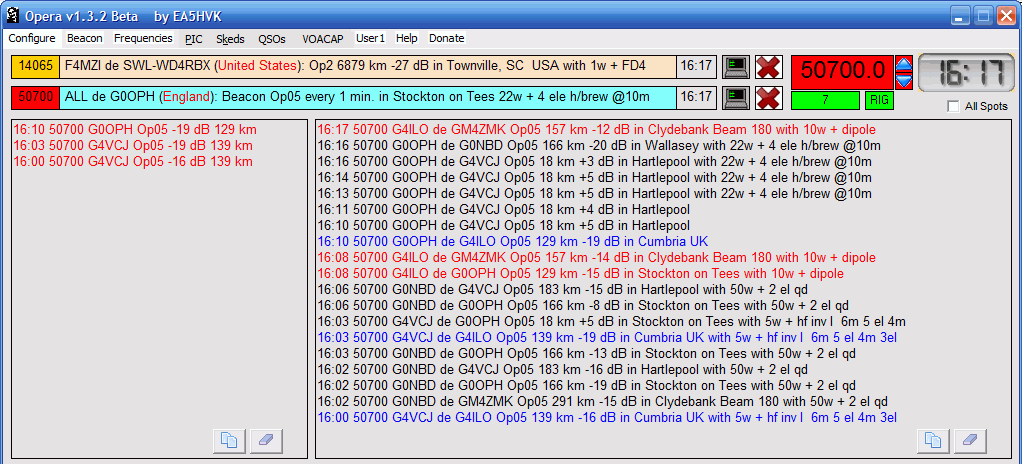
As you can see, not only did I receive some other stations but my own Opera signals were received around the UK. No great DX, but I was only using 20W to my attic dipole and would not expect to hear anything on 6m at this time.
If enough people were prepared to use it, this could be a good tool for discovering Sporadic-E openings on the VHF bands. The 30 second transmit cycle seems more appropriate for this type of propagation than WSPR’s two minute periods.

Portable 50Mhz antenna
One of the enduring aspects of amateur radio is the emphasis on ‘experimentation’ and ‘homebrew’. To many people this means designing innovative circuits for their own transceivers, amps or whatever floats their boat. My area of interest is in collecting either bent wire, off cuts of cable and odd shaped plastic parts scavenged from just about any skip or rubbish bin I can find. Some people like to call this antenna experimentation. My XYL likes to call it ‘That junk in the garage’. I like to call it my continued education. Below is a teaser!

The latest in my armoury of ‘stuff I’ve done’ will never help anyone chase DX or bust a pile up for a little activated square or something else. But it will give me another band to work with when I’m away from home, either on top of a summit, at the mother in laws or operating portable in the summer Es season (I say summer because the top of St Bees head isn’t very welcoming in the winter as I found out whilst operating GB4LBC).
My take on the 5/8 wave 6m vertical originally published by the UKSMG by Mike, G3JVL took a little over a weekend and was made relatively cheaply from scrounged resources. I enjoyed the job so much I’ve added a little project page here which I hope you enjoy. Feel free to try it out yourself and improve on the design path I took, let me know how you got on with the manufacturing of what should be a nice project (that can also be cheap if you’re scrounging skills are up to scratch)
6m digital DX
Conditions were again great on 6 metres yesterday afternoon and evening, with the Sporadic E favouring Scandinavia and the Baltic countries. After making a few contacts on SSB – it’s always gratifying when using an attic dipole to have stations come right back to your call and give you a 59 report – I was tuning up the band and heard the unmistakable sound of PSK31 activity.
I worked LA8OKA and OH2NAF using PSK31 and SM7OYP using PSK63. I thought these may have been my first PSK contacts on 6m but my log tells me I worked Spain using the digimode during June last year.
Signals were strong and steady and most people were using their regular macros and brag files and exchanging greetings rather than sending quick report and locator overs as you might expect for sporadic propagation.
Some bloggers have been advocating using the weak signal digital modes like WSPR or JT65A on 6m but when propagation is this strong I’d rather use a digital mode that allows me to have a proper QSO and exchange names and other details with the stations I’m working.














